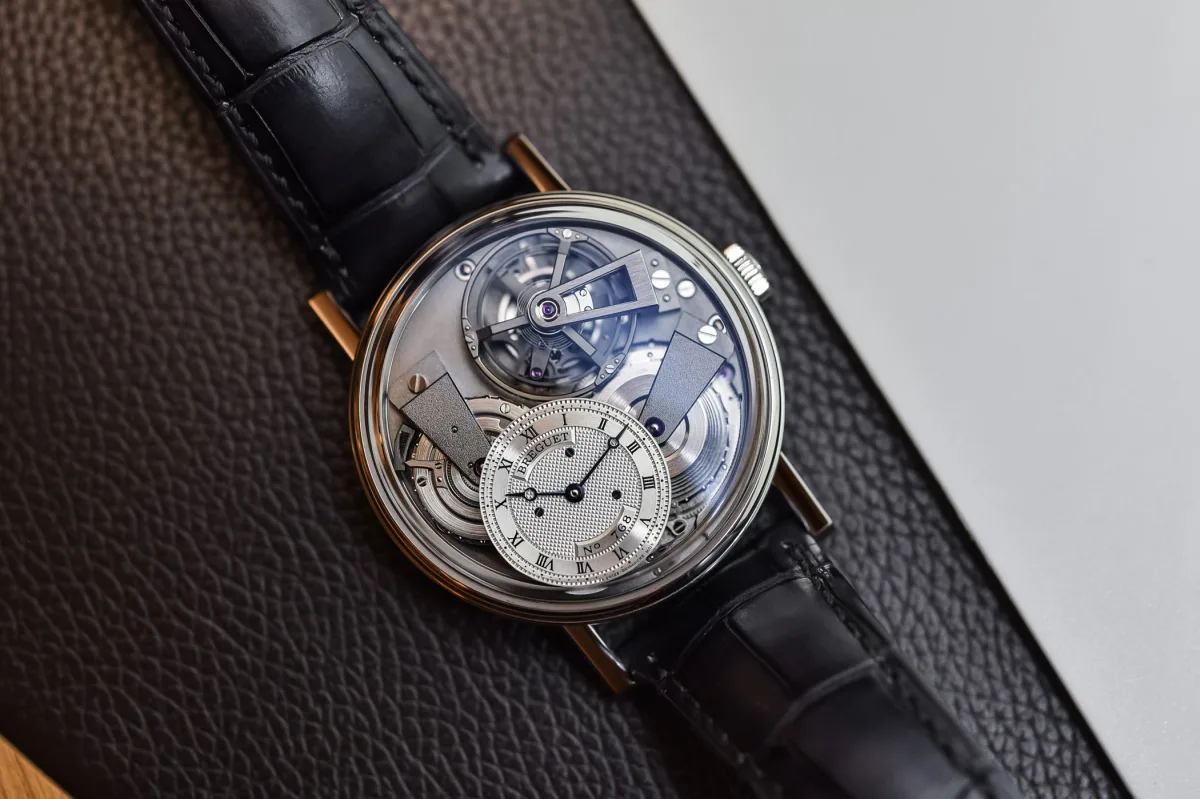
The Tradition Tourbillon Fusée 7047 watch, equipped with horological inventions by the master watchmaker, and the captivating fusée-and-chain mechanism, reveals its soul in a surprisingly modern outfit. Introduced in 2010, the Tourbillon Fusée model belongs to the Tradition family, inspired by the pragmatic design of historical Breguet subscription watches. Instead of hiding the mechanics, the Tradition family turns the movement around so you can admire it from the dial side. Here we see two historical and interacting devices enhancing timekeeping accuracy - the fusée and chain and the tourbillon - which come to life on the dial against a backdrop of modern titanium and silicon elements and anthracite bead-blasted surfaces. Almost an anachronism, the fusion of past and present makes the Tradition family models so unique.
WATCHES FOR THE PEOPLE
Fleeing to Switzerland during the turbulent years preceding the French Revolution, Abraham-Louis Breguet returned to Paris in 1795 and re-established his workshop on the Île de la Cité. Although he was known for his complex chronometers for European royalty and was already engaged in marine chronometers, Breguet developed an entirely new concept to attract a broad audience to his "subscription watches" (montres de souscription). In 1796, Breguet introduced simple, robust, reliable pocket watches with a large diameter (61 mm) and a single hand. The symmetrical mechanism featured a large central barrel, flanked by the gear train and balance wheel. Reflecting the straightforward design of the mechanism, the simple enamel dial was the epitome of sobriety and clarity. However, what was striking was that Breguet used a single hand to indicate both the hours and minutes. Considering the large diameter of the pocket watch, there was ample space to apply a detailed minute track marked at five-minute intervals. The bezel and case back were hinged and could be easily opened to set the time and wind the barrel from the back, with a decorative guilloché pattern on the sides of the case to aid grip.
In 1797, Breguet even released a brochure to support the launch of the watches: “The price of the watches… will be 600 livres; a quarter of this amount will be paid by subscription; thus, there will be no production delays, and delivery will be made according to the subscription order.” The funds collected would be used to purchase parts for his innovative vision of a mass-production line, and if you ever wondered where crowdfunding originated, here is a hint.
TRADITION COLLECTION
The Tradition Collection, introduced in 2005, echoes Abraham-Louis Breguet's subscription watches - with a twist. The idea is to showcase the original architecture and mechanisms of the movement on the dial side, including Breguet's signature bridges. In most Tradition models, the mainspring barrel is positioned centrally, flanked by the gear train and balance wheel. Other common features of the Tradition family include fluted case bands, welded lugs, blued steel Breguet hands, and a guilloché dial - all inventions of Abraham-Louis Breguet. If you want detailed information about the unmistakable signs of Breguet watches, don't miss our video with Emmanuel Breguet, a direct descendant of A.L. Breguet and Vice President of Heritage and Marketing, along with Nakis Karapatakis, Vice President of Operations.
So far, the Breguet Tradition collection has featured several models: with manual winding (7057), GMT (7067), Automatic Seconde Retrograde (7097), chronograph (7077), Tourbillon Fusée-and-Chain (7047), which we discuss in this article, and Automatic Retrograde Date (7597).
OLD AND NEW
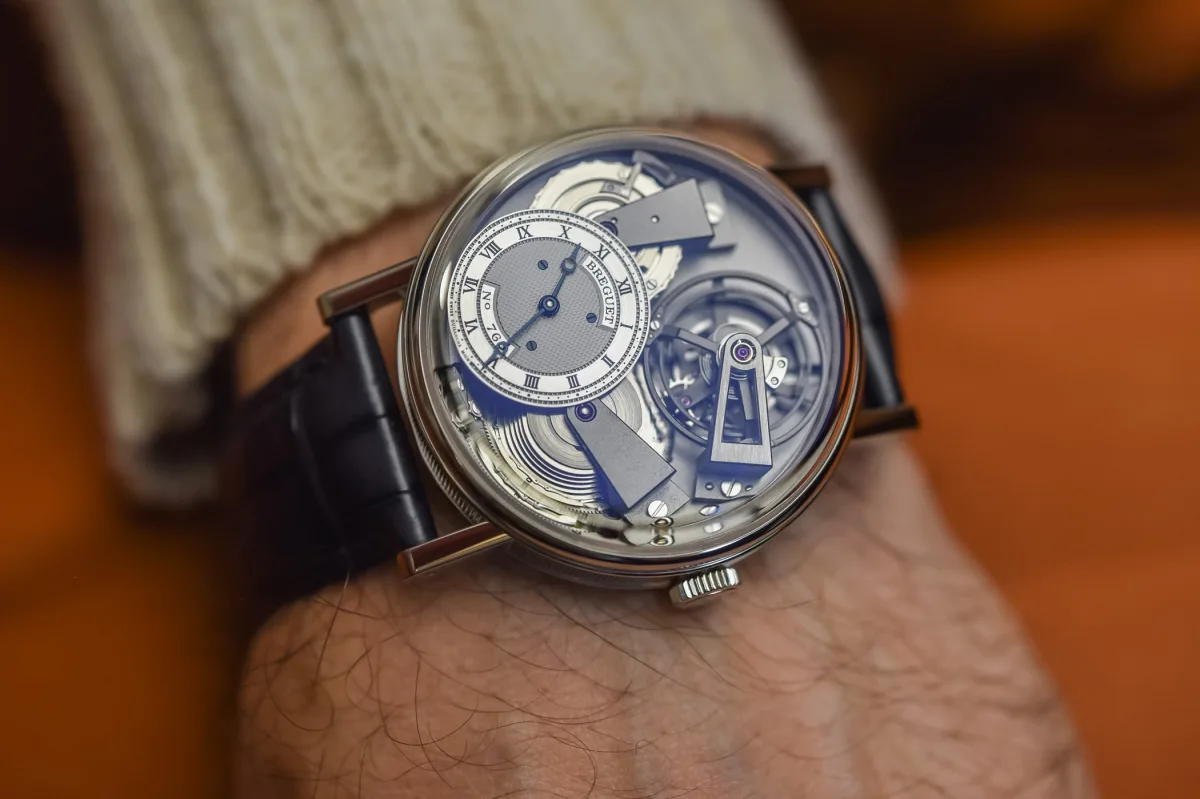
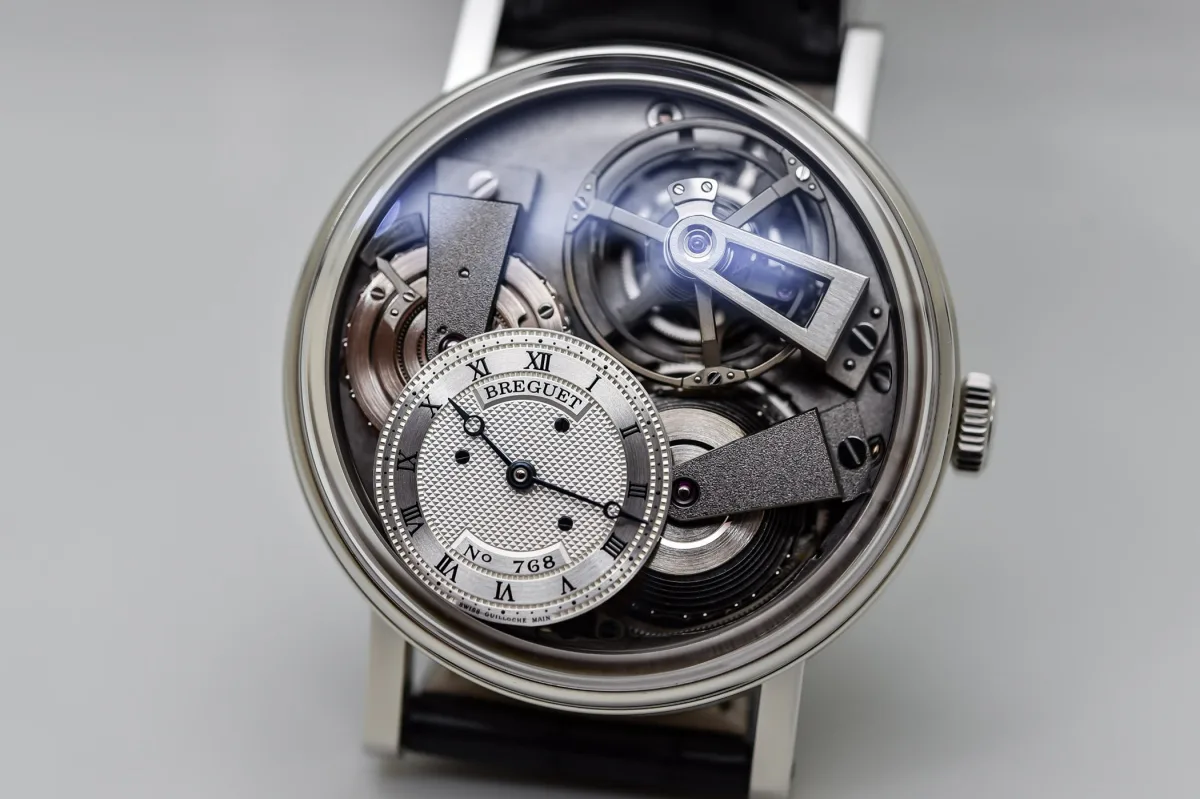
Before examining the mesmerizing mechanics, it might be time to get acquainted with its indications. Although the watch is also available in an 18k rose gold case, the model presented here is the version in platinum 950 with a silvered pure gold dial and anthracite-colored movement. Like other cases in the Tradition collection, the round case features straight welded lugs with screw bars. It measures 41 mm across, 15.95 mm in height, and is polished throughout. However, unlike some other models in the Tradition line, the mainspring barrel is not centrally positioned but at the "10 o'clock" position on the dial. The highlight of this model is the spectacular tourbillon mechanism linked to the fusée and chain transmission, visible on the right side of the dial. The hours and minutes disc is off-centered at "7 o'clock," and the power reserve indicator is located at "9 o'clock." The thin bezel and high box-shaped crystal provide an impressive panoramic view of the dial, and you can appreciate how the tourbillon bridge and dial rise above the mechanics, almost touching the sapphire.
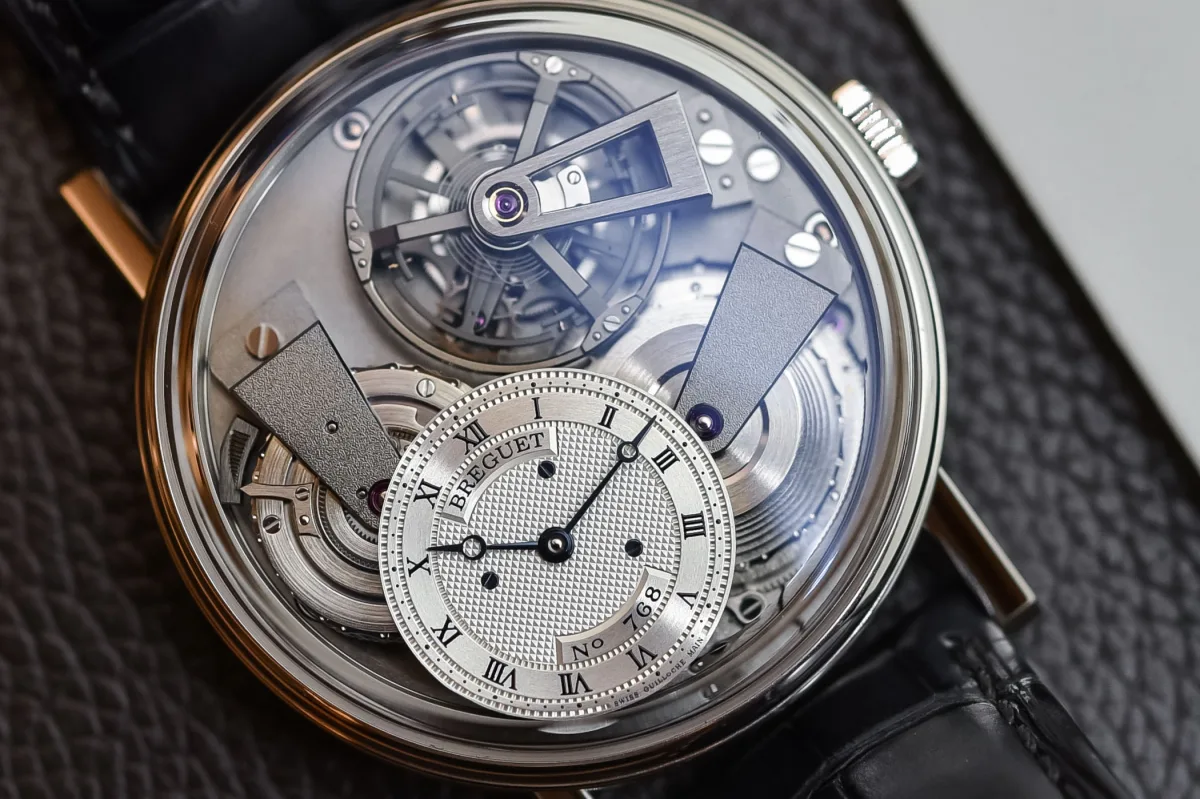
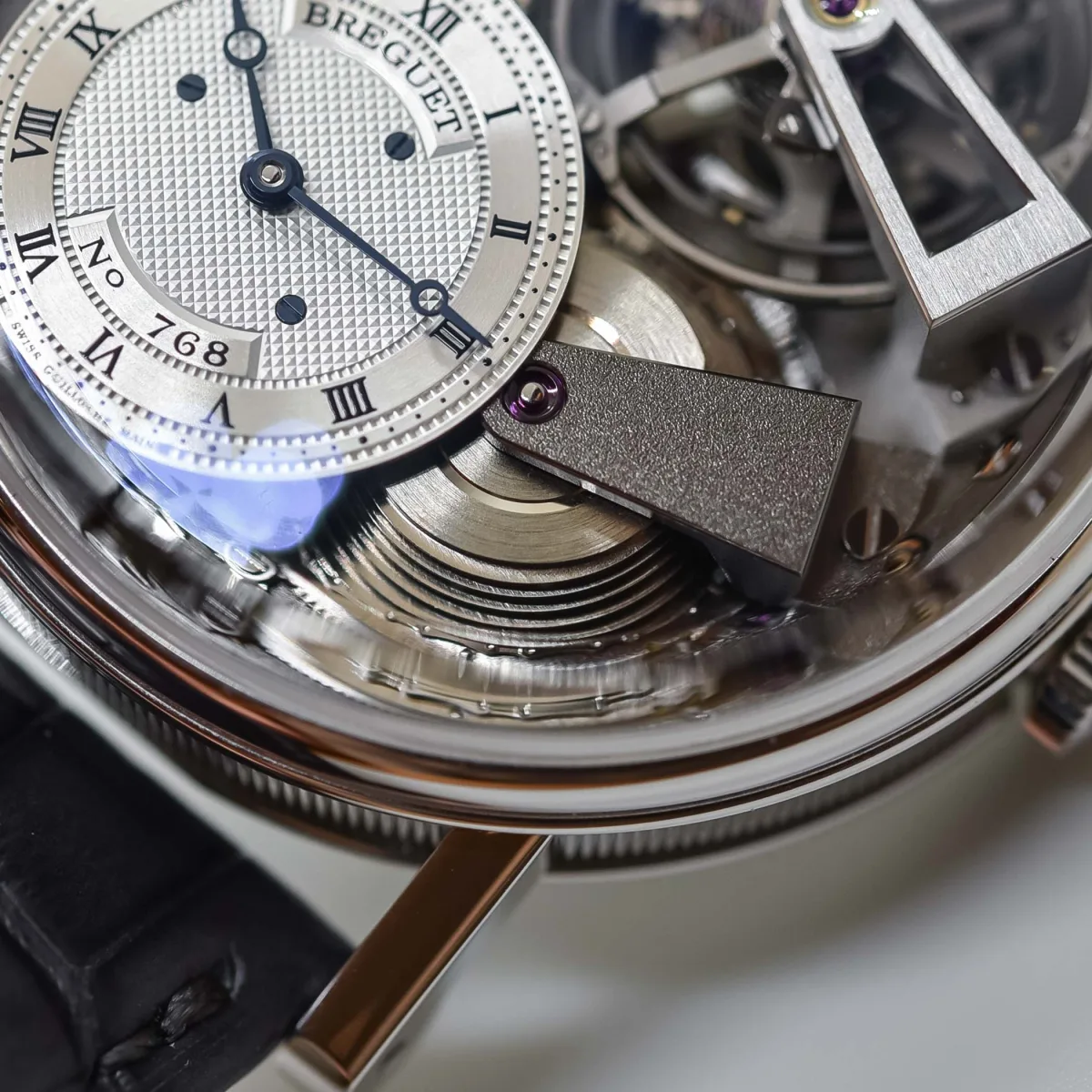
The anthracite-gray alloy used for the mechanical elements on the dial has a matte bead-blasted surface finish, giving it a surprisingly modern, dark appearance. The mainspring barrel (equipped with two main springs to ensure a 50-hour power reserve) is securely held by a fan-shaped bridge reminiscent of the bridges used in antique Breguet pocket watches and features an unusual lever at the "10 o'clock" position pointing to an outer scale. This unique power reserve indicator, directly on the barrel, is fitted with a reduction differential system and has been patented.
TOURBILLON AND CHAIN TRANSMISSION
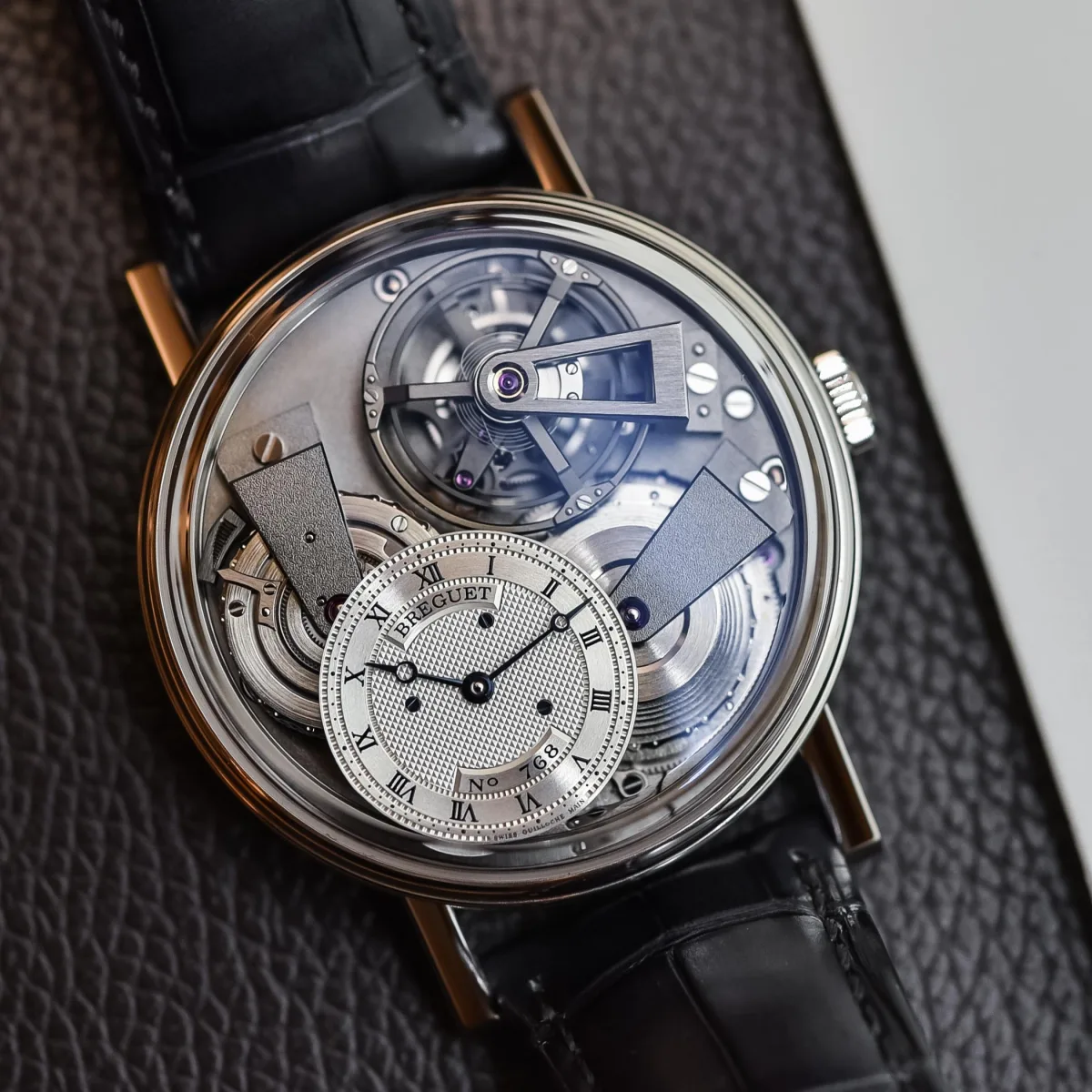
Although the fusée and chain transmission is not one of Abraham-Louis Breguet's inventions, its use in combination with a tourbillon optimizes the regularity of the movement's rate. By providing a constant torque, the fusée's differential gears transmit a continuous flow of energy to the movement. The problem with the energy produced by the mainspring is that when it is fully wound, its force is high, but as it unwinds, it loses power, resulting in fluctuations in precision. The fusée and chain equalize the diminishing force of the mainspring, ensuring a constant supply of energy to the movement and therefore more accurate timekeeping.
To give you an idea of how long this device has been around, in the erudite work of Dominique Flechon "The Mastery of Time," there is a drawing of a conical fusée designed by Leonardo da Vinci between 1490 and 1500. As Xavier Markle writes in his article on the constant force dilemma in watchmaking: “The fusée consists of a conical pulley connected to a chain wound around the barrel. The fusée has a spiral groove to receive the chain. By increasing the circumference of the thread, it compensates for the diminishing force of the mainspring (very much like a bicycle gear). When the mainspring unwinds, the chain rolls off the barrel and onto the fusée. The increasing lever of the fusée compensates for the decreasing torque of the barrel. Movements with fusée and chain are complex to manufacture, difficult to adjust, and therefore quite expensive… plus they take up a lot of space.” From a side view, the fusée resembles a conical pyramid, and the chain, if you could unravel it, indeed looks surprisingly like a bicycle chain!
TOURBILLON AND BREGUET SPRING
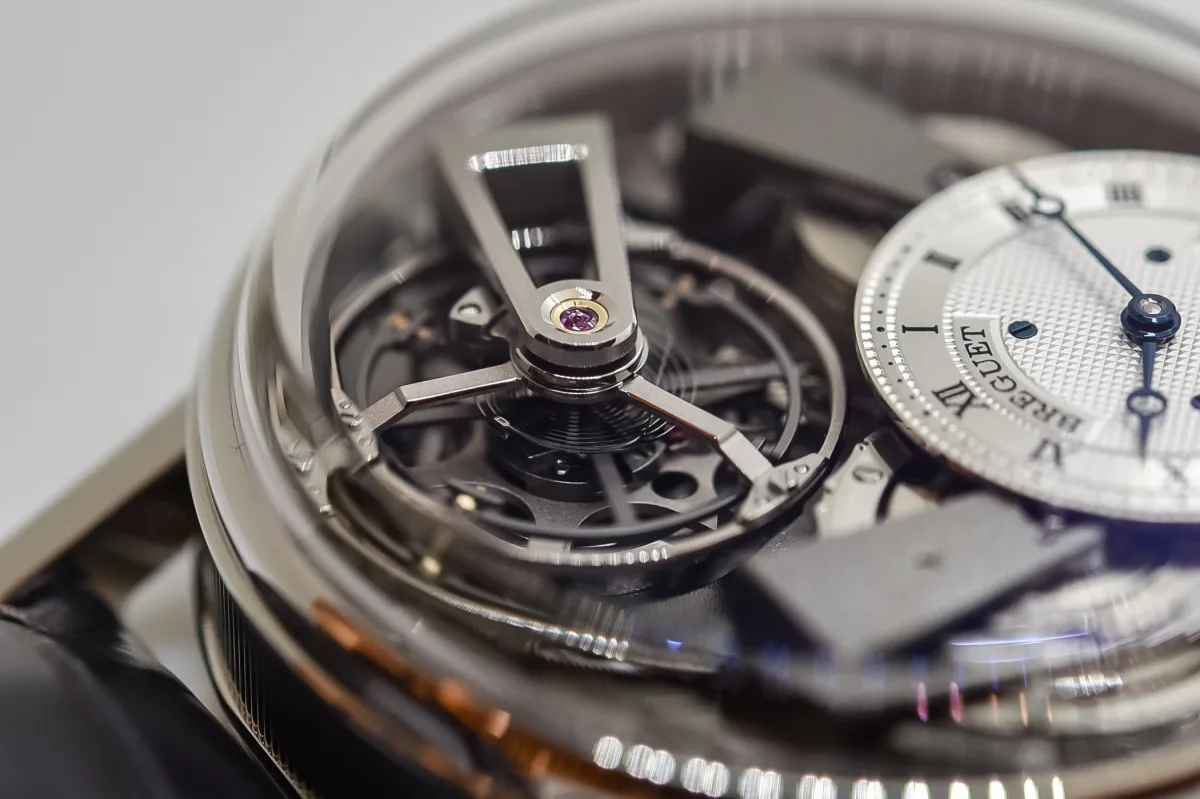
Perhaps the invention most people associate with Abraham-Louis Breguet is the tourbillon regulator, which he patented in 1801. Breguet's idea was to mount the escapement inside a rotating carriage that makes a full turn every minute. The minute tourbillon of this model 7047 is positioned at "1 o'clock," and its delicate bar (barette), upper bridge, and carriage are taken from the first sketches of Abraham-Louis Breguet. The widely spaced 17-mm titanium tourbillon cage with a 13-mm titanium balance wheel is secured by a titanium openwork, matte bridge with a gold chaton and a gemstone. Another invention by Breguet was the Breguet balance spring, or Breguet overcoil, created in 1795. Deciding to improve upon Huygens' flat balance spring of 1675, Breguet enhanced the balance spring's isochronism by raising the last coil of the spring and reducing its curvature to a concentric form. Fast forwarding more than two centuries, the Breguet brand has applied lighter, stronger, anti-magnetic, corrosion-resistant, and lubrication-free silicon components in the escape wheel and lever.
FUSION OF PAST AND PRESENT
Returning to the brand's origins, the off-centered hours and minutes dial at "7 o'clock" with a finely crafted Clou de Paris engine-turned decoration at the center, classic Roman numerals, and open-tipped blued steel Breguet hands contrasts strikingly with the dark bead-blasted background. The fluting on the case band can be seen again on the strap, which we associate with all Breguet watches, and the simple round case with a relatively unobtrusive bezel and round straight welded lugs does not distract from the impressive spectacle on the dial. Even the three blued screws securing the 18k gold silvered dial are reminiscent of the famous subscription watches, and the serial number is engraved on a small plaque mirroring the plaque at noon with the Breguet name. Almost an anachronism, the fusion of past and present is what makes this model unique.
CALIBER 569
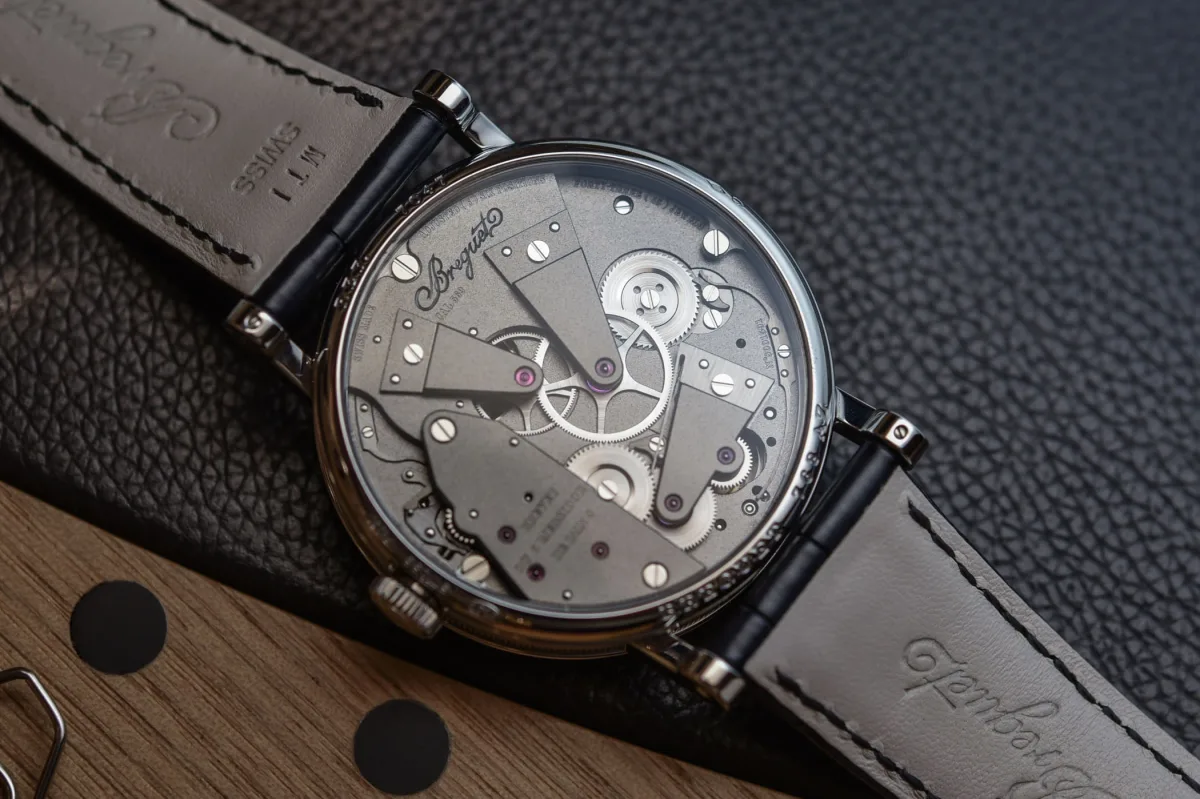
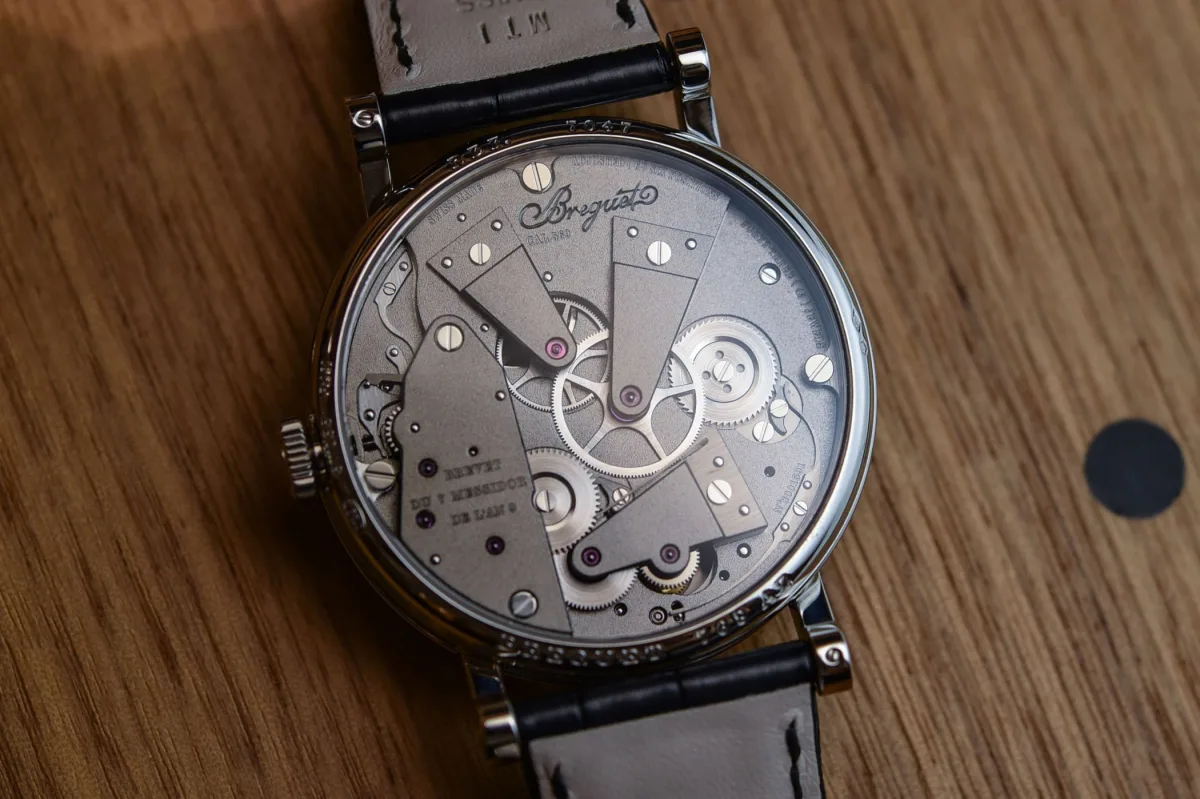
On the back of the case, the design codes used in Breguet's subscription watches are visible, but the colors and finishes are modern, combining anthracite-colored bridges with rhodium-treated wheels. The impressive caliber 569 with 43 jewels and 542 parts is a hand-wound movement with a 50-hour power reserve, operating at a frequency of 2.5 Hz.
PRICE
The Tradition Tourbillon Fusée 7047 watch in platinum 950 is sold at a price of 184,900 euros (including VAT). For more information, visit the Breguet website.
TECHNICAL SPECIFICATIONS – BREGUET TRADITION TOURBILLON FUSÉE 7047
Case: diameter 41 mm x height 15.95 mm – platinum 950, polished – fluted case band – rounded lugs welded to the case with screw pins – sapphire case back and domed sapphire crystal over the dial – water-resistance 30 meters
Dial: anthracite-gray background with bead-blasted finish – tourbillon at "1 o'clock" – fusée and chain transmission at "5 o'clock" – barrel with power reserve indicator at "9 o'clock" – silvered 18k gold dial with hand engraving on pink movement at "7 o'clock" with Roman numerals, individual number and signature, Breguet hands with open-tipped blued steel
Movement: caliber 569 – hand-wound with tourbillon regulator – 542 components -2.5 Hz – 50-hour power reserve with power reserve indication on the barrel – straight-line lever escapement – Breguet titanium balance with 4 gold adjustment screws – Breguet silicon balance spring – constant force delivered by fusée and chain.
Reference: 7047PT/11/9ZU
Price: 184,900 euros (including VAT)