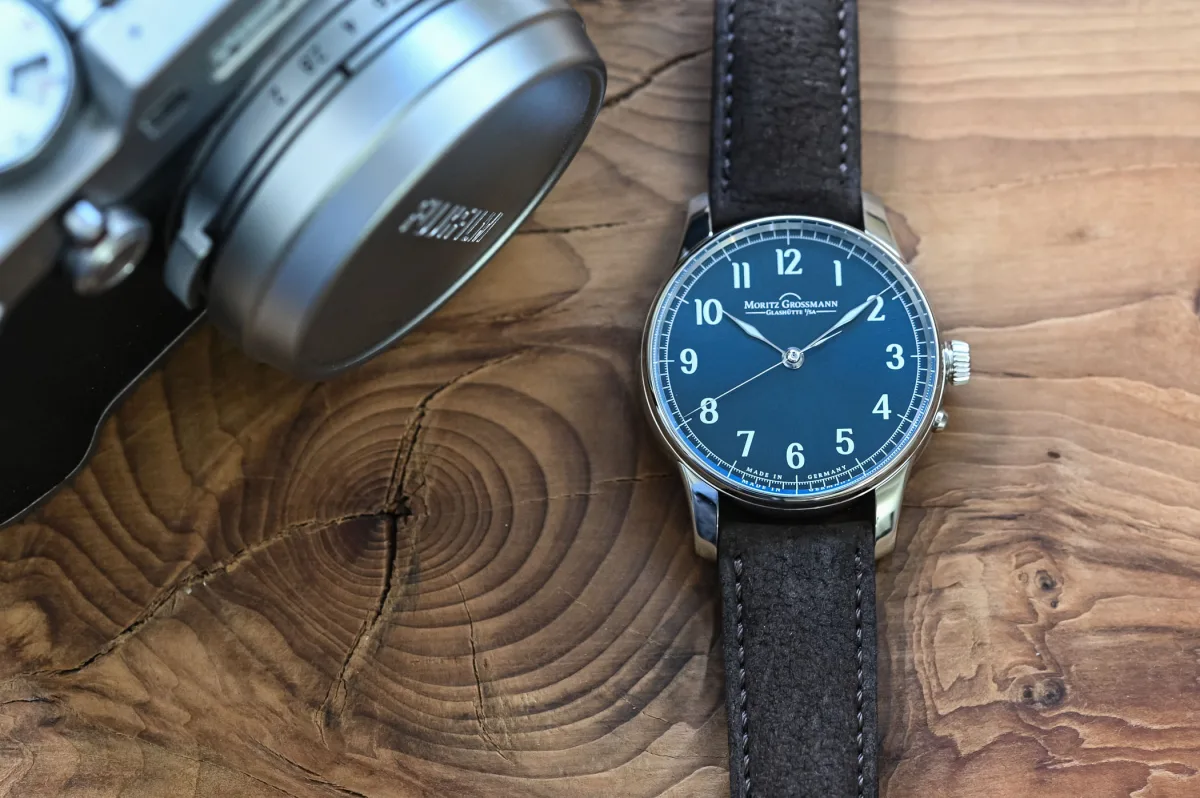
In late March 2021, Moritz Grossmann introduced the Central Second, a new model in the Benu Heritage collection, which highlights a central seconds hand instead of the traditional small seconds sub-dial. Although this may not seem like groundbreaking news in the watch world, the Central Second is Moritz Grossmann's first model with a central seconds hand; all previous models relied on small seconds, patented by the company's founder, Carl Moritz Grossmann (1826-1885), in the mid-19th century. For this new central seconds hand configuration, the brand developed a new movement, caliber 100.11, a reworked version of caliber 100.1, presented in the Moritz Grossmann XII Birthday Edition.
As with everything created at this manufacture, the first impression might not cause fireworks, but the more you learn, the more you will love these watches, especially when you discover how the ingenious stop-seconds mechanism was integrated into these deceptively simple watches. The Central Second watches are available in a limited series of 25 pieces with a salmon dial or a more modern blue dial with luminescent hands and numerals.
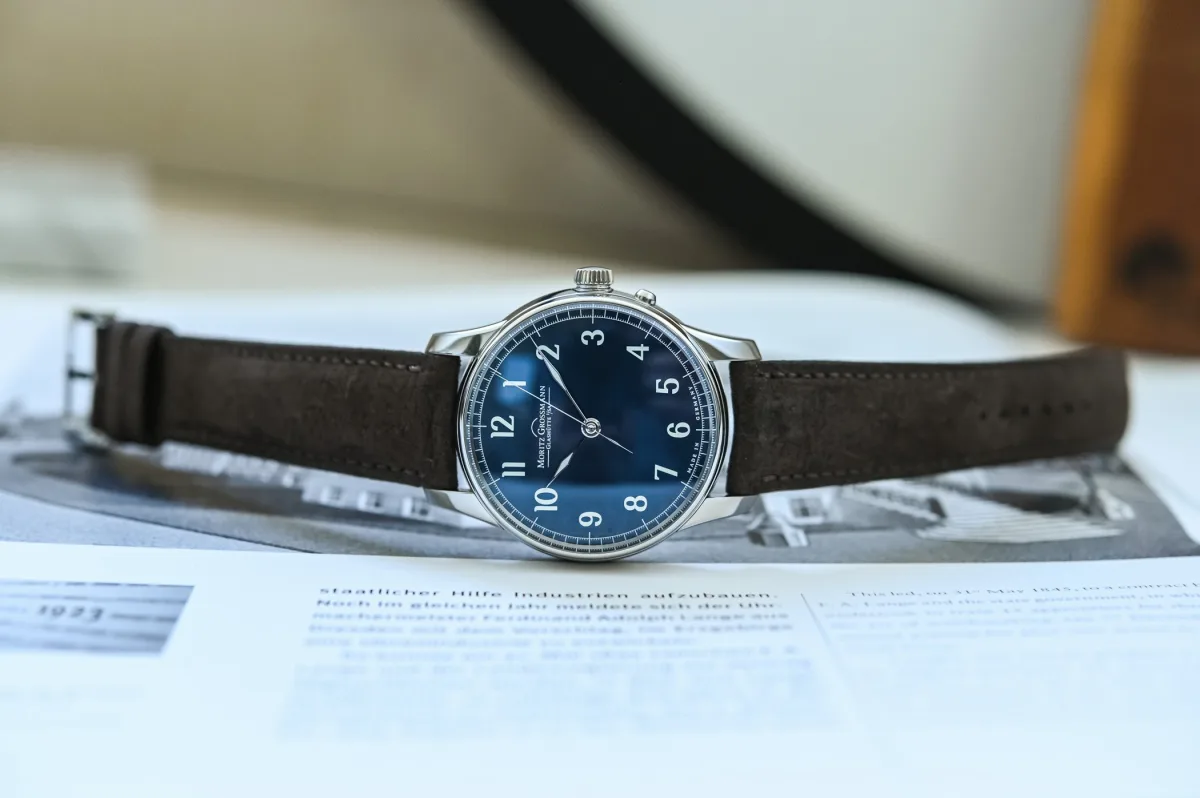
In Moritz Grossmann watches, an elite watch company from Glashütte, there is always a sense of restraint and refinement that whispers rather than shouts. One of the youngest players in the Glashütte market - the brand was acquired in 2008 - Moritz Grossmann has formed its own identity and interprets Glashütte's proud watchmaking heritage without relying on heavyweights like A. Lange & Söhne. With fifteen in-house calibers and a commitment to the principle of Schöntes Deutsches Handwerk (the most beautiful German craftsmanship), the Central Second model, which we are discussing today, belongs to the renowned Benu Heritage collection.
Grossmann in Glashütte
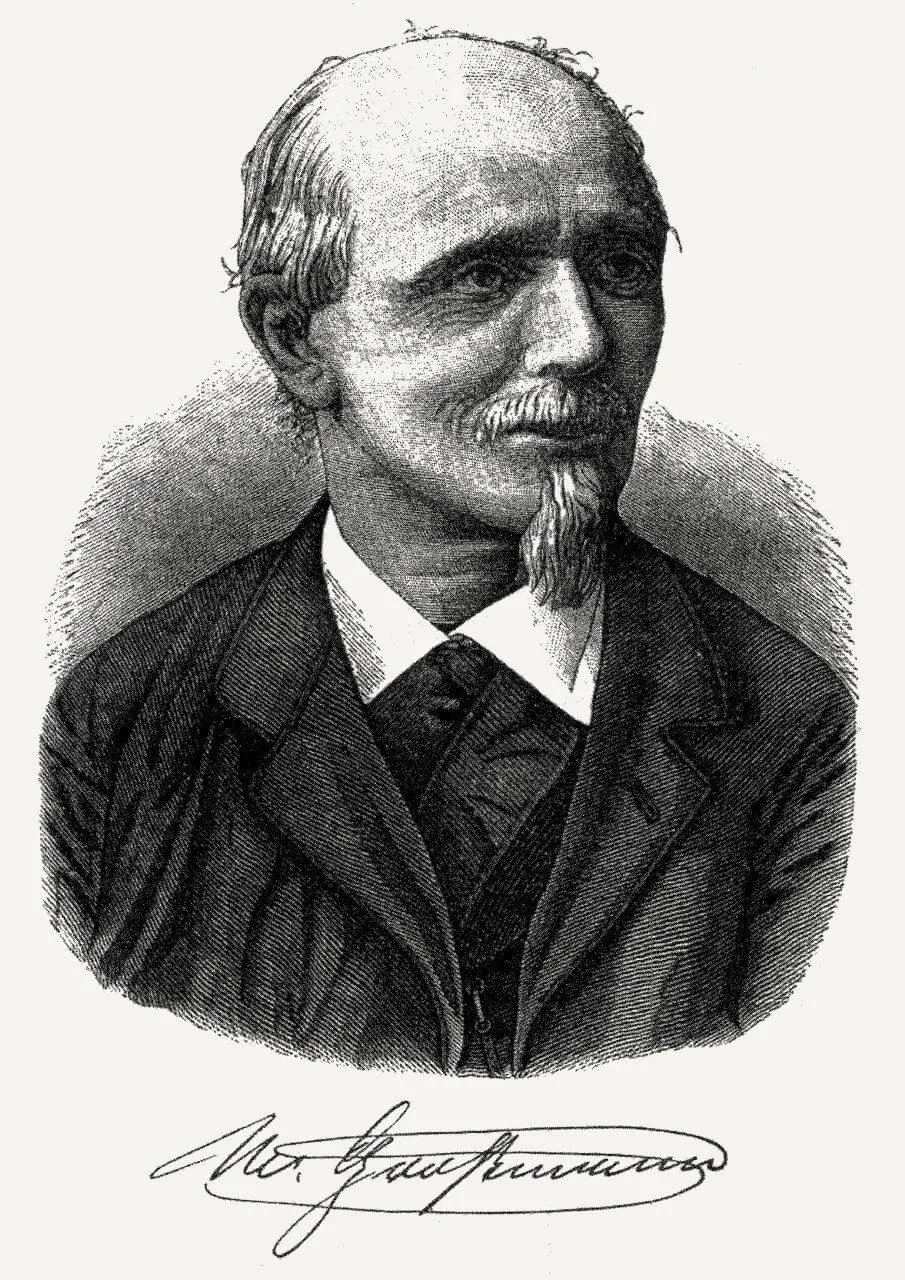
Invited by Ferdinand Adolph Lange to establish a technical workshop in Glashütte, Moritz Grossmann began creating high-precision measuring instruments and tools, later venturing into pocket watches, astronomical pendulum clocks, marine chronometers, and even patenting his small seconds counter. As one of the founders of Glashütte's proud watchmaking tradition, Grossmann wanted to encourage potential watchmakers, and in 1878 he became one of the founders of the German School of Watchmaking in Glashütte. In his treatise on watchmaking, the distinguished watchmaker described how to construct simple yet mechanically perfect watches. After his death in 1885, Moritz Grossmann's name fell into oblivion. In 2008, the brand "Moritz Grossmann" was acquired by Christine Hutter, who revived it with an emphasis on "Schöntes Deutsches Handwerk" or "the most beautiful German craftsmanship." Typical features of Moritz Grossmann watches are borrowed from the founder's pocket chronometers, including large movements and the characteristic untreated German silver two-thirds plate with Glashütte ribbing. With its reverent attention to handcrafted components and habitus, even the annealed steel hands are manufactured in-house and are distinguished by their exceptionally sharp tips and elegant profiles.
SECONDS IN THE SPOTLIGHT
Compared to other members of the Benu Heritage family, the Central Second watch departs from the main classical territory and has a more modern, versatile, everyday look. Naturally, signature features such as exquisite hands and refined finishing are retained, but the appearance of the Central Second with its railway minute/second track, central seconds hand, and large empty dial space has a more technical and instrumental character. Given its absolute simplicity and legibility, some compare the instrumental appeal of this model to deck or pilot watches.
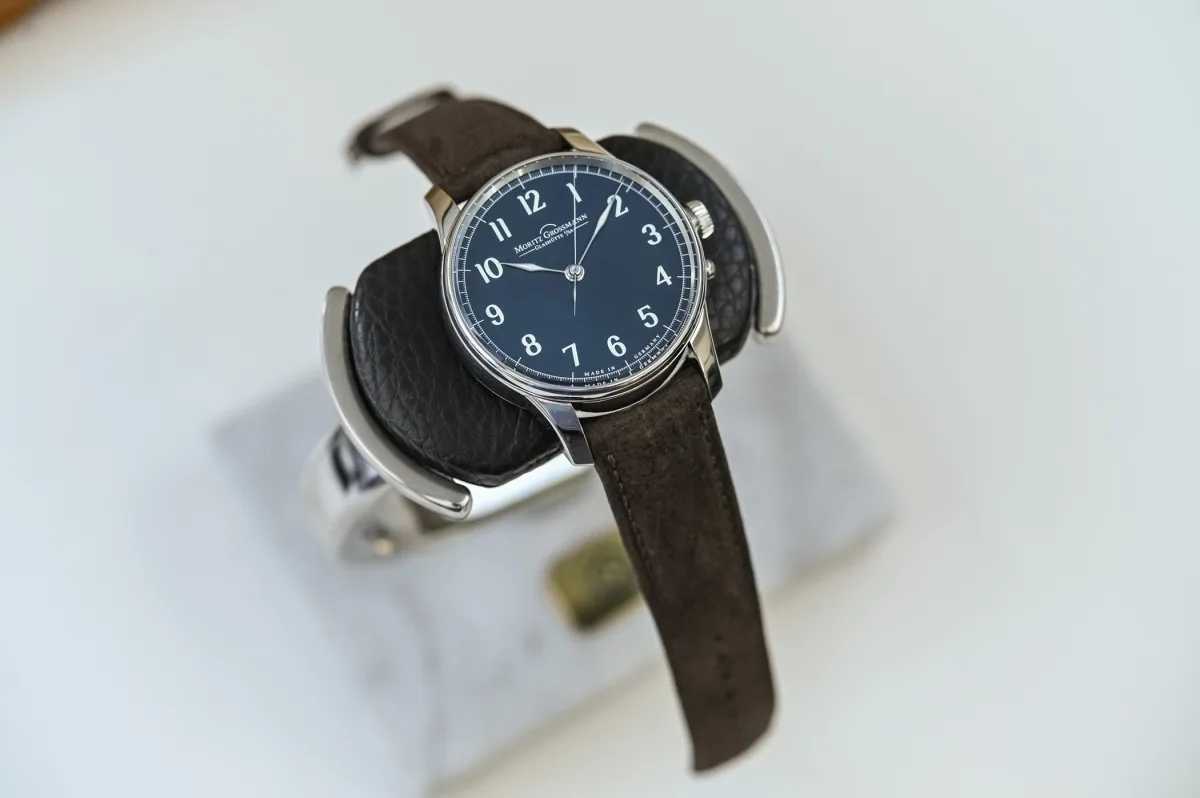
First and foremost, the watch case is large - 41 mm in diameter and 12 mm in height, which is quite noticeable given that the watch is equipped with a manual-winding movement. Both versions of the watch with salmon and blue dials are housed in stainless steel cases, elegantly polished throughout, with curved lugs and a narrow bezel. The only feature that might catch your attention is the small button located just below the winding crown. We will discuss this later.
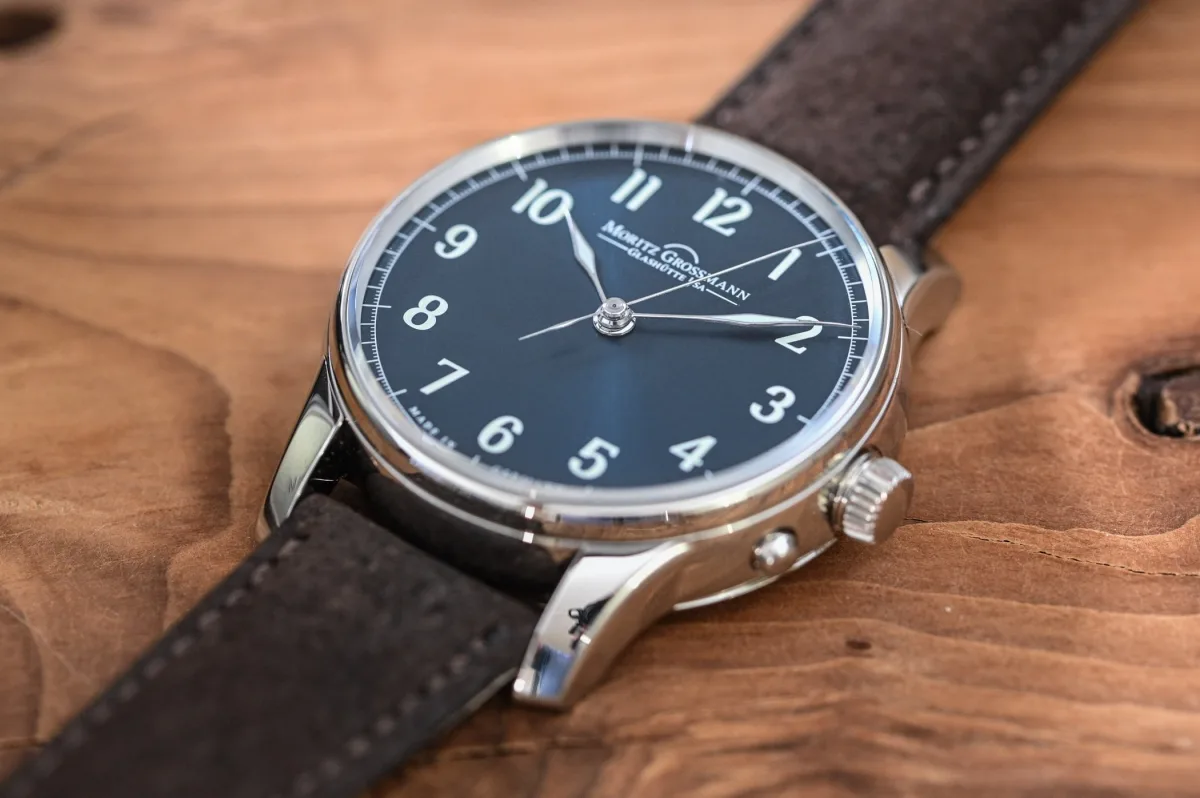
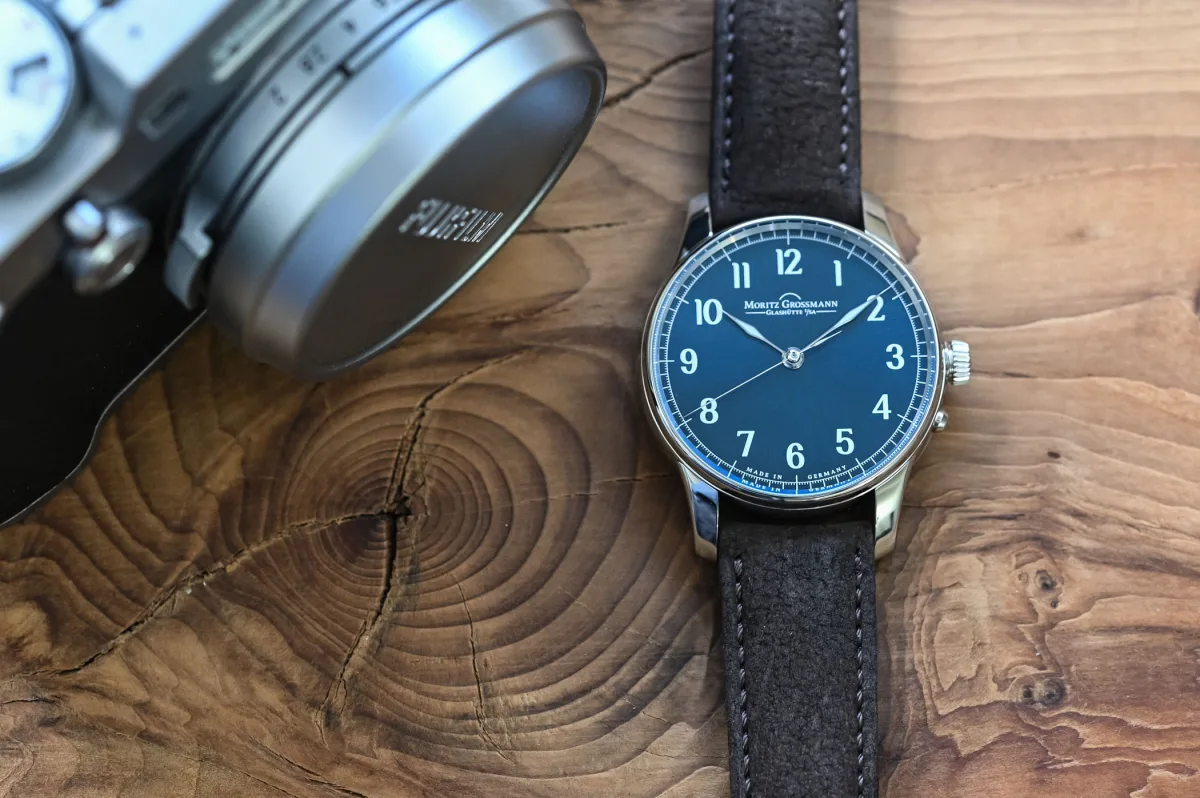
The dial is simple and elegant, with a clear emphasis on the hours, minutes, and, for the first time for the brand, the central seconds hand. Typically, Moritz Grossmann watches display seconds in a fairly large sub-dial at the "6 o'clock" position, without numerals, as seen in this GMT or Hamatic Vintage model. In fact, the slightly more sporty and technical aesthetic of the central seconds hand is very similar to the Power Reserve released a year ago for the brand's 12th anniversary, without a power reserve indicator and with the small seconds sub-dial removed and replaced with a central seconds hand.
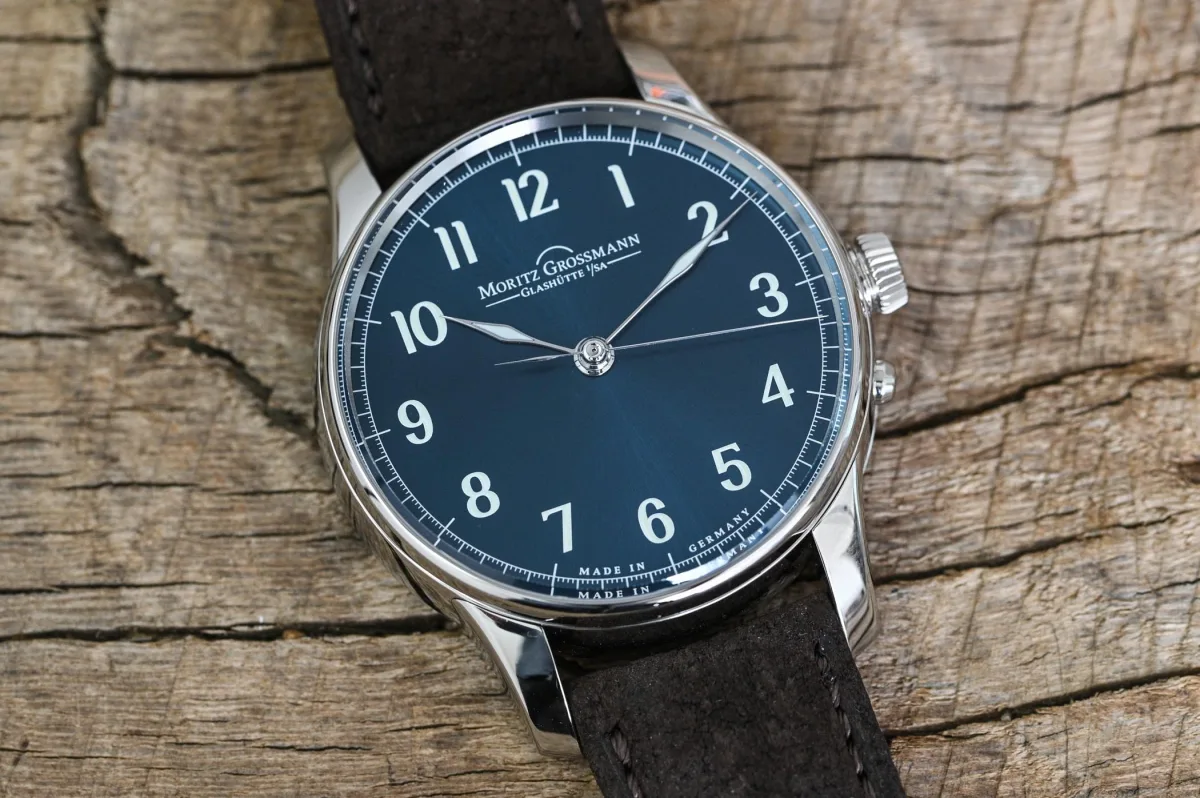
The more modern blue model features a beautiful silky sunray finish. Radiating from the center with fine strokes, the sunray finish allows the blue dial to glow in different shades depending on the lighting. Another departure from the brand's signature codes is the white Arabic numerals, as well as the hour and minute hands treated with white luminescent material. Known as HyCeram Luminex, this hybrid ceramic material consists of powerful luminous pigments that emit an intense bright green color in the dark. It is worth mentioning that Moritz Grossmann manufactures its hands in-house, by hand. To emphasize the brand's virtuosity in this area, a few months ago it released two renowned models - the Hamatic Vintage and Benu Tourbillon - with new hands made of pure rose gold.
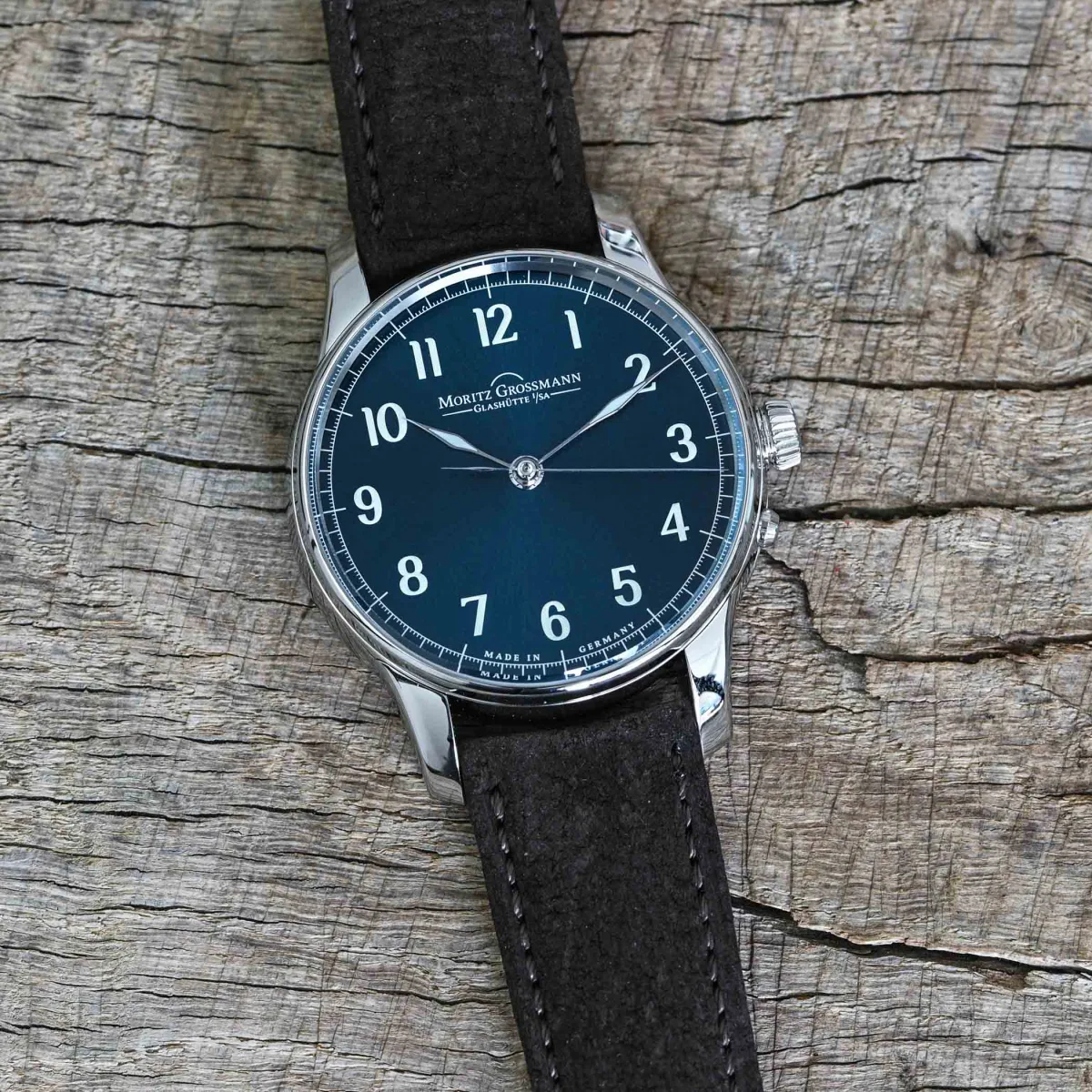
Elegant spear-shaped hands with sharp needle tips are treated with luminescent material. A very thin and elongated central seconds hand, gliding over the seconds/minutes track, is equipped with a conical leaf counterweight. To achieve the sharp profile of the hands, they are ground with diamond files, beveled at the edges, and the bevels are hand-polished with a wooden disk to a mirror finish. It is these details that make MG watches so special.
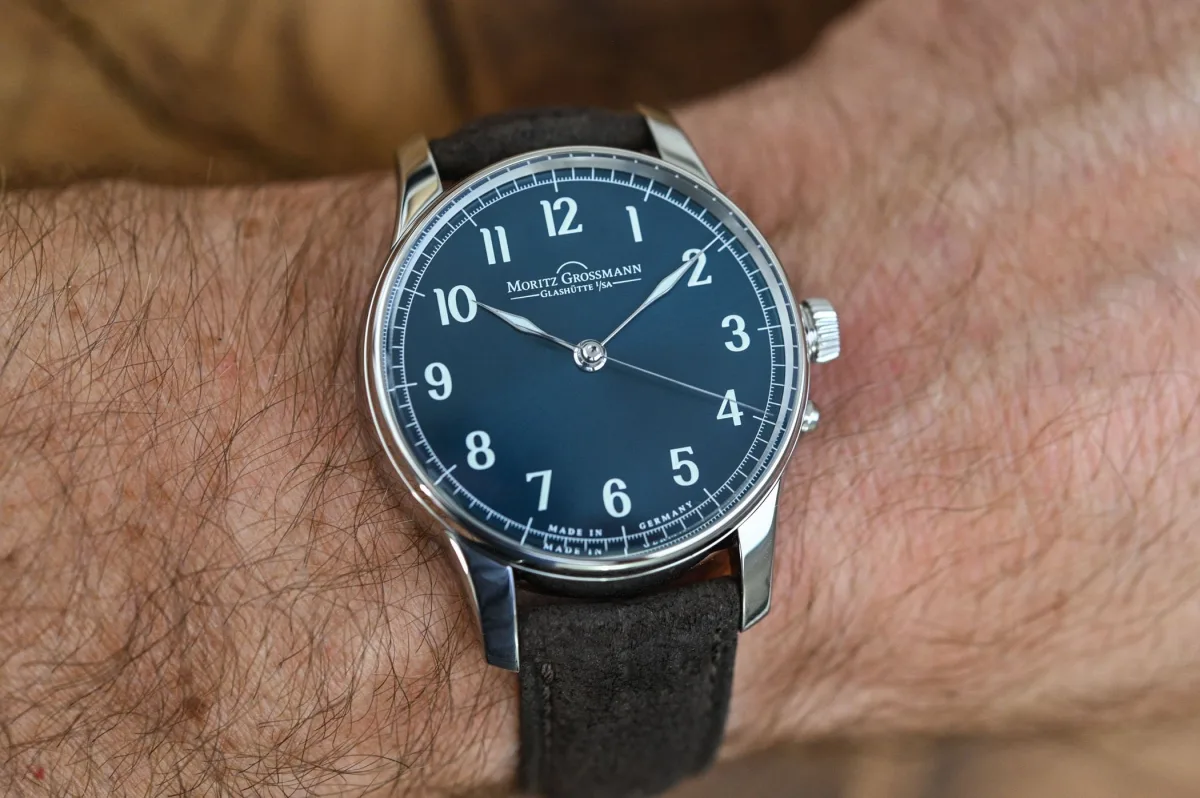
Besides the inscriptions "Moritz Grossmann Glashütte 1/SA" at noon and "Made in Germany" at the "6 o'clock" position, the dial is empty. What might seem spartan to some can be interpreted as the essence of sobriety and understatement to others.
GROSSMANN HAND-WINDING WITH A BUTTON
The small button on the case rim is part of the winding mechanism and reflects Moritz Grossmann's unique and pragmatic approach to watchmaking. Most hand-wound watches are wound using the crown, and the time is set by pulling the crown into the second position. As in regular hand-wound watches, the crown in the Central Second model is used for winding the watch.
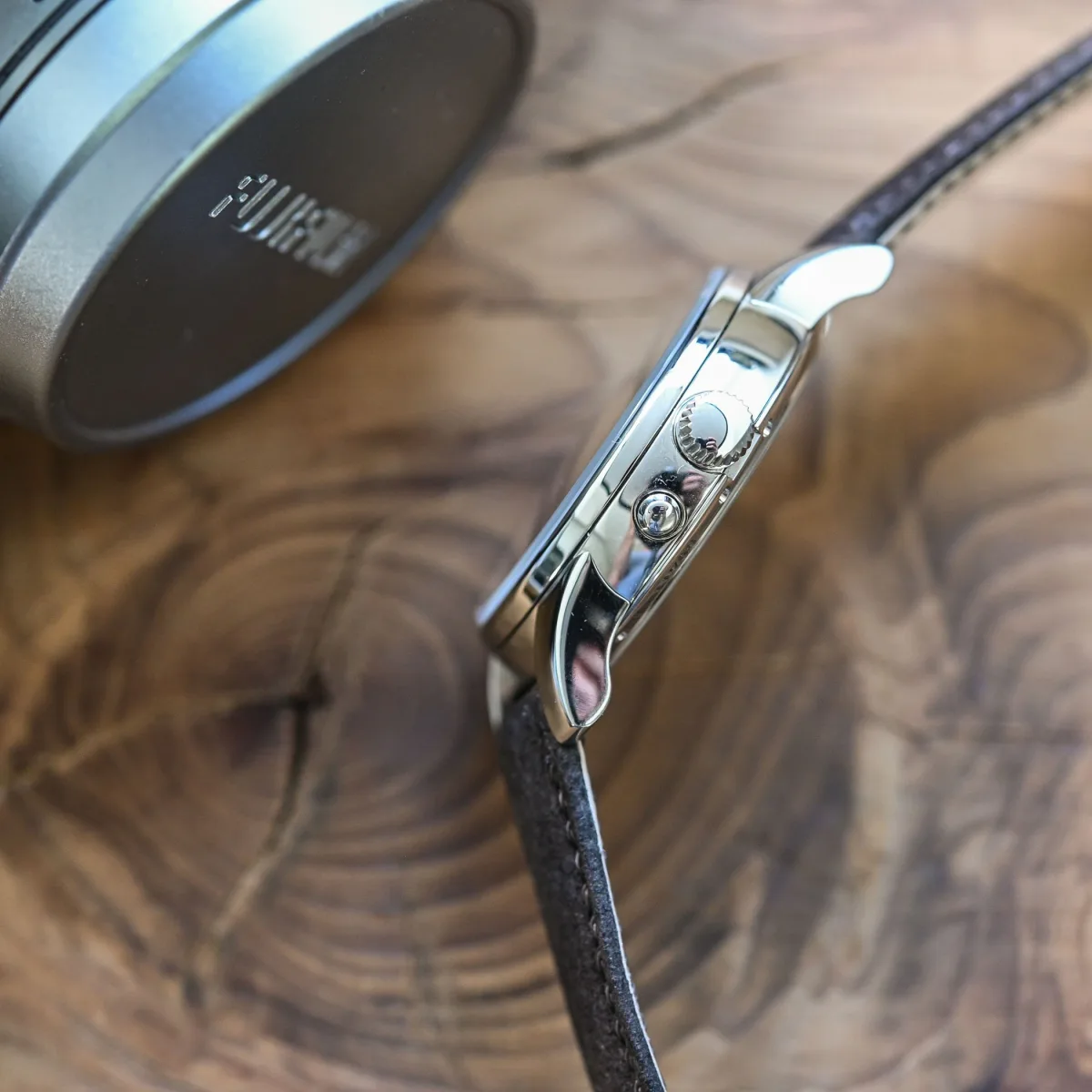
However, if you want to set the time, you will need to pull the crown out, but - here's the unique feature - you will notice that the crown springs back to its original position. This spring-loaded device activates the "stop-seconds" mechanism for precise time setting. After you set the time to the hour, minute, and second, you press the conical button on the strap. The button reactivates the mechanism and switches the crown to winding mode. In short, the crown is used by default for winding and time setting. This original and extremely easy-to-use protective mechanism helps prevent dust from entering the case through the crown, minimizes wear on the keyless mechanism, and prevents accidental change of hand position when setting the crown back in place.
CALIBER 100.11
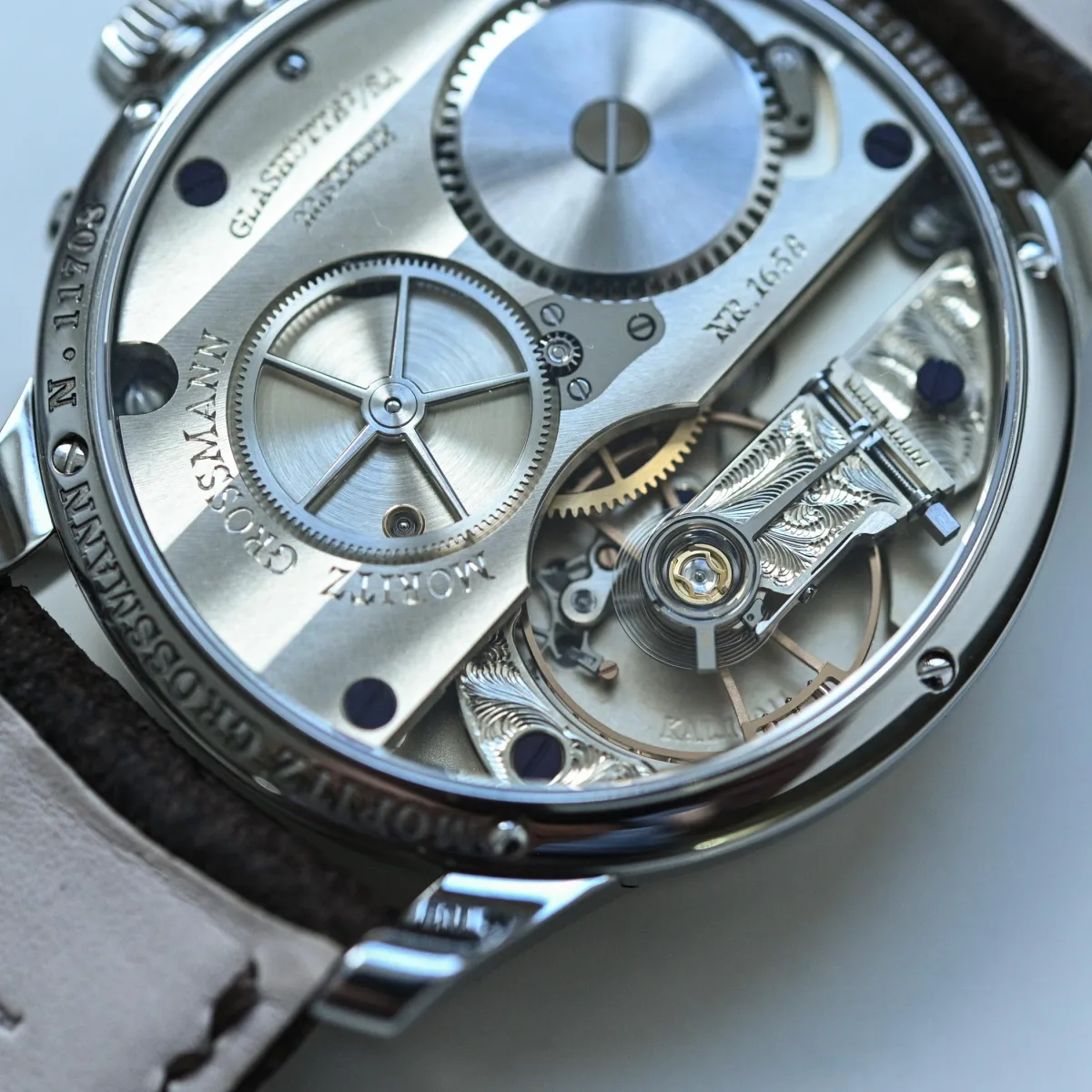
The view of the movement with its spartan yet exquisite dial quickens the pulse and deserves admiration. Some distinctive features, such as the untreated German silver 2/3 plate adorned with a wide Glashütte stripe (a nod to Moritz Grossmann's 19th-century pocket watches), hand-engraved balance and escape wheel curves, sunray decoration on the ratchet wheel, purple thermally annealed screws, and hand-engraved inscriptions on the 2/3 plate, clearly indicate the movement's origin.
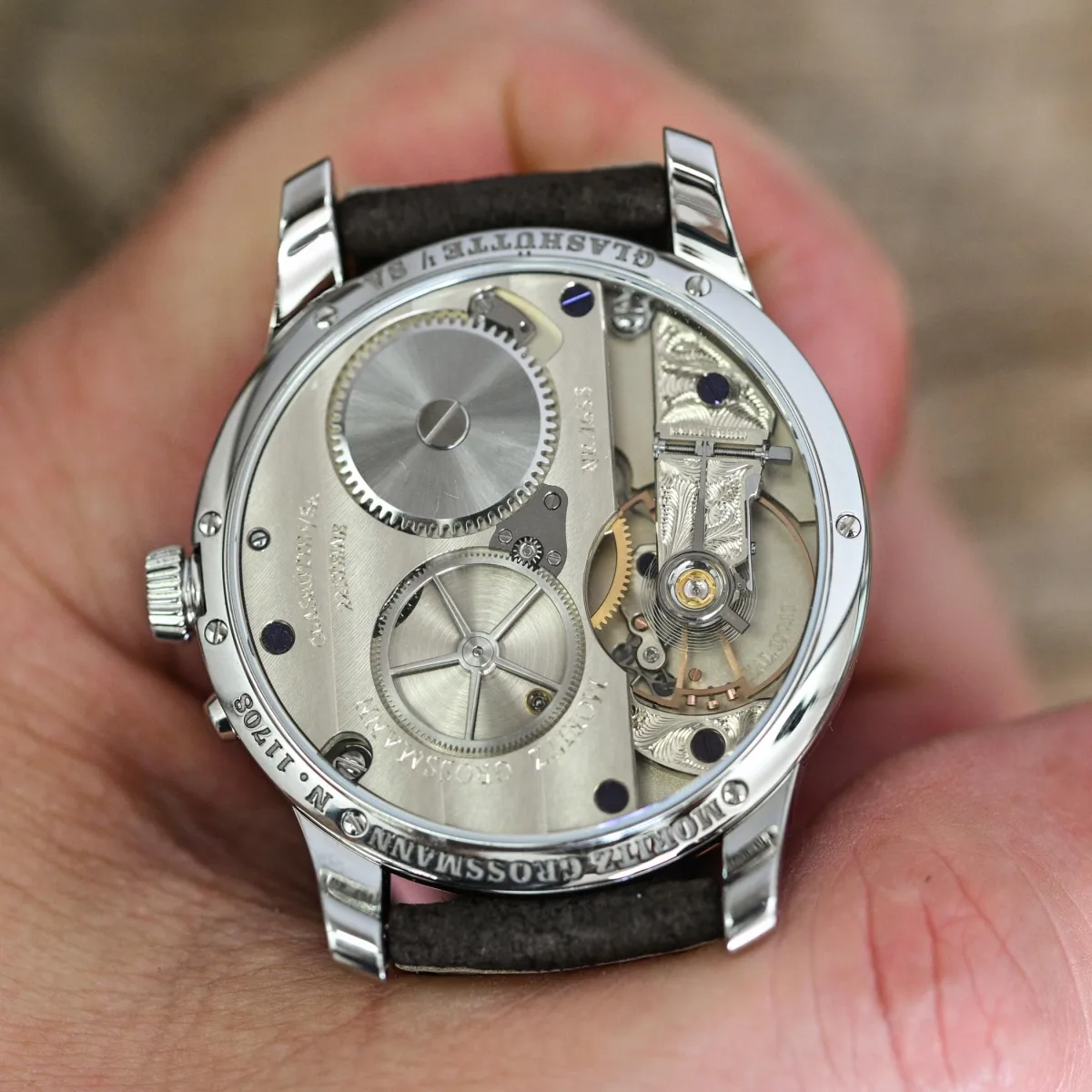
The new caliber 100.11 is based on the company's caliber 100.1. To allow the seconds hand to rotate at the center of the dial, the mainspring's force is transmitted from the third wheel to the new central seconds wheel via an additional intermediate wheel. All components of the train bridge are arranged on one level, providing a harmonious and uniform appearance. Equipped with a Grossmann balance with variable inertia, positioning screws, and a Nivarox balance spring, the 14.2-mm balance has a slow frequency of 18,000 semi-oscillations per hour. Another distinctive feature is the use of white sapphire jewels instead of standard rubies. The fully wound caliber 100.11 provides a somewhat modest 42-hour power reserve.
WHAT DO WE GET IN THE END
The German philosophy of pragmatism and understatement is in full force here. The deceptively simple Central Second dial hides a brilliant button-operated winding mechanism that ensures precise time setting, protects and extends the mechanism's lifespan. The finish is excellent, but there is nothing ostentatious in the case or face of the Central Second; in fact, many enticing touches are found in the movement. Perhaps this is Moritz Grossmann's interpretation of an everyday beater? A simple, everyday three-hander with an attractive dial and a beautiful movement for the exclusive pleasure of its owner?
AVAILABILITY AND PRICE
The watch is worn on a brown kudu leather strap (that's the skin of an African antelope, if you're curious) with a steel buckle. The Moritz Grossmann Central Second model with a blue dial is released in an unlimited series, while the salmon dial version is limited to only 25 pieces. The price for both models is set at 25,600 euros.
For more information, visit the Moritz Grossmann website.
TECHNICAL SPECIFICATIONS – MORITZ GROSSMANN CENTRAL SECOND
Case: diameter 41 mm x height 12 mm – stainless steel, polished – sapphire crystal with anti-reflective coating – sapphire case back – unique retractable crown with reset function – mechanism restart button at 4 o'clock
Dial: massive silver base with blue sunray pattern or salmon color – white luminous (blue dial) or blue (salmon dial) numerals – minute/second track on the perimeter – handmade steel hands, polished or blue thermal annealed – luminescent coating HyCeram Luminex on hour/minute hands on blue dial
Movement: caliber 100.11 – in-house manual-winding movement – 198 parts – 22 jewels – 18,000 semi-oscillations/hour – 42-hour power reserve – Moritz Grossmann inertia balance – Moritz Grossmann pusher system – hand finish, including Glashütte ribbing, polished chamfers, hand-engraved decorations, polished chatons, and thermally annealed screws
Strap: brown Kudu leather, hand-stitched – steel buckle
Reference/Availability: MG-002909 blue dial, unlimited, MG-002939 salmon dial, limited to 25 pieces
Price: 25,600 EUROS