
The three new models for 2026 feature a reduced case size, the familiar layout with two chronograph buttons, and an updated dial.

The Santos de Cartier line represents sporty watches in a casual-chic style as part of the broader Santos collection. It includes a variety of models, from 'Time Only' watches to chronographs. In 2026, Cartier introduced a new generation of Santos de Cartier Chronographs. Here’s what has changed in this series.

To appreciate the upgrade, we need to go back to 2020. Back then, Cartier released a new Santos chronograph in an XL-format case measuring 43.3 x 51.4 x 12.5 mm. The unique feature of this model was the unusual button layout. Instead of the standard pair of pushers on the right side of the case, a discreet rectangular button on the left handled start and stop functions, while the reset function was performed by pressing the cabochon on the crown. Inside was the automatic caliber 1904-CH MC, which debuted in 2012 in the Calibre de Cartier Chronograph model.

Six years have passed since then. Large watches are no longer in fashion. The industry has returned to more compact and wearable sizes. These changes are reflected in the new release, which consists of three models. The watches have become smaller, thinner, and much more comfortable on the wrist. The XL format has been replaced by the LM (Large Model) format. The current case dimensions are 39.8 x 47.5 x 11.6 mm. That's 3.5 mm less in width, 3.9 mm less in length, and 0.9 mm less in thickness.

The new model returns to the traditional layout with two chronograph buttons: the start and stop functions are controlled by the button at the '2 o'clock' position, and the reset function by the button at '4 o'clock'. Otherwise, this is a classic Santos model. The case features satin finish around the perimeter, polished side bevels, a polished bezel with visible screws, and an ergonomic top-to-bottom curve, making the watch comfortable to wear. The case is water-resistant to 100 meters.

The watches are available in steel, a bi-color version with steel and yellow gold on the bezel and bracelet screws, and entirely in yellow gold. The first two models come with steel bracelets but include a black rubber strap. The third model comes with a solid gold bracelet and a dark gray alligator leather strap.
The bracelets are equipped with the SmartLink system for easy length adjustment without additional tools, as well as the QuickSwitch system for quick bracelet-to-strap changes. In the first two models, the crown is adorned with a synthetic blue spinel. The gold-cased model features a sapphire cabochon.
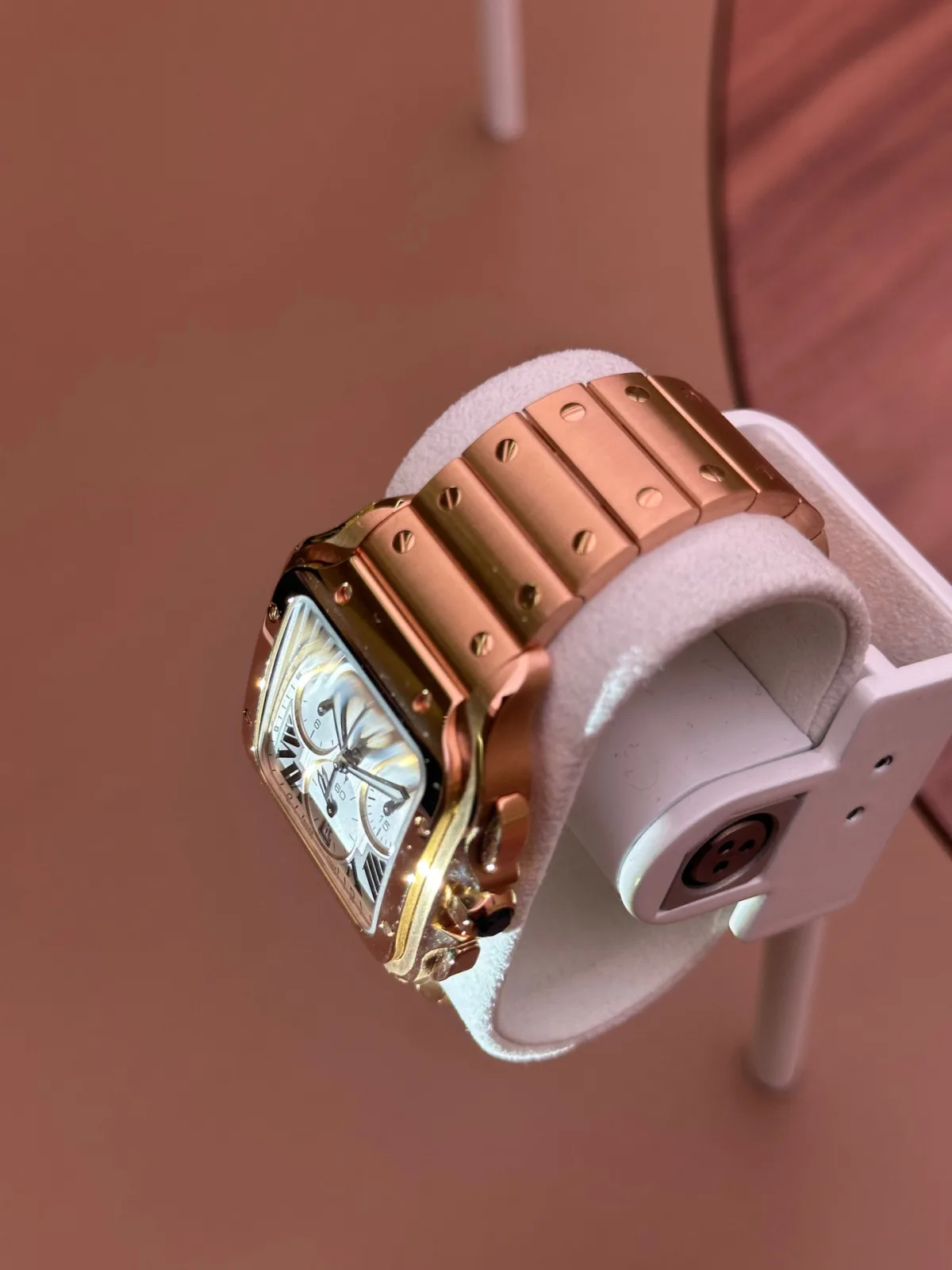
Updates in this trio affected not only the size and button layout on the case but also the dial. In the previous chronograph version, the minute and hour counters were larger than the seconds counter; now it's the opposite. From a readability perspective, the choice might be debatable, but in terms of visual balance, it's entirely justified. Regardless of the model, the dial features black sword-shaped hands coated with Super-LumiNova.
The dial finish combines vertical brushing on the minute scales with a sunray finish around the hour scale. Classic Cartier Roman numerals are pad-printed. The depth and clarity of the dial are enhanced by metal rings on the counters, which are coated with yellow gold or rhodium, depending on the model.

The watch continues to be powered by the caliber 1904-CH MC - an automatic movement produced by ValFleurier. This integrated chronograph features a column wheel and vertical clutch, operating at a frequency of 4 Hz. Despite having two mainspring barrels, the movement offers a rather modest 47-hour power reserve when fully wound.

The new Santos de Cartier chronographs will join the permanent collection in June. The approximate cost is €12,000 for the steel model, €15,000 for the bi-color version, and €60,000 for the yellow gold-cased model.