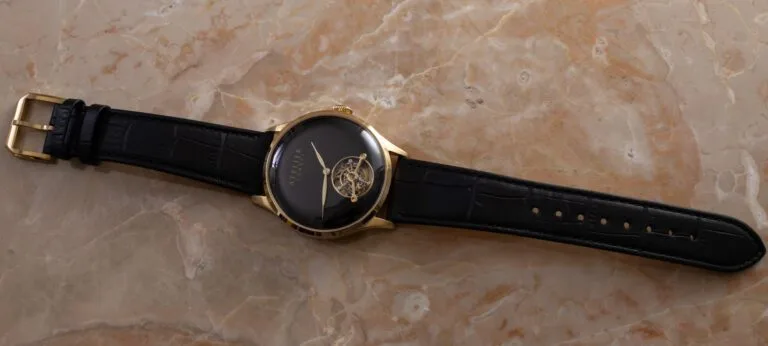
In 2026, the regulation system of the tourbillon both retains its essence and undergoes changes.
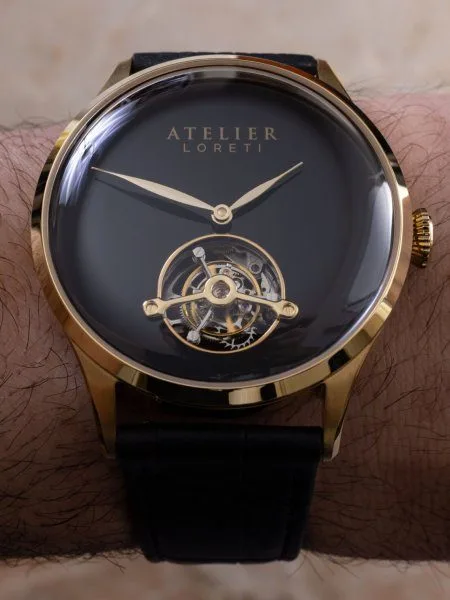
Mechanically, this device, invented in the late 18th century and rotating the balance wheel around its own axis, has hardly changed since the 1990s when watchmakers began incorporating it into luxury watches en masse. Although the tourbillon was invented earlier, it remained a rare exotic feature for a long time until select prestigious brands realized that visually impressive “whirlpools” were perfect embellishments for the most expensive and status-laden watches. For many years, having a tourbillon in a watch implied significant financial investment. Historically, one could assume that the owner of a tourbillon watch spent at least $100,000 on it. Of course, one could spend more, but this amount was the benchmark.
Development Directions for Tourbillons Over the Last 25 Years
The development of tourbillons has followed two main directions:
- Complexity and exclusivity. Prestigious manufacturers stopped being satisfied with the “simple tourbillon” and began creating watches with multiple tourbillons or mechanisms rotating on multiple axes.
- Affordability and imitation. Budget-friendly or even fake tourbillons emerged, designed to imitate expensive models. It all started with copies, and then inexpensive Asian tourbillons appeared, attempting to replicate the Swiss experience but at a much lower cost.
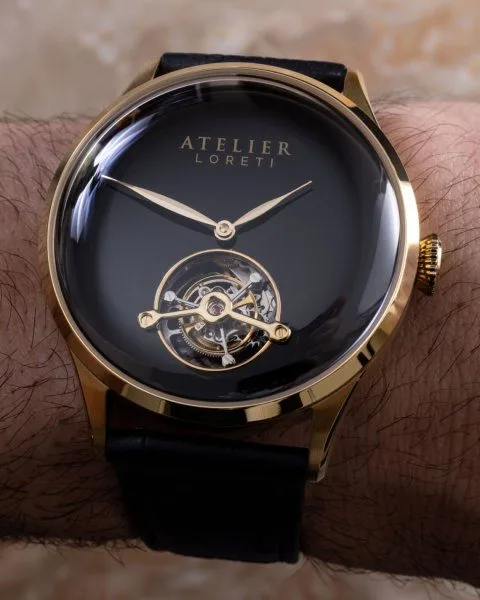
For many, the presence of a tourbillon became a symbol of status and wealth rather than a recognition of watchmaking craftsmanship. However, times are changing.
Modern Status of the Tourbillon in Watches
Today, having a tourbillon in a watch no longer guarantees high cost or status. Certainly, a certain level of craftsmanship is required to produce and assemble such mechanisms, and the cheapest mechanical watches are not equipped with a tourbillon. However, the question is, how much must one pay for a genuine tourbillon experience? Some buyers focus on prestige and want others to perceive them as affluent individuals. Others enjoy the tourbillon from afar, knowing they cannot afford such watches themselves.
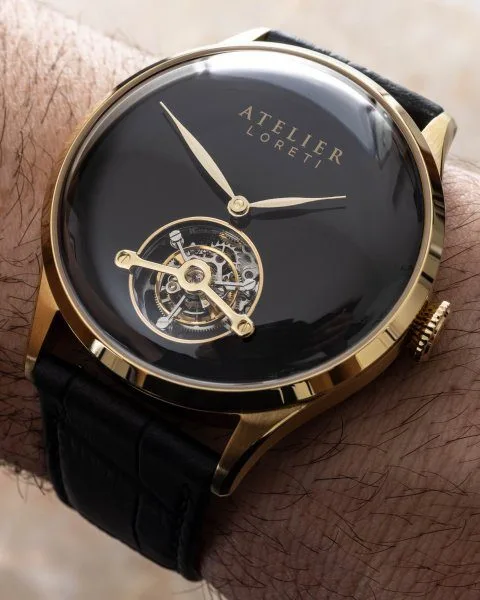
In 2016, TAG Heuer was the first among Swiss brands to offer a tourbillon priced around $15,000–20,000, which shocked the industry. Today, one can purchase a Swiss tourbillon for about $5,000, and Chinese counterparts are even cheaper. The Atelier Loreti Celestial Tourbillon model from Filippo Loreti is priced at just $850, making it one of the most affordable on the market.
New Brand Atelier Loreti and Its Positioning
“Atelier Loreti” is a new direction of the Filippo Loreti brand, debuting with the Celestial Tourbillon collection. Despite the relatively low price for a tourbillon, these watches are more expensive than most Filippo Loreti models, so the company decided to separate them into a sub-brand to avoid confusion among buyers. It is also worth noting that since the previous review, the brand has come under the management of the Montrichard group, owners of brands such as Nivada Grenchen and Vulcain.
Tourbillon as a Symbol of Passion, Not Luxury
Today, the tourbillon has ceased to be a symbol of exclusively high price.
I assert that watches with a genuine tourbillon will never be perceived as “cheap,” but the marketing of budget models is no longer aimed at deceiving consumers.
The tourbillon is now an indicator of the owner's interest in horological art and mechanics, and the visual animation of the mechanism's operation brings aesthetic pleasure. Thus, the tourbillon has become a social signal of belonging to a community of watch enthusiasts, especially if it concerns affordable models.
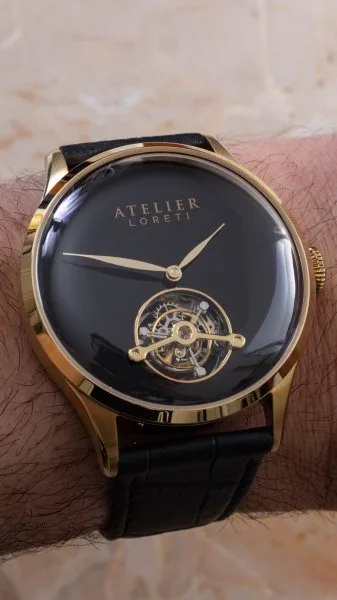
Tourbillons are often criticized for impracticality. In my opinion, accessible tourbillons should develop in this direction. Although inexpensive models exist, rarely any of them can compete in accuracy with expensive counterparts. Most budget tourbillons do not claim chronometer status. Atelier Loreti does not improve the situation, releasing the first models without hour markers, which reduces the convenience of reading time. In the future, I would like to see not only affordable tourbillons but also models with COSC certification.
Origin of the Atelier Loreti Celestial Tourbillon Mechanism
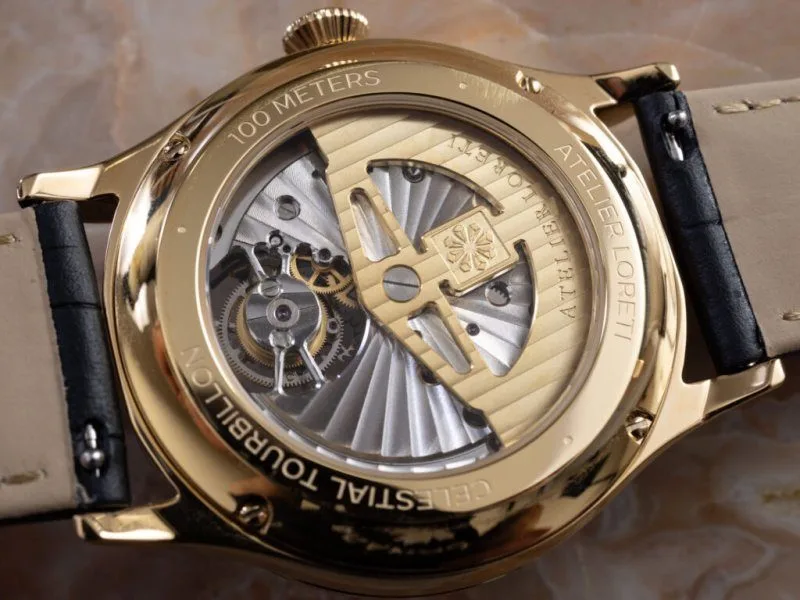
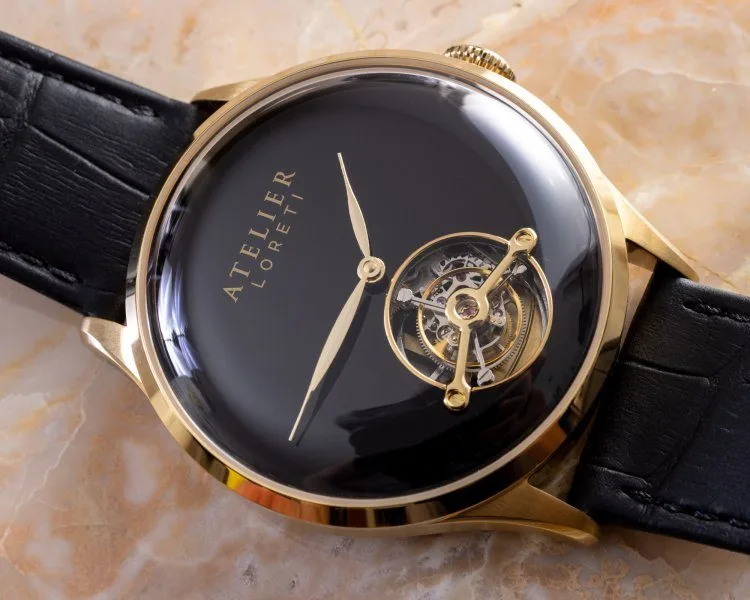
The key question is where the mechanism comes from. It is not a standard Chinese tourbillon with an overlay dial and case. The movement was developed exclusively for Filippo Loreti/Atelier Loreti and based on the Japanese Miyota 8215 caliber. The model is designated L.1T (L1T). I find it ironic to use one of the most common and inexpensive automatic movements as the base for a tourbillon. The movement's frequency was increased from 3 Hz to 4 Hz. The power reserve is not specified, likely just under two days. The mechanism thickness is 5.67 mm. The functionality is limited to displaying hours and minutes, with the tourbillon positioned in a window at the “6 o'clock” position of the case.
Significance of the Tourbillon in Modern Wristwatches
The historical function of the tourbillon - counteracting the effects of gravity - is practically irrelevant in wristwatches, as watches are constantly changing position. The main reason for choosing a tourbillon today is the aesthetics and enjoyment of observing the movement. Atelier Loreti offers a worthy experience for its price. Although the finish is not hand-made or expensive, the construction looks elegant and does not reveal its low cost. If you are looking for a tourbillon for practical watch enthusiasts where precision is not the priority, this model will be appealing.
Case and Design of the Atelier Loreti Celestial Tourbillon
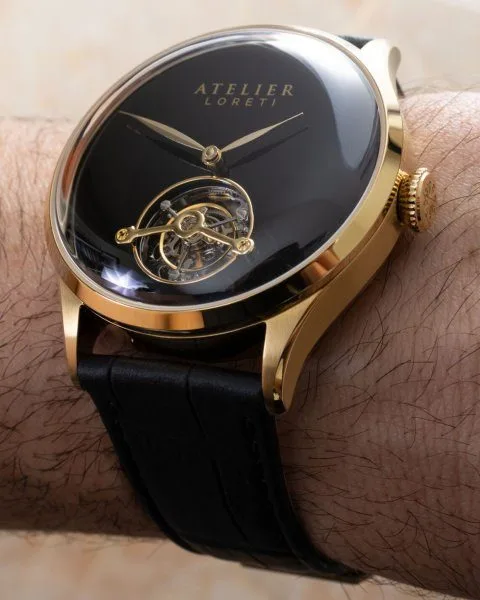
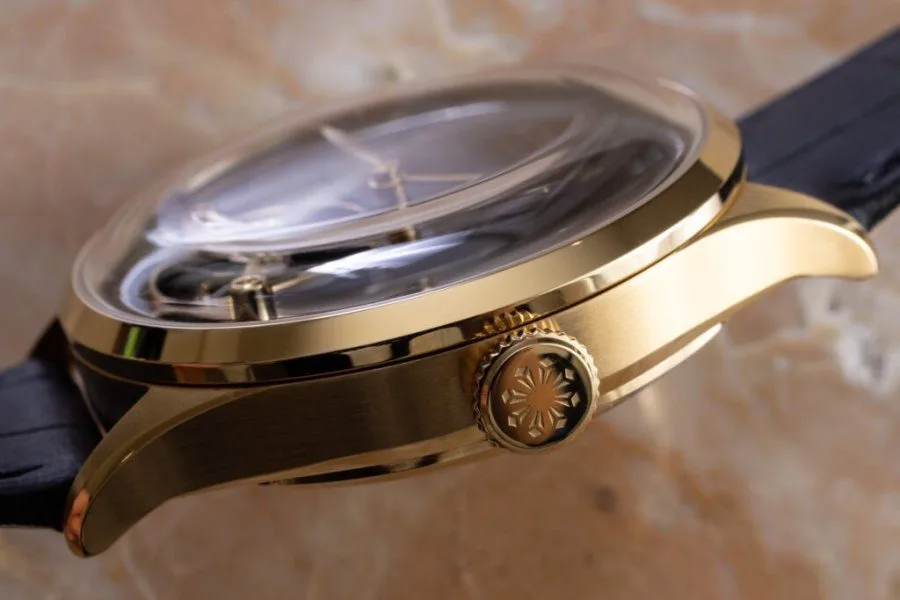
The case could have been made thinner - it is comfortable but seems 1-2 mm thicker than necessary. For ultra-thin tourbillons, you will have to pay significantly more. The steel case is available in several finishes, with the review featuring a gold PVD coating. The case diameter is 42 mm, with a thickness of about 14 mm (claimed 10.85 mm excluding the domed sapphire crystal). The lug-to-lug distance is about 49 mm. Water resistance is 100 meters without a screw-down crown.
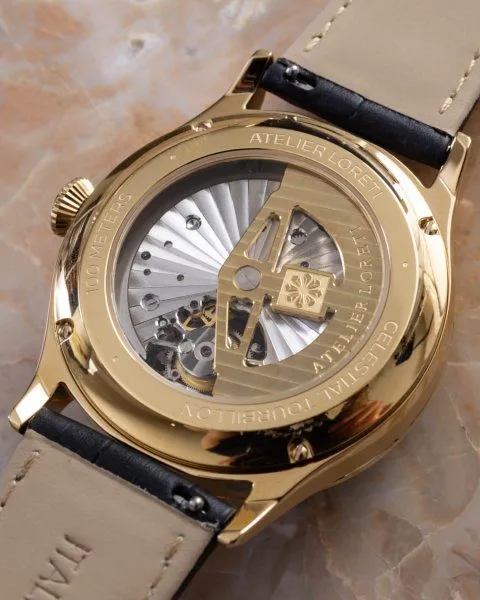
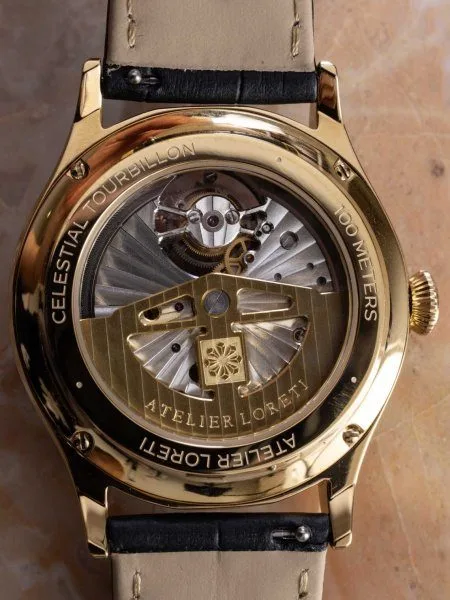
The Miyota 8215 mechanism is not known for its beauty, but in refining the L.1T, designers tried to decorate it as much as possible, especially the surface visible through the transparent case back with bridges and a gold rotor of the automatic winding.
Model Variants and Dials
The Celestial Tourbillon collection is presented in four versions with natural stone dials:
| Case Version | Dial Color | Model Name | Features and Price |
|---|---|---|---|
| Gold Steel (PVD) | Blue Aventurine | “A Sky in Motion” | Elegant option |
| Gold Steel (PVD) | Black Onyx | “Pure Depth” | Review model, classic style |
| Polished/Matte Steel | Turquoise | “Ancient Memory” | Natural stone, affordable price |
| Polished/Matte Steel | Silver Meteorite | “Beyond Earth” | More expensive due to dial material |
The yellow gold tone of the case pairs excellently with deep black onyx. Although such dials are not always convenient for reading, they are visually appealing. This is exemplified by the popularity of models with minimalist dials without hour markers (Movado Museum Dial, H. Moser & Cie). The dial hides the “flying” tourbillon, adorned with a decorative bridge that is not connected to the mechanism and serves only as a design element. Most likely, in future models, this element will be removed.
Straps and Complements
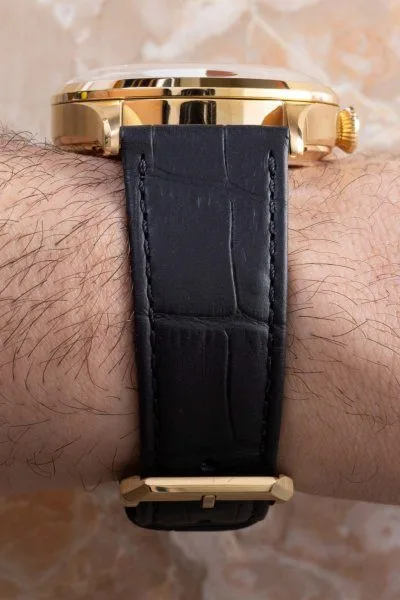
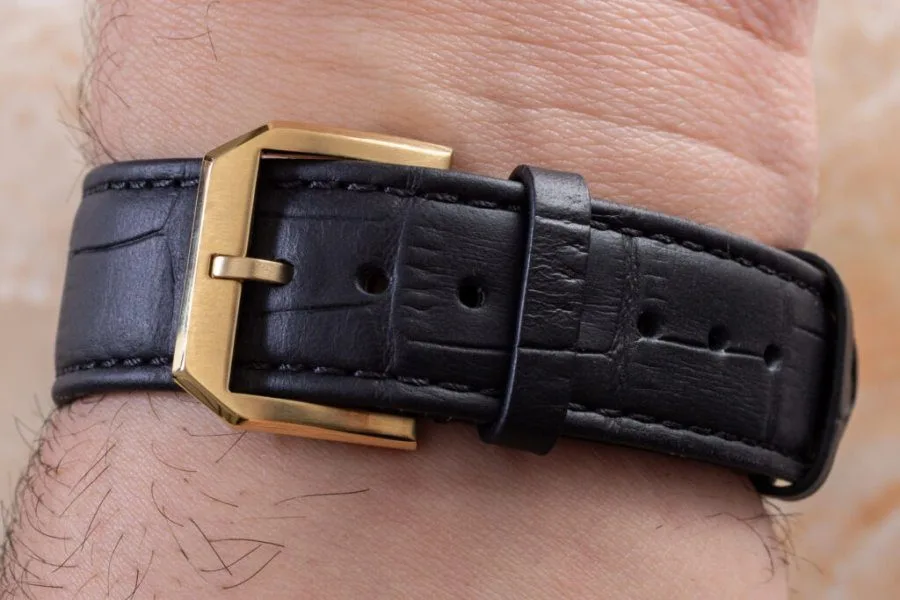
All models come with textured black leather straps, which are good but not premium. To enhance the appearance, it is recommended to replace them with straps made of alligator, crocodile, or other exotic skins with a light gloss. Atelier Loreti promises to supply the watches with a second strap, specially matched to the model.
Conclusions and Prospects
Atelier Loreti proudly presents its own automatic tourbillon L.1T and the Celestial Tourbillon collection - the first watches with this mechanism. It is interesting how much the market shares my opinion on the modern status of the tourbillon. Even inexpensive tourbillons possess intellectual appeal and artistic value. Wearing a tourbillon is no longer associated with wealth but remains a positive and intriguing sign for others.
The price of the Atelier Loreti Celestial Tourbillon is $850 for most versions, including the review model with black onyx, and $1,050 for the model with a meteorite dial.
This review reveals the modern significance of the tourbillon in watches, highlighting its role as a symbol of passion and aesthetic pleasure, not just luxury. Filippo Loreti, through the Atelier Loreti sub-brand, offers an affordable tourbillon that may interest both novice and experienced collectors.