For an emerging independent brand, it takes a certain bravado to illustrate a press release with a photo of the mechanism of a new piece. But we are talking about a brand created by Gaël Petermann and Florian Bédat, a dynamic duo of talented young watchmakers who won the 'Horological Revelation' award at the GPHG in 2020 for their Deadbeat Seconds 1967 watch. The latest creation from their workshop in Renens, Switzerland, marks the second chapter in the life of the 1967 Deadbeat Seconds model, now in a titanium case with blue accents on the dial.
HISTORY
If you thought the mention of 1967 referred to the birth year of the watchmakers, you are mistaken, as were many of us. Between 2007-2011, Gaël Petermann and Florian Bedat shared a workbench at the Geneva School of Watchmaking when they were just 30 years old. Their paths diverged when Petermann moved to A. Lange & Söhne in Glashütte, and Bedat joined Harry Winston in Geneva. Eventually, Bedat joined Petermann at Lange, engaging in assembling, disassembling, and reassembling complications to master the craft. Feeling nostalgic, Petermann returned to Switzerland in 2014 to focus on restoring antique and complex watches. Two years later, Bedat joined him; they opened a workshop in Renens and founded Petermann Bédat Sàrl in 2017.
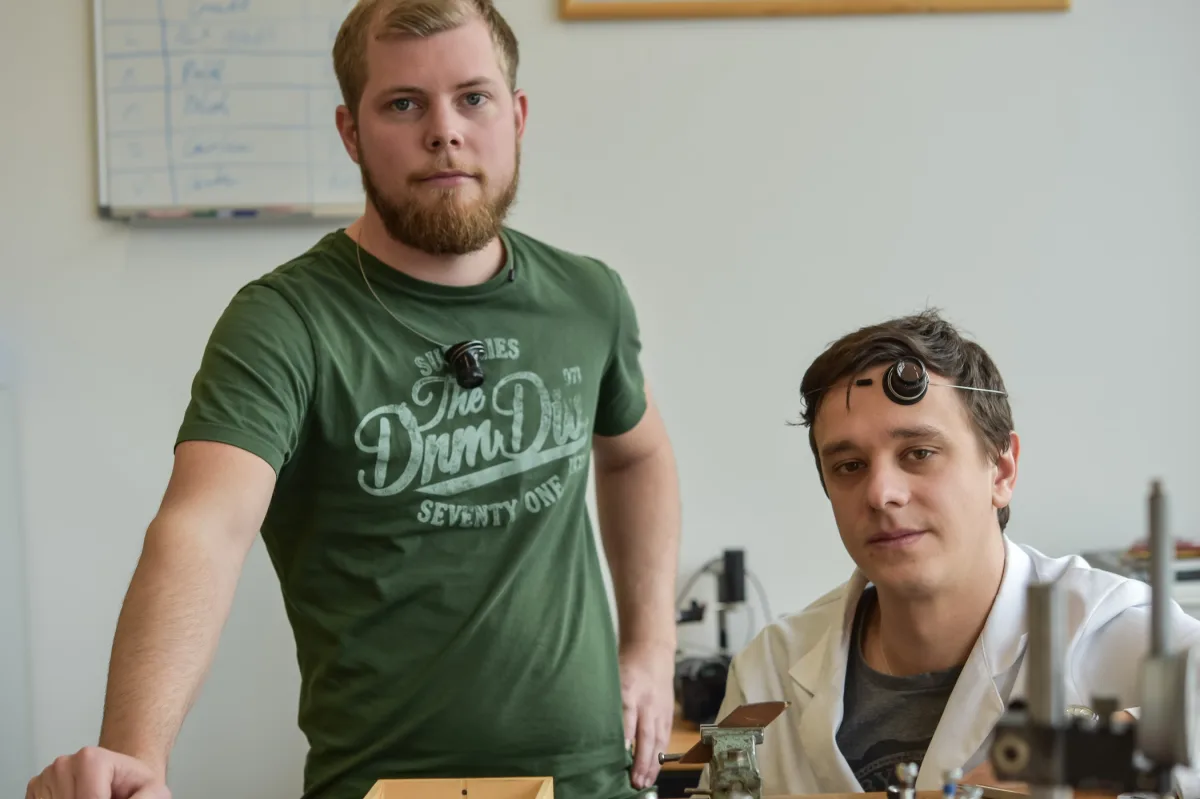
Coincidentally, their workshop was located next to the atelier of Dominique Renaud, co-founder of Renaud & Papi. Recognized as one of the best producers of complicated watches in Switzerland, Renaud & Papi is now owned by Audemars Piguet. In 2017, Renaud asked the young watchmakers to help him with decorative work, and in exchange, they sought his assistance in developing their first movement. Unfazed by challenges, Petermann and Bédat settled on the complex deadbeat seconds complication.
PETERMANN BÉDAT 1967 YEAR CHAPTER 1
The caliber they developed for the Deadbeat Seconds 1967 model was inspired by a pocket watch with a tourbillon and a seconds hand made by Robert Gafner, a teacher at the La Chaux-de-Fonds watchmaking school in the 1940s. Unlike regular seconds hands that move smoothly across the dial, the seconds hand makes a discreet jump every second. Below is a sample of the first series in an 18k rose gold case.
The reference to 1967 indicates the year the first quartz movement was released. Obviously, quartz has no relation to these watches, but the precise staccato beat of a quartz seconds hand is identical to the action of the deadbeat seconds mechanism, allowing for more accurate timekeeping. If you are interested in the workings of the deadbeat seconds, don't miss Xavier's technical insight into this complication.
CALIBER 171
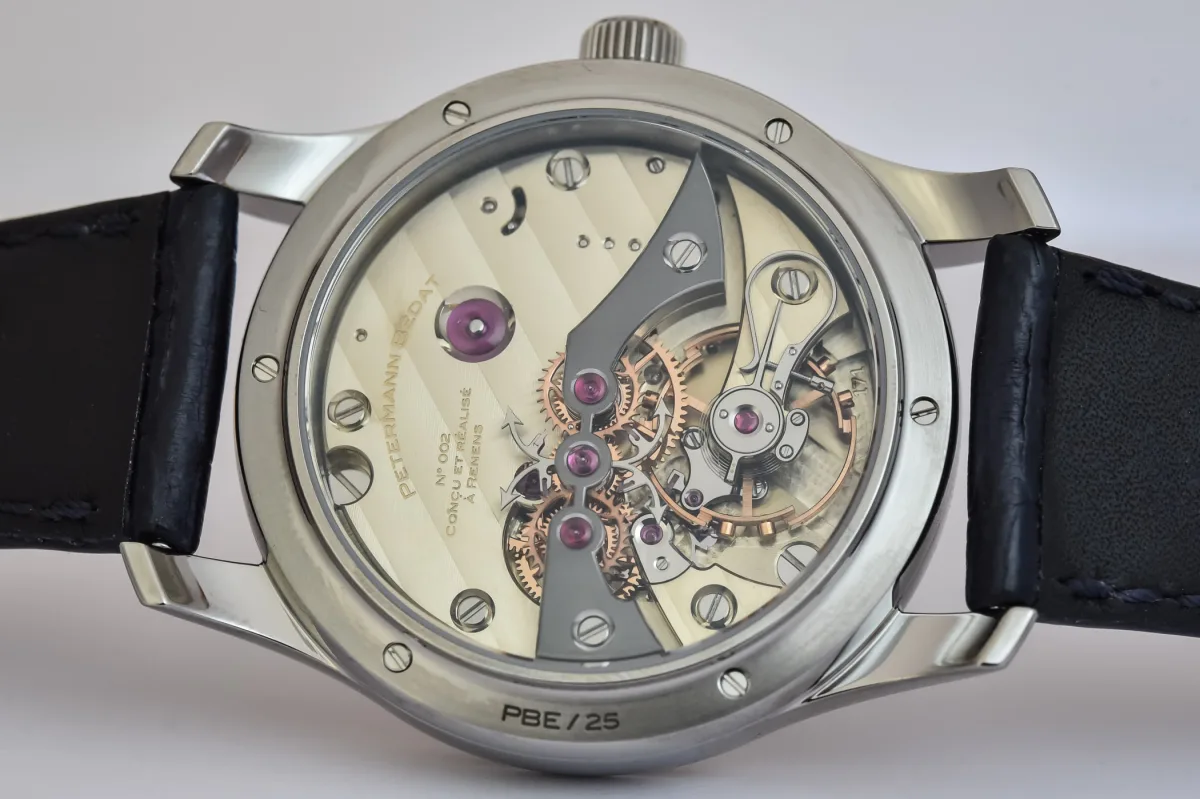
In 2017, Petermann and Bédat felt ready to create their first movement. Naturally, the finishing had to reflect the partners' high regard for traditional watchmaking art. With the help of Dominique Renaud and inspired by Robert Gafner's pocket watch, Petermann and Bédat embarked on creating the hand-wound caliber 171 with a deadbeat seconds. The movement is based on a secondary escapement for the deadbeat seconds, mounted on a three-quarter plate, and a complex four-armed anchor mechanism. Driven by a wheel train, the mechanism stops, and the arrow-shaped anchor releases the spring-loaded seconds barrel wheel precisely every second. The four-armed anchor with four pallet jewels was the most complex component and had to be manually adjusted to hundredths of a millimeter. Imagine the challenges faced to ensure an even level of chamfering throughout the case and to polish the sharp contours of the hands!
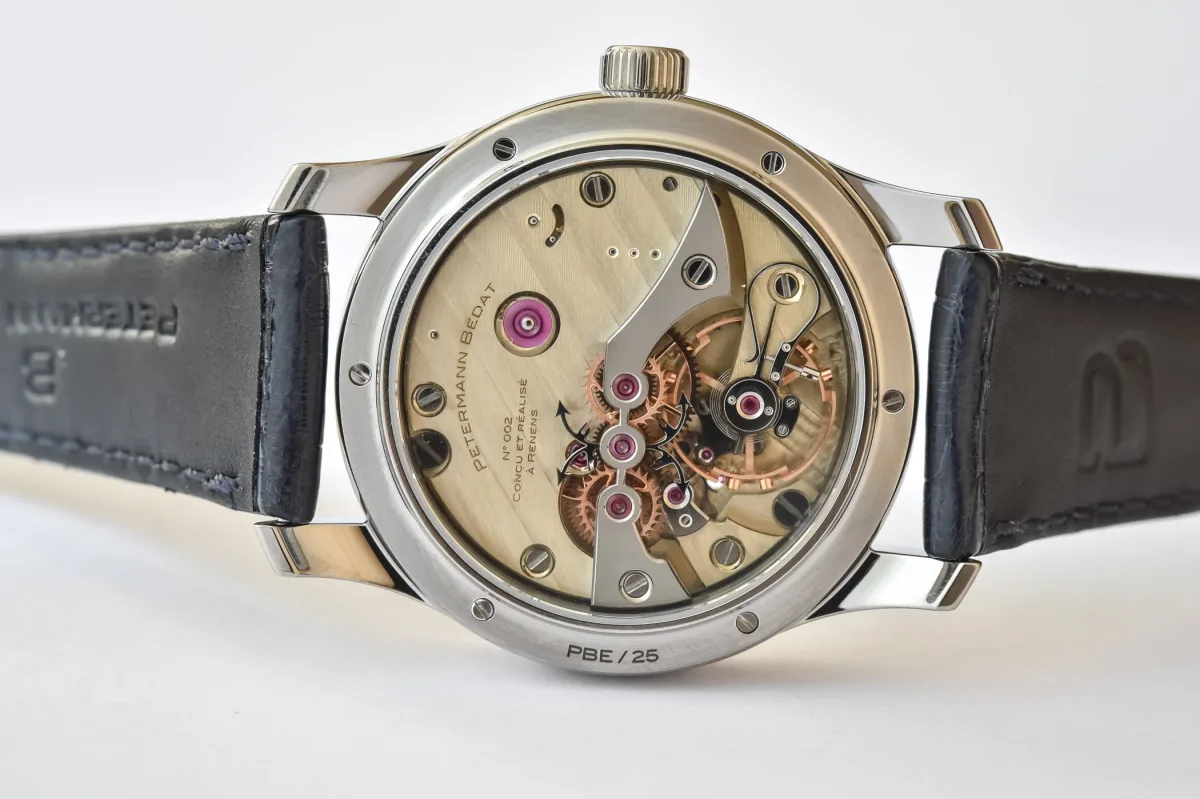
The large balance wheel (11.5 mm) beats slowly at 18,000 vibrations per hour, and the power reserve - considering the large amount of energy used for the deadbeat seconds impulse - is a short 36 hours. You can appreciate the influence of Saxon watchmaking in the watch with its elegant black-polished swan-neck regulator and untreated German silver three-quarter bridge. Beautifully adorned with hand-polished bevels, black-polished steel parts, and thick Geneva stripes (also handcrafted, and you can see the difference...), the movement has attracted admiration from all sides. Using the obsolete technique of mixing poudre de levant with olive oil, the duo achieved a deep matte finish on the deadbeat seconds bridge.
Although the prototype of the Deadbeat Seconds watch created by Petermann Bédat in 1967 was highly praised for its stunning mechanism, the dial was deemed too simple. Instead of attempting to create a new dial themselves, they turned to designer Barth Nussbaumer, who replaced the original closed dial with a 1950s-style sector dial with a transparent skeletonized section between 1 and 4 o'clock, revealing the levers of the keyless works behind the deadbeat seconds mechanism. Presented in 39 mm cases of rose and white gold, ten pieces of each metal were sold out.
PETERMANN BÉDAT 1967 SECOND SERIES
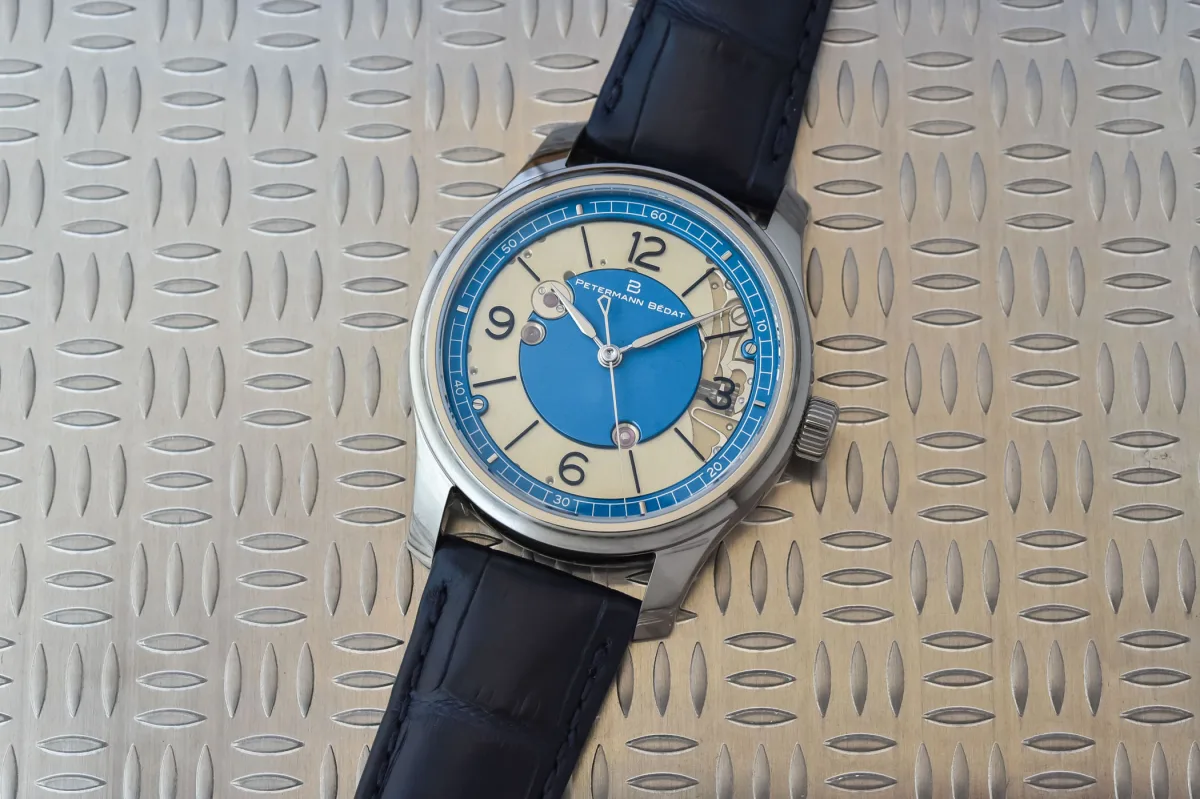
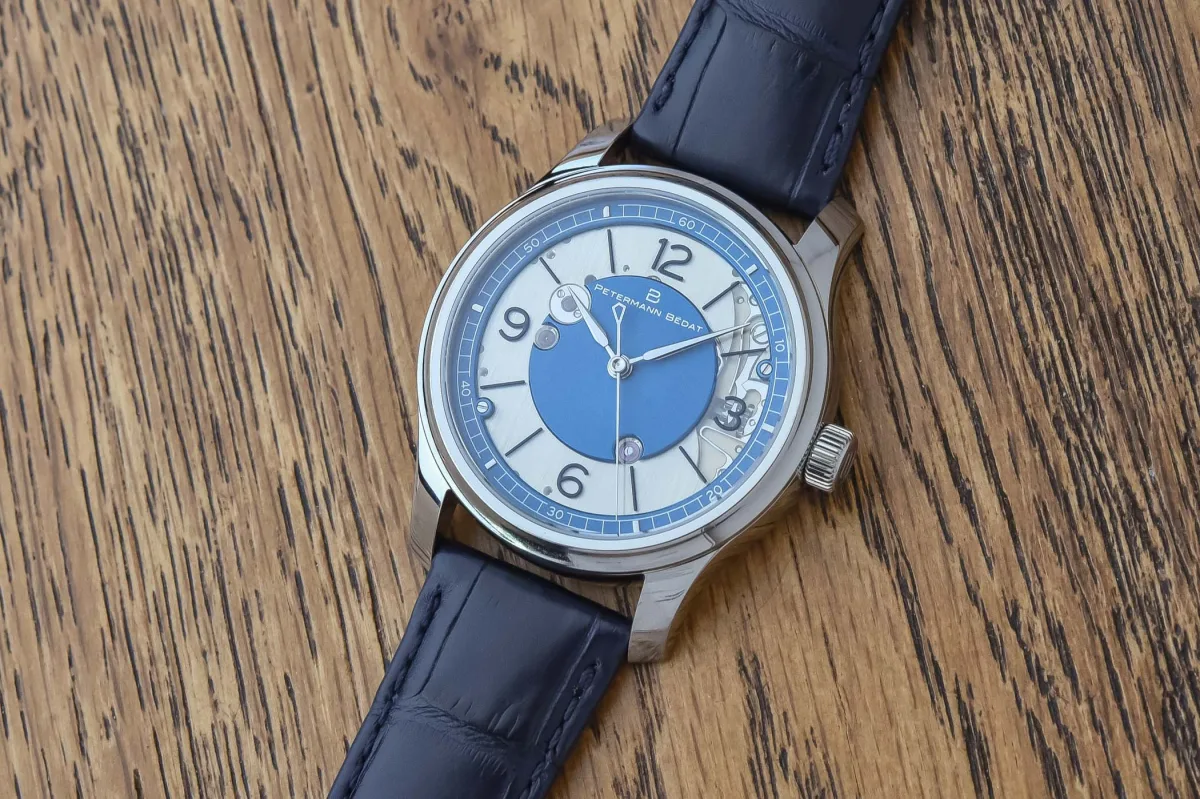
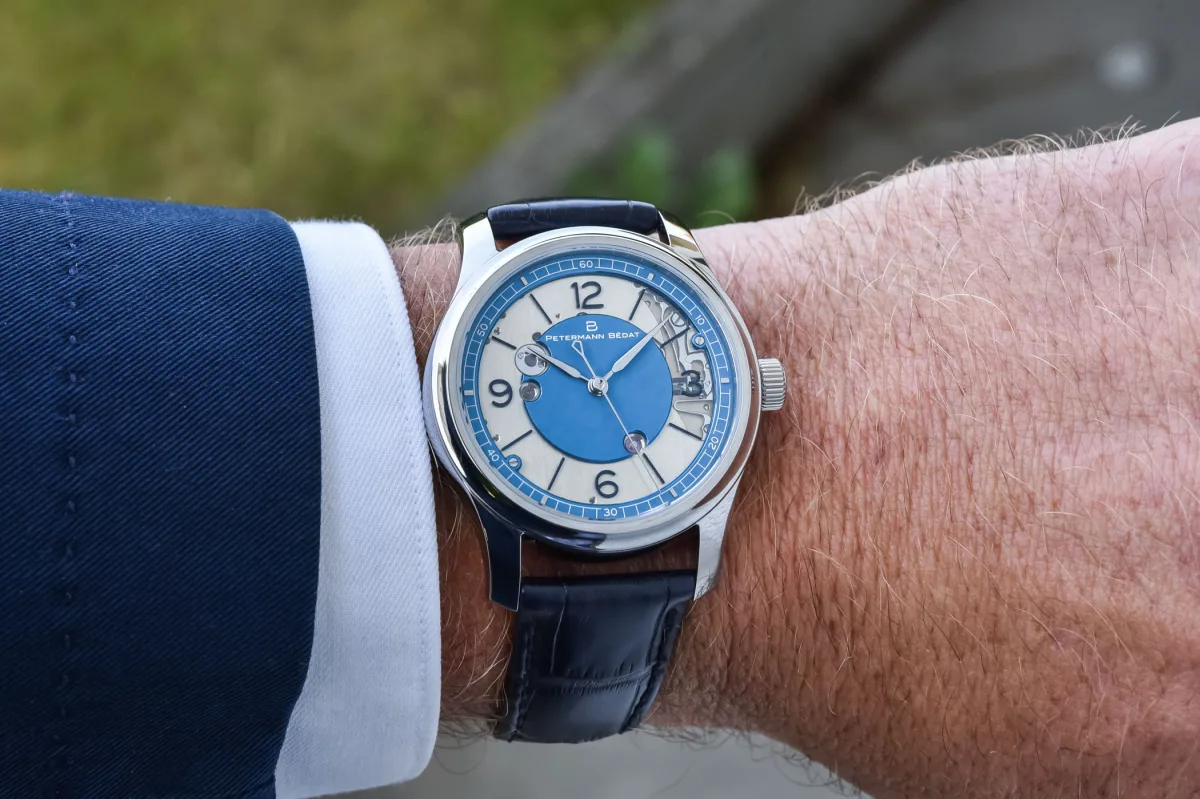
The new series of Petermann Bédat 1967 Deadbeat Seconds watches has the same dimensions as the gold models - 39 mm x 10.70 mm - but now the case is made of grade 5 titanium. The watchmaking duo admits they chose titanium not because it's light, but because it's hard. According to Petermann and Bédat, although achieving a fine hand-finish on a titanium case requires one and a half times more effort, it delivers twice the benefit. The polished curved sides of the case flow smoothly into the lugs and are equipped with an elegant stepped bezel and a large crown.
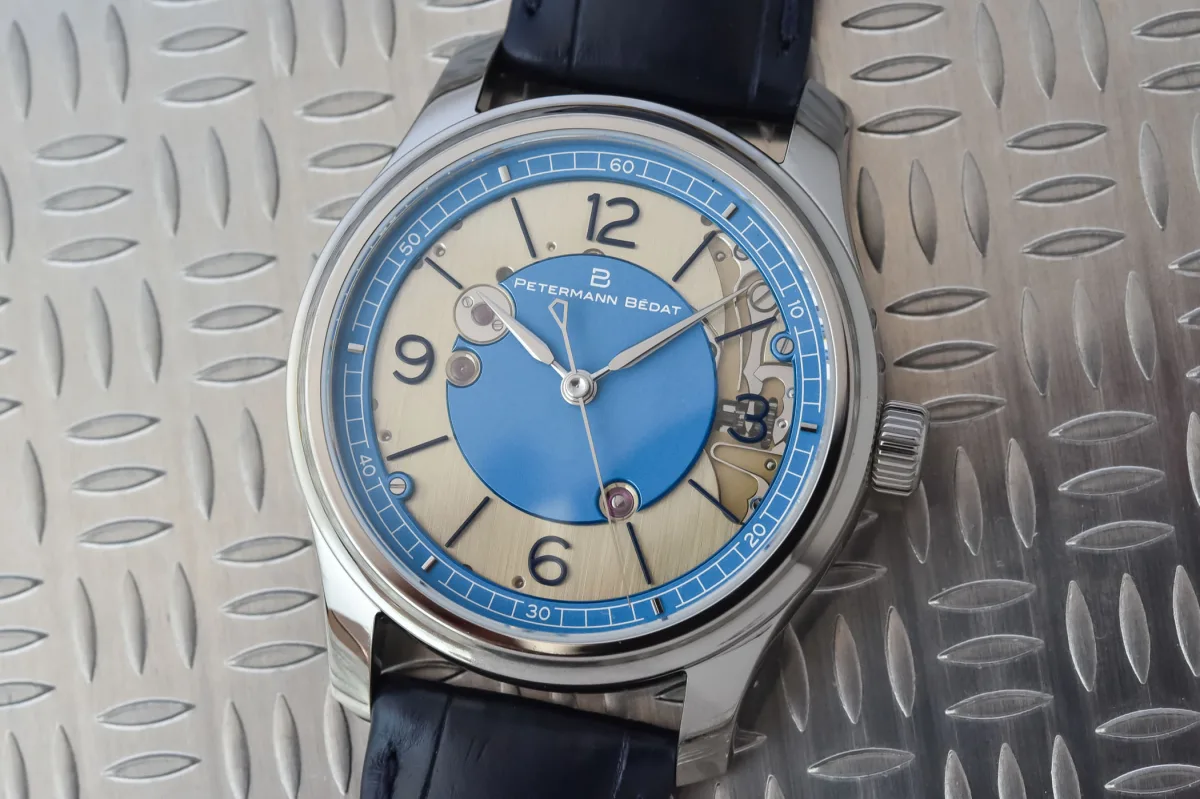
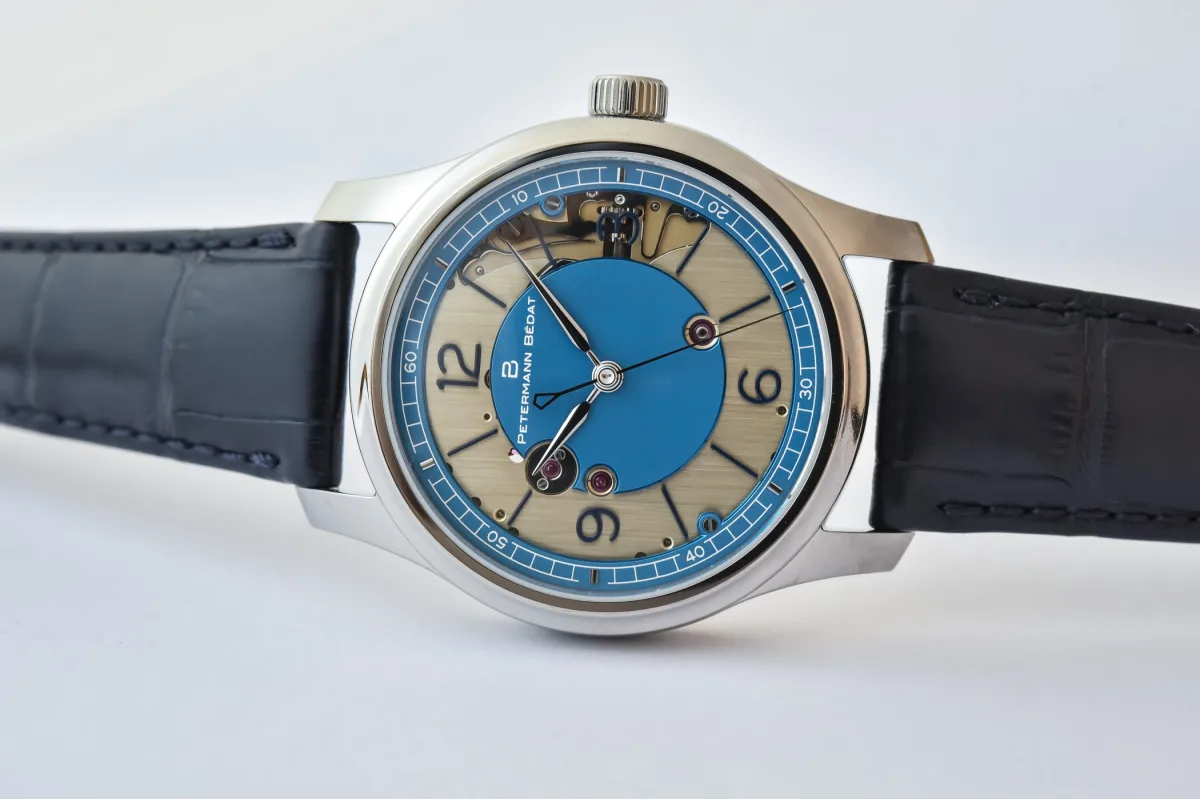
Maintaining the same technical specifications and layout as previous releases, another innovation in the Second Series of 1967 is the blue accents on the dial. The dial (manufactured by Comblémine), a cross between a sector dial with skeletonized sections and exposed jewels and shells, now features a blue central disk and seconds track, also made of titanium and anodized to achieve a bright blue color. Although the peripheral track is also a minute track, in the context of the deadbeat seconds complication, it's more appropriate to call it a seconds track, indicating the distinct jump of the central seconds hand. As in previous series, the relief central disk and seconds track are sandblasted for a grained matte finish.
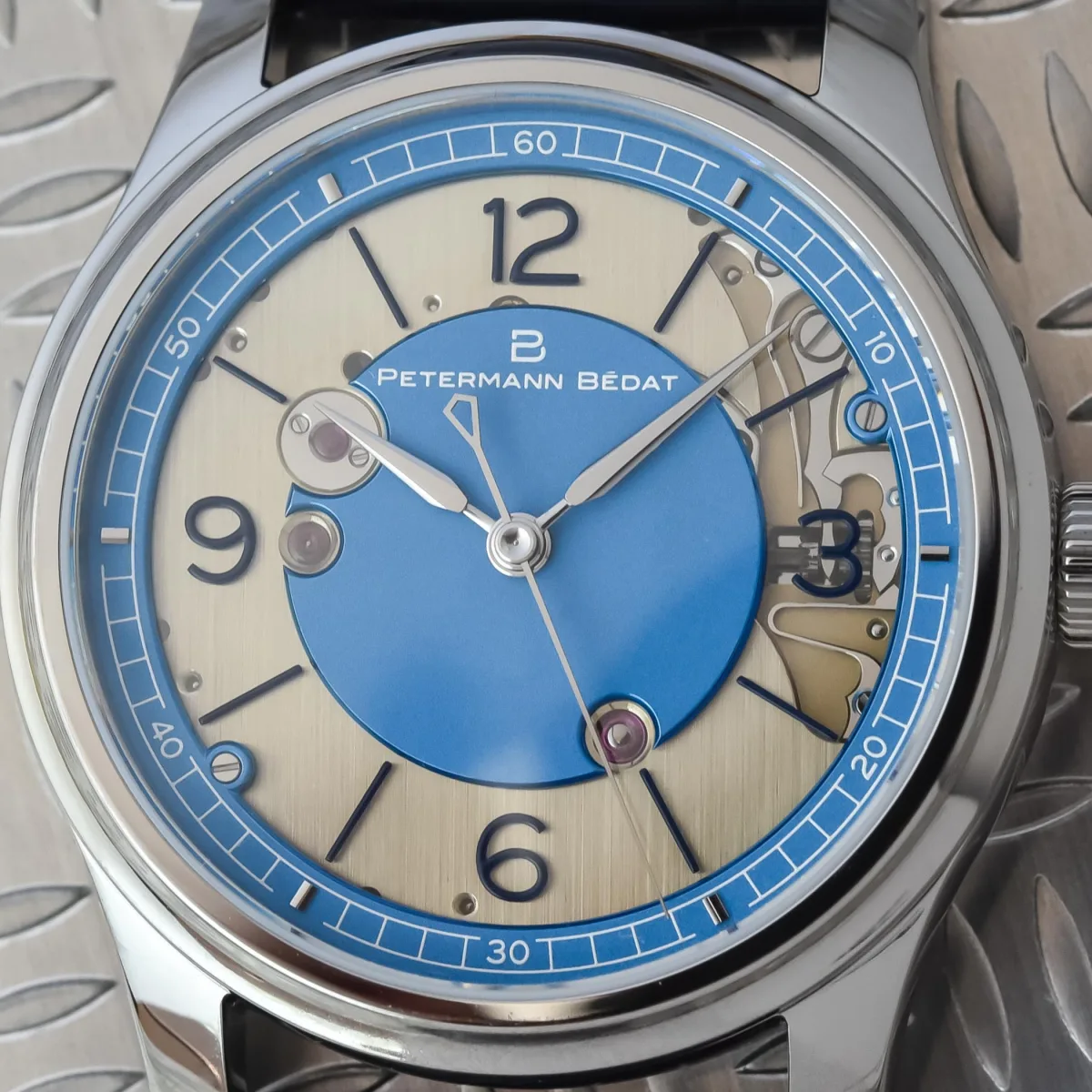
The dial consists of several layers and features a vertically brushed base with an asymmetrical skeletonized zone covered with sapphire crystal between 1 and 4 o'clock. The main dial hosts black Arabic numerals at the '3', '6', '9', and '12 o'clock' positions, interspersed with long black markers. The peripheral track is attached to the base with two screws and features a white railroad track and small applied markers. Interestingly, the central blue disk has cutouts to house three large rubies, including a capstone with a mirror-polished stainless steel plate and screws. Exquisite beveled spear-shaped hands are hand-finished with mirror polishing.
AVAILABILITY AND PRICE
The 1967 Second Series comes with a hand-stitched black alligator leather strap with a titanium buckle. The watch is limited to 25 pieces and is priced at 69,800 Swiss francs (excluding taxes).
For more information, visit www.petermann-bedat.ch.
TECHNICAL SPECIFICATIONS – PETERMANN BÉDAT 1967 DEADBEAT SECONDS SECOND SERIES
Case: diameter 39 mm x height 10.70 mm – grade 5 titanium, polished – sapphire crystal front and back – water resistance up to 30 meters
Dial: sector dial with blue central disk and peripheral seconds hand – skeletonized area between 1 and 4 o'clock with sapphire crystal, revealing keyless works – spear-shaped hands with hand-finish
Movement: caliber 171 – in-house, manual winding – diameter 30 mm – 18,000 vibrations/hour – power reserve 36 h – 29 jewels – hours, minutes, seconds hand – hand-finish in traditional Haute Horlogerie technique
Strap: hand-stitched black alligator – titanium buckle
Availability: limited to 25 pieces
Price: 69,800 SWISS FRANCS
(excluding taxes)