The history of Audemars Piguet is inextricably linked to its native region: founded in 1875 in Le Brassus, the manufacture built its reputation on independence and a long-term strategy - especially in the field of complications and craftsmanship.
The modern image of the brand is largely defined by a single groundbreaking design - the Royal Oak, created by Gérald Genta in 1972, which redefined steel as a luxury material through its finish, form, and integrated bracelet.
However, Audemars Piguet is not just about the Royal Oak. Behind this cultural symbol lies a deep 'mechanical' tradition. For instance, in 1892, AP created the world's first wristwatch minute repeater for Louis Brandt & Frère (future Omega), and some of the first wristwatches with a jumping hour - a key reference for one of this month's major new releases.
Audemars Piguet's new releases for the first half of 2026 reflect the brand's essence, starting with color and natural materials applied consciously, not just for novelty. New Royal Oak Selfwinding models in yellow gold, available in 37 and 41 mm sizes, stand out with unique malachite dials with distinctive patterns, while the 23 mm Royal Oak Mini ventures into the jewelry direction with black onyx and extra white mother-of-pearl. In the Royal Oak Offshore sports collection, vibrant Diver versions and two new 43 mm chronographs with ceramic and titanium contrast debut.

The technical idea is to make complex complications more convenient for everyday use. The new skeletonized perpetual calendar calibre 7139 with a universal crown correction system is presented in Code 11.59 and Royal Oak models. The Royal Oak QP in 'Bleu Nuit, Nuage 50' ceramic with calibre 7138 continues the ergonomic course. The Royal Oak 38 mm chronograph enters a new era with its own calibre 6401 and a sapphire case back. The collection is complemented by openworked Royal Oak models with a monochromatic design that unifies the case and mechanism.

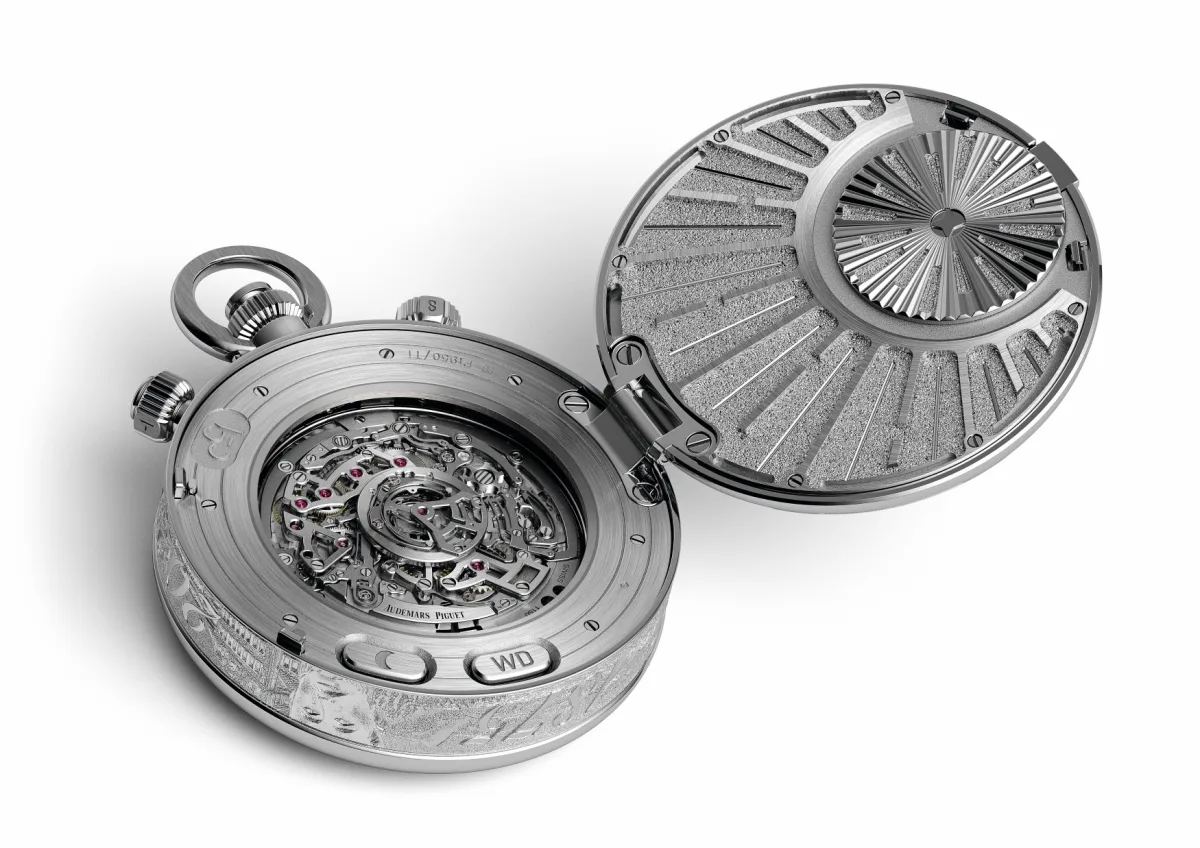
The pinnacle of the lineup is the pocket chronometer '150e Héritage' with an ultra-complex calibre 1150 and a unique Universal Calendar visualizing celestial cycles and cultural time systems on the back cover. The Code 11.59 Flying Tourbillon with an ivory dial completes the year's new releases overview, showcasing finishing expertise and user-friendliness focus. Audemars Piguet is not just about the Royal Oak. Below is a detailed review of all the new releases for the first half of 2026.
Jumping Hour Watches (Calibre 7122)
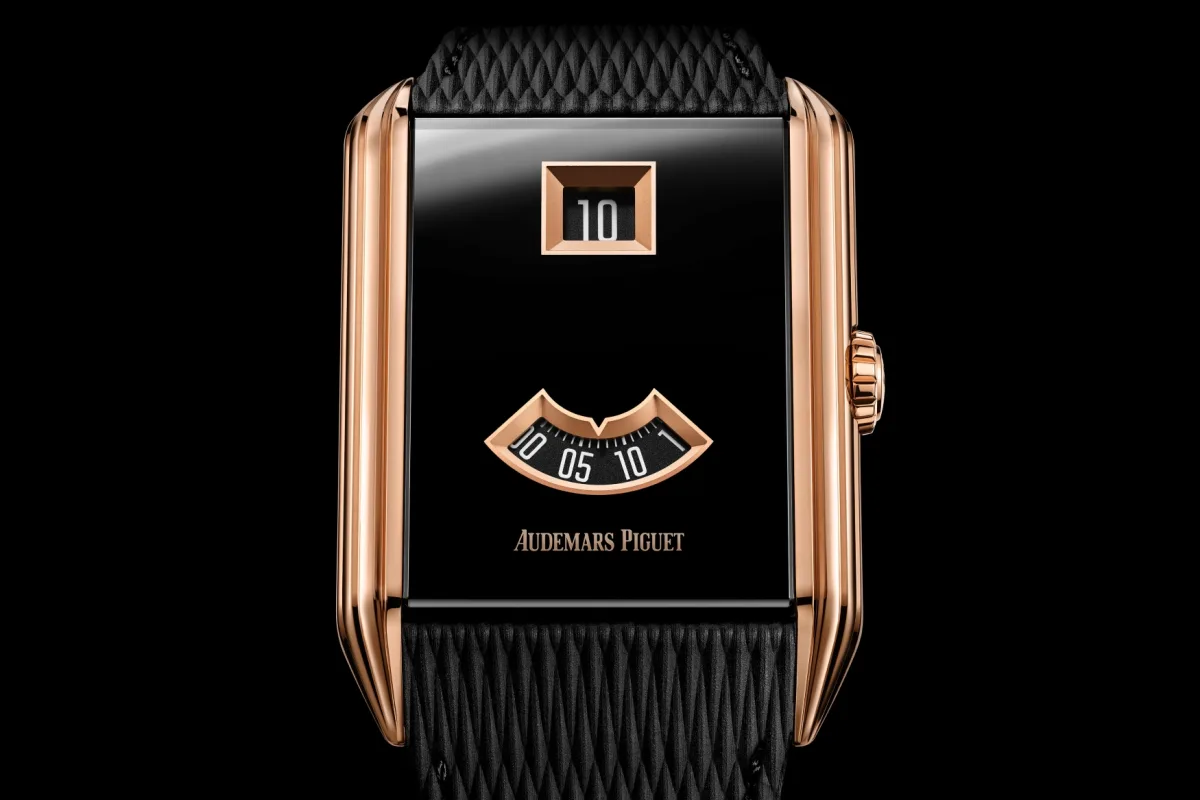
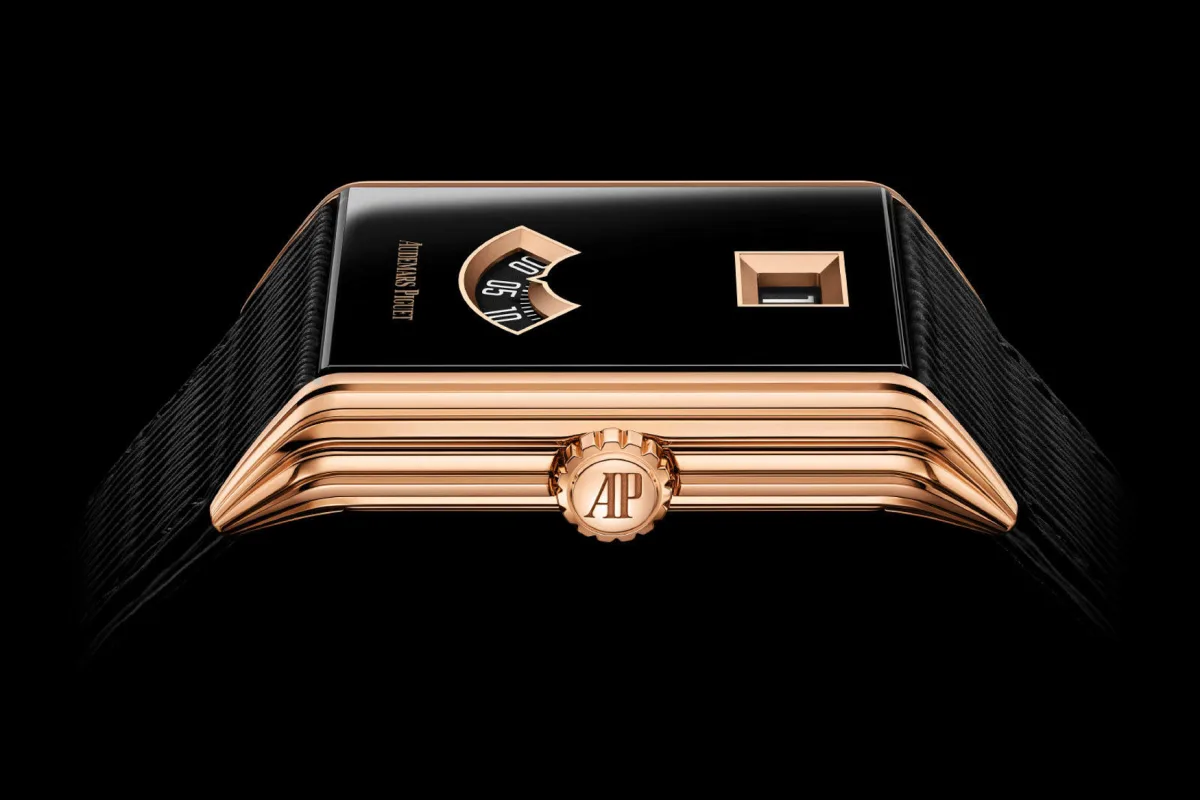
Let's start with arguably the most unexpected model - the Jumping Hour. These are rectangular watches in Streamline Moderne style, where time is read through two windows: a jumping hour and running minutes. This design shifts the focus from the traditional dial to a pure display.
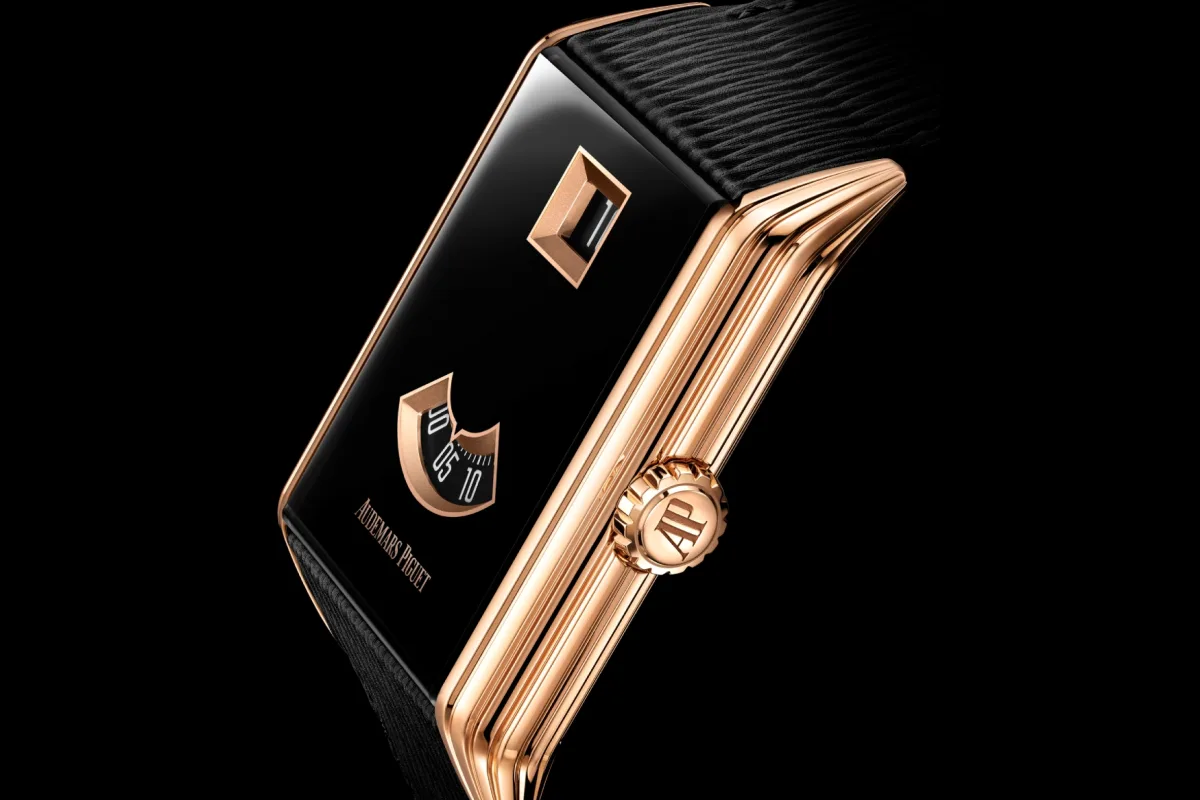
The rose gold case measuring 47.1 × 34 mm is adorned with eight vertical ribs (gadroon) on each side - they are repeated on the back cover, crown, and even the rotor. The black sapphire dial with PVD coating creates a modern two-tone effect and provides an unusual structure: there are no metal frames at the 12 and 6 o'clock positions, so the dial is glued to the sapphire, and the entire construction is fixed with screws to achieve 20 m water resistance.
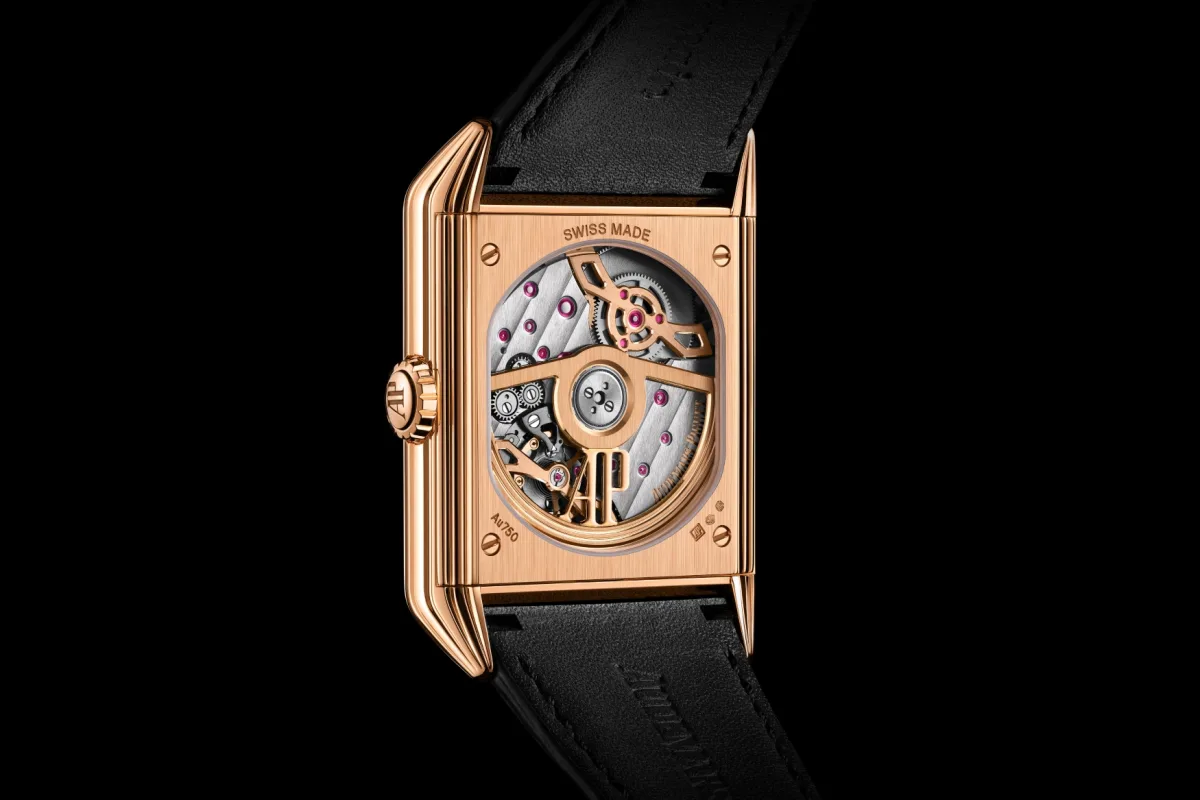
Inside debuts the calibre 7122 - the brand's first automatic movement with a jumping hour (52 hours power reserve, 4 Hz frequency), based on calibre 7121 and enhanced by a patented shock absorber system preventing accidental hour jumps. An additional feature is the titanium hour disc and aluminum minute disc.
Calibre 7139: A New Generation of Skeletonized Perpetual Calendars (Code 11.59 and Royal Oak)

The key new release is calibre 7139, a new automatic skeletonized perpetual calendar with a proprietary crown correction system, first introduced last year. The main goal is convenience: four crown positions manage winding, time setting, and all calendar settings without tools. A red prohibition zone for correction from 9:00 PM to 3:00 AM is introduced to protect the mechanism.

Calibre 7139 debuts in two 41 mm models with sapphire dials: the first is an openworked perpetual calendar in Code 11.59 with a white gold case and black ceramic on a black alligator strap; the second is an openworked perpetual calendar Royal Oak in titanium with a bezel, back cover, and screws made of Bulk Metallic Glass (BMG). AP uses BMG for its reflective surface and wear resistance, emphasizing contrast with the matte titanium surface. Calendar indicators are reorganized for better readability: day of the week at 9 o'clock, date at 12, month at 3, and week numbers start with '1' at 12 o'clock.
Royal Oak Chronograph 38 mm: New Calibre 6401 (Three References)

The next new mechanism is the calibre 6401 chronograph, developed in-house over five years, replacing the long-lived calibre 2385 (used since 1997). This is an integrated column-wheel chronograph with vertical coupling, complemented by a patented coupling system simplifying the design, reducing play, and decreasing button pressure.

Two noticeable changes: all 38 mm models are now equipped with a sapphire case back - a first in Royal Oak Chronograph history of this size - allowing the finish and construction of the mechanism to be admired. Secondly, the dial layout is changed: the minute counter is moved to 9 o'clock, the hour counter to 3, and the date is shifted closer to the center between 4 and 5 o'clock. Power reserve is 55 hours, frequency is 4 Hz. The watches retain compact 38 mm dimensions.
Royal Oak Perpetual Calendar 41 mm in 'Bleu Nuit, Nuage 50' Ceramic (Calibre 7138)

If calibre 7139 is a skeletonized 'inside-out' perpetual calendar, then this model is 'outside-in': the Royal Oak Perpetual Calendar Selfwinding 41 mm is entirely made of 'Bleu Nuit, Nuage 50' ceramic in combination with calibre 7138. AP positions it as a fusion of two 2025 innovations - color-accurate ceramic and universal crown correction system - with an emphasis on ergonomics. The adjustment system is protected by two patents and eliminates the need for tools, reducing risks during adjustments.

The appearance is based on finish, not contrast: polished and satin-finished ceramic surfaces maintain the clear geometry of the Royal Oak in a deep, uniform shade. The dial is a blue Grande Tapisserie with blue counters and inner bezel, complemented by white gold hour markers and luminescent hands for better readability. Titanium and sapphire case back reveals the mechanism and reduces weight.
Two New Royal Oak Openworked 'Tone on Tone' (Jumbo 39 + DBWO 37)

Audemars Piguet develops the 'case-mechanism' monochrome design idea with two Royal Oak Openworked models with opposite approaches. The 39 mm Royal Oak 'Jumbo' Extra-Thin Openworked combines titanium with BMG in the bezel and back cover, emphasizing material contrast, wear resistance, and shine, while maintaining the watch's lightness. Inside is the rhodium-plated open calibre 7124 with black hour markers and hands for good readability against the skeletonized mechanism.

The second model is warmer and more homogenous: the 37 mm Royal Oak Double Balance Wheel Openworked is entirely made of 18-carat yellow gold, including the gold open calibre 3132. A technical feature is the patented double balance system introduced by AP in 2016, which enhances accuracy and stability. The sapphire case back showcases the gold rotor, completing the monochrome look.
Pocket Watch 150e Héritage: Calibre 1150 + Universal Calendar (Two Unique Platinum Pieces)
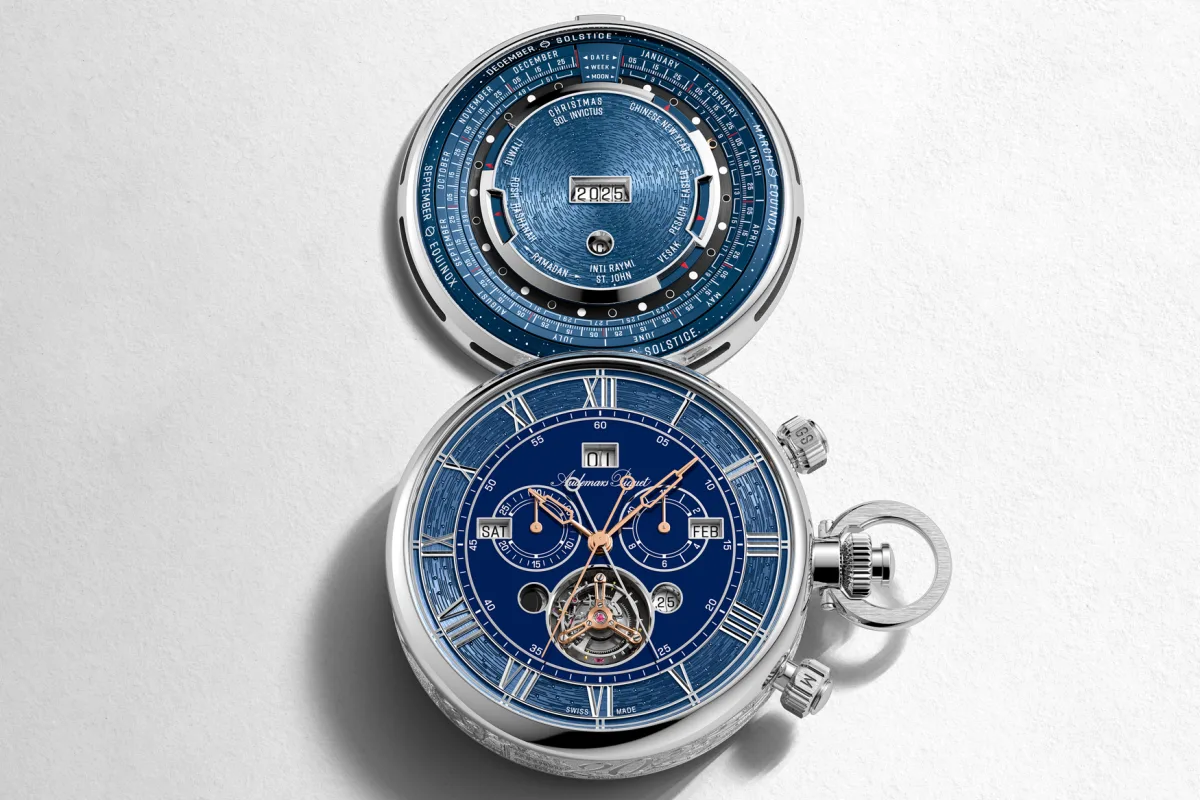
The central model of the month is the pocket watch 150e Héritage, a new ultra-complicated model, originally designed for pocket wear, not adapted from a wristwatch. At its core is the hand-wound calibre 1150, built on the calibre 1000 architecture and adapted for pocket watch ergonomics and management. The mechanism has 47 functions (including 30 complications and 17 technical devices), among them - a grande and petite sonnerie supersonnerie, minute repeater, flying tourbillon, semi-Gregorian perpetual calendar, and split-seconds chronograph with flyback function.
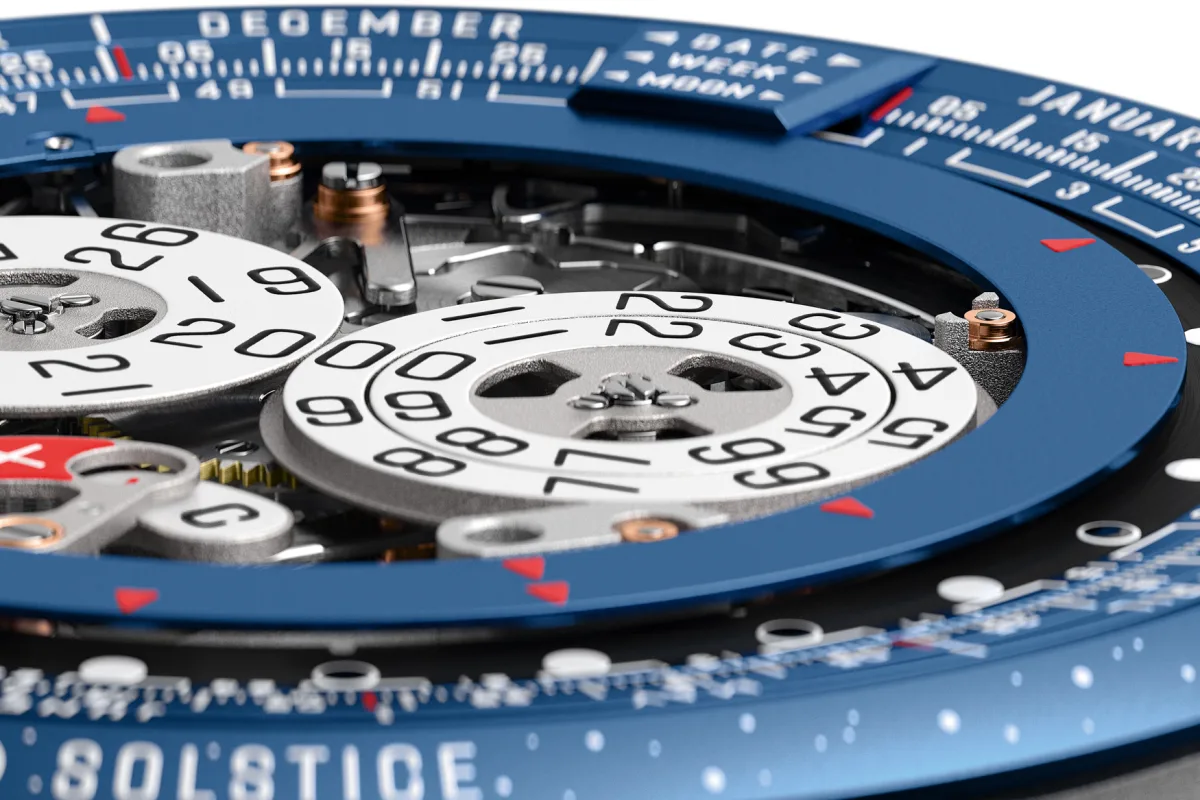
The novelty is the Universal Calendar, visible from the back cover and independent of the mechanism: a mechanical 'calculator' displaying solar, lunar, and lunisolar cycles in a panoramic format, including nine cultural holidays. The calendar is regulated by a bidirectional wheel and synchronized for the period from 1900 to 2099. Made using métiers d’art: platinum case with hand engraving, blue translucent grand feu enamel dial, and hand-crafted platinum chain. Two unique platinum pieces were produced.
Royal Oak Mini (23 mm Quartz): Black Onyx and Mother-of-Pearl

From the most complex to the simplest... The Royal Oak Mini line expands with two 23 mm quartz models where stone takes center stage, moving away from the matte gold finish of previous versions. The first is the most graphic: a mirror-polished black onyx dial in a case and bracelet of 18-carat rose gold, with diamond hour markers creating contrast that the stone itself does not provide. The second features an extra white mother-of-pearl dial in a case and bracelet of 18-carat yellow gold. AP positions this model as a return to the classic jewelry language of the Royal Oak, but with a brighter and iridescent dial personality.

Both models are equipped with the quartz calibre 2730, with the brand emphasizing durability (94 months of battery life) and power-off function when not in use. The cases retain the characteristic alternation of satin and polished Royal Oak surfaces, which is important since the dial here is essentially a slice of precious stone, and the case finish becomes the 'texture' of the design.
Royal Oak Selfwinding in Yellow Gold with Malachite Dials (37 mm and 41 mm)
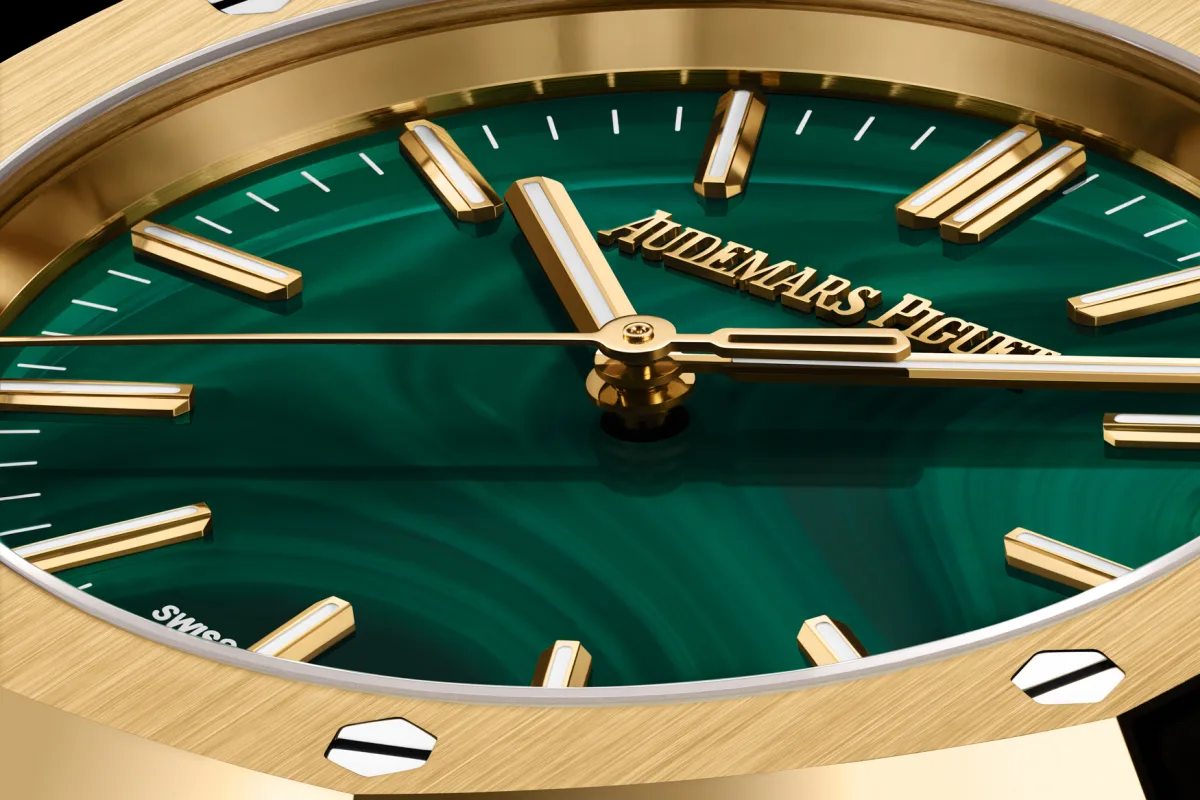
Audemars Piguet continues the theme of solid stone dials with two Royal Oak Selfwinding models in 18-carat yellow gold, available in 37 and 41 mm sizes with polished malachite dials. The appeal of malachite lies in the material itself: the striped pattern is formed during crystallization, and the shade of green depends on the copper content, so no two pieces will be identical when illuminated. The dials are complemented by applied yellow gold hour markers and luminescent Royal Oak hands, so the stone does not appear merely decorative.

Mechanically, AP remains straightforward: the 37 mm is equipped with automatic calibre 5909 with a 60-hour power reserve, and the 41 mm with automatic calibre 4309 with a 70-hour reserve. Both models have 50 m water resistance, emphasizing that these are not 'fragile' novelties with stone dials, but fully-fledged Royal Oaks for everyday wear.
Code 11.59 by Audemars Piguet Selfwinding 38 mm
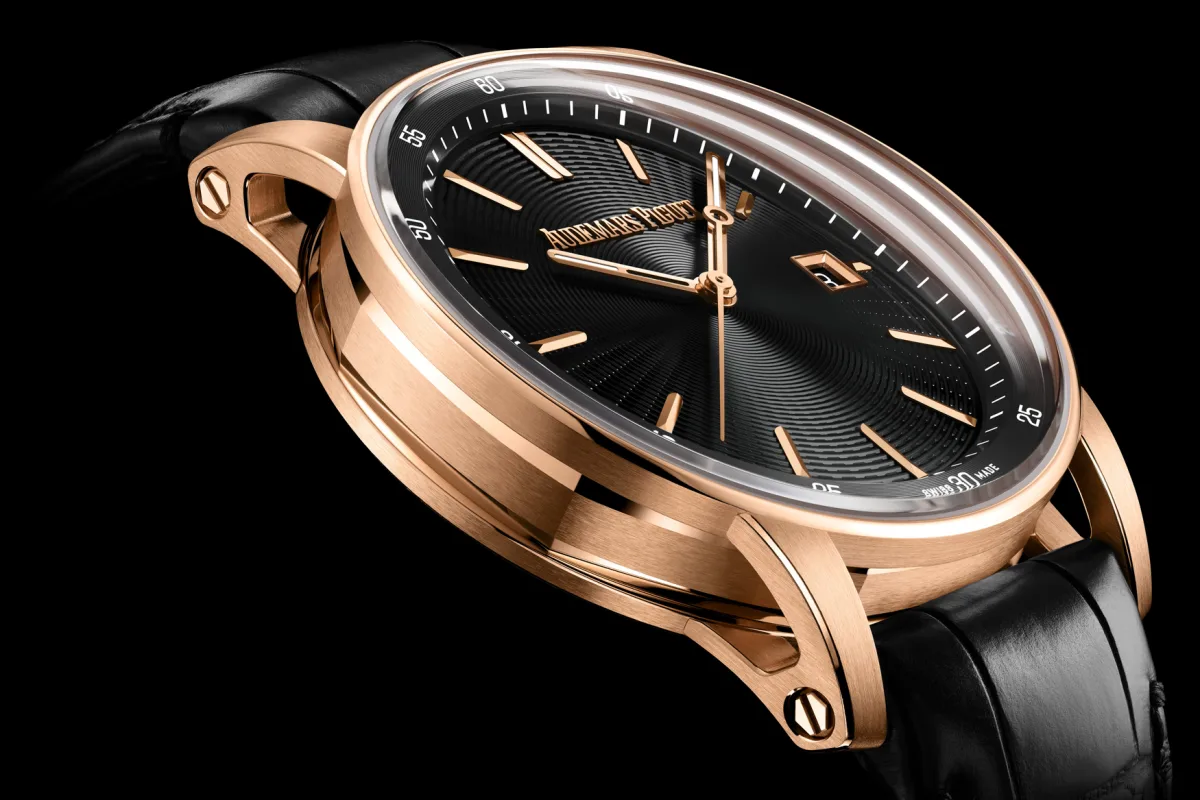
The Code 11.59 collection is expanded with two new Selfwinding 38 mm versions in 18-carat rose gold, focusing on the contrast between the dial and strap rather than mechanical innovations. One model is entirely dark with a black dial, inner bezel, and black alligator strap, while the other is lighter, with a silver dial and inner bezel, complemented by a new brown calfskin strap with white stitching.

Both use the 38 mm case introduced in 2023, with a distinctive dial texture - concentric 'waves', rose gold applied elements, and luminescent hands for reading ease. The mechanism is the automatic calibre 5900 with a 60-hour power reserve and a 4 Hz frequency, visible through the sapphire case back with a 22-carat rose gold rotor. Case thickness is 9.6 mm, water resistance is 30 m.
Code 11.59 Selfwinding Flying Tourbillon 41: Ivory 'Signature' Dial

This model is more about dial finishing mastery and contrasts rather than new mechanical solutions. The 41 mm case combines the bezel, lugs, and back cover in 18-carat white gold with a black ceramic middle case. The dial is in an ivory shade with the collection's 'signature' pattern - concentric circles, engraved by hand and enhanced by PVD coating, created in collaboration with guilloché master Yann von Känel. The effect is subtle - depth and shimmer, not color saturation, framed by an ivory inner bezel and a darker outer edge, echoing the ceramic middle case.

Inside is the automatic calibre 2950 with a 65-hour power reserve and a 3 Hz frequency, with a flying tourbillon at 6 o'clock, visible from the front and through the sapphire case back. Rose gold hands and hour markers emphasize the warmth of the ivory dial, while the black alligator strap adds restraint to the image.
Royal Oak Offshore Diver 42 mm: Three New Color Accents

Audemars Piguet updates the Offshore Diver 42 mm model (2021 platform) with three vibrant color options, all in stainless steel with two black ceramic crowns and 300 m water resistance. Basic characteristics are retained: Méga Tapisserie dial and quick-change strap system with rubber straps.

Two models keep the black dial and use the luminescent 0-15 minute zone for color accents: one with pink elements and a white strap, the other with turquoise accents and a turquoise strap. The third version has a deep turquoise Méga Tapisserie dial, a white luminescent 0-15 minute zone, and a turquoise strap, creating a more serious mood but still associated with summer thanks to the bright contrast around the diving scale. All three models have a date window at 3 o'clock. The mechanism is the automatic calibre 4308 with a 60-hour power reserve and a 4 Hz frequency, focusing on reliability rather than complications.
Royal Oak Offshore Selfwinding Chronograph 43 mm: Two New 'Creative Designs'

Finally, two new versions of the 43 mm Offshore chronographs, using material contrast as the main design technique, both on calibre 4401 - an integrated flyback chronograph introduced to the collection in 2021. The first model is entirely in 'Bleu Nuit, Nuage 50' ceramic with titanium details and protective elements, a beige Méga Tapisserie dial with ceramic counters of the same shade, creating a 'sand and deep water' contrast. The strap is textured calfskin of the same dark blue color, interchangeable.

The second version is more technical: a titanium case with a black ceramic bezel, buttons, and crown, a smoked green PVD Méga Tapisserie dial, black counters, and beige zones for improved readability. The strap is an interchangeable rubber in gray-green color, highlighting the utilitarian style. Both models are water-resistant to 100 m, thickness is 14.4 mm, the black rotor is visible through the sapphire back. AP emphasizes that the processing of ceramic and titanium meets the level of precious metal finish.
Concluding Remarks
Audemars Piguet's new releases for the first half of 2026 demonstrate the brand's 'two-track' approach: on one hand, focusing on material identity and color palette on the surface, on the other - improving the convenience and functionality of complex watches. Universal crown correction systems, improved readability, and mechanisms visible through sapphire case backs make complicated models more accessible for daily use. This is not a singular high-profile launch, but a series of thoughtful steps across the catalog - from elegant 23 mm quartz models to ultra-complex pocket watches.
This review of Audemars Piguet's 2026 new releases reveals key trends and technical innovations of the brand, enabling experts and collectors to better understand the strategy and direction of one of the leading watchmaking houses.