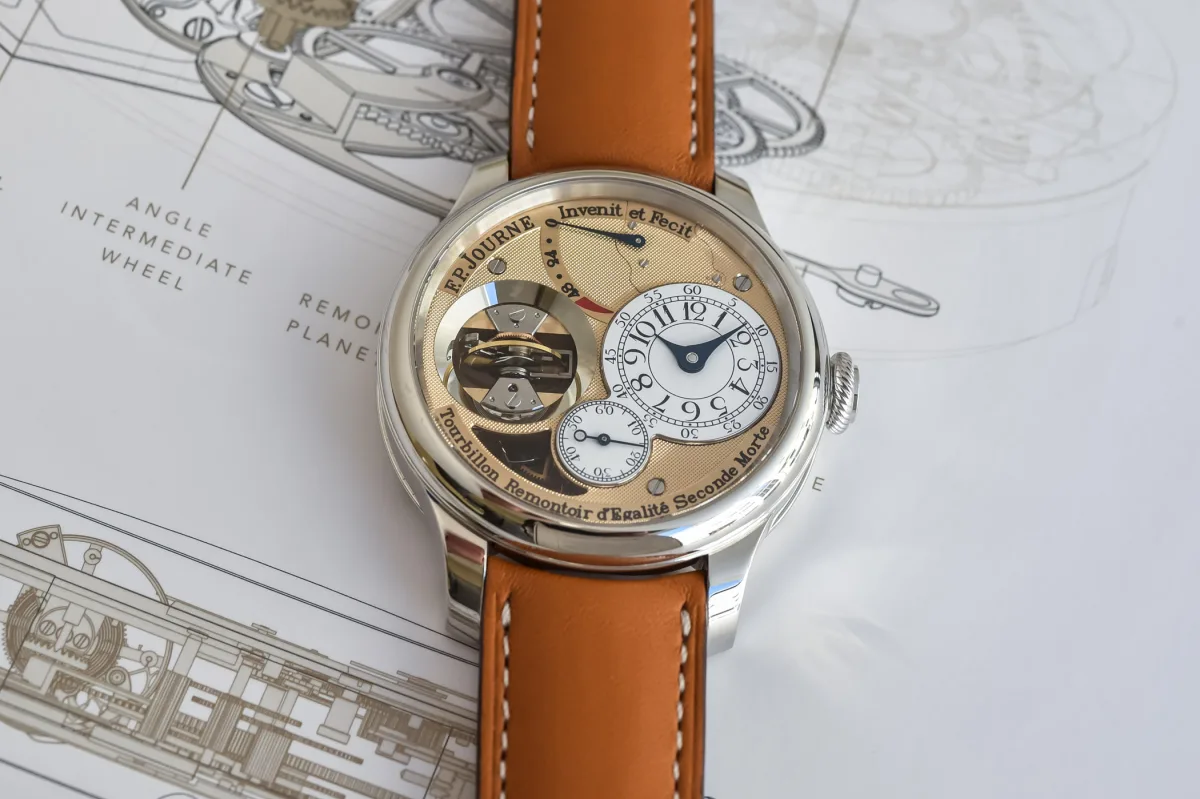
François-Paul Journe is undoubtedly one of the most influential independent watchmakers of our time. Known for his strong character and inventiveness, he is recognized among his peers (as a member of AHCI) and the collector community. The Frenchman is also known for his passion for everything related to chronometry and traditional watchmaking techniques, having spent much time studying the works of Janvier, Breguet, or Daniels. It's no surprise that Journe's earliest watches were clearly focused on chronometric results and equipped with a tourbillon. Continuing this path towards precision, F. P. Journe recently released a new, quite unexpected version of his signature combination of constant force and anti-gravity - the impressive Tourbillon Souverain Vertical watch.
Tourbillon, Signature Watch of F. P. Journe
After graduating in 1976, François-Paul Journe worked for several years with his uncle Michel on the restoration of extremely complex and historically significant pocket watches, including Sir Cecil Clutton's watch, both A.L. Breguet and George Daniels' pocket watch tourbillons. He also worked on the restoration of Breguet No. 3177, created based on the resonance concept and now housed in the Paris museum Arts et Métiers, which may have inspired the creation of the F.P. Journe Resonance wristwatch.
But beyond this work with his uncle, Journe quickly showed a desire to "invent and create" (Invenit et Fecit) on his own, and so from 1978, he began creating his own pocket watches. By January 1983, at the age of 25, François-Paul Journe completed his first homemade watch and movement. These pocket watches were already equipped with a tourbillon regulator, a dual-barrel architecture, and a detent escapement. In 1985, Journe opened his own workshop and began creating movements and pocket watches that demanding clients ordered at the time. However, up to that point, Journe had only produced chronometers meant to be worn in a pocket or displayed on a table. Only in 1991 did the first F.P. Journe wristwatches see the light of day.
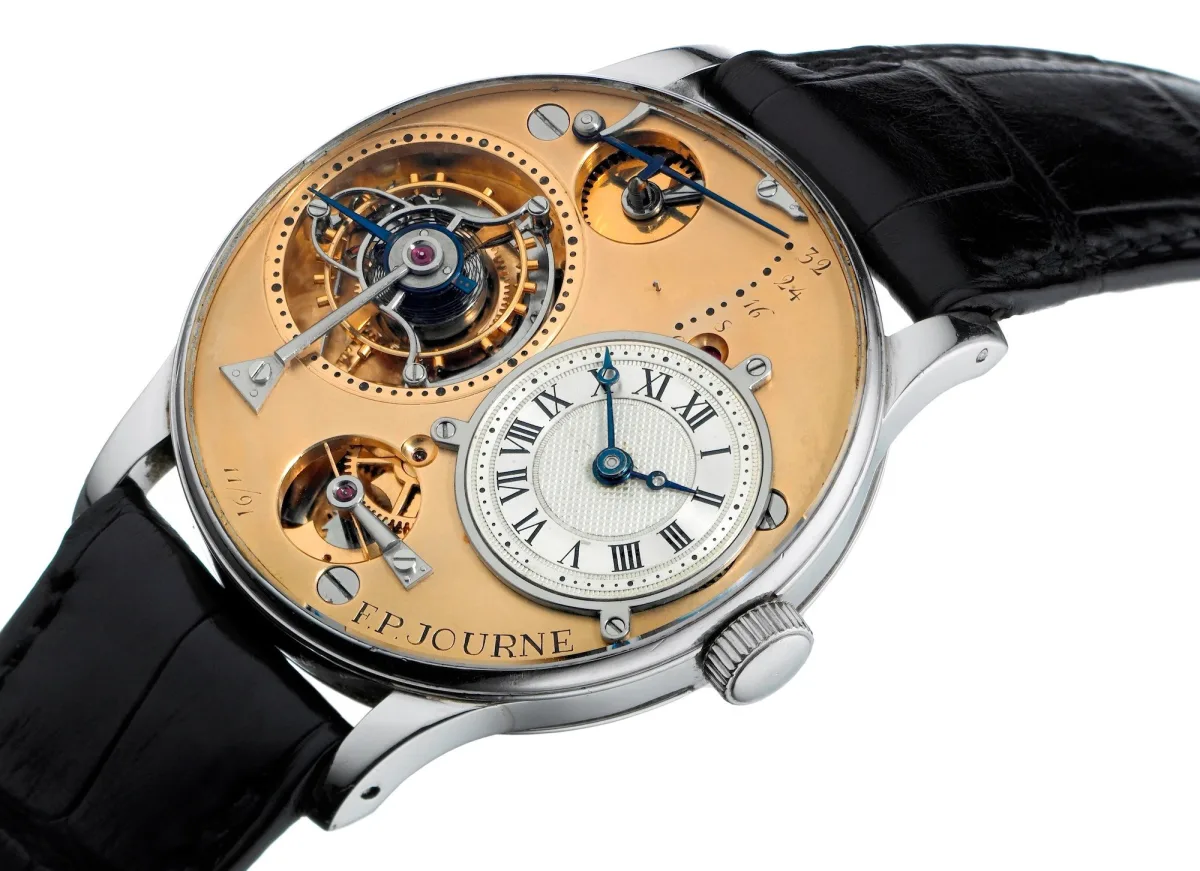
As expected, François-Paul Journe's very first wristwatches were equipped with a tourbillon regulator, but also featured another rare complication that would become a signature element in many of his future watches - a constant force device called remontoir d’égalité. These watches, completed in 1991 and numbered on the dial with 11/91, would form the foundation of everything the F.P. Journe brand represents today in terms of design, execution, and collection. These watches, which later gave rise to the Tourbillon Souverain, are foundational in the relatively short history of the brand. The watches were presented at the AHCI booth at Baselworld that same year and were extremely well received by the watch community. Importantly, for the first time, this constant force mechanism was integrated into a wristwatch, once again demonstrating the young F.P. Journe's interest in complex and historical chronometric solutions.
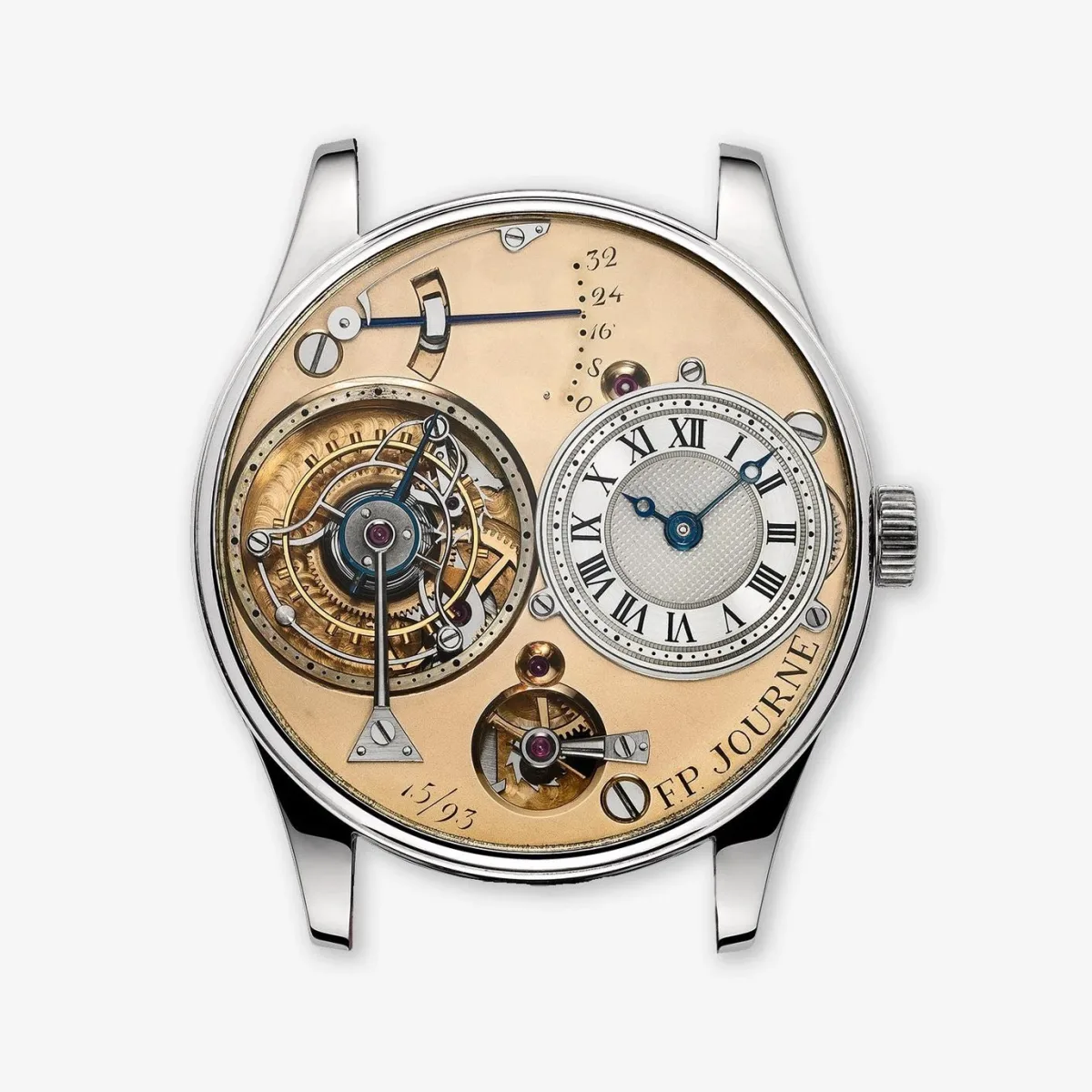
The F.P. Journe Tourbillon prototype already featured many design and construction elements that would later define most of the brand's watches. The watch was made of platinum, with a simple, clean, and deliberately understated case, so the main focus was on the mechanism, complications, and display. The entirely handmade movement was already made of pure gold. The dial, in the strict sense, covering the mechanism, was absent. Instead, the watch featured apertures for the tourbillon and remontoir d’égalité, as well as an off-center dial for the hours and minutes on the right side. As Osama Sendi (The Journe Guy) explained in an interview with A Collected Man, this dial "was designed so he could discreetly glance at the time, allowing the watch to slightly protrude from under the cuff, and thus not appear impolite by checking the watch in the company of others."
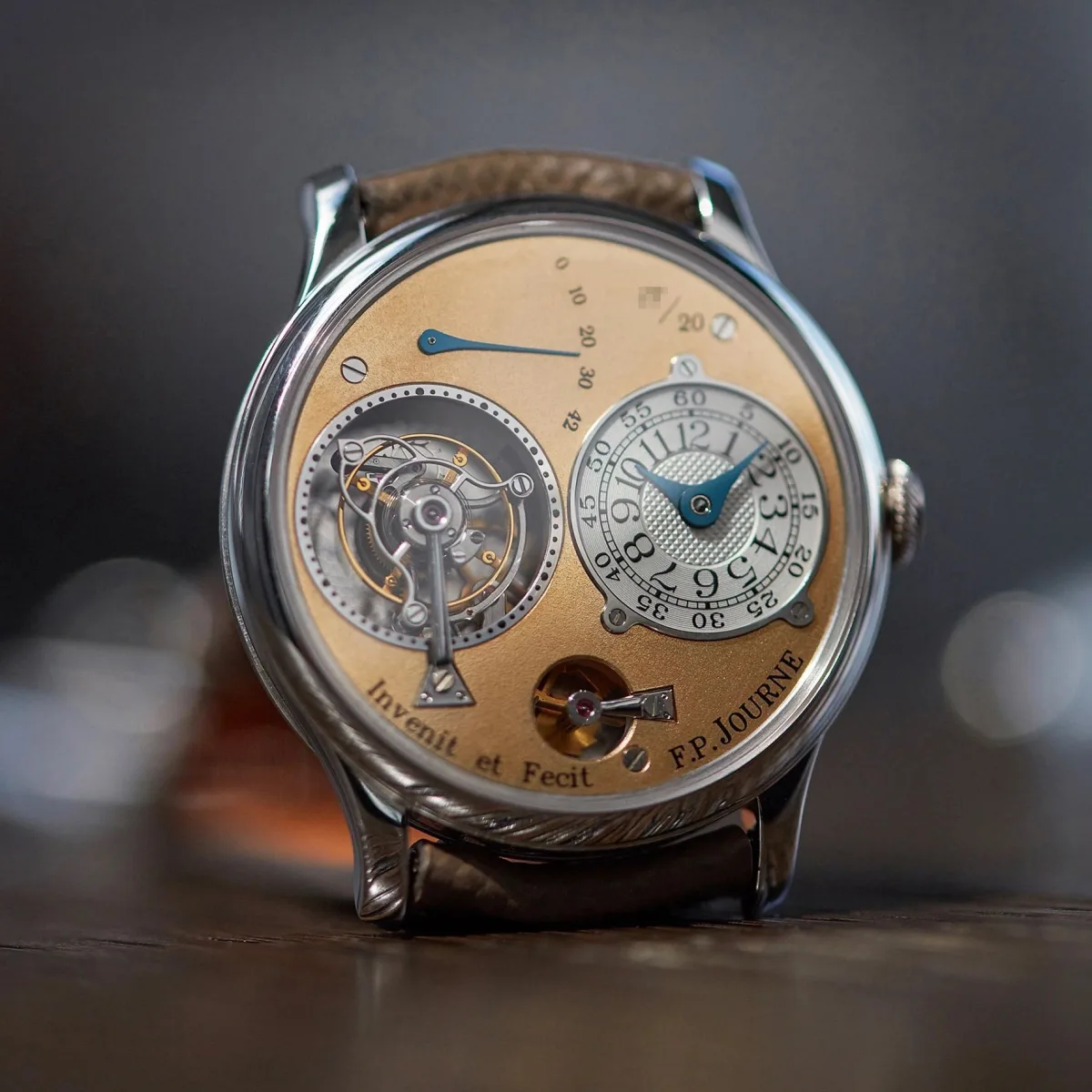
Three prototypes of these tourbillon watches were made - the last of which is visible above and numbered 15/93 - until F.P. Journe decided to create his eponymous brand and a series of watches that would be known as the Souscription Tourbillon. Then, as it is today, creating an independent watch brand and workshop was no easy task. Thus arose the idea of a subscription model to attract more potential clients. Early subscribers received a discount on the future retail price in exchange for their patience. This allowed François-Paul Journe to cover his expenses and produce more watches to later sell at the regular price. The subscription campaign began in 1998, and the first 20 Souscription Tourbillon watches were delivered during 1999.
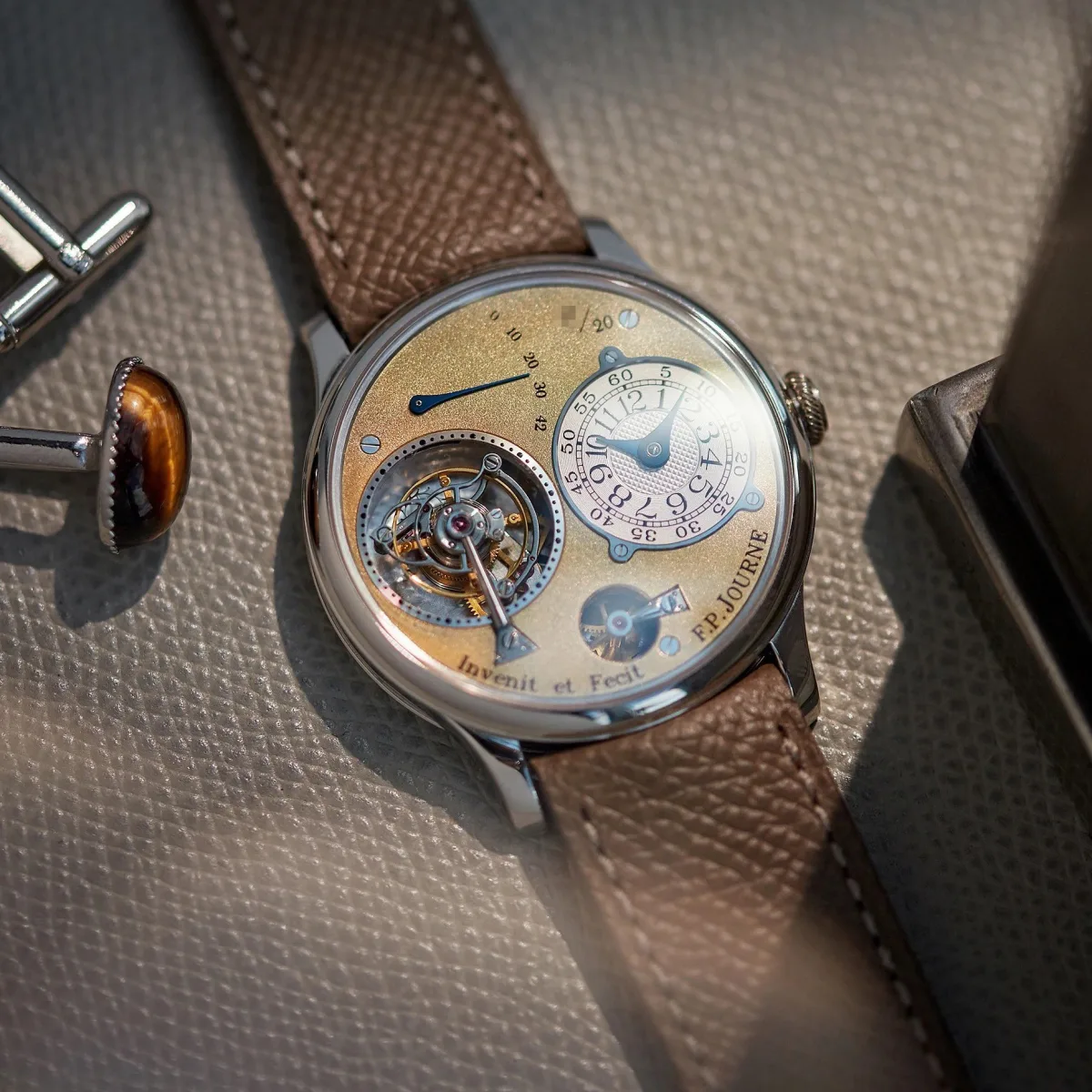
These early watches were very close in style and concept to the first series-produced Tourbillon Souverain - the first generation, from 1999 to 2003. They had the same layout as the prototypes: tourbillon on the left, more refined power reserve at the top, and off-center dial at the "3 o'clock" position. However, the movements were made of rhodium-plated brass and housed in a 38mm platinum case. Following these early subscription models, the classic Tourbillon Souverain, in rhodium-plated or solid gold, in cases of various sizes, later with the Natural Dead Seconds function (from 2003 to 2019), becomes a cornerstone of the brand's collection. Until 2019, in honor of the watch's 20th anniversary, F.P. Journe decided to radically update his signature tourbillon watch, introducing the Tourbillon Souverain Vertical model, which we will now examine.
F. P. Journe Tourbillon Souverain Vertical
After 20 years of numerous iterations of the Tourbillon Souverain wristwatch, which to some extent displayed the same design (purists and fans of the brand will kill me for this, but yes, all these watches were more or less based on the same concept), F.P. Journe decided it was time for his signature tourbillon with remontoir d’égalité to adopt a new design, a new layout, a new architecture, and essentially a completely new mechanism... plus something quite original when it comes to the positioning of the tourbillon itself. Indeed, as the name suggests, the anti-gravity system is now positioned vertically in the watch, which is obviously not often seen in watchmaking. But more on that later.
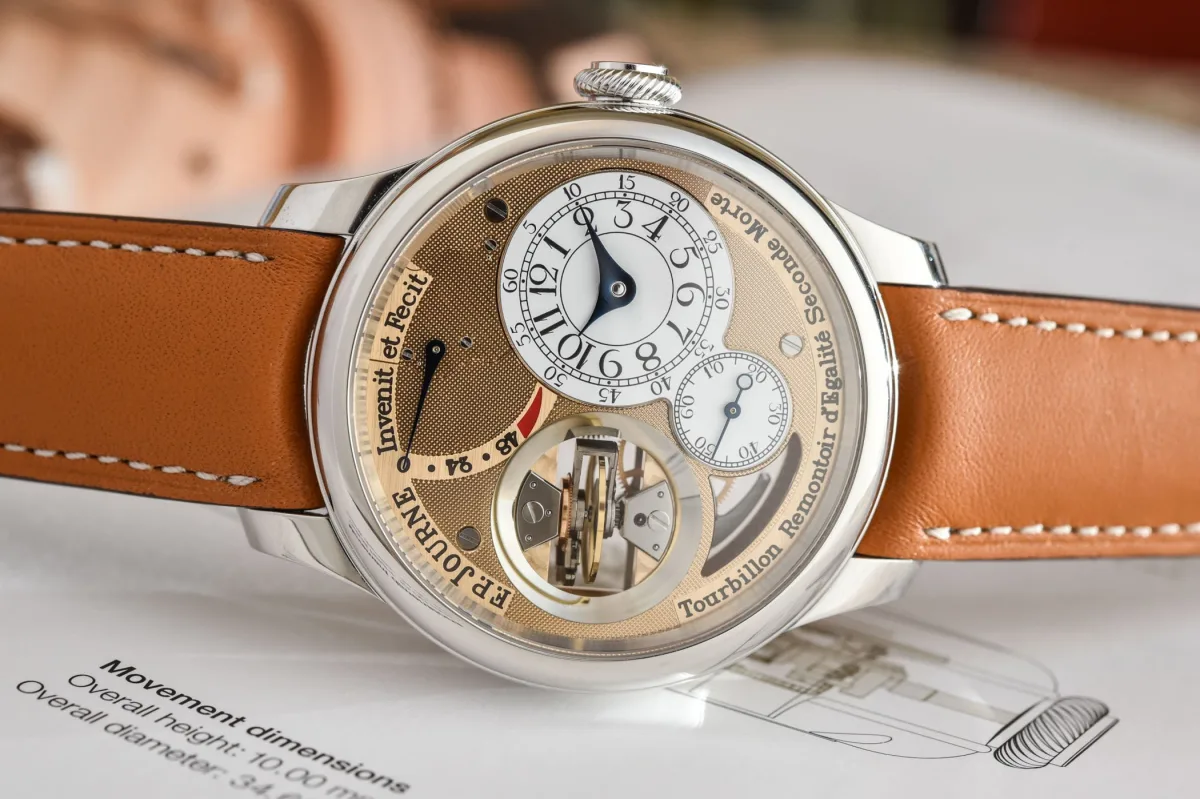
This new take on the Tourbillon Souverain is simultaneously different from others, with bold execution and dimensions, and yet feels completely familiar. There is something undeniably Journe about this watch, something that echoes the style of the earliest tourbillon and subscription watches, a certain roughness and prototype-like feel in the dial and its execution, as if this watch is still experimental. And this was undoubtedly intentional.
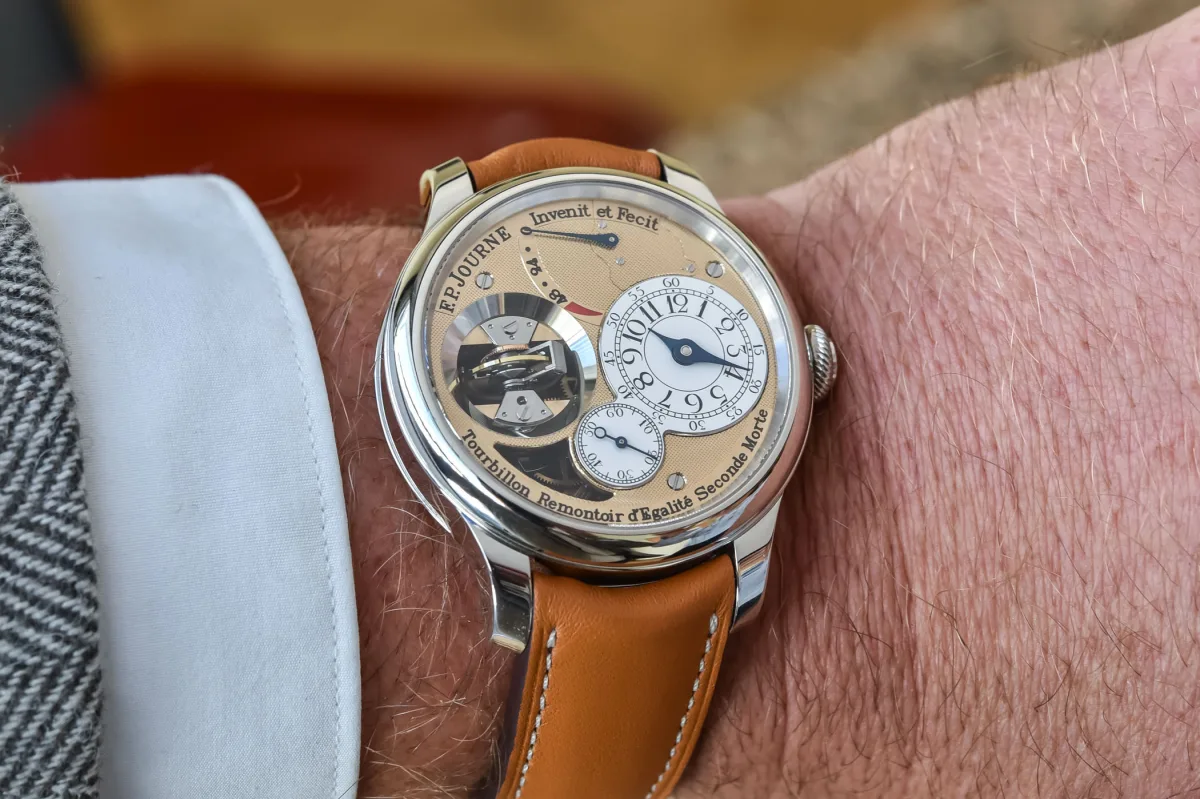
The F. P. Journe Tourbillon Souverain Vertical watch, when it comes to case design, is unsurprising. The case, made of 18-carat red gold or 950 platinum, as presented here, is fully consistent with the rest of the brand's products regarding its shape. A domed bezel, large dial opening, strong lugs, fully polished finish, and flat crown - all are classic for FPJ. What is less traditional is the size of these tourbillon watches: 42mm in diameter and 13.60mm in height - this is explained by the very architecture of the mechanism, but still surprising for a brand that often produces thin yet complicated watches. All previous Tourbillon Souverain models were in the under 10mm category.
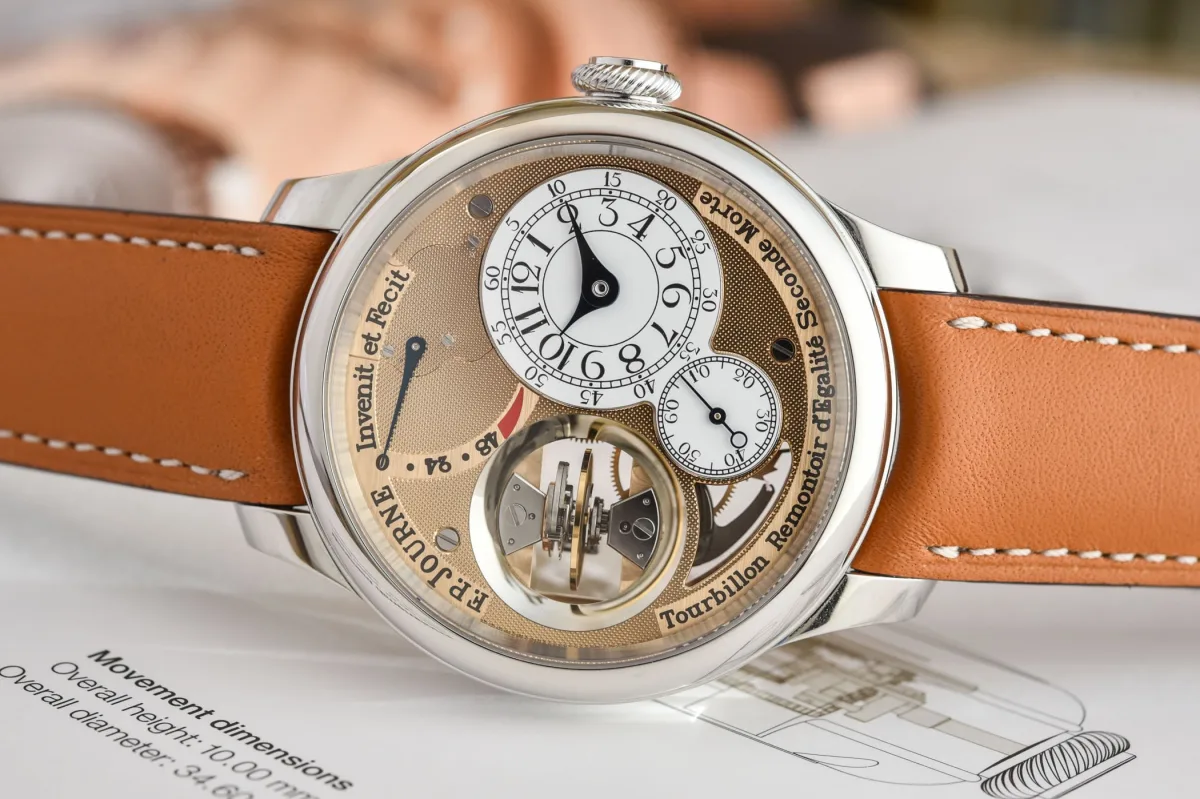
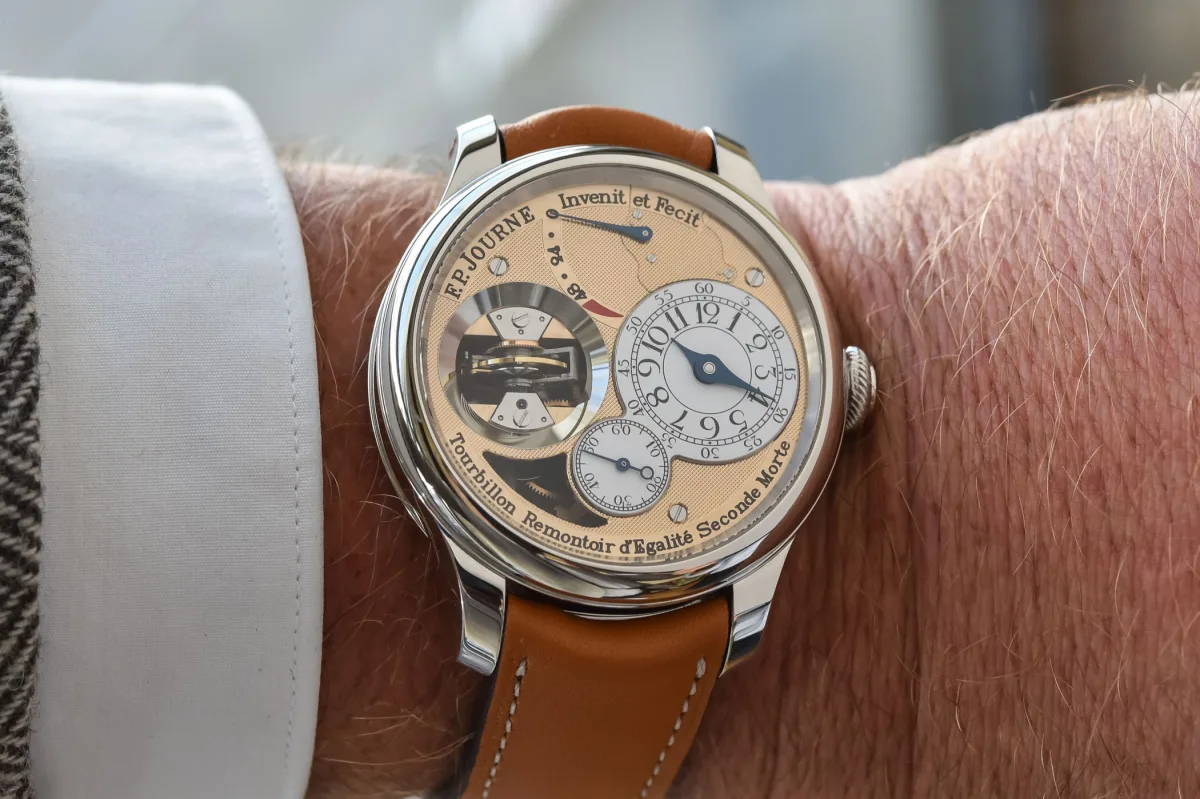
What clearly echoes the earliest models designed and made by François-Paul Journe is the dial and the way it is made and finished. Like the Souscription models and prototypes, this Tourbillon Souverain Vertical model does not have a dial in the classic sense of the word, but instead reveals its mechanism as a foundation for the display. Indeed, the visible gold background, finished with a Clous de Paris guilloché pattern, is the base of the mechanism - and naturally, it is made of pure 18-carat pink gold. The screws are obvious, as are the connections between the various bridges. But this technical base is a canvas for the typical Journe display. Tourbillon at "9 o'clock", power reserve at the top, offset dial for hours and minutes at "3 o'clock", and dead seconds at "6 o'clock"... All characteristic of Tourbillon Souverain watches.
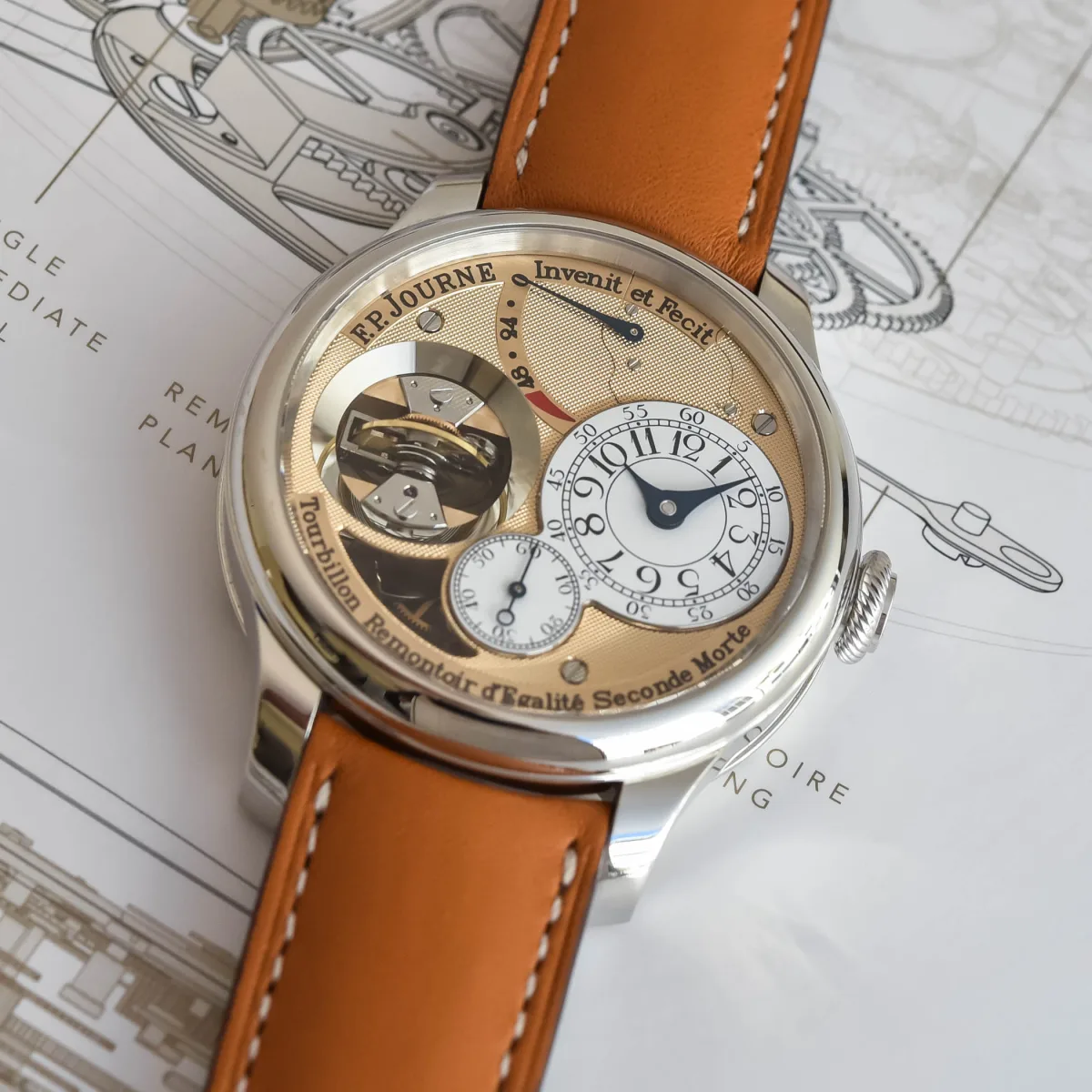
If this design has possibly lost some of the classical elegance of previous versions, the watch is nonetheless very well crafted and has retained most of the distinctive elements that made F.P. Journe watches recognizable and unique. However, with some changes. The classic blued steel hands now indicate time on massive white gold dials, which are enamelled white for the first time. Additionally, the power reserve layout has been changed. And finally, there is a massive, angled aperture to accommodate the unusual vertical tourbillon. Knowing that this arrangement would reduce focus on the regulating organ, the brand decided to create a focal point using a conical ring with mirror polishing, which concentrates light by reflecting the tourbillon cage. A point of attraction for placing a device designed to counteract gravity... I found a certain irony in this design, which cannot help but remind me of the spirit of its creator.
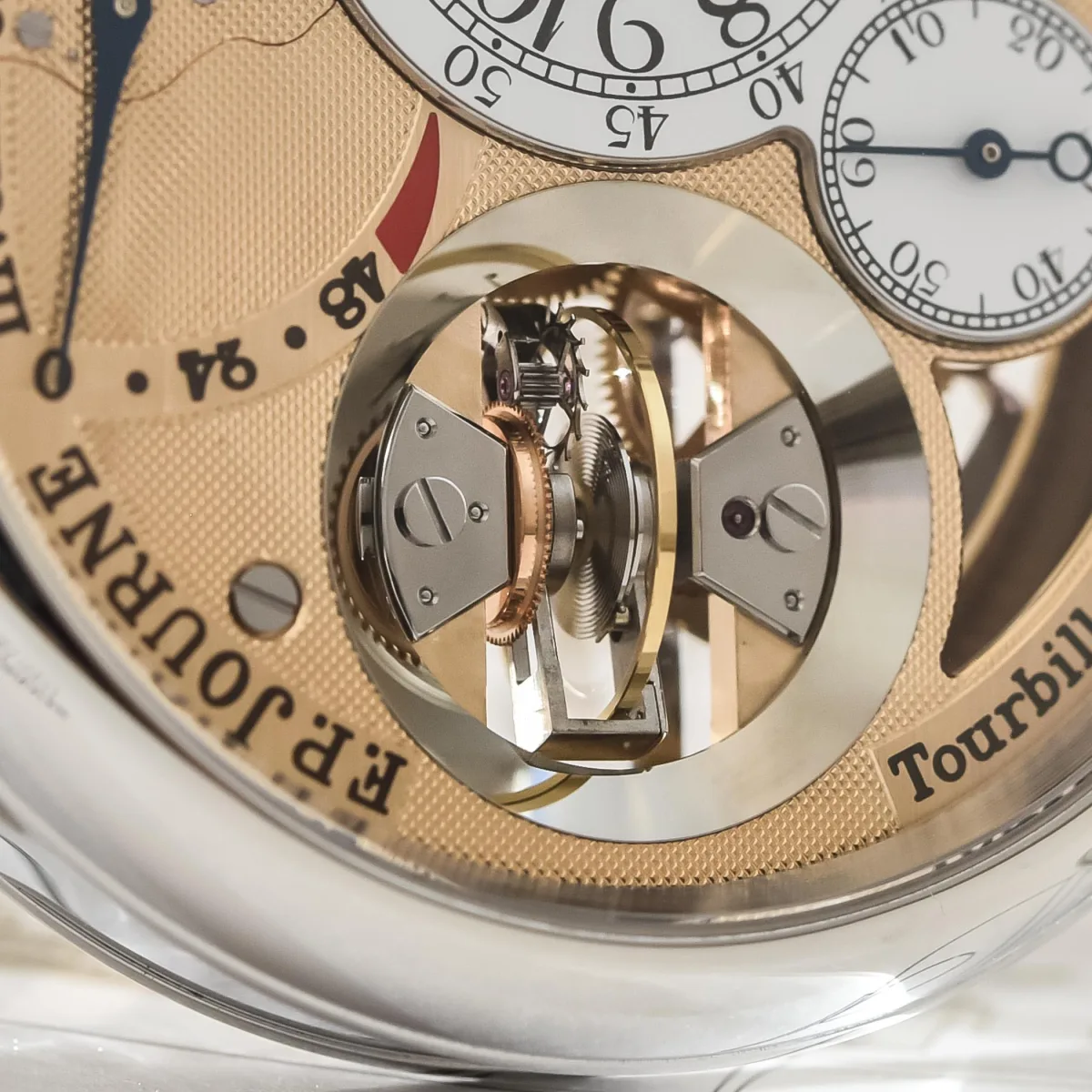
Now on to the "pièce de résistance" - the vertically mounted tourbillon. Why this design? According to the watch's creator, "I designed this vertical tourbillon so that the functions of the tourbillon remain unchanged whether the watch is lying horizontally or on a strap, and the amplitude is the same, regardless of whether a deployant or ardillon clasp is used." The very idea of a tourbillon is that the regulating organ constantly changes its position, countering the action of gravity. In pocket watches, the flat position of the cage was due to how the instrument was worn, whereas wristwatches are most often in a flat position - on the wrist or on a table. The idea of such a vertical position comes from this observation and ensures that the instrument plays its role. Importantly, this tourbillon makes one rotation every 30 seconds, which is faster than the usual one-minute time.
But the Tourbillon Souverain Vertical is not just about the regulating organ. Traditionally for Journe, it is equipped with a system aimed at equalizing the force reaching the escapement - a constant force device named remontoir d’égalité. First invented in the 15th century by watchmaker Jost Bürgi, the constant force device was forgotten after Christian Huygens invented the balance spring and pendulum, which gave watch mechanisms an unprecedented degree of time-measuring accuracy. Nevertheless, in the 18th century and with the growing need for ultra-precise clocks for astronomical observations and longitude calculations, the constant force device returned with watchmakers Thomas Mudge and Robert Robin. Although its use in watches remained relevant, throughout most of the existence of wristwatches, the constant force device remained unheard of until F.P. Journe brought it back in his tourbillon watches - an industry first.
The constant force device used by F.P. Journe has remained unchanged for several years - remontoir d’égalité. While the power from the mainspring gradually decreases as it unwinds, affecting the accuracy of the regulating organ due to less torque (lower amplitude), the remontoir d’égalité smooths the torque transmission by adding a spiral spring attached to the gear train, which is periodically loaded and unloaded to transmit (theoretically) the same torque to the escapement. In the Tourbillon Souverain Vertical watch, the remontoir is rewound once per second and thus performs the function of a natural dead second, which is displayed on an additional dial at "6 o'clock". Being mounted on one of the wheels of the constant force device, this dead second cannot in any way affect the accuracy of the watch's movement.
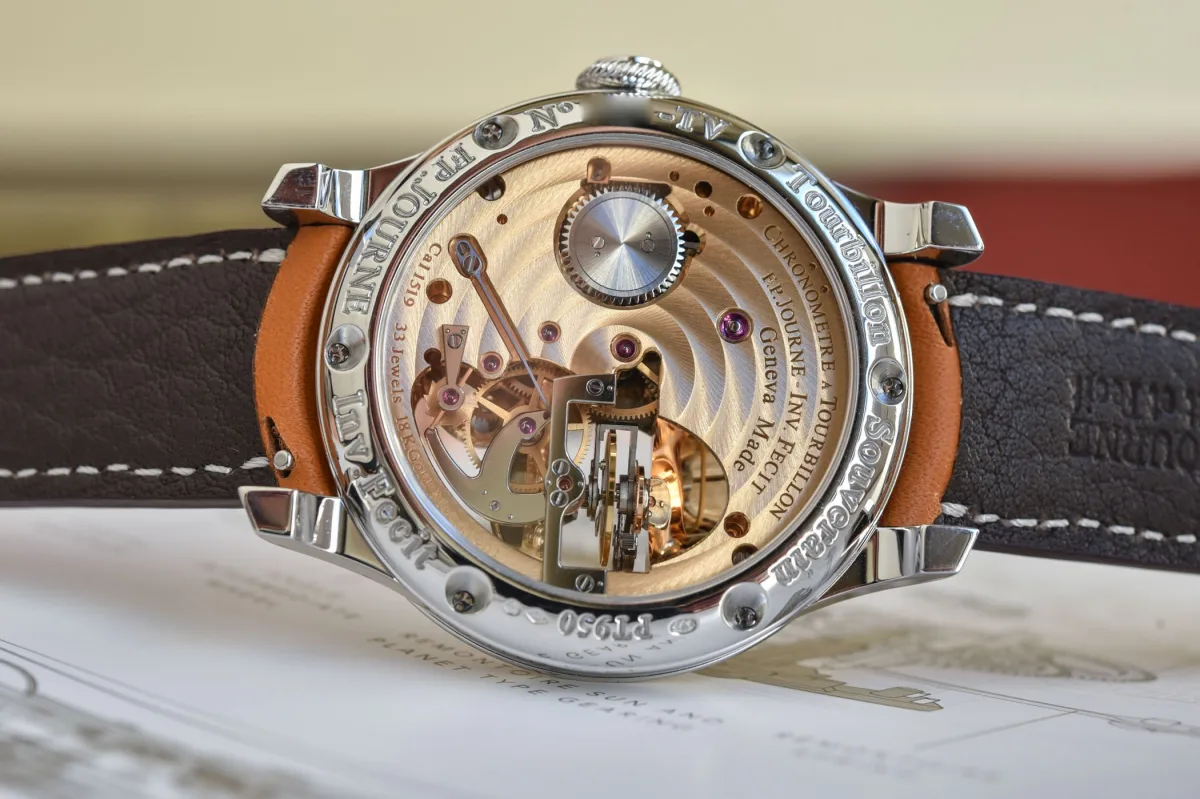
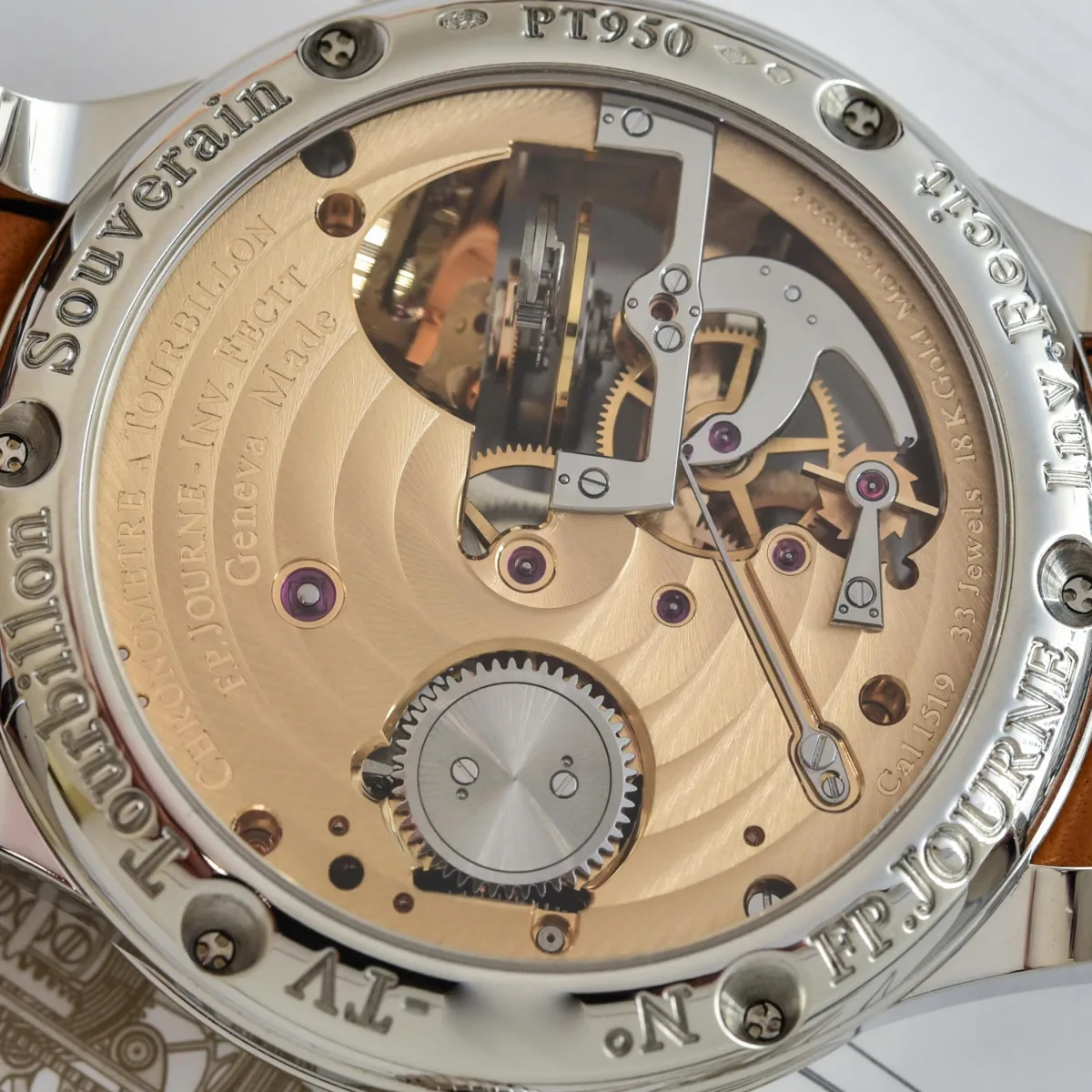
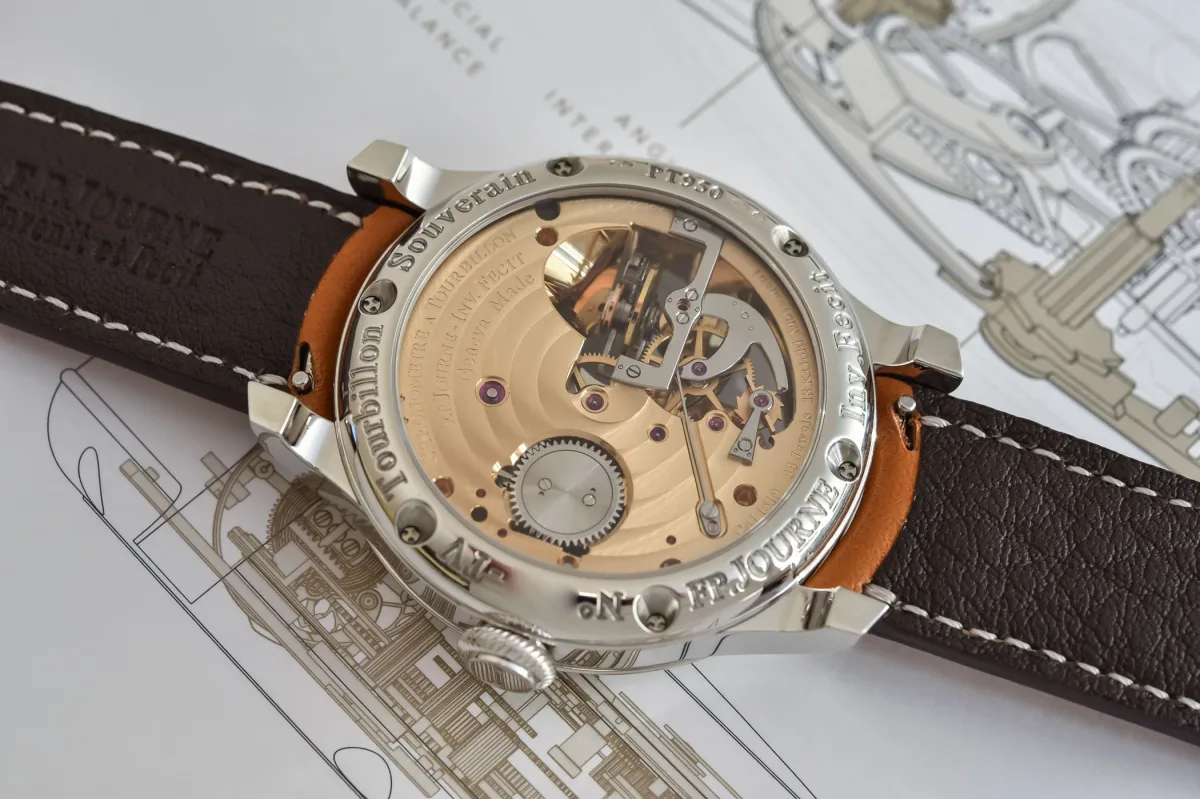
The rest of the mechanism is just as impressive and beautifully finished. The in-house F.P. Journe Caliber 1519, naturally, has plates and bridges made of pure 18-carat pink gold, finely decorated with circular Geneva stripes, polished chamfers, polished and beveled screw heads, black-polished steel parts, and perlage. An interesting element, the vertical tourbillon is also equipped with a second reflector, created on the movement side to provide lighting around the tourbillon cage, as well as for a better view of its motion. The manually-wound movement is equipped with a balance with a free-sprung balance spring with 4 inertia weights, beating at a frequency of 3 Hz, a flat Anachron balance spring with a Philips overcoil, and its main spring can maintain a power reserve of up to 80 hours.
Thoughts
By applying innovations in the new tourbillon architecture while at the same time implementing well-known solutions such as the constant force remontoir d’égalité with natural dead seconds, as well as a layout that remains true to the roots of tourbillon wristwatches, F.P. Journe demonstrates an evolution that seems both natural and bold. These are not the mature watches you expected to see; this is rather a rethinking of the concept, without denying its origins. What surprises me the most is the combination of classic design elements and a certain prototype feel, which arises from the lack of a conventional dial, as well as more polarizing characteristics - the relatively large size and tourbillon placed in a "cone of light". Clearly, F.P. Journe did not play for consensus here, but the result is undoubtedly stunning - both visually and technically.
Availability and Price
The F. P. Journe Tourbillon Souverain Vertical model replaced the classic Tourbillon Souverain watches in the permanent collection and is not limited in number - however, its production remains low. The watches are available in a case of 18-carat red gold or 950 platinum priced at 243,900 Swiss francs ~ $262,000 and 247,800 Swiss francs ~ $266,000 respectively.
More information can be found at www.fpjourne.com.
TECHNICAL SPECIFICATIONS – F. P. JOURNE TOURBILLON SOUVERAIN VERTICAL
Case: 42mm diameter x 13.60mm height – 950 platinum or 18k 6N red gold, polished – sapphire crystals front and back
Dial: No dial in the strict sense. Visible movement plate of 18k 4N gold with guilloché pattern, off-center hour/minute and subseconds dials – white enamel on white gold
Movement: In-house F.P. Journe Caliber 1519 – plates and bridges in 18k pink gold – manually-wound vertical tourbillon, automatic constant force tourbillon and dead seconds – 32 jewels – 34.60mm x 10mm – frequency 21,600 vibrations/hour or 3 Hz – power reserve 80 hours – flat Anachron balance spring with Philips overcoil – balance with free-sprung balance spring and 4 inertia weights – hours, minutes, small seconds, power reserve
Strap: Light brown calf leather strap with 950 platinum or 18k 6N red gold buckle
Price: 247,800 Swiss francs in platinum
243,900 Swiss francs in red gold