In the chronograph sphere, the watch industry in 1999 largely relied on calibers from external manufacturers.
Rolex, for instance, was still using a modified Zenith El Primero in the Daytona model, and Patek Philippe had not yet introduced its own chronograph (2005); the chronograph 5070 released by Patek in 1998 was based on the Lemania 2310 ébauche. Calibers like the Valjoux 7750, introduced in the early 1970s, were adopted by many brands, and few new chronograph movements appeared thereafter. Exceptions were the Frederic Piguet 1180 and 1185 calibers, introduced in 1987 and 1988, respectively. They were developed by Edmond Capt, the same person behind the creation of caliber 7750. Since 1996, Jaeger-LeCoultre has used caliber 829 in the limited Reverso Chronograph Retrograde series, but at that time, brands relied on third-party movements and ébauches to create chronographs.
Watch companies began investing in caliber development in the 1990s, aiming to create their own movements, including classic chronographs. However, tangible results only started appearing at the turn of the century. In 2000, Rolex released its own caliber 4130 for the Daytona model; that same year, Glashütte Original introduced PanoRetroGraph, and in 2004, Jaeger-LeCoultre unveiled the Master chronograph equipped with the JLC751 (in a modified form, it is still used today).
The History of the Datograph and Its Mechanism
The arrival of the A. Lange & Söhne Datograph in 1999, based on the flyback chronograph caliber L951.1, which was launched for general production and not as a limited series, marked an important chapter in watchmaking history. This small digression from the main topic seems appropriate given the historical context that highlights the significance of the Datograph. It marked the debut of the first new chronograph movement in the watch industry in many years. The Datograph became a masterpiece of its kind. This high-end, in-house developed chronograph, meticulously decorated, featured an enlarged date, a signature complication of the brand, and challenged traditional dial design.
The genesis of the Datograph began with discussions between the legendary Günter Blümlein, who, along with Walter Lange, revived A. Lange & Söhne in 1990, and Reinhard Meis, then the director of product development. Initially, they focused on the dial, resulting in an innovative concept of date placement and two sub-dials positioned at “4 o’clock” and “8 o’clock” in the form of an equilateral triangle.

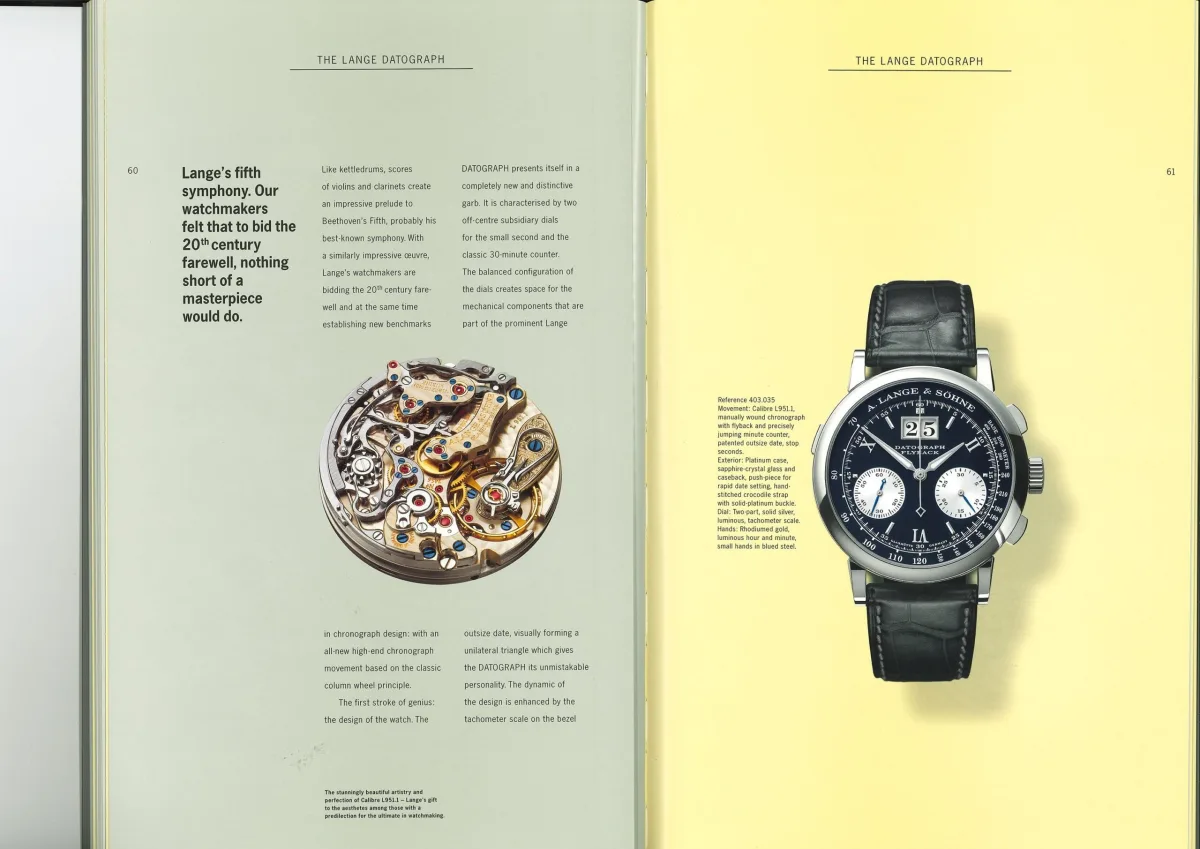
However, deviating from the traditional sub-dial placements at “3” and “9 o’clock” required a complete re-evaluation of the configuration of a traditional column-wheel chronograph with a lateral coupling. Annegret Fleischer, a movement designer who joined A. Lange & Söhne soon after the company's founding in 1990, was tasked with finding a solution for integrating the movements into the new dial layout. Collaborative work began in 1995, with ideas being exchanged between departments in a constant dialogue.
Four years later, A. Lange & Söhne created a surprisingly voluminous and aesthetically appealing movement consisting of 405 parts. It features a column wheel, lateral clutch, flyback chronograph, precisely jumping minute counter, and a large date function.
In addition to technical specifications, the movement was equally interesting visually. Drawing inspiration from historical pocket watch chronographs, it features the signature use of bridges and plates made of German silver, combined with polished steel components, screwed gold chatons, thermally blued screws, and a hand-engraved balance cock.

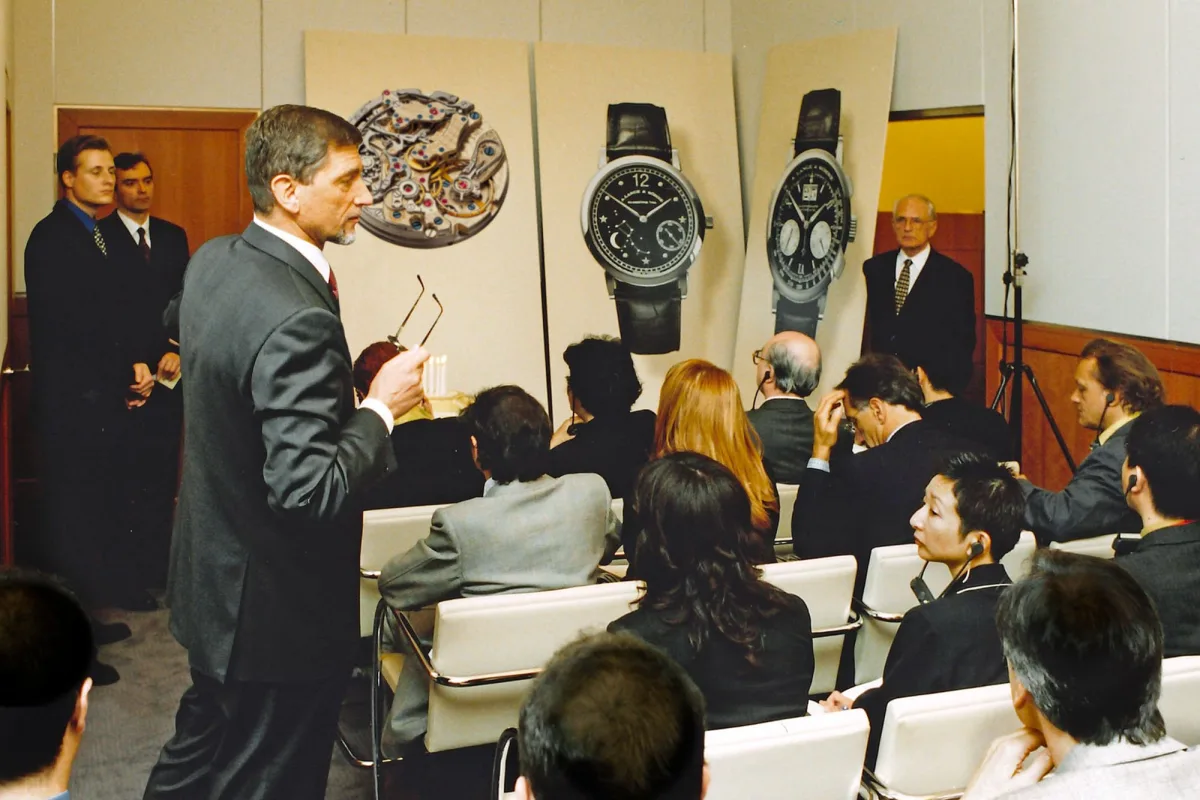
When the Datograph debuted at Baselworld in 1999, the company's booth showcased a large-scale model of the movement, inviting visitors to admire its intricacies and share their thoughts. Remarkably, it was the newly revived German brand, not a long-established Swiss company, that spearheaded the development of a new proprietary chronograph movement. The significance of this achievement did not go unnoticed by any brand or industry representative.
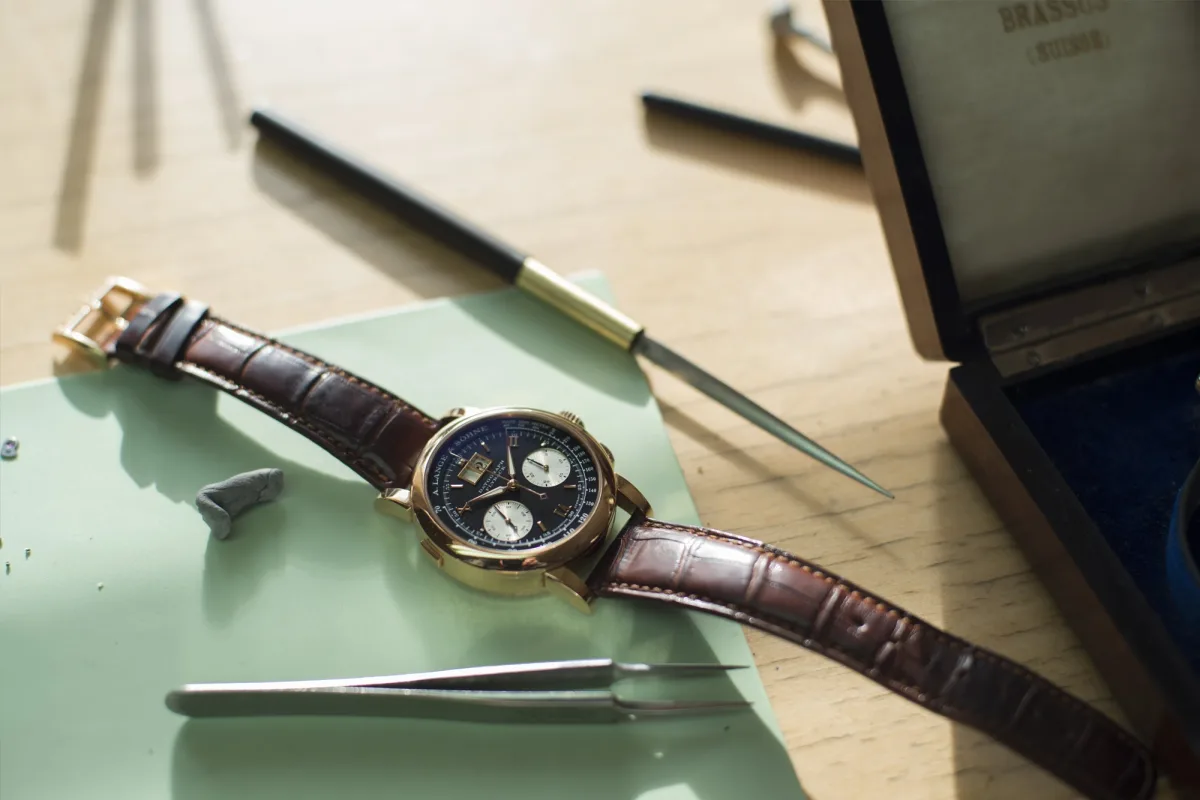
Philippe Dufour, a watchmaker renowned for his attention to movement aesthetics, highly appreciated the Datograph. Not only did he speak fondly of these watches on several occasions, but he also acquired them for himself. This act led to one of the Datograph references being unofficially dubbed the Dufourgraph - allowing us to briefly review some variations released from 1999 to 2012, starting with the original model Ref. 403.035.
First Generation Datograph (1999-2012)
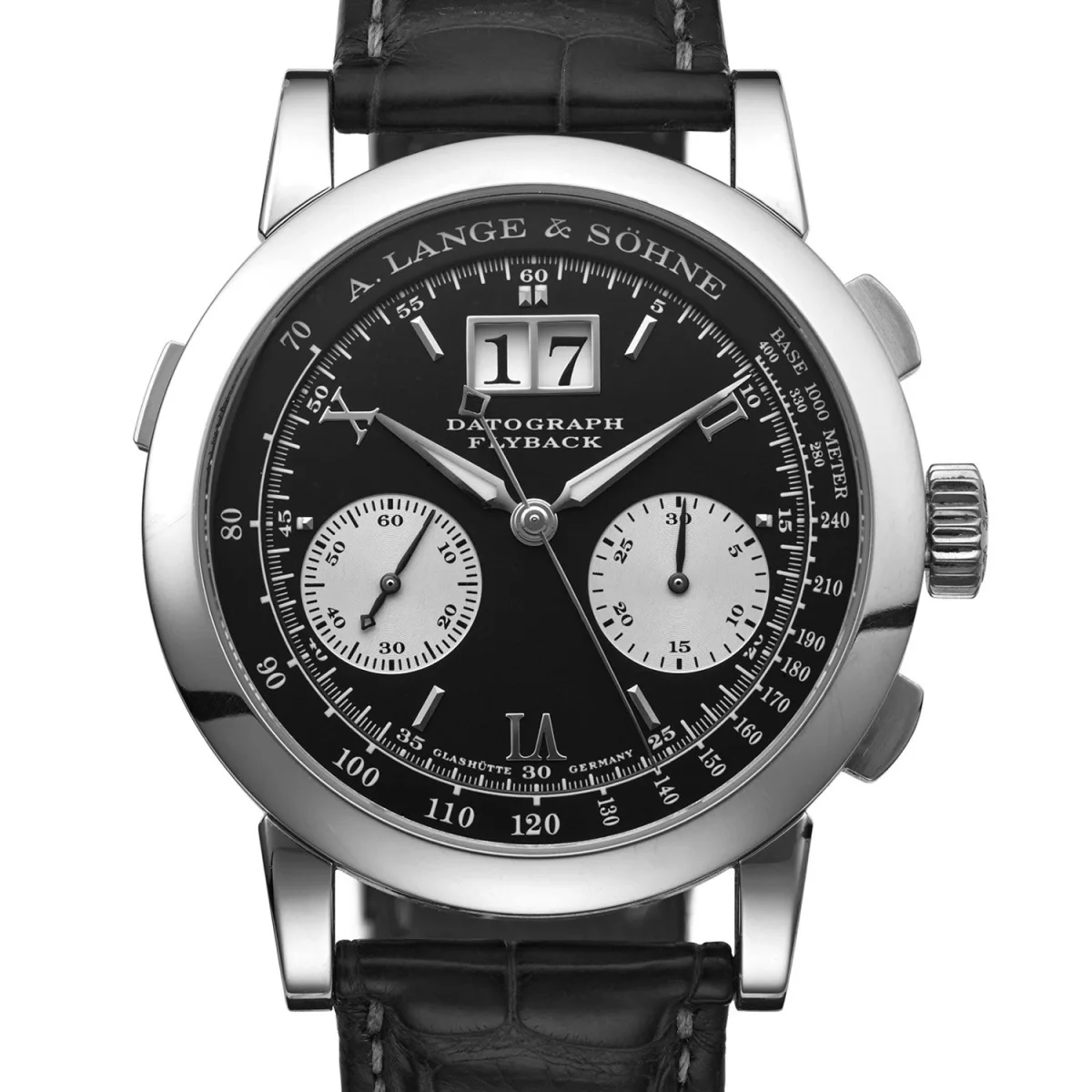
The original Datograph Ref. 403.035, introduced in 1999, featured a platinum case with a diameter of 39 mm and a thickness of 12.8 mm and remained a staple of the collection for the next 13 years. These iconic watches had a three-step case design with angular lugs and notches, a crown for winding and setting, two chronograph pushers on the right, and a button for quick date correction on the opposite side. The watch had a black dial, silver-white sub-dials, and a black-and-white date window for exceptional readability. The design of the watch was characterized by perfect balance (equilateral triangular layout), hour markers consisting of Roman numerals at “2, 6, and 10 o’clock” and baton-style indices elsewhere, highlighted by the distinctive inverted 6. Over time, small refinements were made to the dial, such as the grammatical correction of “meter” to “meters” on the tachymetric scale and the introduction of a thinner font on the sub-dials.

Produced from 2003 to 2005, the Datograph Ref. 403.031 in pink gold with a black dial and silver sub-dials holds special significance. It was this model that Philippe Dufour acquired, giving it his name. Interestingly, this “Dufour” is the only instance where an eminent watchmaker acquired a watch, as his collection typically consists only of his own creations.
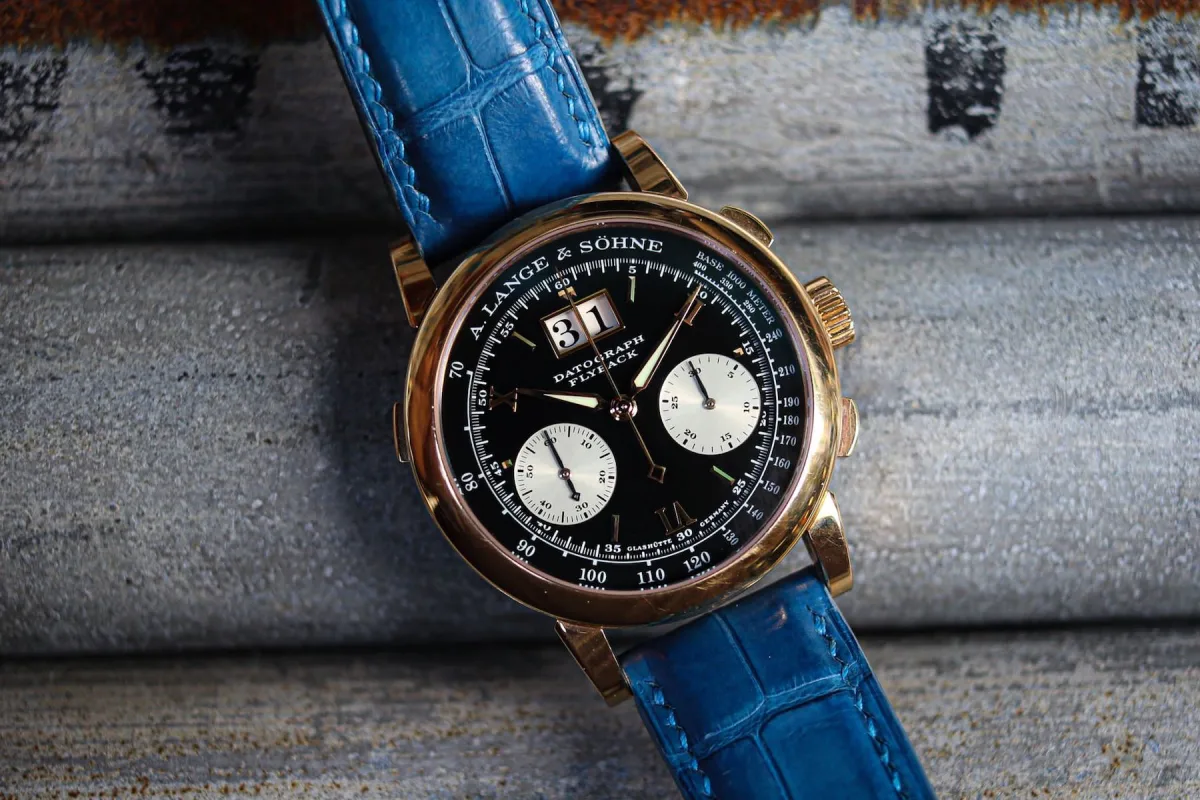
In 2004, Lange introduced a limited edition Datograph Ref. 403.025X exclusively for the Italian retailer Pisa Orologeria. This model, housed in a platinum case, featured a monochrome rhodium-plated dial, including sub-dials, earning it the nickname “Albino.” Only ten pieces were produced, and all watches were sold with a standard exhibition back, accompanied by a solid platinum back. Notably, until the release of the limited edition Datograph Lumen in 2018, this model remained the only limited edition Datograph in the A. Lange & Söhne lineup.

In 2005, Lange introduced the rose gold Datograph Ref. 403.032 with a silver dial, which appeared less contrasting. This variant remained in the catalog until 2013 and essentially replicated the Dufourgraph model with a silver dial instead of black. However, due to the shorter production period of the black dial watch Ref. 403.031, the likelihood of encountering the rose gold silver dial version is much higher than the one named after the watchmaker.

Another noteworthy example is the 2008 model Ref. 403.04, distinguished by its yellow gold case and combination of black dial and silver sub-dials, affectionately nicknamed “yellow jackets” in the collector community.
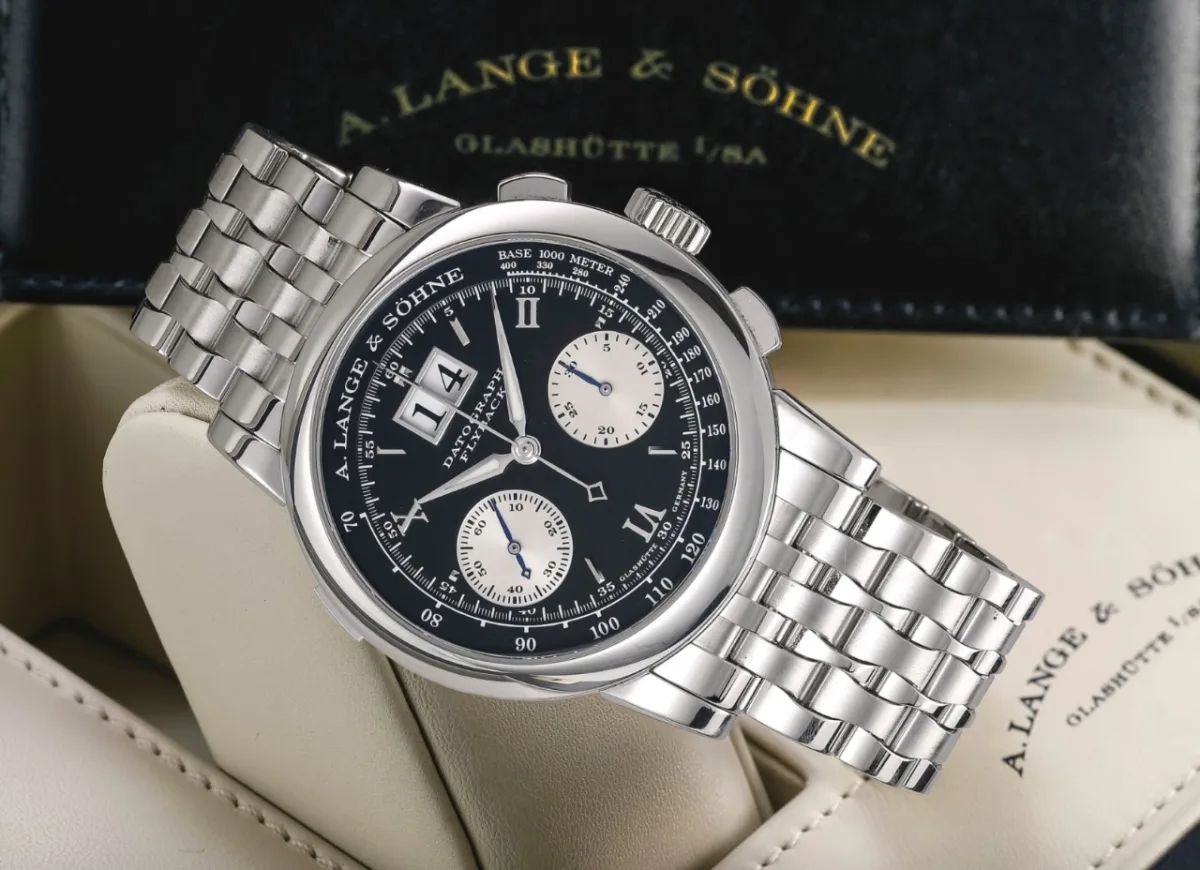
Although the aforementioned models were primarily offered on leather straps, A. Lange & Söhne also produced a series of Datograph with bracelets made by the German jewelry brand Wellendorff, which could be either detachable or soldered to the respective case. Over time, several watches were created with gemstones on special orders, usually with bezels adorned with baguette-cut diamonds. Additionally, there are reports of several unique pieces created in the earliest years of the Datograph for the top management of A. Lange & Söhne and Mannesmann VDO - then the owner of Les Manufactures Horlogères (LMH), the parent company of Lange.
Datograph Up/Down (2012-Present)
In 2012, A. Lange & Söhne introduced the updated Datograph Up/Down Ref. 405.035 in platinum, which is still produced today. This iteration brought several changes, notably, the case diameter increased from 39 mm to 41 mm, allowing for improved proportions with a thickness of 13.1 mm. Shorter lugs enhanced wearing comfort. The dial, like the inaugural 1999 Datograph, features a black background with silvered sub-dials and an enlarged date inspired by the Semper Opera House, presented in black on white. Notably, the date window was enlarged by 4% to maintain proportional layout. However, the introduction of the power reserve indicator Auf/Ab at “6 o’clock” led to the complete omission of Roman numerals, which displeased some collectors.
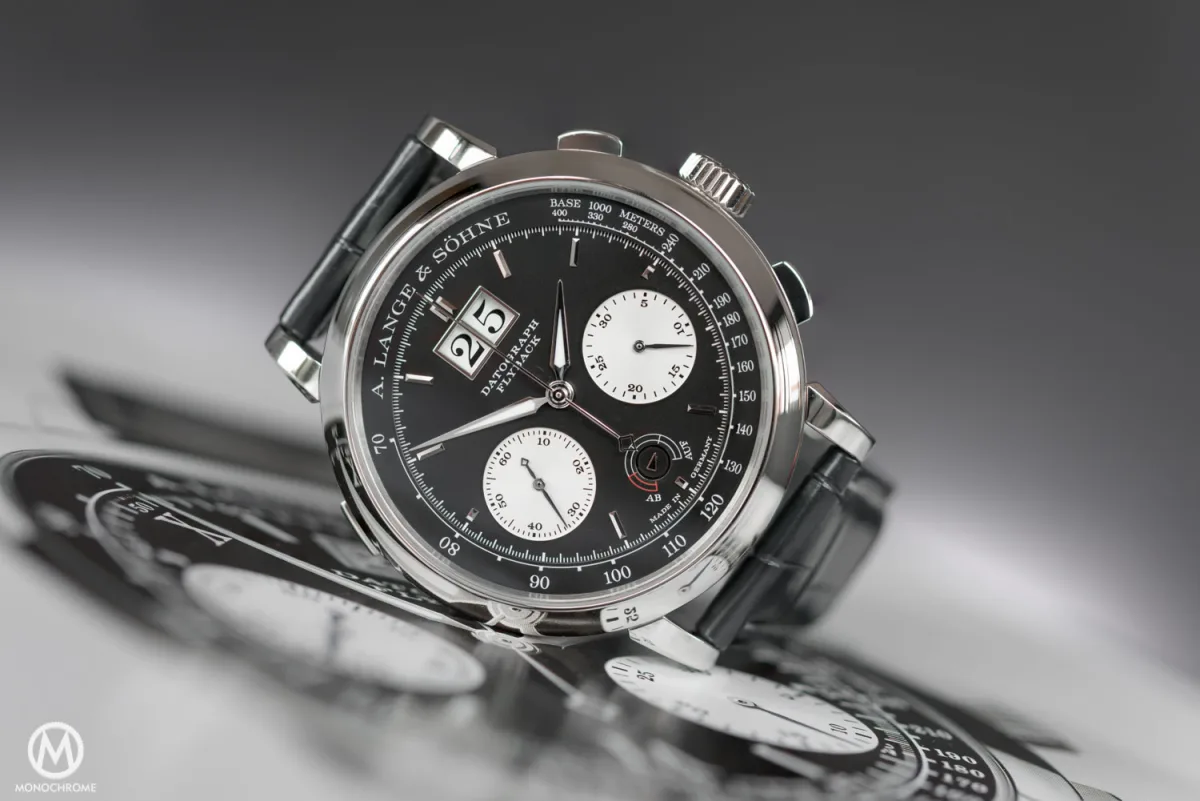
The Datograph Up/Down caliber L951.6 retained the classic frequency of 18,000 semi-oscillations per hour, maintaining the flyback and precise minute counting functions in the chronograph. However, thanks to a larger mainspring barrel and a thicker spring, it now operates autonomously for 60 hours, surpassing the 36 hours of the original Datograph. Additionally, the L951.6 is equipped with a Lange free-sprung balance wheel with an in-house manufactured hairspring, distinguishing it from the Glucydur balance with screws in the L951.1 model. Subtle adjustments were made to the start/stop and reset levers of the chronograph.

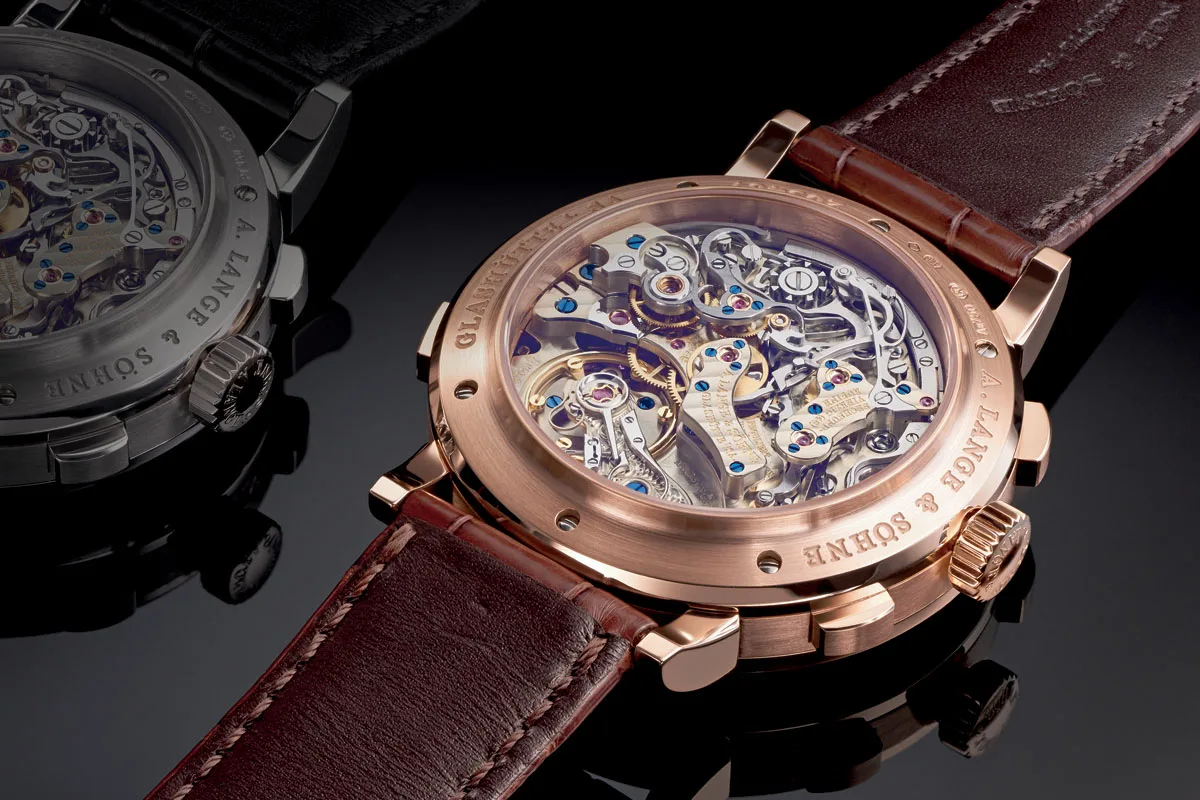
The L951.6 caliber consists of 451 parts and embodies Lange's best traditions, characterized by meticulous hand finishing. All bridges and plates are made of untreated German silver, with their angled edges perfectly polished. Flat surfaces are decorated with Glashütte stripes, and jewels are set in gold chatons secured by thermally blued screws. Steel parts are also painstakingly hand-finished, featuring straight graining on flat surfaces and polished edges. The balance cock is adorned with elaborate hand engraving, which is one of the signature features of all A. Lange & Söhne watches.
In 2015, the brand introduced the Datograph Up/Down Ref. 405.031 in pink gold with a black dial and contrasting silver sub-dials, reminiscent of the first-generation Dufourgraph aesthetic. However, it was the limited edition 2018 Datograph Lumen Ref. 405.034 that truly stood out and garnered widespread attention. This is partly due to the fact that the Datograph Up/Down never featured a variety of versions; Ref. 405.034 quickly became a sought-after collectible (limited to 200 pieces), but primarily because it showcased a tinted sapphire dial, allowing a view of the decorated main plate and the luminous date discs normally hidden from view.
Additionally, the model featured several other luminous components, including sub-dials, hands, power reserve indicator, and a tachymetric scale ring. The Datograph Lumen was equipped with virtually the same caliber as the regular models, designated as L951.7, encased in platinum and consisting of 454 parts - slightly more than the regular model due to necessary modifications for the luminescent effect.
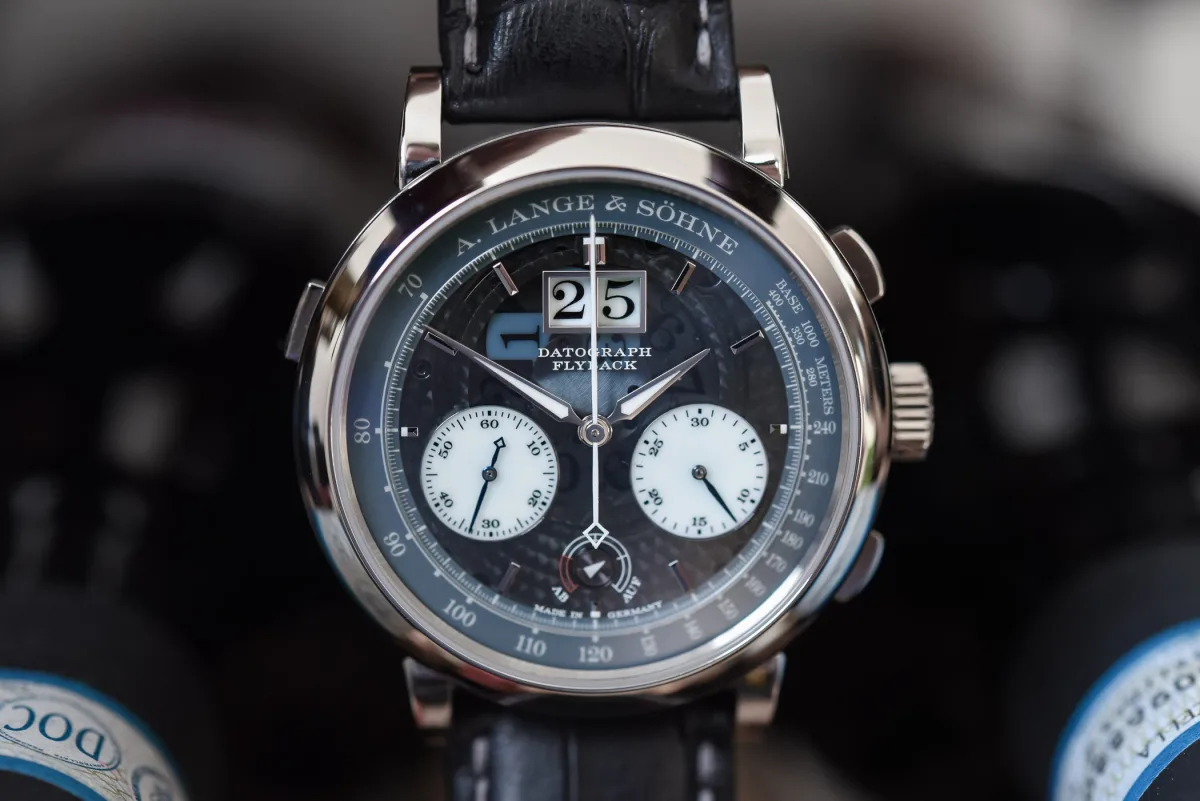
While we aimed to maintain chronological order in our review of the Datograph family, two significant models were inadvertently omitted from the narrative, despite being introduced by A. Lange & Söhne long before the Datograph Lumen. These are the discontinued Datograph Perpetual model, first introduced in 2006 in platinum (Ref. 410.025) and white gold (Ref. 410.030) and updated in 2010 (rose gold Ref. 410.032) and 2015 (white gold Ref. 410.038), and the 2016 Datograph Perpetual Tourbillon model.
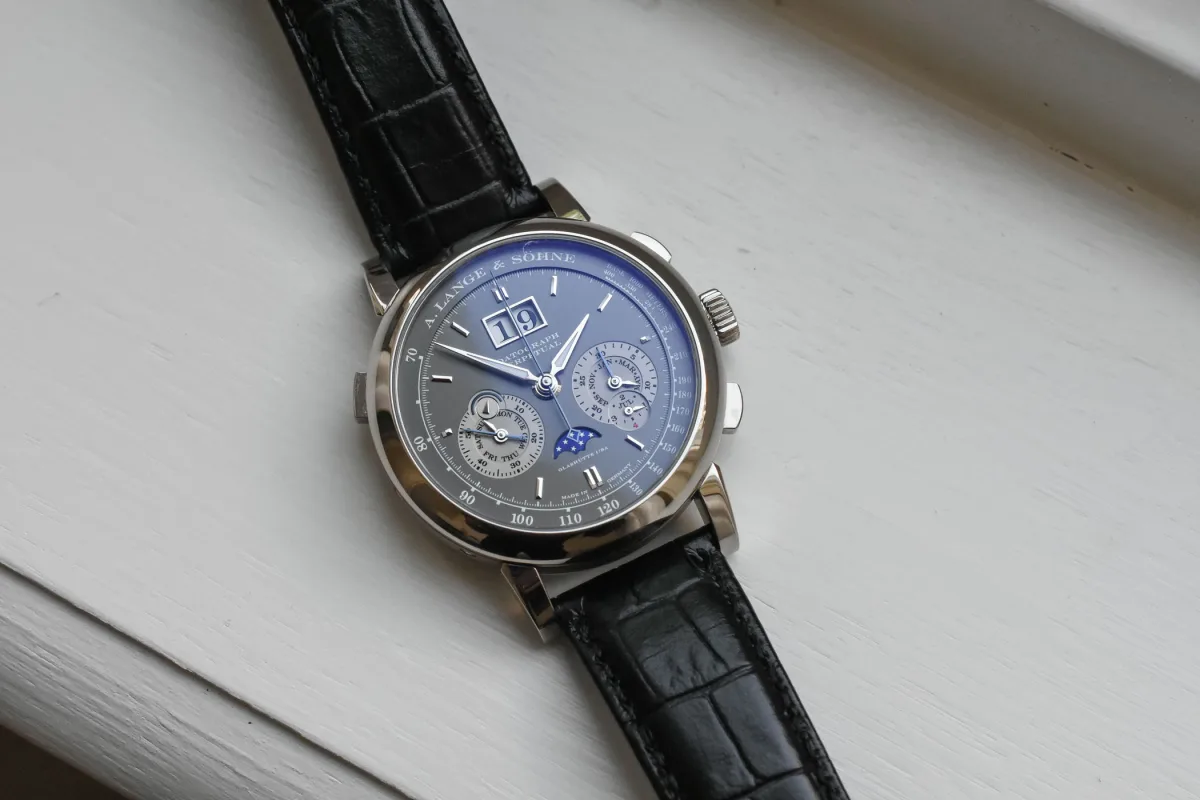
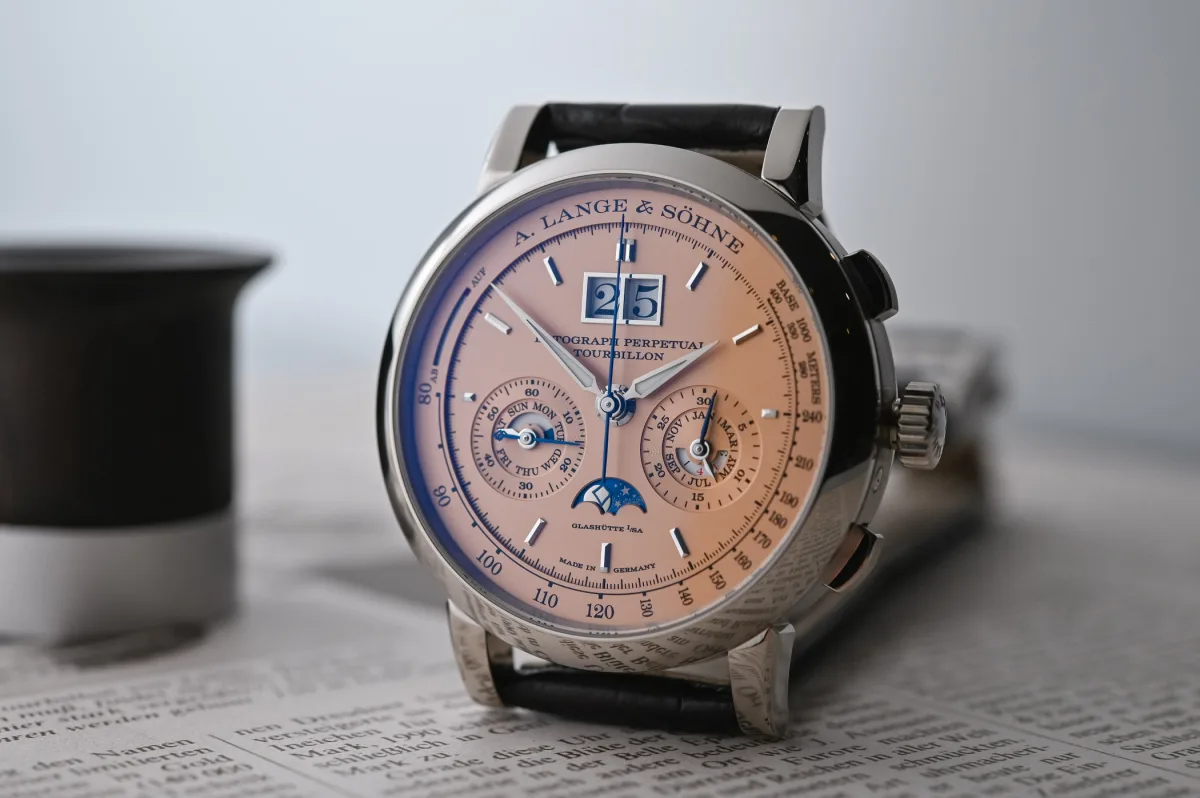
The latter, equipped with the L952.2 caliber comprising 729 parts, boasts a flyback chronograph with a jumping minute counter, an instant perpetual calendar, and a tourbillon providing a 50-hour power reserve from a single barrel. This model had other variations, such as the limited 2019 Datograph Perpetual Tourbillon with a salmon dial, Ref. 740.056, and the Datograph Perpetual Tourbillon Lumen Ref. 740.055FE, released in a limited edition of only 50 pieces this year.
Blue Datograph 25th Anniversary
In conclusion to this brief overview, let's turn our attention to the recently introduced Datograph Up/Down model, released by the brand to mark the 25th anniversary of the series.

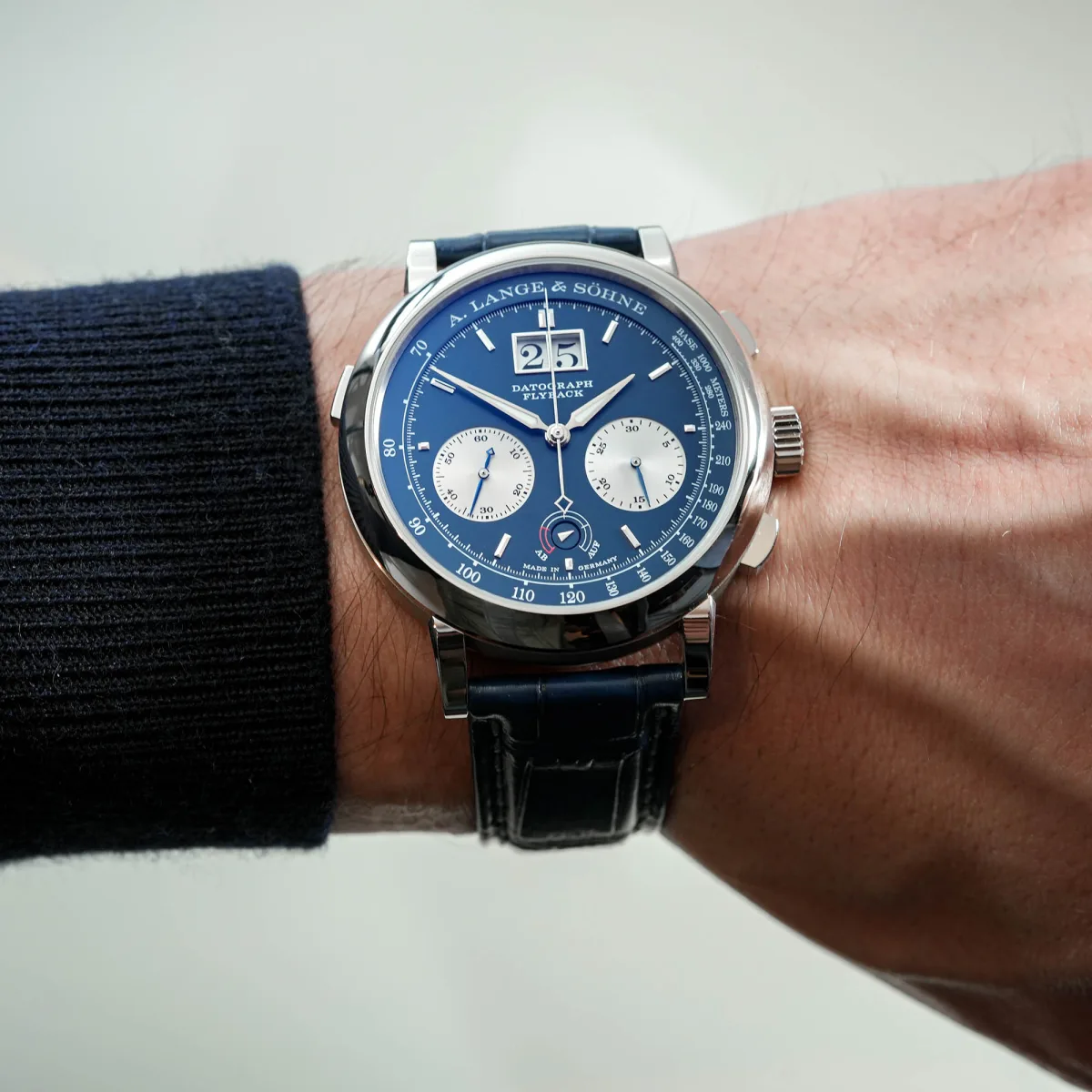
This particular model, A. Lange & Söhne Ref. 405.028, is released in a limited edition of 125 pieces in a 41 mm wide and 13.1 mm thick white gold case. The model is equipped with a fluted crown, two chronograph pushers at “2” and “4 o’clock”, and a button for quick date setting. The dial is adorned with blue rhodium-colored sub-dials. Like the similar models in platinum and pink gold, the Anniversary Datograph Up/Down features a flyback chronograph, jumping minute counter, the legendary oversized double date, and a power reserve indicator.
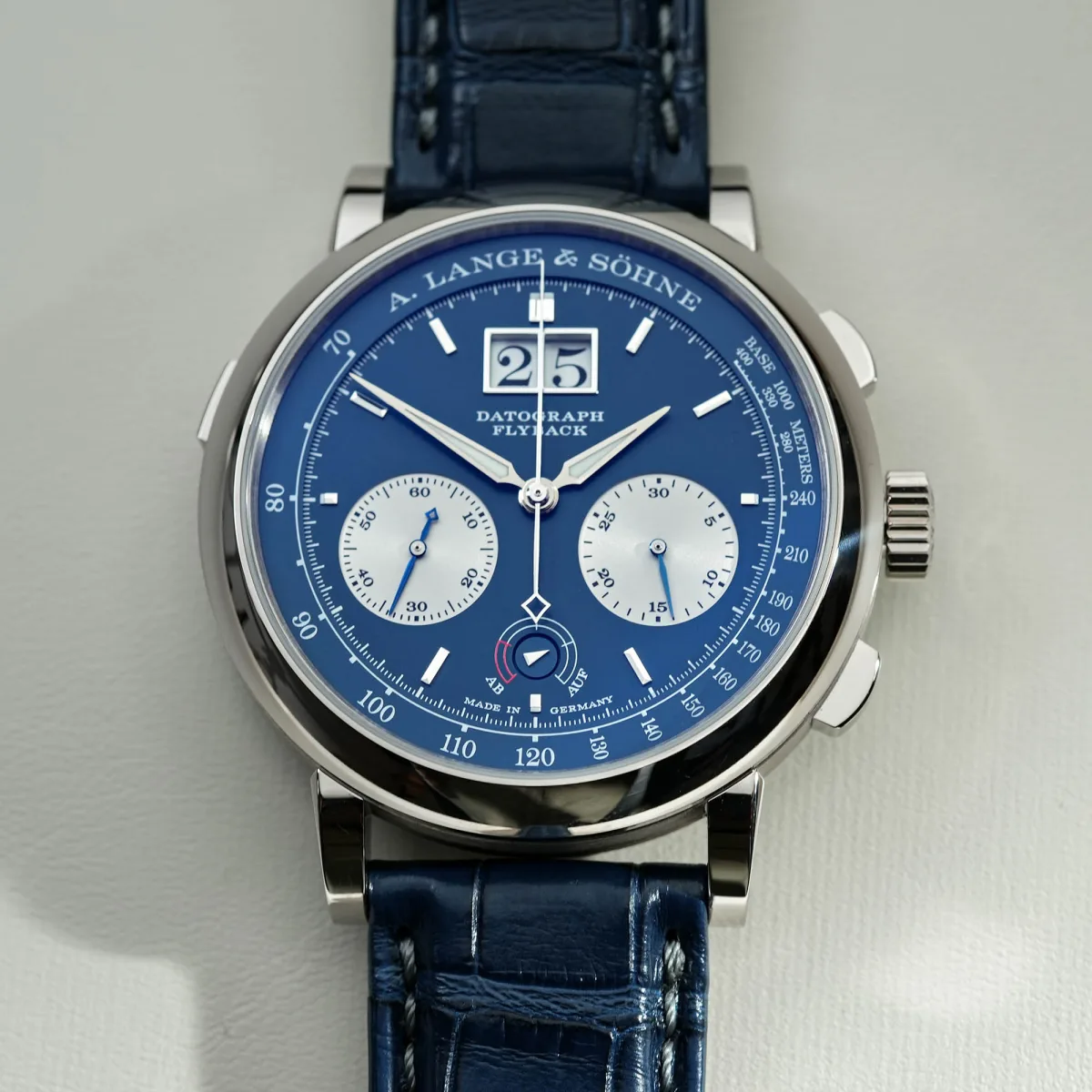
The L951.6 caliber, as always, is distinguished by the meticulous hand-finishing of each component, including the skillfully engraved balance cock, visible through the sapphire crystal caseback. While this is only an aesthetic novelty in the series - a blue dial appeared only once in a unique first-generation platinum Datograph model Ref. 403.035, and it was a fully blue variant - it is pleasing to see that the brand does not limit the current Datograph offering to only black (reverse panda) dials, and we hope that “albino” and salmon variants are in the works.
In summary, we did not aim for an exhaustive and detailed study of the Datograph line but wanted to pay tribute to its outstanding representatives and note their enduring magnificence. The A. Lange & Söhne Datograph watches quickly achieved iconic status due to their quintessential Lange design, meticulous attention to detail, and unparalleled excellence in various aspects.
While the debut of the watch in 1999 may have been very timely, it is the continuous development of the series in subsequent years that truly cemented the Datograph as a revered model. Langepedia.com proved invaluable in fact-checking, and I could not resist sharing a poignant quote from Ming Thein, founder of Ming Watches, which I came across while reading this valuable resource: “In many ways, owning a Datograph represents the end of the line for this hobby.” Indeed, it is well put.
For more detailed information, visit www.alange-soehne.com.