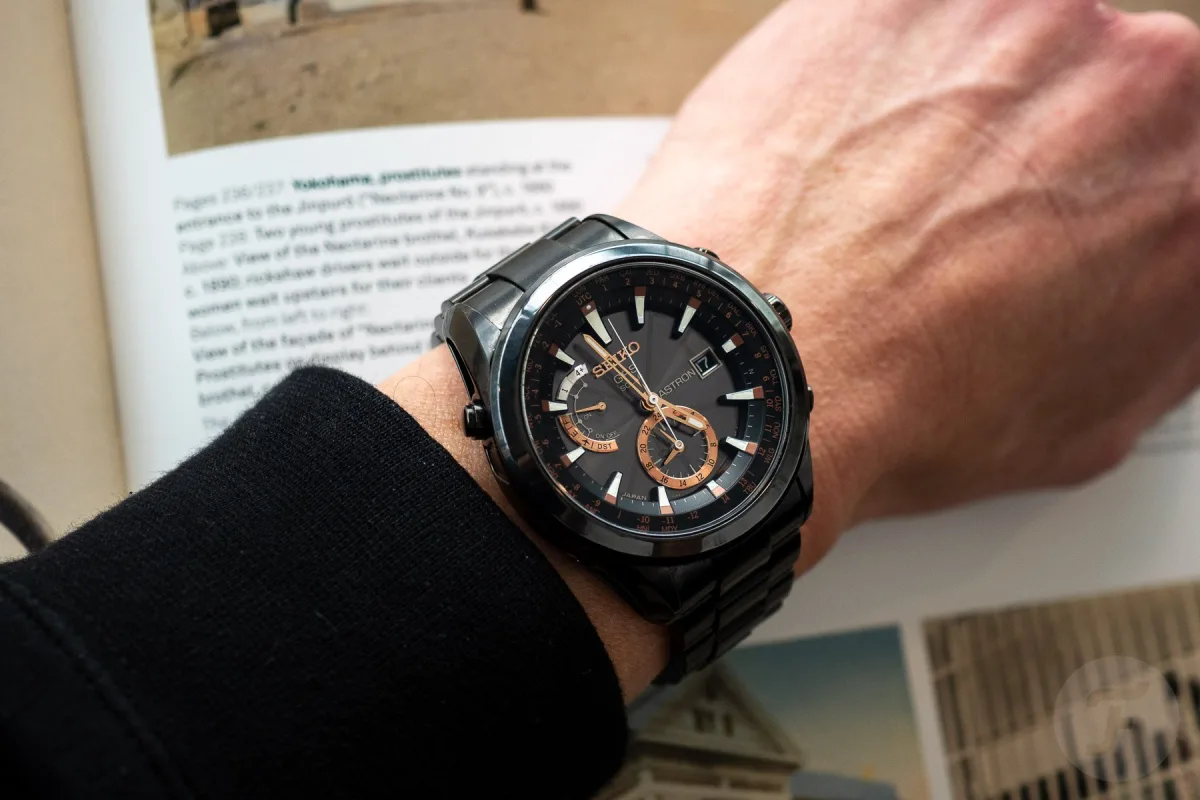
The Astron GPS Solar with a solar battery, introduced by Seiko 14 years ago, became the world's first wristwatch to use satellite signals for automatic time adjustment.
To accommodate this technology, a case size of 47 × 16 mm was required, making the first Astron GPS Solar models impressive in every sense. Over time, the cases have shrunk, the design has become more refined, and the technology more compact. This article presents a brief history of Seiko Astron GPS Solar - a review of key moments that will help you better understand and appreciate the innovations of this unique watch mechanism. Note that the selection of events is subjective and reflects my personal opinion.
Let There Be Light
The use of light to power a watch mechanism first appeared in the early 1970s. You might think Seiko was a pioneer in this field, but that's not the case. The first commercially available wristwatch powered by light is considered to be the Synchronar 2100, created by American engineer Roger W. Rie in 1972. Seiko entered the solar watch market five years later, releasing its first quartz watches with a solar battery, a year after the Japanese company Citizen introduced the world's first analog solar watch.
Seiko's distinctive feature was the original concept of capturing light: instead of covering the entire dial with photovoltaic cells, small solar panels were neatly placed around the hour markers. This was an elegant approach that anticipated further technological developments with improved solar cell efficiency. And much more was yet to come.
A Brief Look at the History of Seiko Astron GPS Solar
From the very beginning, Seiko aimed to make solar watches externally similar to ordinary mechanical models. The light collection technology was to become invisible, and constant improvement allowed the solar elements to be hidden under the dial. In 2012, Seiko made a breakthrough by introducing the Astron GPS Solar - a light-powered watch capable of connecting to GPS satellites for precise time setting. These watches became the first in the world to automatically determine the owner's location and adjust the time according to the local time zone anywhere on Earth.
Similar to the original Quartz Astron of 1969, the GPS Solar became another milestone in Seiko's long history of technological innovations.
Advantages and Features of Astron GPS Solar
Watches that automatically determine the correct time zone based on the owner's location, adjust the time, and run exclusively on solar energy, eliminating the need for regular battery replacement, are a significant achievement. However, such models have their own characteristics: appearance and size. Many notice that the Astron GPS Solar are quartz, not mechanical. Nevertheless, for a wide range of users, design, dimensions, technical characteristics, and price are important.
Let's consider the most notable Astron GPS Solar models since 2012.
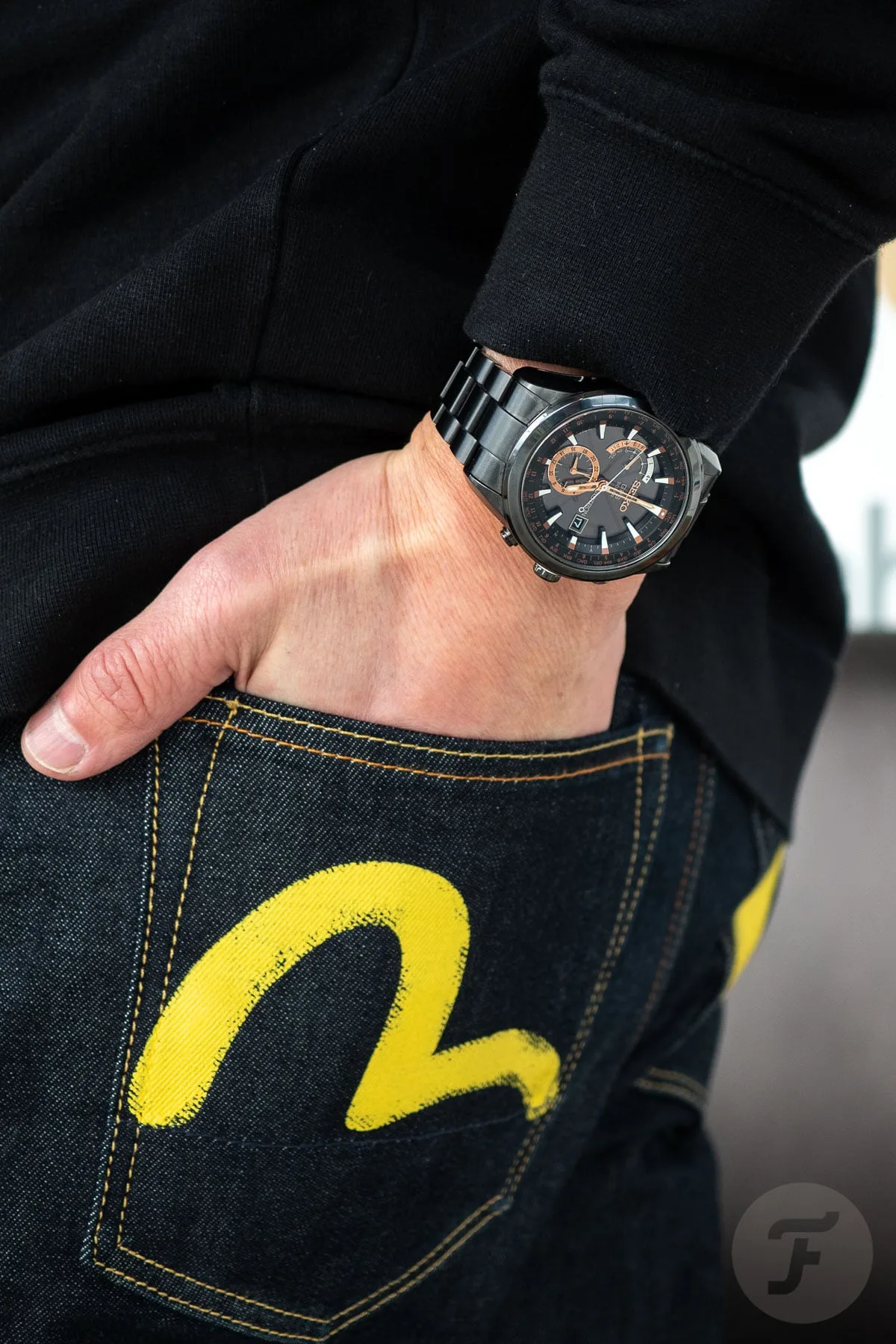
Admiration for the "Original" - Massive Model SAST001
At the debut of the Astron GPS Solar in 2012, six variants were presented, among which the black SAST001 stood out - a limited edition of 2500 pieces. The enormous case (47 × 16 mm) was made of lightweight titanium and black ceramic, reducing the weight to 125 grams - about half the weight of steel counterparts. Thanks to this and the short lugs, the watch wears comfortably, feeling like a model with a diameter of around 44 mm.
The quality of the case, bracelet, and clasp finish is still impressive - the level of execution leaves no room for criticism. The depth of the dial remains attractive, though the color scheme initially requires getting used to. Nonetheless, the evolution of the Astron GPS Solar is evident: the reduction of cases and the refinement of design have moved the model from the category of technological gadgets to "real" watches.

Evolution of the Movement
Inside the SAST001 is the caliber of the 7X series. It requires a ring-type antenna with a diameter of 38 mm, which determined the large case size. Two years later, the 8X series appeared with 35.5 mm antennas, allowing the watch size to be reduced. In 2018, the 5X series debuted - a significant technical breakthrough: the ring antenna was replaced by a patch antenna measuring 10 × 10 mm, enabling the use of steel bezels, speeding up operation, and improving energy efficiency.
In 2019, the ultra-compact 3X series appeared with an antenna integrated into the movement bridge, resulting in Astron models with cases less than 40 mm. In 2024, the caliber 5X63 was released, replacing the 5X83 - the most advanced GPS Solar mechanism by Seiko to date.
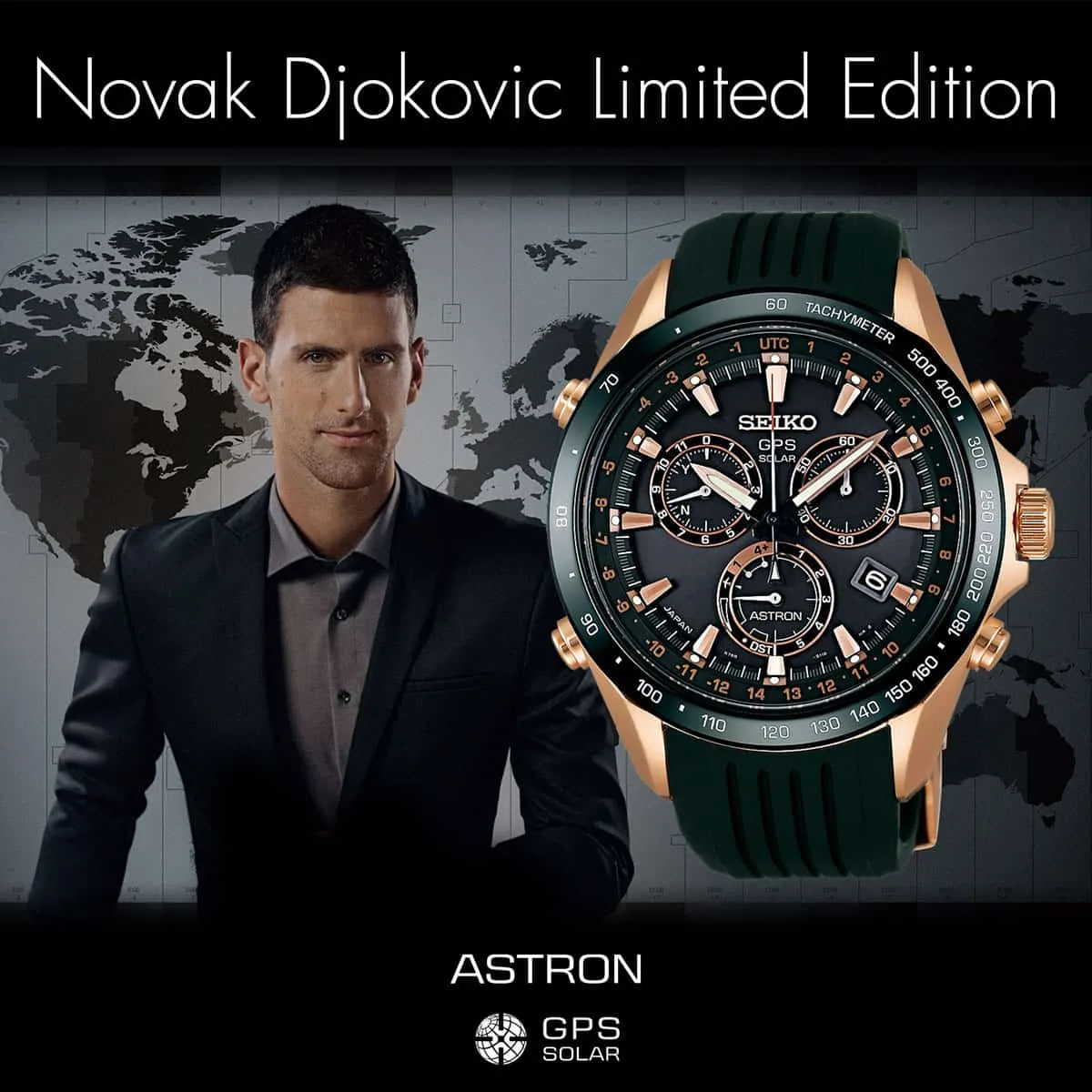
One of the notable models with an evolutionary mechanism was the Astron GPS Solar chronograph with caliber 8X82 - the limited edition Novak Djokovic Limited Edition SSE022, introduced in November 2014. These watches were not only solar-powered and GPS-controlled but also equipped with a chronograph function, a perpetual calendar, supported 40 time zones, and daylight saving time transitions. At the same time, the case was reduced to 44.6 mm.
In 2015, the watch appeared on Novak Djokovic's wrist during his victory at Wimbledon, where he defeated Roger Federer with a score of 7-6, 6-7, 6-4, 6-3.

Astron GPS Solar SSH063 - Elegant Snow-White Design of 2020
The 5X53 caliber appeared in 2018, but this article examines the 2020 model - Astron GPS Solar 5X53 Dual-Time Sport Titanium SSH063 with a white dial and titanium bracelet with a buttoned clasp. The use of titanium reduces the watch weight to 105 grams.
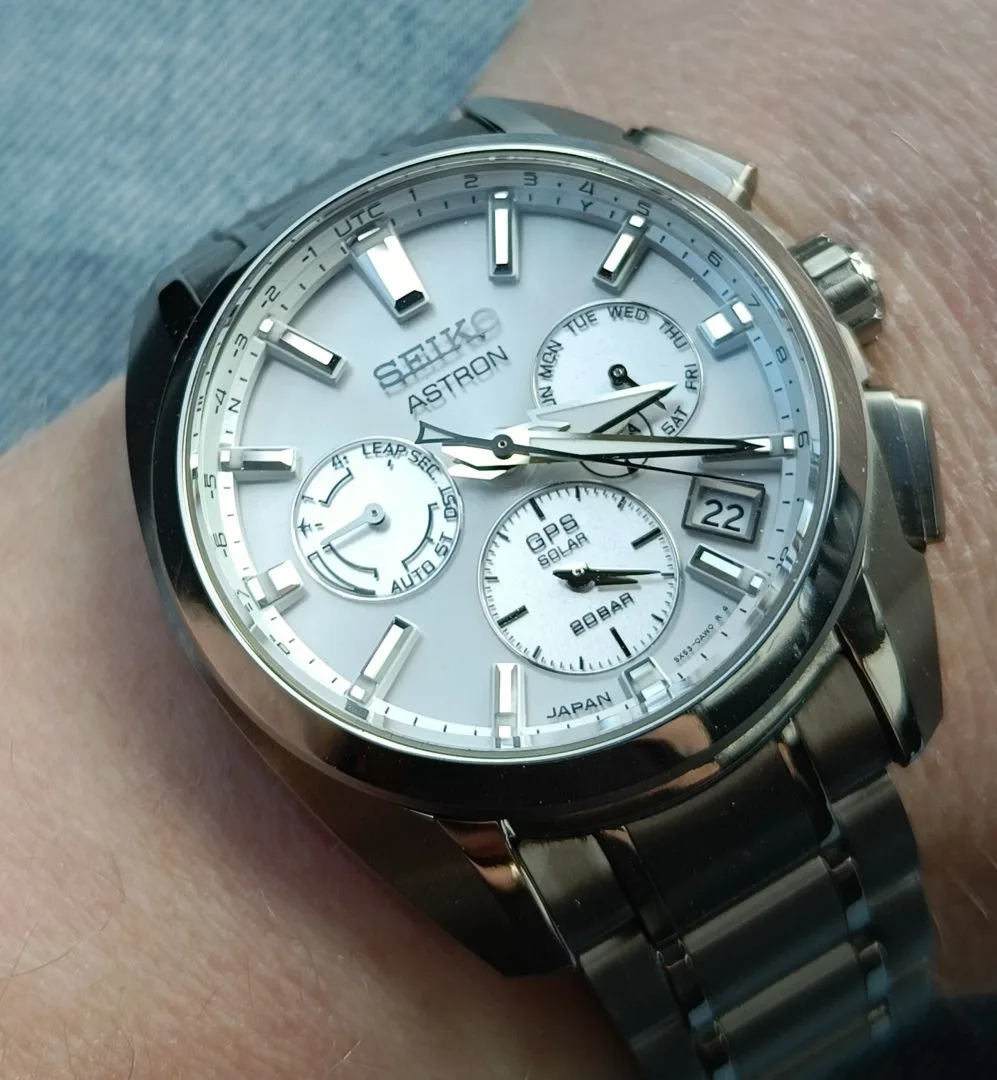
The case diameter of 42.8 mm, thickness of 14.6 mm, and lug-to-lug length of 50 mm ensure wearing comfort. This model is perfect for travel: with one button press, you can display the local time.

Astron GPS Solar SSJ017 - Reminiscent of Grand Seiko
The 2023 model SSJ017 with a silver dial is equipped with the 2019 caliber 3X22. The titanium case measuring 41.2 × 12 mm is reminiscent of the Grand Seiko Tough Quartz SBGX341 with a diameter of 40 mm. This is a successful use of a compact caliber with an antenna integrated into the movement bridge.
Although this model is not equipped with a chronograph, it remains a powerful tool for travel. The mechanism searches for a GPS signal several times a day when there is sunlight, providing accuracy of ±1 second per 100,000 years. Without a signal, the accuracy is 15 seconds per month. When changing time zones, the watch automatically updates the time, and the flight mode allows you to disable signal reception at an inopportune moment. Unlike mechanical watches, where it is necessary to rotate the hands to adjust the time, here you just need to press a button - especially convenient on vacation.

"Crystal Pink" - Astron GPS Solar Dual-Time Chronograph HAB006
In 2024, Seiko released a limited series of 1200 pieces dedicated to the brand's 145th anniversary - Astron GPS Solar Dual-Time Chronograph HAB006. The case measuring 43.4 × 50 × 12.4 mm is made of titanium with a super-hard coating on all sides. The design has become more defined and refined compared to previous models.
The new two-section octagonal bezel combines a matte top surface with polished facets on the sides, creating a sense of dynamism and depth. The watch is equipped with the latest 5X63 caliber, replacing the 5X83, which led to a change in the dial layout. Instead of the unusual 6-9-12 counter arrangement, a more harmonious 3-6-9 layout is used, which improves readability.
The updated ergonomics and stylish appearance, including a high-quality dial, make this model a worthy representative of the lineup.
If you want to choose your favorite Astron GPS Solar, just click on the "Seiko Astron" link and check out the models reviewed on WatchTested over the years. Don't forget to share your choice in the comments.