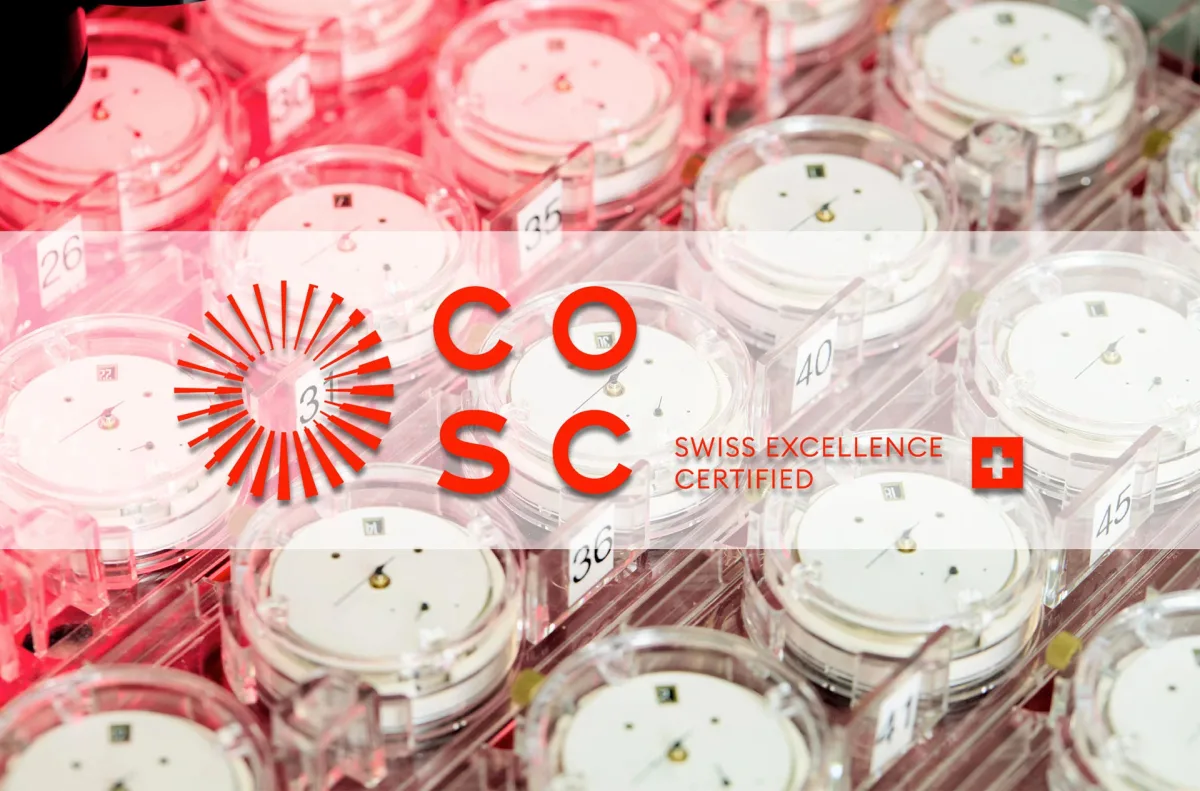
It represents an extended version of the existing standard with stricter tolerances and testing for resistance to magnetic fields.
Last year, information appeared in the press that the Swiss Chronometer Testing Institute COSC was announcing a stricter testing standard. Recently, details have emerged about the tests included in this new standard.
First and foremost, the Excellence Chronometer certification includes a daily error margin of 6 seconds instead of 10, resistance to magnetic fields up to 200 Gauss, and verification of the declared power reserve. Additionally, the watches will be tested under conditions as close to real-world usage as possible.
The first phase of testing involves passing the usual COSC tests, where watch movements are checked for compliance with 7 criteria of the ISO 3159 standard. After passing these tests, the movements are returned to production for casing. Then the watches undergo an additional 5 days of assessment. Using a robot that simulates wearing the watch on the wrist, the accuracy of the watch is tested over a day in semi-dynamic conditions.
Subsequently, a measurement is conducted where the average daily error must be within the range of -2 to +4 seconds per day (instead of -4 to +6 seconds per day for standard COSC certification). Why weren't the tolerances made even stricter? Likely because a too stringent accuracy criterion could potentially exclude many market participants, particularly watches equipped with Sellita movements.
This is followed by a test for resistance to magnetic fields up to 200 Gauss. For comparison, the basic industry standard ISO 764 stipulates that watches must withstand a constant magnetic field strength of 4800 A/m or approximately 60 Gauss. In 2020, a new version of the ISO 764 standard for "watches with increased magnetic resistance" was published. According to the updated criteria, watches must withstand a magnetic field strength of 16,000 A/m and above, approximately equal to 200 Gauss. This value formed the basis of the new certification.
In March 2026, the first pilot tests will be conducted in COSC laboratories to verify procedures and assist brands in adapting to the new certification. The first watches certified under the updated standard will appear in October 2026.