
How often do you adjust your watch? Your answer likely depends on how frequently you wear it.
If you only use it occasionally, you probably set it every time you pick it up. But if you wear the same watch daily (or keep it on a winder when not in use), you likely adjust it only when you notice deviations. Watches with annual and perpetual calendars have simplified this task, but if you haven't switched exclusively to digital models, setting the time remains a fact of watch ownership. And as collectors of vintage watches without quick-set date functions can attest, painstakingly advancing the hands just to set the date window correctly can make even the most seasoned aficionado weep.
Thus, we were understandably intrigued when IWC announced that its new Perpetual Calendar boasts 45 million years of precision. At least for the moon phases. The perpetual calendar complication? Your fiftieth great-grandchild might need to adjust it once every 4000 years. Nevertheless, the new IWC Portugieser Eternal Calendar is a remarkable achievement in watch mechanism design, and we saw it firsthand at the Watches & Wonders 2024 exhibition.

This mind-boggling capability has more in common with supercomputers than one might assume from an automatic mechanical movement. By using software to simulate trillions of gear combinations, IWC managed to determine a sequence that would provide a correct timing system for Eternal's long-term accuracy. Naturally, such breakthroughs in watchmaking should be accompanied by equally noticeable aesthetics, and the dial certainly delivers. While the layout of IWC perpetual calendar dials has always drawn attention with its symmetry and simplicity, Eternal alters this approach by removing the seconds hand from the sub-dial at the 9 o'clock position and updating the dual moon phase indication.
Understandably, the boastful label helps address the issue of truncated numbers, replacing the chopped-off number “12” with the “Eternal Calendar” stamp. The hemisphere indicators to the left and right of the moon phase have also been simplified by removing the “N” and “S” labels, using intuitive semicircles instead to denote which part of the moon phase corresponds to the northern and southern hemispheres. Color has also been omitted: the seven-day power reserve now appears monochrome, matching the overall dial look. All these updates are, in their way, connected to the most important part of the Portugieser calendar update - the glass and lacquer construction that makes the text on the dial appear to float.
Starting with a thick glass dial, IWC coated its underside with white lacquer, then printed the text and applied silver numerals on top. Combined with other voluminous elements, such as the hands, separate dual moon phase indicator, and stepped cutout at the 4 o'clock position, the Eternal dial gains depth that gives it a unique character.
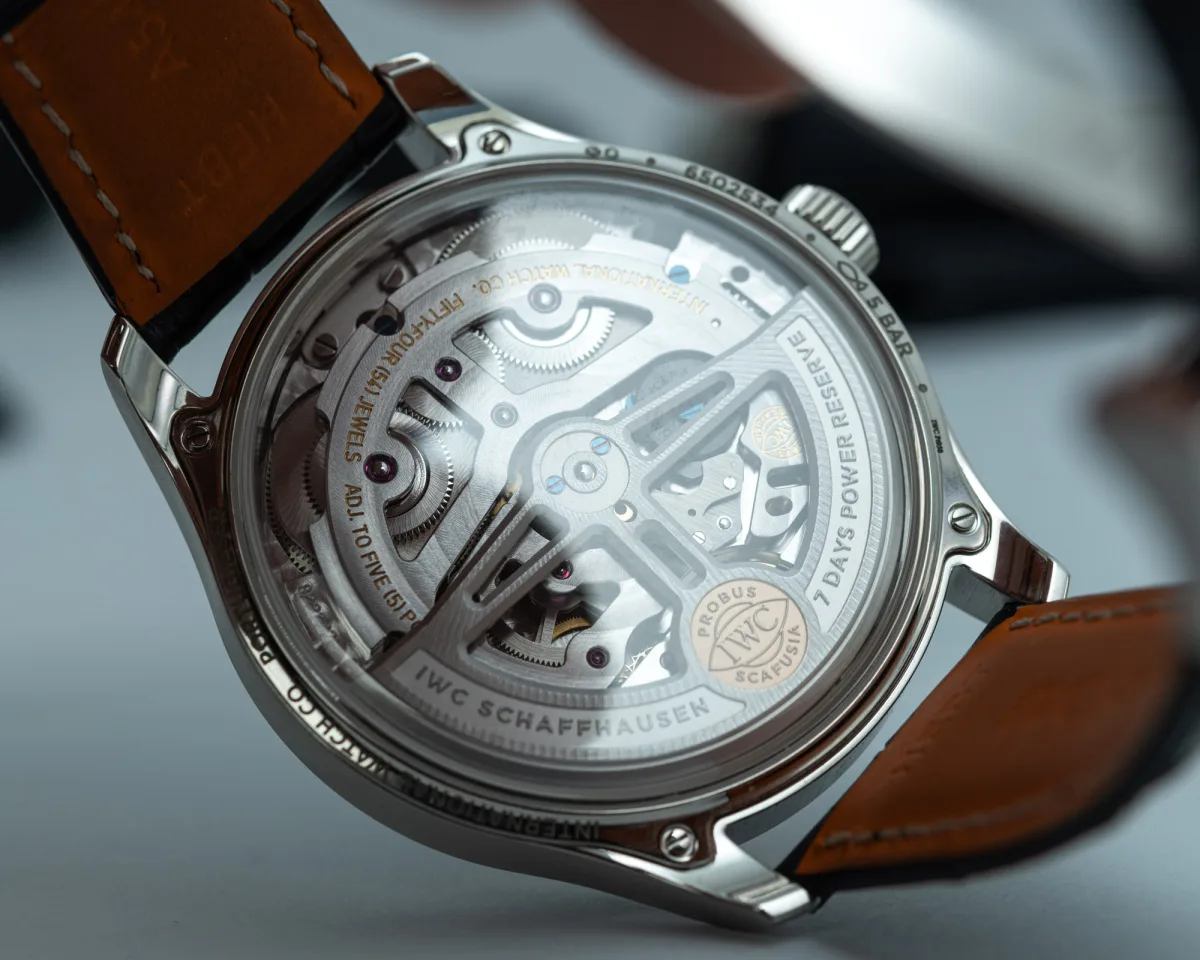
The automatic IWC Caliber 52640 is the engine behind all this magic, and it is fully displayed on the back of the Eternal. Thanks to the panoramic sapphire case back used in other models of the new Portugieser line, the internal workings can be seen from edge to edge. Those who spend their free time examining watch mechanisms will quickly realize this is not just any engine, thanks to the unique gear arrangement at the top of the caliber. And though it's not visible from the back, within the hardworking metal stack hides the “400-year wheel” 52640, which (as the name suggests) rotates once every four centuries to correctly account for the years 2100, 2200, and 2300.
These years, while falling within the usual four-year leap year cycle, are not actually leap years, and if this confuses you, imagine trying to create a watch mechanism that accounts for these discrepancies. These quirks ultimately limit the functionality of the Perpetual Calendar, though using the word “limitation” to describe a watch that can theoretically keep time for twice the entire period of anno domini seems unfair. Nonetheless, these discrepancies accumulate and, unfortunately, mean that in the year 4000, the watch will require correction.
Oddly enough, an easier task for the Caliber 52640 is the correct operation of the moon phases. Here, the 29.5-day lunar schedule is so predictable that “Eternal” can account for it up to 45002024. This is not a typo. Amusingly, IWC has chosen to advertise on the movement's rotor not the 45-million-year moon phase, but the seven-day power reserve.

At 15 mm thick, the new Eternal Calendar is not much bulkier than most other calendar watches, but the unique case design gives it special depth and presence. As befits such powerful watches, the case is made of platinum and adorned with a white lacquer flange. The numerals applied on the side and the clearly defined minute track on top are embedded under the box sapphire crystal and appear elevated.
When viewed from above, it frames the dial, yet it's difficult to say where the dial ends and the flange begins. The appearance is almost (dare I say?) smartwatch-like, albeit from an alternate universe where ubiquitous black-cushioned rectangles suddenly became round and white. Perhaps the most impressive aspect of the 44 mm case is the absence of any buttons typically found on calendar watches.
Instead, the only mechanism for setting and adjusting the watch's extensive capabilities is the unprotected crown at the 3 o'clock position of the Portugieser. The black alligator leather strap is secured through slanted lugs and complemented by a platinum folding clasp.

As clichéd as it sounds, the watch makes us ponder time. Holding it in hand or wearing it on the wrist, the IWC Portugieser IW505701 extends the scale from typical calendar watches (days, months, years) to literal eons. Pushing the boundaries of horological art and creating a watch whose limitations (manufacturer-recommended service intervals) exist thousands and even millions of years ahead, the Perpetual Calendar becomes almost a philosophical experiment, akin to Zeno's arrow or the Ship of Theseus.
Considering that the Perpetual Calendar could theoretically operate until its components are literally worn to dust, it prompts reflection. This is especially pertinent in our times, where the dirty secret of manufacturing - and yes, this applies to watchmaking as well - is that it is often cheaper to replace than to repair. Priced at 155,000 USD, the IW505701 is not a disposable watch, but mainly due to its ability to at least pause the conversation about the technical limitations of watchmaking.
Realistically, the main lesson of horological art is that in some brilliant watchmaker's workshop, there's always one more development, so is this model the absolute counterpart of calendar watches? Probably not. Yet, while this is not “the end of history,” the “Perpetual Calendar” comes very close. More detailed information about the IWC Portugieser Eternal Calendar can be found on the brand's website.