The past month was filled with events related to the FIFA 2026 World Cup.
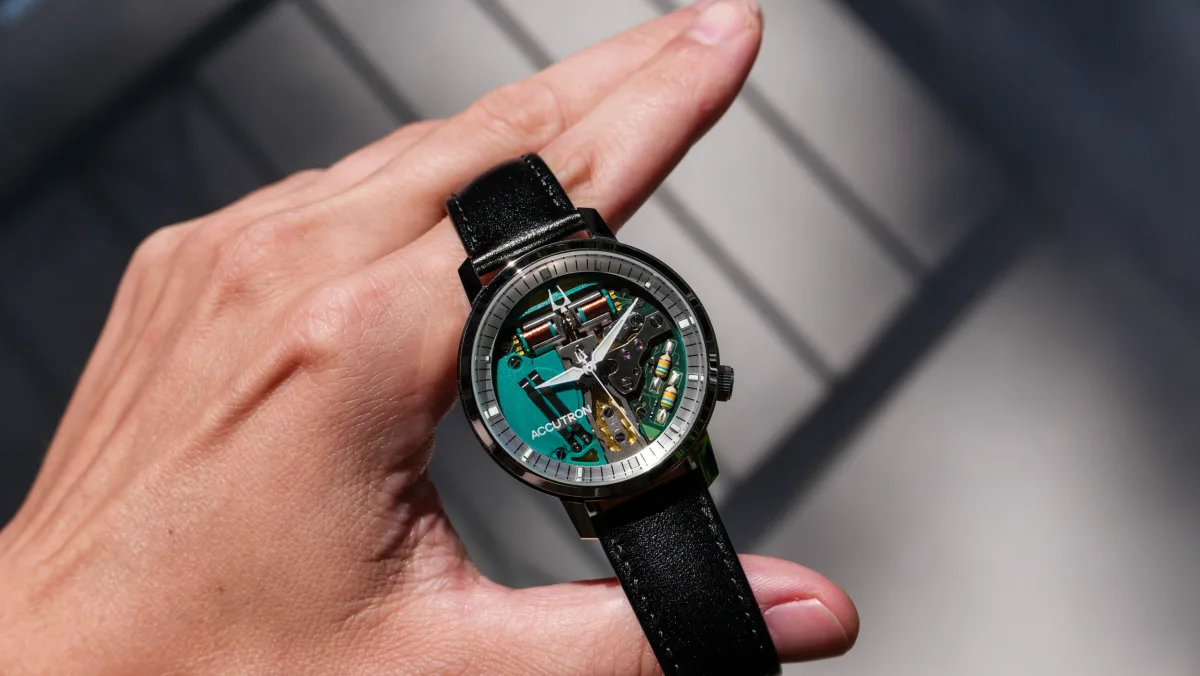
As a supporter of the England team, I was emotionally invested in every game up to the final. It was at the start of the quarterfinal stage that a unique timepiece, the Accutron Spaceview 314, arrived in our studio, which we will examine in detail today.
During the matches, I wore my Land-Dweller 36, calling them my "lucky watch," but I couldn't help appreciating the presence of the Spaceview 314 with its revolutionary Y230 caliber based on tuning fork technology. Interestingly, both models use high-frequency movements but achieve this in fundamentally different ways. In terms of construction, design, and functionality, these watches are almost opposites.
History and Development of the Accutron Brand
Initially, Accutron was a separate model within the Bulova lineup, debuting in 1960. Since then, the brand has undergone numerous structural and ownership changes. Today, Accutron exists as an independent brand within the Citizen group, alongside Bulova. This separation has allowed not only the preservation of the original tuning fork watch lineup but also the expansion to include new variations.
Technology and Uniqueness of Accutron Spaceview 314

The Spaceview 314 represents an almost "three-dimensional" approach to watch design and production. There are mechanical, quartz, and several rare types of movements, but Accutron occupies a separate segment thanks to its tuning fork technology. This is fundamentally different from classic watches: instead of a mainspring and balance wheel, an electronic transistor circuit is used.
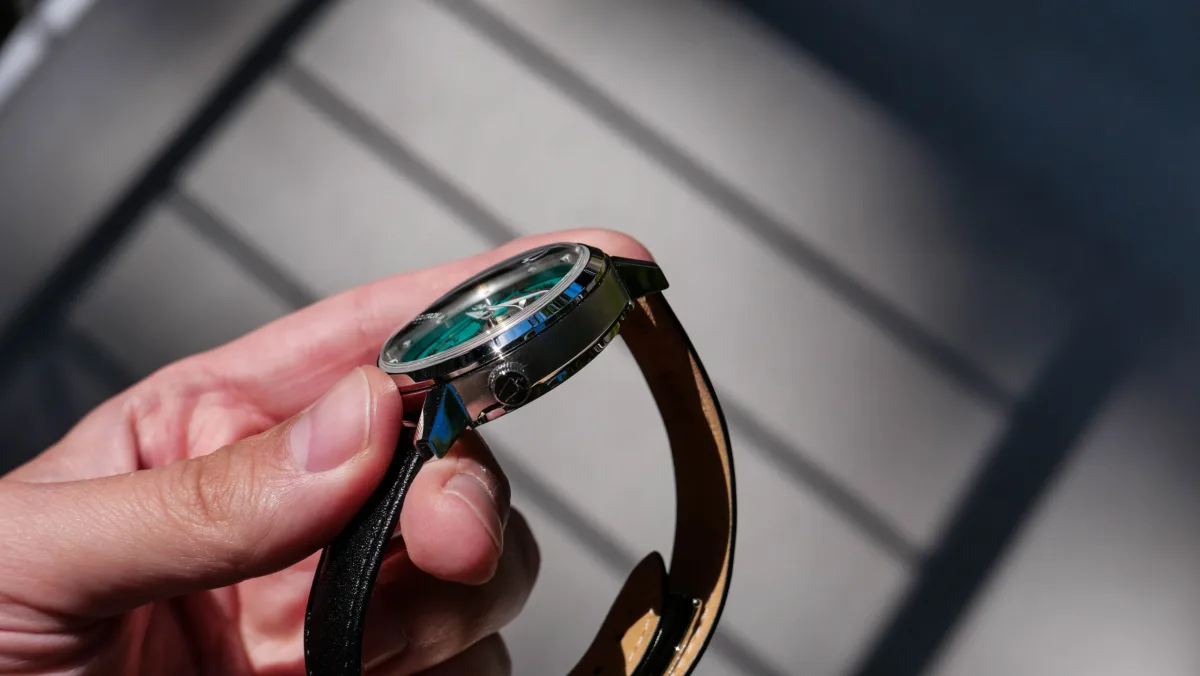
At the time of its debut in 1960, this was a true breakthrough. The model features an open dial and a transparent case back, showcasing the complex electronic components. Another distinctive feature is the barely audible hum of the movement, reminiscent of a bee's buzz, which can be detected by bringing the watch to the ear.
Appearance and Design Features of the Spaceview 314
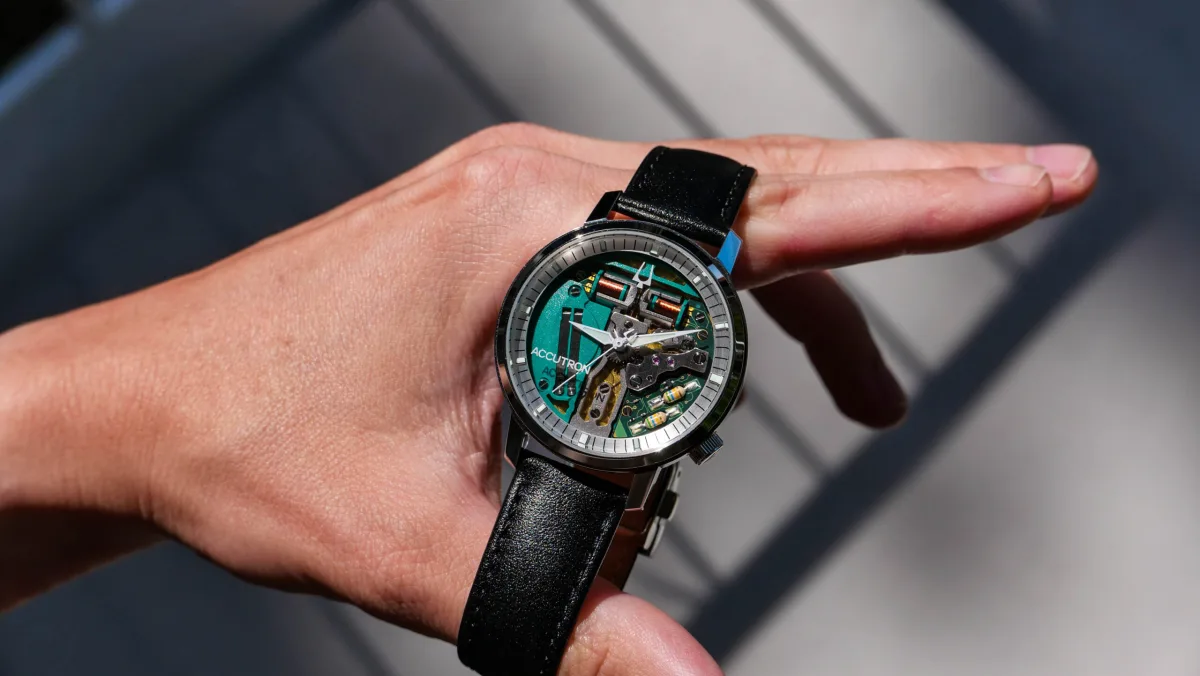
In terms of design, the watch is more reminiscent of the evolution of the personal computer than European watchmaking art or sports models. The dial and transparent case back resemble an old-style microchip, which is particularly intriguing for IT and technology specialists.
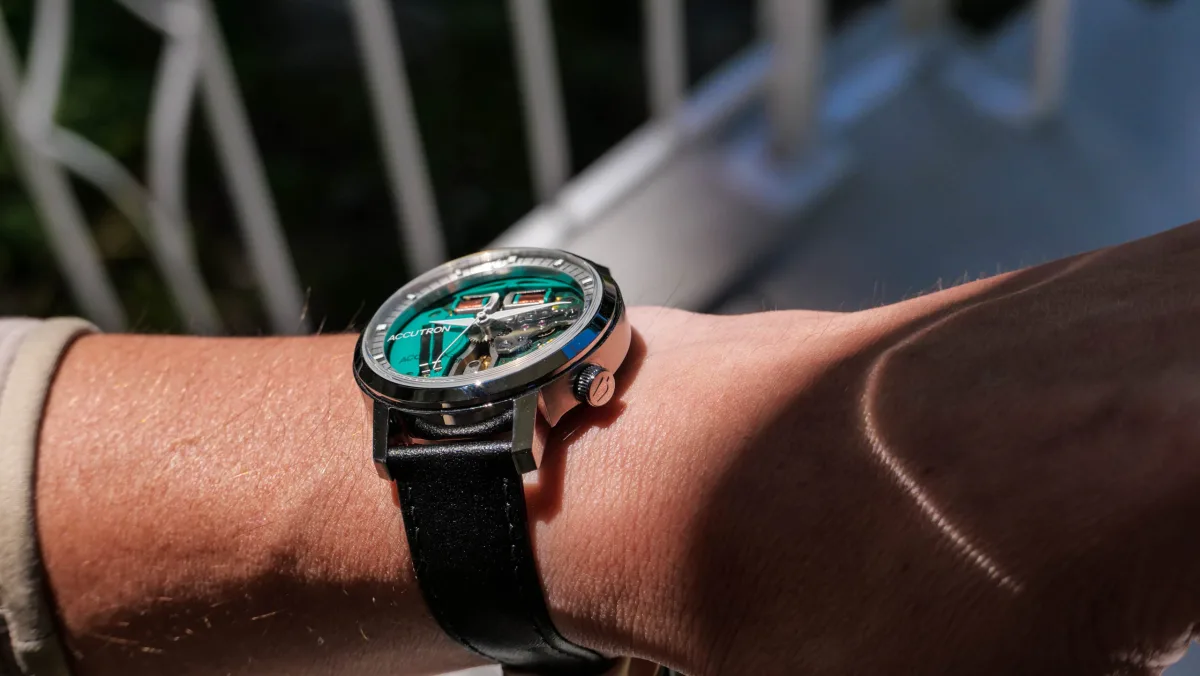
Modern time display elements are limited to just the sapphire crystal and the dial's outer ring. The Accutron logo on the glass does not feel engraved on the outside and might be inside, as the surface feels smooth.
The outer ring of the dial is silver with markings and baton hour markers, which blend with the background during the day but are coated with a luminescent compound for nighttime reading.
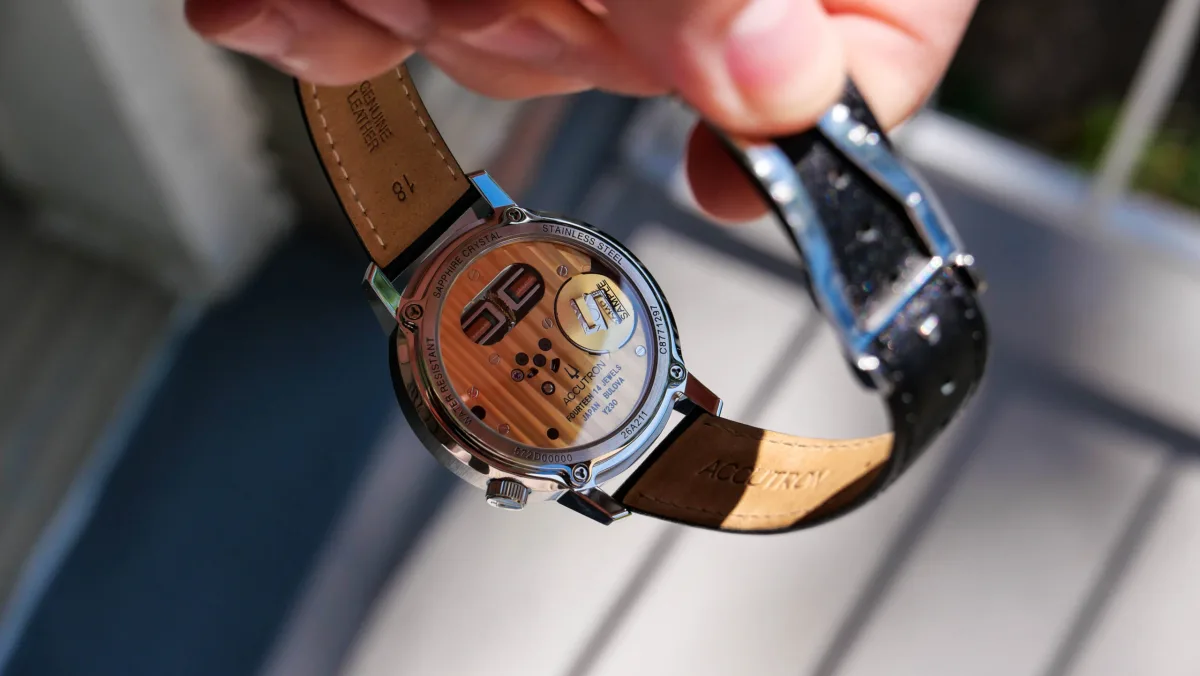
The hour and minute hands are dauphine-shaped, providing good readability against the green and metallic pattern reminiscent of a microchip. The second hand is long and thin, with the trademark tuning fork logo as the counterbalance. Thanks to the patented 360 Hz technology, it moves very smoothly, showing one of the smoothest rotations I have ever seen.
Upon closer inspection of the dial, it seems that some details were taken from a mechanical movement and combined with transistors and coils, like on a circuit board. This design looks both modern and retro at the same time, giving the watch a unique charm.
Back Side and Japanese Movement
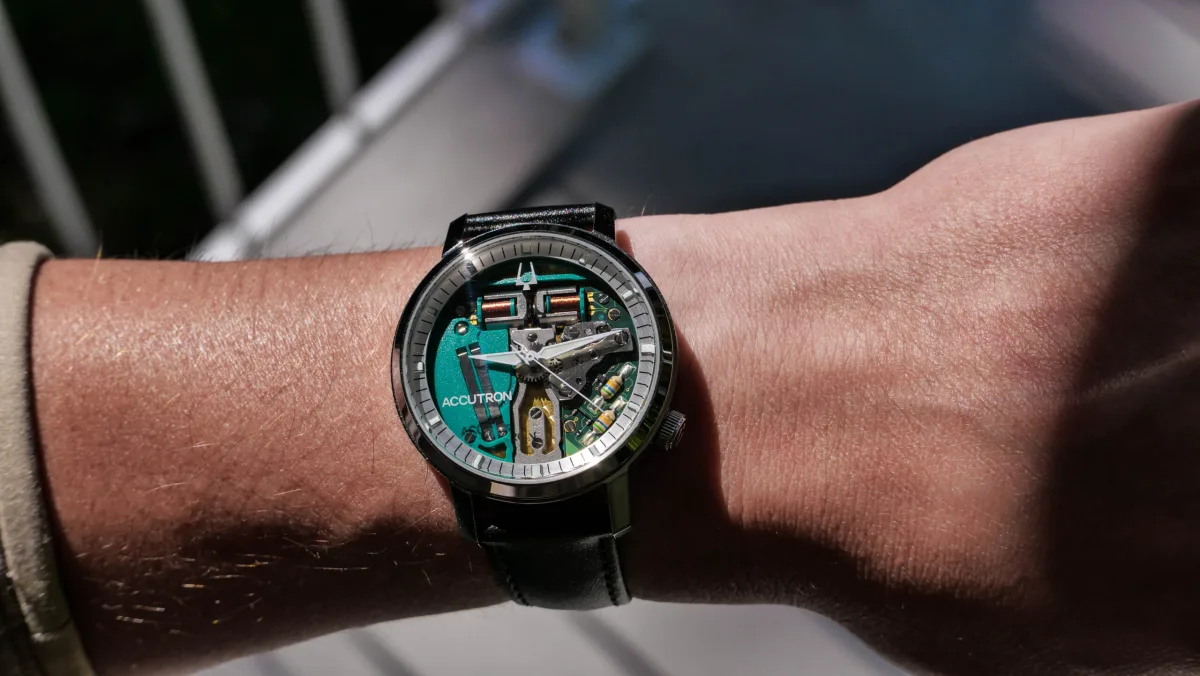
Turning the watch over reveals its famous Japanese movement. Unlike traditional mechanical calibers, there is no complex array of parts, yet the movement is a hybrid of mechanics, quartz, and tuning fork technology.
The case back is done in a gold-copper color with a vertical "Geneva stripes" finish. Screws and the battery are visible, and the main visual highlight is a small elliptical window displaying the reverse side of the tuning fork.
Comfort and Wearability
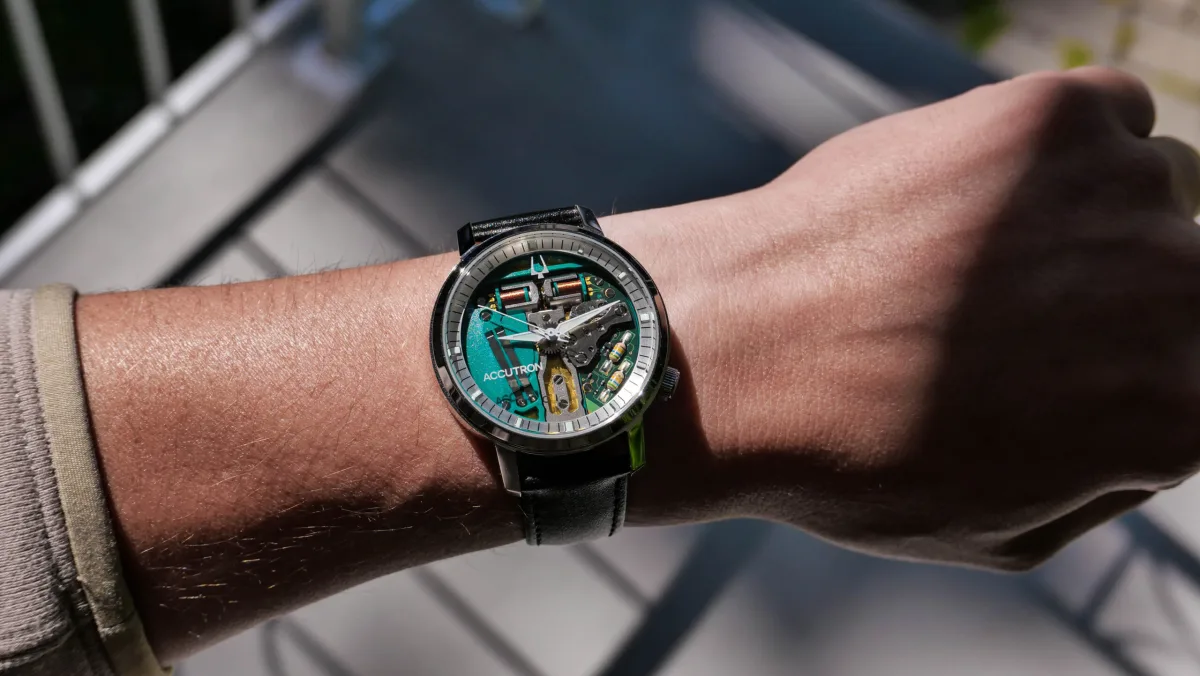
The Accutron Spaceview 314 has a case diameter of 39 mm and a thickness of 13.4 mm with short, beveled lugs. In size, the watch sits on the wrist exactly like a 39 mm model. It looks great on my 16.5 cm wrist. As a watch enthusiast, I would have liked to see a thinner case, but the thickness is probably due to the features of the tuning fork technology, as a classic quartz movement would have allowed for a much thinner watch.
Overall, the watch is very comfortable to wear and looks impressive both up close and from a distance.
Final Conclusions and Recommendations
These watches don't just happen to come into your hands. If you're reading this review and studying the Spaceview 314, you're likely a fan of the original 1960s model with caliber 214 and know exactly what you want.
The vintage 214 has become a collectible rarity and is increasingly difficult to find in good working condition. Additionally, outdated battery technology complicates maintenance, requiring modifications and adaptation to modern power sources.
The Spaceview 314 addresses these issues, offering a higher level of production and an improved Y230 tuning fork movement. The watch's appearance is as close to the original as possible - the open dial and neat component arrangement with high-quality finishing create an impressive visual composition.
The only downside might be the price - $5990 USD. It's a significant amount, but you are getting one of the most unique watches in watchmaking history, combining technological innovation and aesthetic appeal.