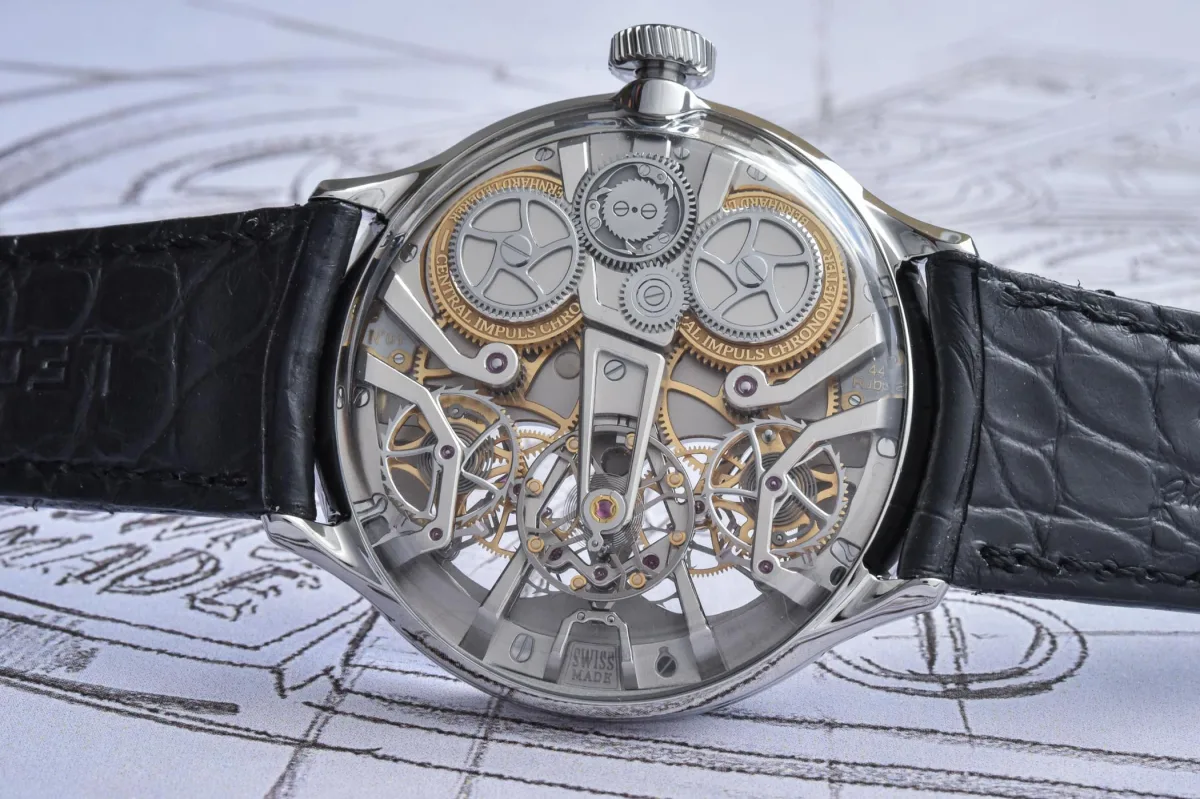
Lederer Central Impulse Chronometer is one of the most intriguing technical concepts introduced recently. Inspired by George Daniels' independent double-wheel escapement, renowned watchmaker Bernhard Lederer developed a highly efficient double-wheel escapement driven by two independent gear trains, each with its own barrel and constant force remontoir d’égalité. After presenting the first prototypes about a year ago, the Lederer Constant Impulse Chronometer is now available in its final version. While technically little has changed, the new dial brings an elegant look and an interesting view of the mechanism and its concept.
The basic principle of a mechanical movement is as follows. Energy is stored in the mainspring inside the barrel. Energy is released through the gear train, which moves the watch hands. The speed of the gears is controlled by a regulator consisting of the escapement and oscillator. The escapement transmits energy to the oscillator (the balance wheel and attached hairspring) via impulses. In turn, the oscillator regulates the escapement. Its oscillations regularly unlock the escapement, allowing the gears to rotate and the mainspring to unwind gradually.
The escapement, which supports and counts the oscillations of the watch movement, is undoubtedly one of the most complex and fascinating components of a watch. In the vast majority of mechanical wristwatches, a lever escapement, invented by British watchmaker Thomas Mudge about 250 years ago, is used. Despite its simplicity, it is reliable and particularly well-suited for mass production. However, its efficiency is low: the lever escapement transmits barely a third of the energy it receives from the mainspring to the oscillator.

Today, very few other escapements are produced. Omega's Co-Axial Escapement (originally developed in collaboration with George Daniels) was for a long time the only other escapement to reach mass production, and recently Grand Seiko joined with its Dual Impulse Escapement. However, over the years, several watchmakers have tackled the efficiency issue of the escapement and started developing alternative solutions, which is probably one of the most challenging tasks in mechanical watchmaking and chronometry.
INDEPENDENT DUAL-WHEEL ESCAPEMENT BY LEDERER
Among these recent developments is the unique escapement by independent German watchmaker Bernhard Lederer. One of the first members of AHCI (Academy of Independent Watchmakers), Lederer made a name for himself with innovative watch concepts, particularly with the brand BLU. Now, Lederer primarily operates behind the scenes through his company MHM SA in Saint-Blaise, developing movements and technical solutions for other watch brands… But he has returned with a watch under his own name, presenting an exciting example of watchmaking ingenuity.
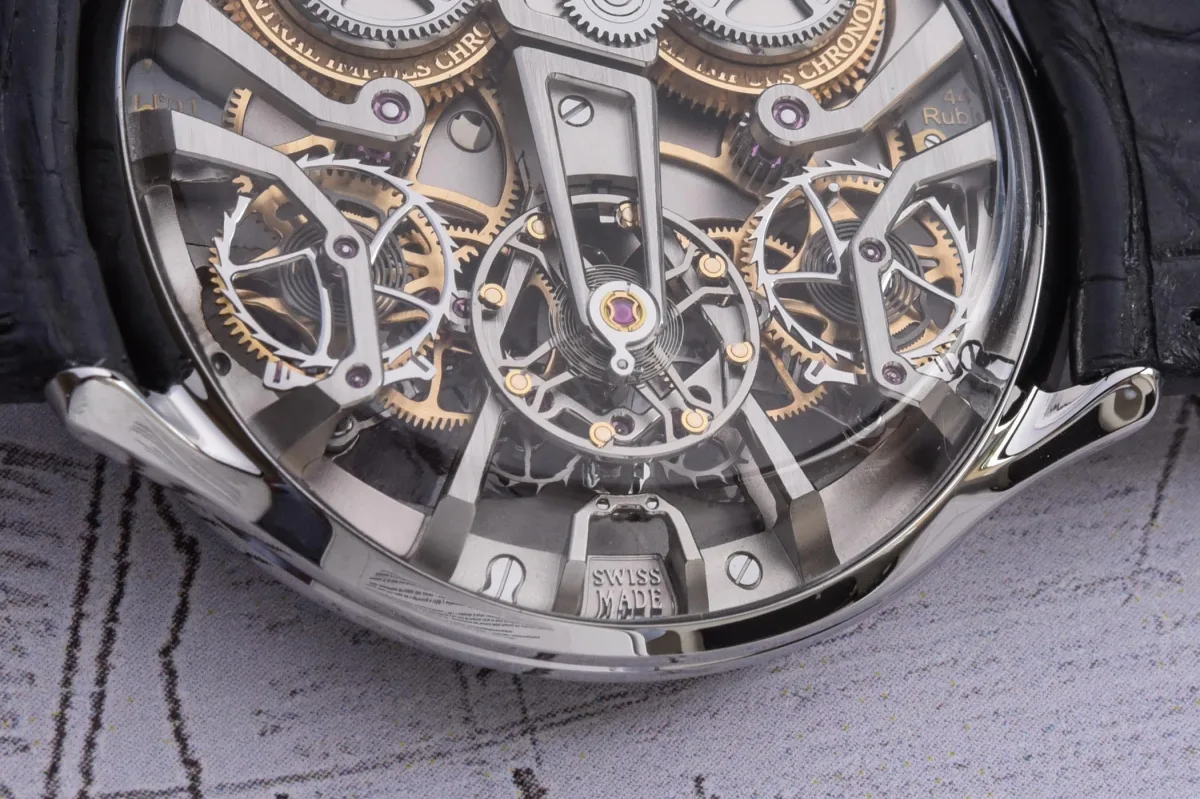
The Lederer Central Impulse Escapement is inspired by George Daniels' independent double-wheel escapement for pocket watches (with whom Lederer exchanged experiences several times), which the British master used for Breguet's natural escapement. This type of escapement, equipped with two escape wheels, is considered natural because the impulses are transmitted as directly as possible to the balance wheel roller.
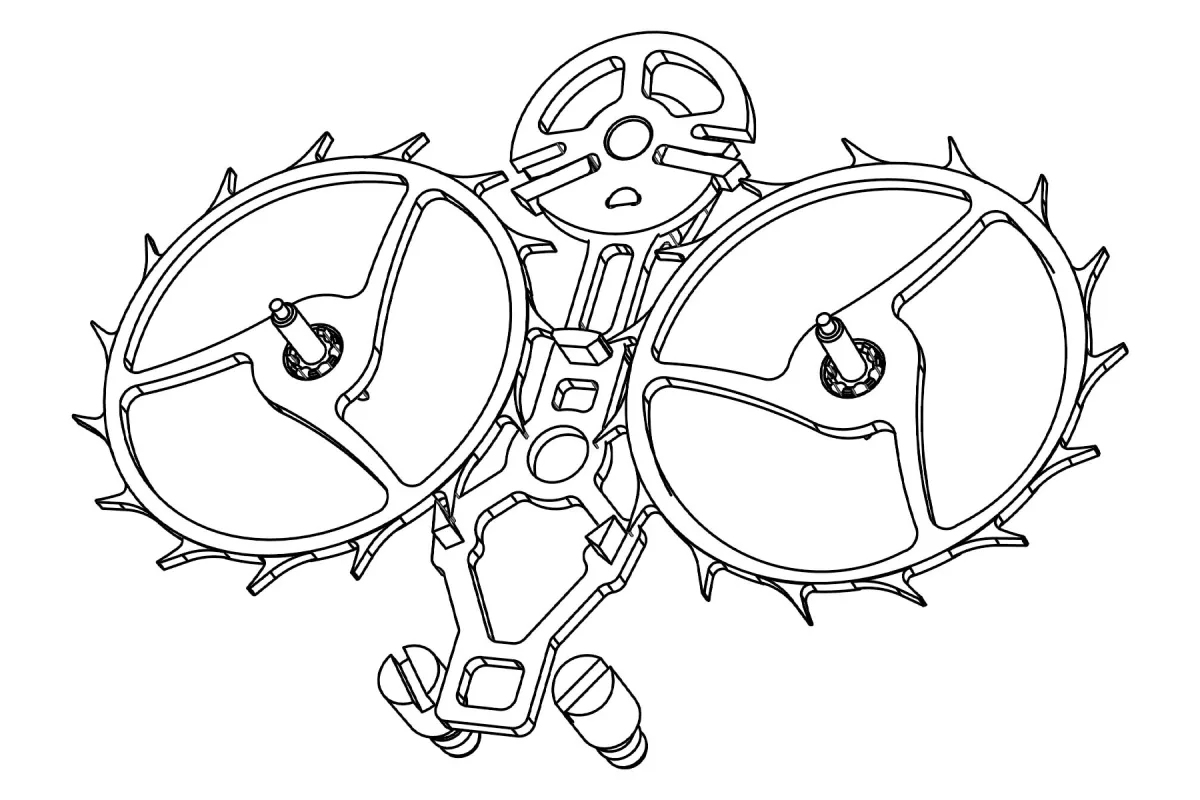
While several dual impulse escapements have been developed over the year, Lederer's originality lies in placing two escape wheels at the end of two separate gear trains, each with its own barrel. Thanks to the two independent gear trains, the two escape wheels do not need to be engaged with each other, making the escapement less complex and more efficient. Furthermore, to align the driving force, each gear train is equipped with its own remontoir d’égalité - a small spiral spring that periodically accumulates and releases a small fixed amount of energy. They are mounted on an intermediate wheel (roue de moyenne) and operate in 10-second cycles, which, according to Bernhard Lederer, allows for a more stable driving force.
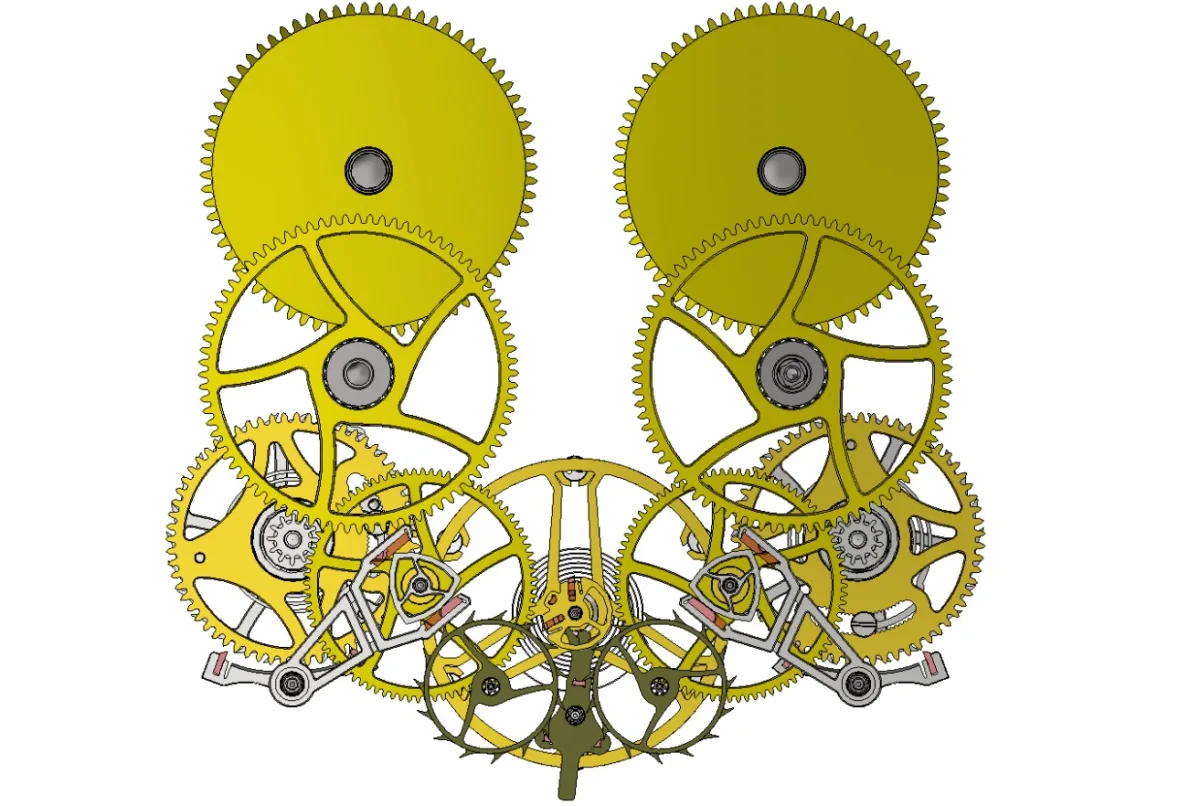
Bernhard Lederer also made numerous changes to the escapement, making the Lederer Central Impulse Chronometer unique. For example, the escape wheels and lever are made of lightweight titanium. With less inertia, they start quickly and are more energy-efficient. The shape and geometry of some parts have also been optimized. In particular, the central “waiting” locking stone is slightly rounded, whereas Daniels used a triangular stone. This is done to avoid the escape wheel recoiling in the opposite direction and to optimize the contact time of the escape wheel tooth with the balance wheel's impulse pallet. Explaining the sequence of the escapement functions, Bernhard Lederer speaks of an indirect impulse initiating the sequence (provided through the locking stone) and preparing the optimal direct impulse. Last but not least, according to Lederer, ensures the escapement's self-start.
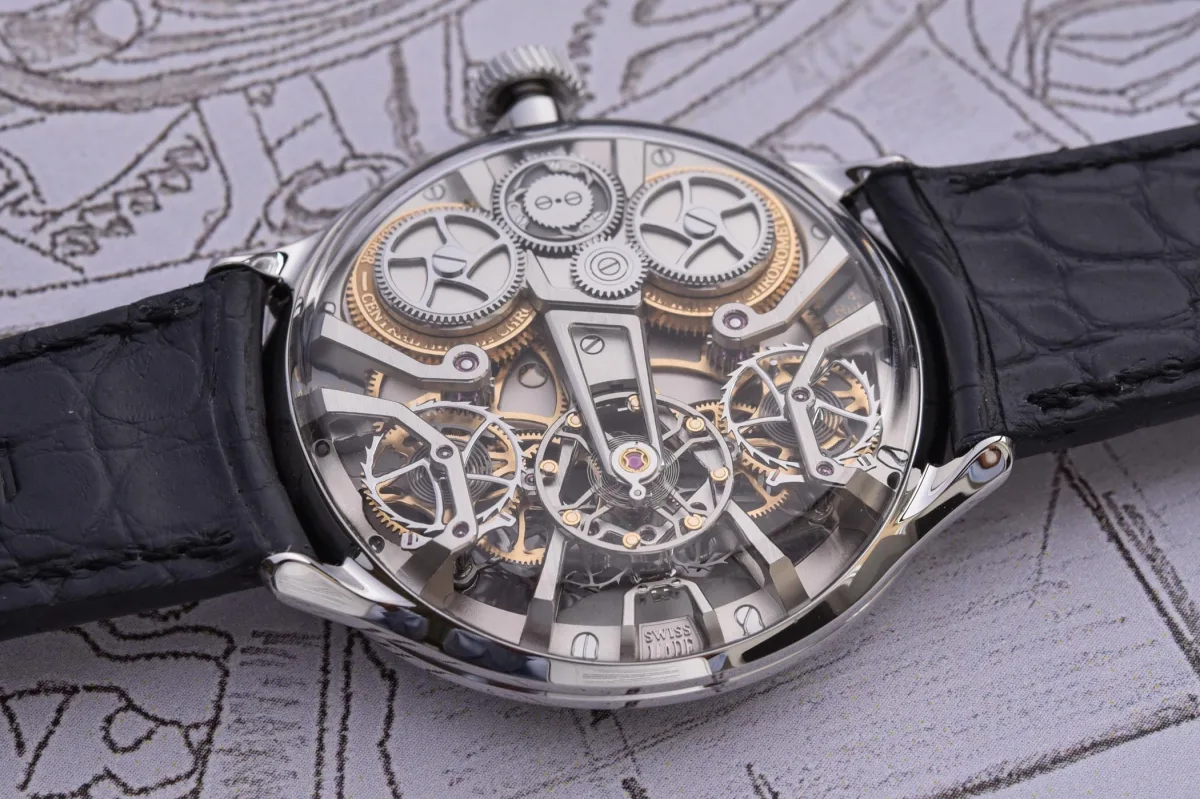
LEDERE CENTRAL IMPULSE CHRONOMETER IN ITS FINAL FORM
After the concept presentation about a year ago, the Lederer Central Impulse Chronometer is now presented in its final form. This fascinating technical concept remains housed in a 44mm case with two sapphire crystals - front and back. This allows for a thin case profile - despite the watch's thickness of only 12.2 mm, which is quite thin given the complexity of the mechanism. The sapphire glass on the case back also provides a captivating view of the magnificent mechanism with its three-dimensional architecture and beautiful finish.
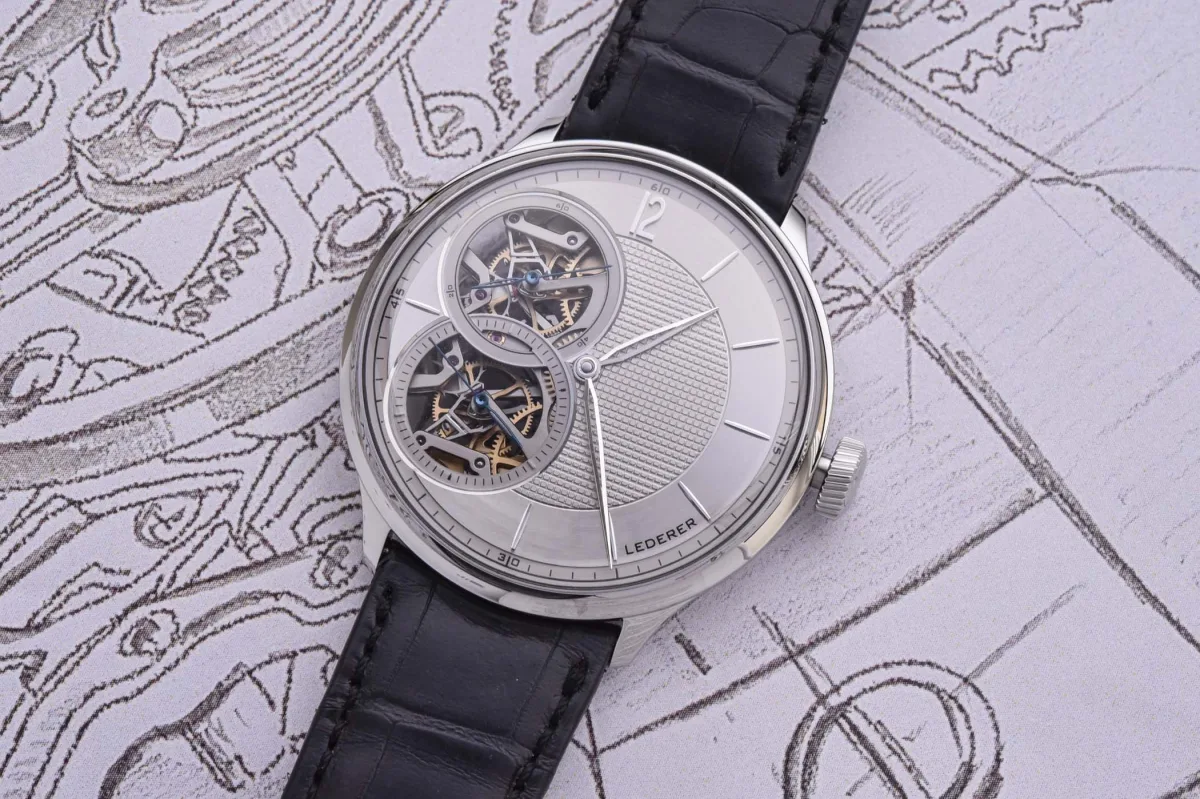
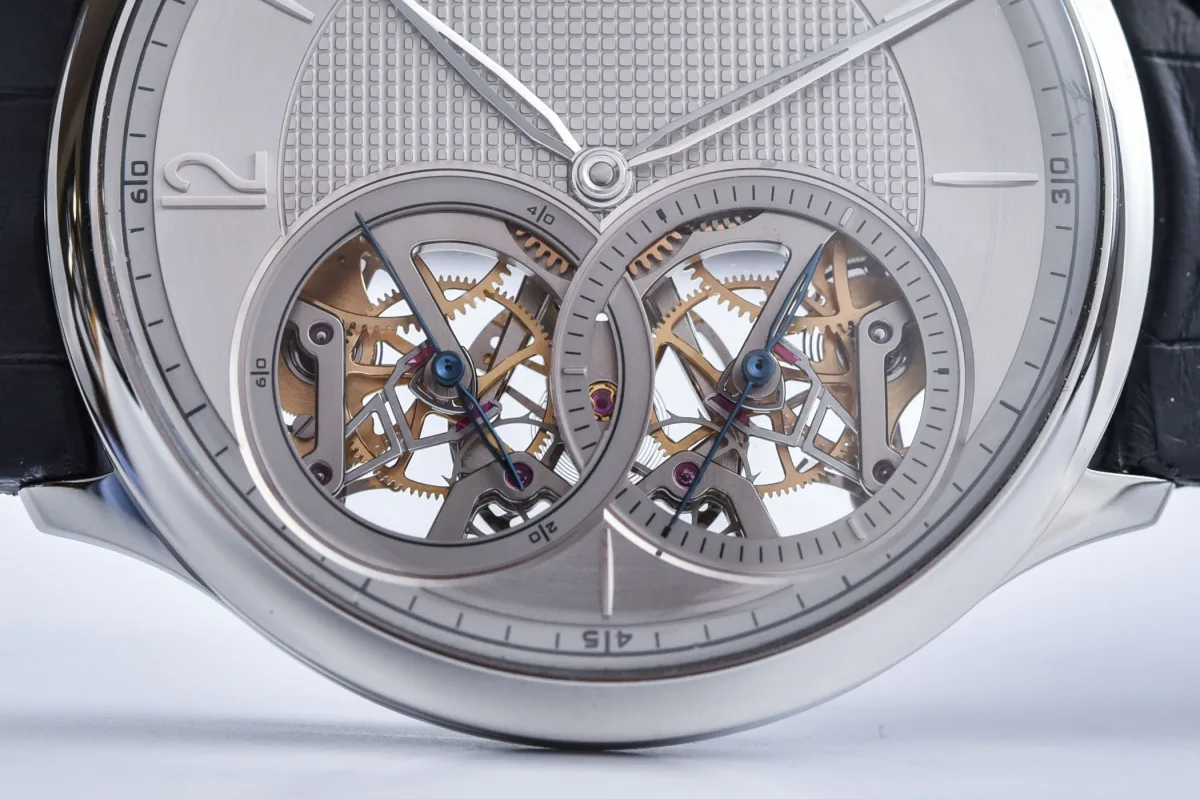
The main novelty of this final version of the Lederer Central Impulse Chronometer is its design and dial, which now has two round apertures, two interconnected circles forming an eight. Through them, the most important and impressive components of the mechanism - the escape wheels and remontoirs - are visible. Each aperture is equipped with its own seconds hand, synchronized and moving in opposite directions. For Lederer, this is also an opportunity to showcase his technical concept beautifully and express an original, symbolic vision of time.
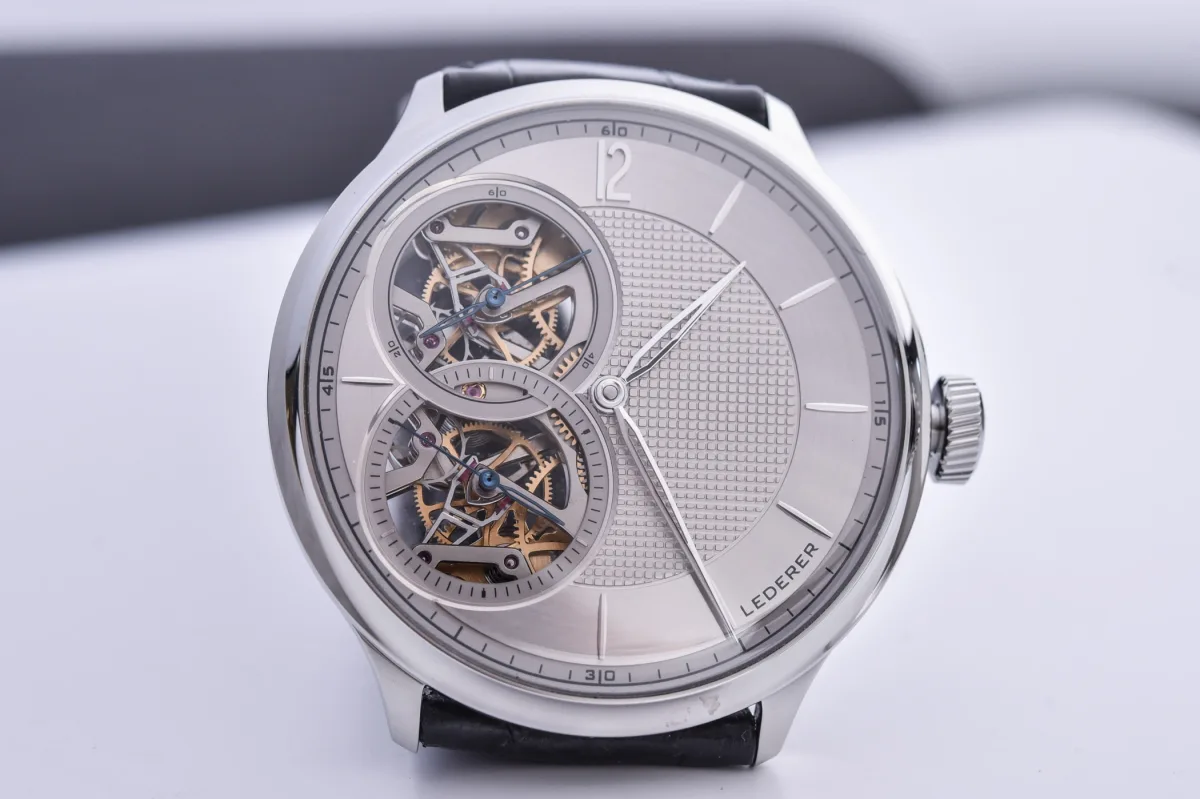
The Lederer Central Impulse Chronometer is offered in two limited series of 25 pieces in white gold, with a blue dial or a rhodium-plated dial. The price is set at 128,000 Swiss Francs.
More information on ledererwatches.com.
TECHNICAL SPECIFICATIONS – LEDERER CENTRAL IMPULSE CHRONOMETER
Case: 44 mm diameter x 12.2 mm height – 18k white gold – sapphire crystals front and back – water resistance 30 m
Dial: guilloché (exclusive Lederer motif) with two circles intertwined into an eight. Available in two colors: rhodium-plated and dark blue.
Movement: caliber 9012 – manual winding – 39.3 mm x 5.98 mm – 21,600 vibrations per hour – 42-hour power reserve – 44 jewels – 210 components – two barrels, two independent gear trains, two automatic mechanisms, central impulse escapement – hours, minutes, small seconds at 8 and 11 o'clock
Strap: alligator leather strap with gold clasp
Availability: two limited editions of 25 pieces
Price: 128,000 SWISS FRANCS