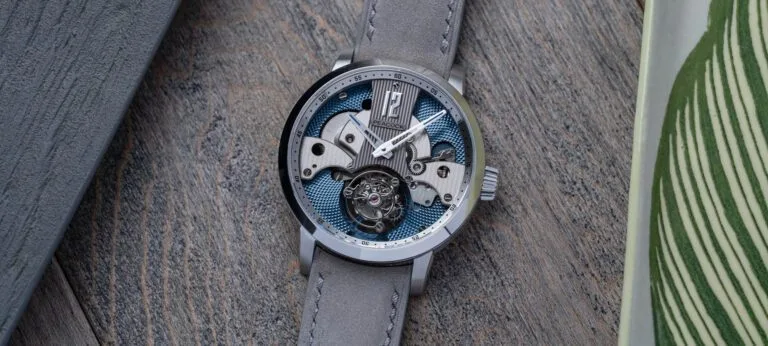
I have never before conducted a full review of a watch with a tourbillon.
Of course, I have handled many such models at exhibitions and meetings, and have written reviews of new releases, but the time spent with them was relatively short compared to a detailed analysis. I have even developed some skepticism towards tourbillons and other unnecessary watch embellishments. So why did I decide to start with the Peacock Witness Tourbillon? For many, this may not seem like the best choice for a first in-depth acquaintance with a tourbillon. However, the Peacock Witness immediately caught my attention: I appreciate depth and texture, and watches where each element is deliberate and intentional. This model meets all these criteria.
Peacock: A New Level of Chinese Watchmaking
People often associate the Peacock brand with the image of Chinese watchmaking from the early 2000s and 2010s. In reality, Peacock is an example of how far the Chinese industry has come in recent years. There are certainly more expensive Chinese manufacturers and independent masters creating impressive pieces. Nevertheless, Peacock is rightfully considered a flagship of the new Chinese watch industry. Yes, it is still an industry that produces cheap watches like Daniel Wellington priced at 10 cents, and it supposedly "does not use Swiss parts." But in the last five years, the industry has demonstrated impressive capabilities in creating genuinely quality watches. Many brands have stopped hiding their Chinese origin or use of Chinese parts - on the contrary, they proudly declare it. Examples include Atelier Wen (which uses Peacock movements), CIGA, and Behrens. Atelier Wen and Behrens were nominated for the GPHG award, and CIGA won it.
Case and Design: A Blend of Simplicity and Premium Quality
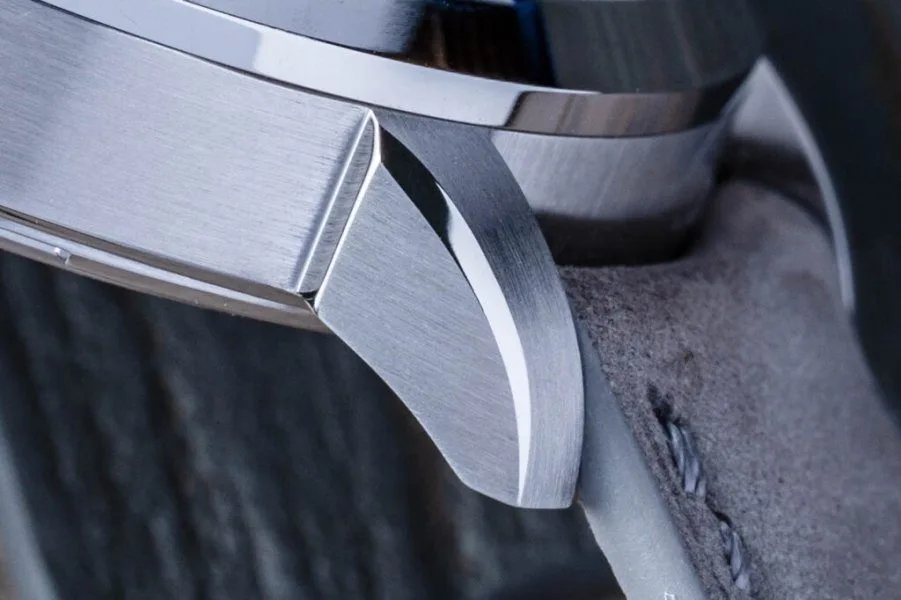
The Peacock Witness is equipped with a relatively simple but premium-looking case. The design is not overly ornate, yet it's clear that the manufacturer was inspired by high-end brands. The case consists of three parts: a polished homogeneous bezel surrounds a flat sapphire crystal. Beneath it, between the polished ring of the case back, is a horizontally brushed middle case, and the space between the lugs is finished with vertical brushing. The lugs are particularly noteworthy - they resemble those of Lange. Although they are shorter than Lange's, they have a wide polished bevel, a smooth curved shape with a flat end surface, and interestingly, a notch at the connection point with the case. For Lange, this notch is due to the lugs being attached separately, but in the case of Peacock, this is likely not so. Nonetheless, this element looks impressive and is fully polished.
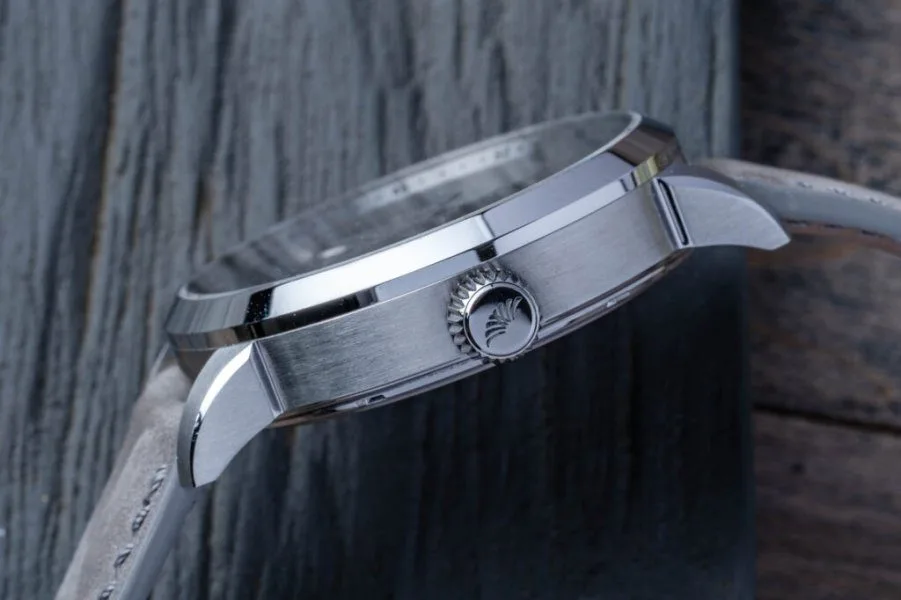
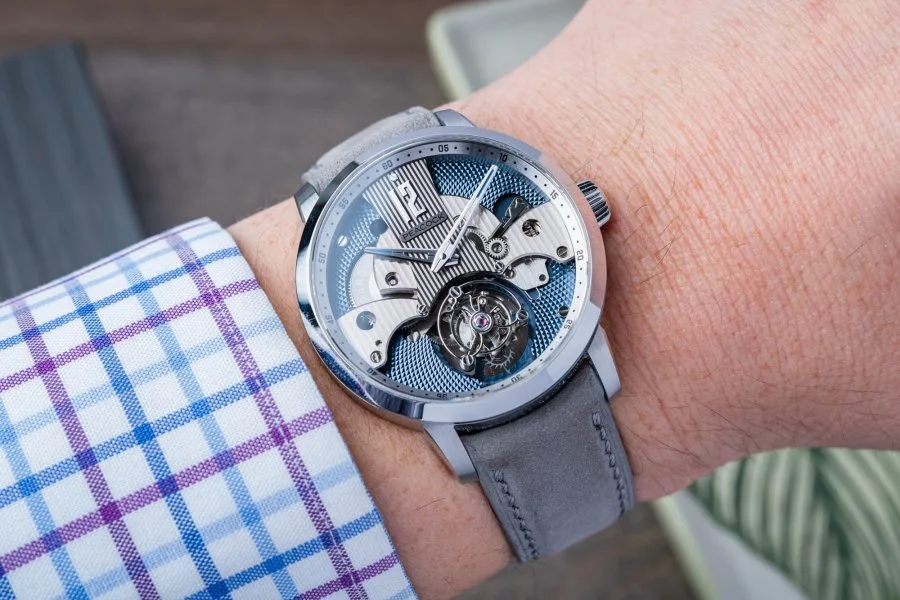
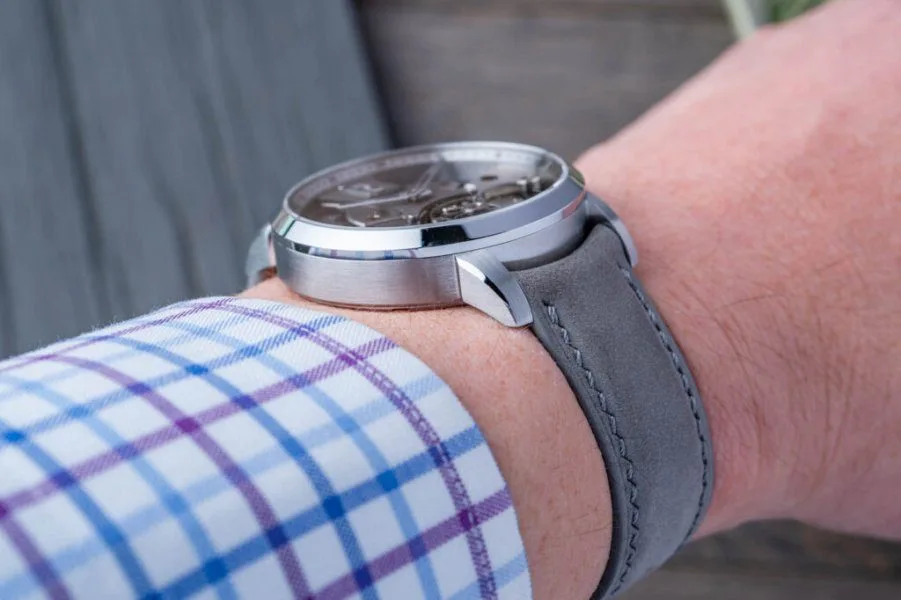
The case is made of 904L steel, with a diameter of 41 mm and a thickness of 11 mm. These proportions are versatile and particularly successful for a multi-layered dial. On my 7-inch wrist, the watch fit perfectly. The smooth transition of the strap from the case to the wrist adds to the comfort. A 20-millimeter suede strap with a quick-release mechanism, light padding, and curved ends is included. The strap quickly took shape, and the padding was not uncomfortable. However, the holes for the spring bars are located quite close to the case, making straps with straight ends either rub or not fit at all. I have several straps with curved ends, but they lack padding, and I realized that due to the flat sides of the case, a padded strap looks better.
Dial: Depth, Texture, and Unique Aesthetics
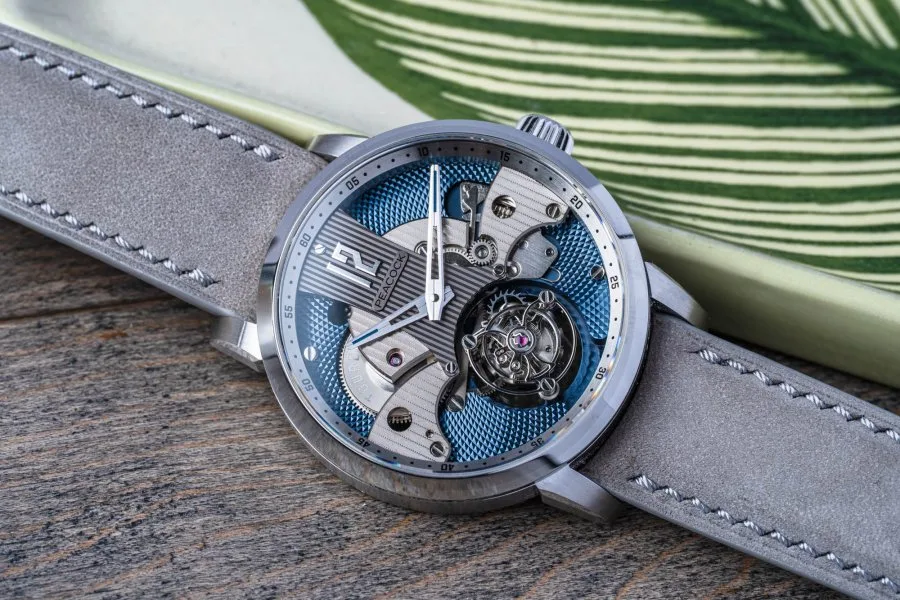
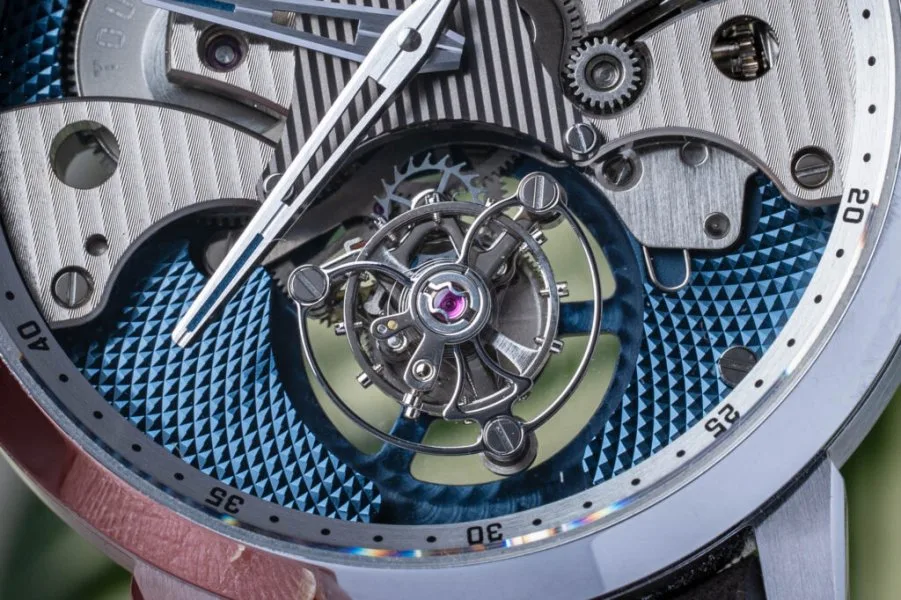
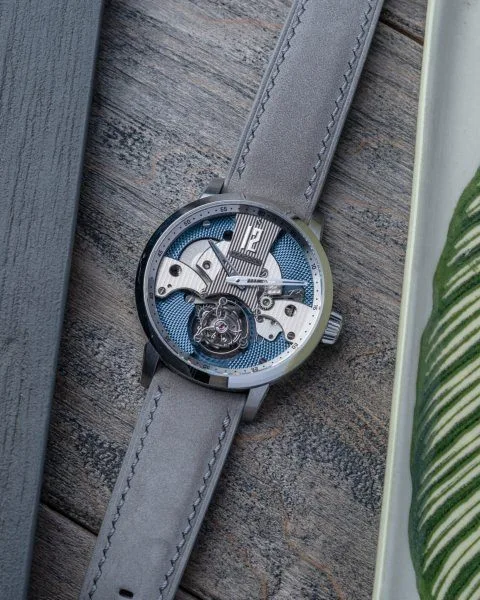
Looking at the dial, I remember the Girard-Perregaux Free Bridge Meteorite watch, which I reviewed earlier. Both dials feature depth and texture, with the time regulator positioned at the "6 o'clock" mark. While GP looks sharper, the Peacock Witness is more of a demonstration with an airy and appealing design. Aesthetically, it is closer to the Christopher Ward C12 Loco, which also features layering and texture but is significantly cheaper than GP. In any case, the Witness dial is a real success. Essentially, the dial is the mechanism itself, available in gold, purple (sold out), black (with black bridges), and blue colors. I especially like the blue and purple - black seems too gloomy, and light gold - not expressive enough. The saturation level of blue and purple is executed perfectly.
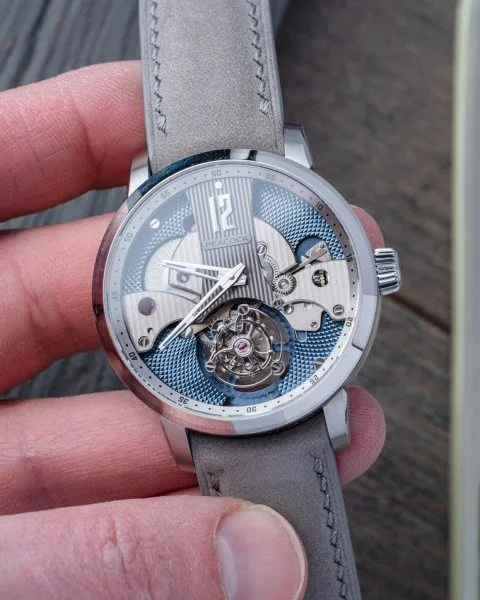
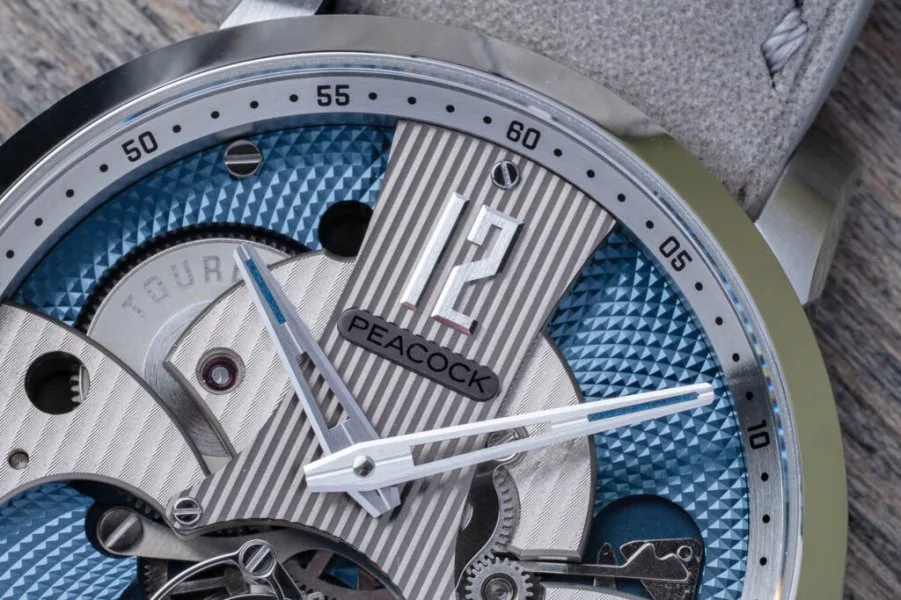
The main plate of the mechanism is decorated with two types of finishes: pink guilloche in a "pineapple" pattern on top and blue perlage in the recessed parts. The bridges have a neat bevel and a striped texture, while the exposed elements of the winding mechanism are polished and matte-finished. The hands perfectly complement the dial - they are skeletonized, with facets treated with brushing and polishing, and the tips are colored to match the dial (they do not glow). Completing the look is a large "12" on a striped bridge above a darkened horizontally brushed plaque with the brand name. The only controversial detail is the "TOURBILLON" inscription on the winding barrel. The winding barrel is not a tourbillon, and in my opinion, marking functionality on the dial seems inappropriate, but it does not spoil the overall impression of the design.
Tourbillon: An Ornament, Not a Complication
I have repeatedly expressed my opinion on tourbillons in other articles, but I will repeat briefly. Tourbillons are not complications and are almost entirely devoid of practical necessity in the modern world. They mainly serve a decorative function, and there is a place for that. Previously, a tourbillon cost at least 40 thousand dollars, but the situation has changed. Now several Swiss brands offer tourbillons at a more affordable price - Bremont, Louis Erard, Delma. They all use a mechanism from BCP Tourbillons, and although they are significantly more expensive than Peacock, in my opinion, they look less attractive. This is because the Peacock watches are designed entirely around the tourbillon, rather than having it as an addition. The depth and complexity of the tourbillon harmoniously blend with the other elements of the dial, creating a cohesive image.
Peacock PAX9612 Movement: In-House Production with a Focus on Color
The Peacock Witness is equipped with its own PAX9612 movement - one of several tourbillon calibers of the brand (including a double tourbillon). As mentioned before, the entire main plate is colored blue, including the back side with striped finishing and openings for light to pass through the tourbillon. The winding mechanism is pleasing to the eye, although fundamentally quite simple.
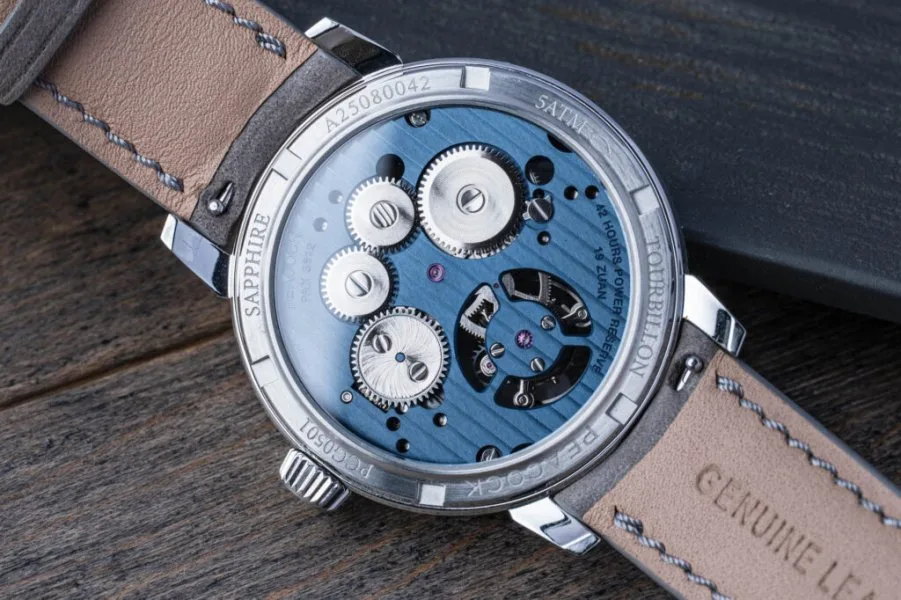
The color palette plays a key role in its appeal, and there is nothing wrong with that. However, in terms of finishing quality, it falls short of more expensive movements, such as those from Glashütte Original. But it is important to remember that the goal here is not to compete with the elite but to show what is possible for more accessible money. The power reserve of the movement is 42 hours at a frequency of 21,600 vibrations per hour.
Conclusion: Why Start Your Tourbillon Journey with Peacock
Why did I choose Peacock for my first tourbillon review? Better to ask: why not? Starting with the affordable segment is an excellent way to understand what is really achievable and how price and quality relate. It helps to separate the product's value from brand perception and other factors. Are Peacock Witness watches equal in status to Vacheron Constantin or Lange tourbillons? Of course not. But the wave of affordable tourbillons has shattered the illusion of exclusivity created by luxury brands. Like most complications, the tourbillon has become democratic. The Peacock Witness is proof of that. The model is priced at $2,299 USD.