There are so few watches that can be called unique, new, or original.
Even rarer are watches that truly deserve these words while managing not to overcharge 95% of the population. Most stunning innovations and designs come with corresponding prices, leaving most of us empty-handed. At best, we have to settle for ersatz derivatives of what we really want. The buzz around Kollokium was gradual, building to a crescendo that culminated in a very limited release for friends and family. The new brand from watch enthusiast Amr Sindi, Manuel Emch of Louis Erard (and formerly of Romaine Jerome and Jaquet Droz), and designer Bart Nussbaumer was created in 2020 with the aim of "creating something from scratch, without any established or inherited frameworks." The Kollokium Projekt 01 achieves this goal, and even more.


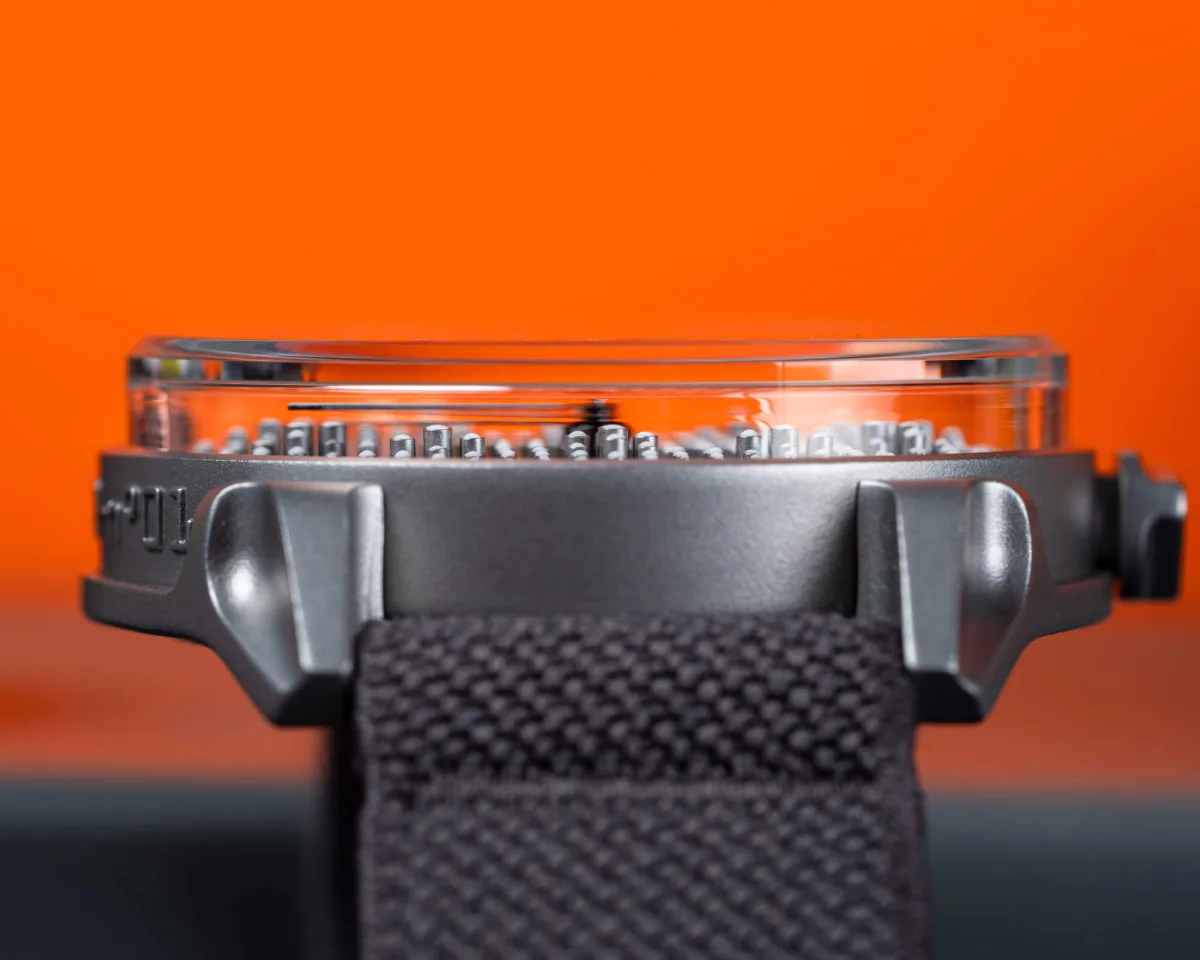
The watch features a satin-finished steel case, but its production and construction are not typical. Instead of the CNC machine used by 99% of brands, the Kollokium Projekt 01 case is pressure-cast in two parts. It sets the tone for the entire watch, which the brand calls a neo-brutalist design. The base of the 40mm case serves almost as a cradle for the other parts of the watch: the lugs first rise up to embrace the watch and then move outward and downward to hug the wrist.
The upper part, including the middle case and crystal, measures 38.5mm, and I would say that this is a more accurate representation of how the watch feels on the wrist. On the left side, there's almost cryptographic embossing with the abbreviated brand name and model, while on the right, there's what the brand calls a "valve-like" crown. This crown looks aesthetically pleasing but is not very functional. With three satin sides, the grip is not ideal, and even pulling it out can be awkward. Perhaps this model is best left in a winder.


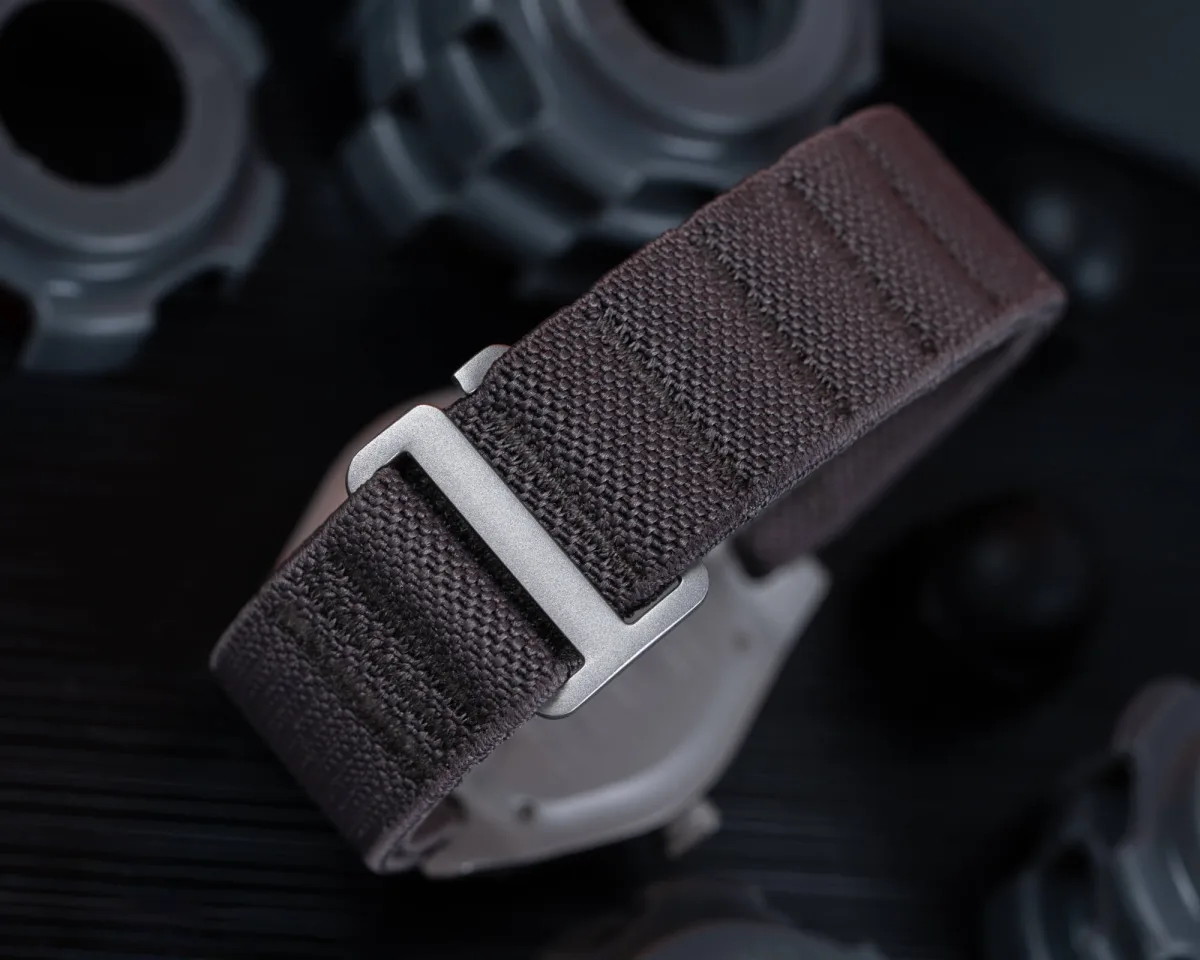
If you look at the watch's profile, you can see three distinct tiers: the bottom, middle, and crystal, each stepping inward. It creates the illusion of draping, as if the watch expands from top to bottom. If you've worn such a watch (a bulkier and less soft example might be the Oris Aquis), you know that they do not match their stated sizes and fit beautifully on the wrist. The standard equipment of the watch includes an elastic nylon strap with hooks and loops that is incredibly comfortable.
If you are not familiar with these straps, one end has a spring bar slit, and the hook end is threaded through another loop, like a NATO, and then hooks onto itself. You get the NATO comfort without the thickness (or security, I suppose). Although I didn't photograph them, I tried them on several straps; and while you need to be careful with thickness, the black-and-white color scheme and 20mm lugs allow for many pairing options.

The sapphire crystal here is simply huge, box-shaped, and takes up almost half the height of the watch. It not only looks amazing but also allows the incredible dial not to interfere with other dimensions. There is no bezel, so the crystal is a showcase for the dial. So far, I've talked about the case, but even thanks to pressure casting and the two-component construction, its shape is not entirely new. It's still a round watch case with pointed lugs, even if these elements are executed in a new way.

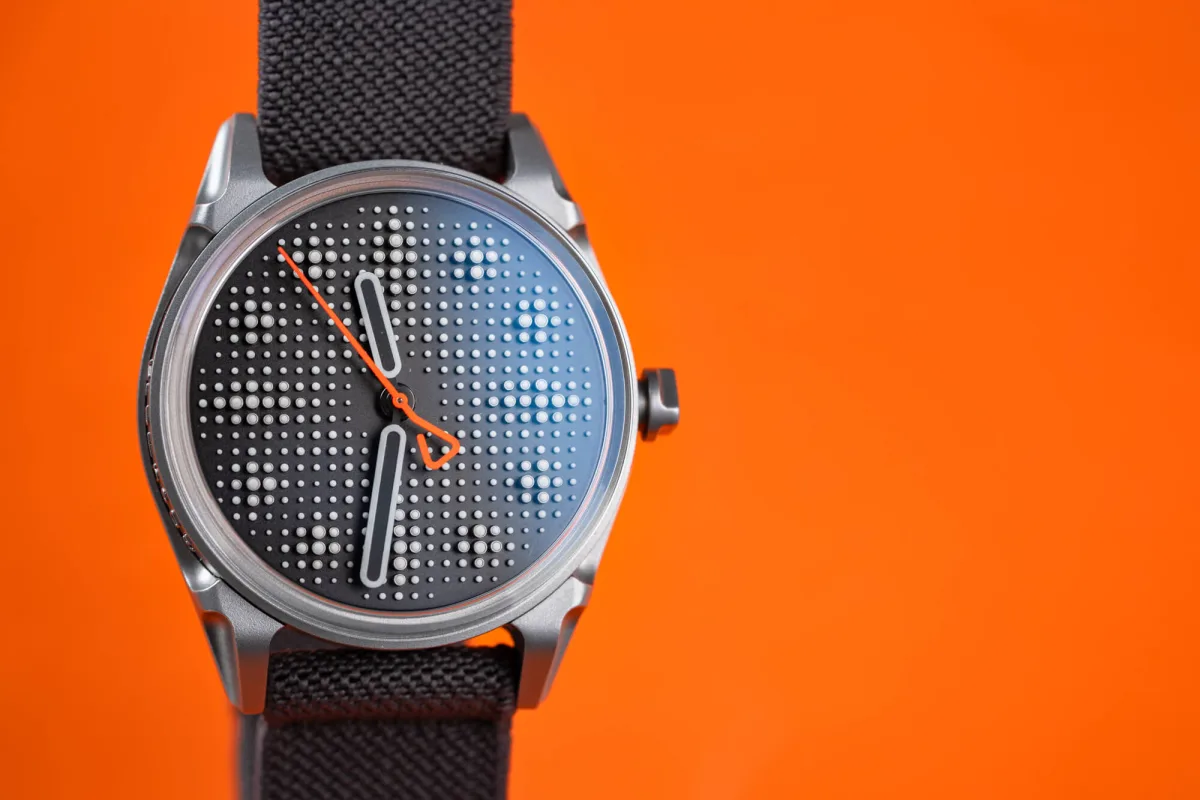
The dial, on the other hand, is entirely new. We've all seen dials with depth and texture, but this is something more. On the matte black dial, 468 cylindrical markers of varying heights and diameters are hand-placed, with the tip of each hand-painted with orange-glowing Super-LumiNova. The cylinders are arranged so that they rise and expand at each hour and descend between them. If you've ever played with a pinhead toy, this is probably what comes to mind first. From the side, the dial looks like a metropolis with an endless sea of massive buildings (when I wore these watches, my son asked me to "show him the city").


The handset is simple and modern, with a black base and an orange luminescent outline that doesn't shine as brightly as the more concentrated luminescent dial. The second hand reminded me of an angular shepherd's crook. It has no luminescence but is so electrically orange that it is visible in virtually any lighting.
The fully luminescent dial is one of the main attractions of this watch, and on the wrist, this spectacle looks very impressive. The lume doesn't last very long (I've heard that this issue will be resolved in future models), but every time it glowed even a little and was visible, I took the time to look at it. Thanks to the difference in the glow of the dial and hands, as well as the bright orange of the second hand, you get three different shades of orange at once. I think I would have preferred a different lume color on the hands to make them more contrasting and readable in low light.

The iconoclastic style continues on the case back. Like on the case backs of Bell & Ross watches, there's text with the name and model on the left, followed by all necessary information in German. Below it is a bold text accusing the heroes of high horology of creating watches that are impossible to use. (The irony is that with 30m WR, the Kollokium is not exactly adventure-ready). Under the case back is the La Joux-Perret G101, a date-free version of the LJP G100. This movement is gaining more attention as an automatic alternative to Swiss Sellita and ETA. It provides an excellent 68-hour power reserve at 28,800 vph.
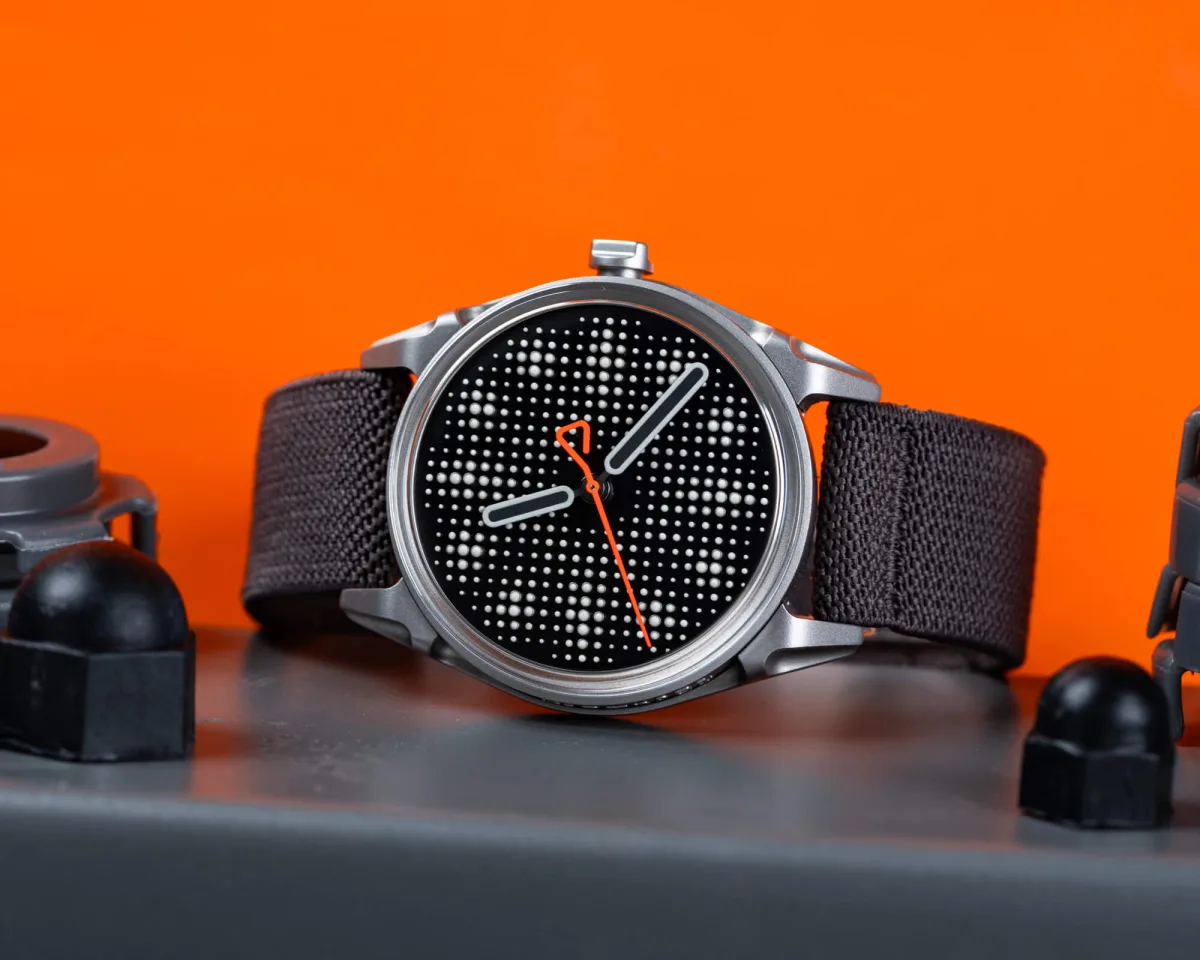
The design of watches has quite clear boundaries if you want to make the model accessible and appealing. There are materials, shapes, and proportions that limit the possibilities of successful market promotion. Working within these frameworks, yet being able to create watches as original and fresh as those made by Kollokium, is something that should impress everyone, whether they like these watches or not. Now, besides other Projekt 01 releases, the task is what comes next. Has Kollokium created a DNA with one watch that it will use to create other watches? Or will the brand take a more complex path, starting from first principles for its second model? I would like to see how this idea is implemented in a chronograph or diving watch, but I'm also intrigued by how the trio might approach these watch archetypes without the constraints of existing design language. In any case, Kollokium is up to something, and I will be watching them.
The Kollokium Projekt 01 watch in this iteration was limited to 99 pieces, intended almost exclusively for the brand's "friends and family." These people have long since moved on, but the brand did not intend to release a single watch and close shop. In the first half of May, Kollokium will release "Variant B," shown above. These will be the same watches with lume glowing blue instead of orange and a fully luminescent white second hand.
The price of the Kollokium Projekt 01 is 2,666.66 Swiss francs, and the Variant B model will cost the same but will be released in a limited edition of 199 pieces. For more information, visit the Kollokium website.