As any watch enthusiast will confirm, there are watch models that are such a great buy that missing them is simply not an option.
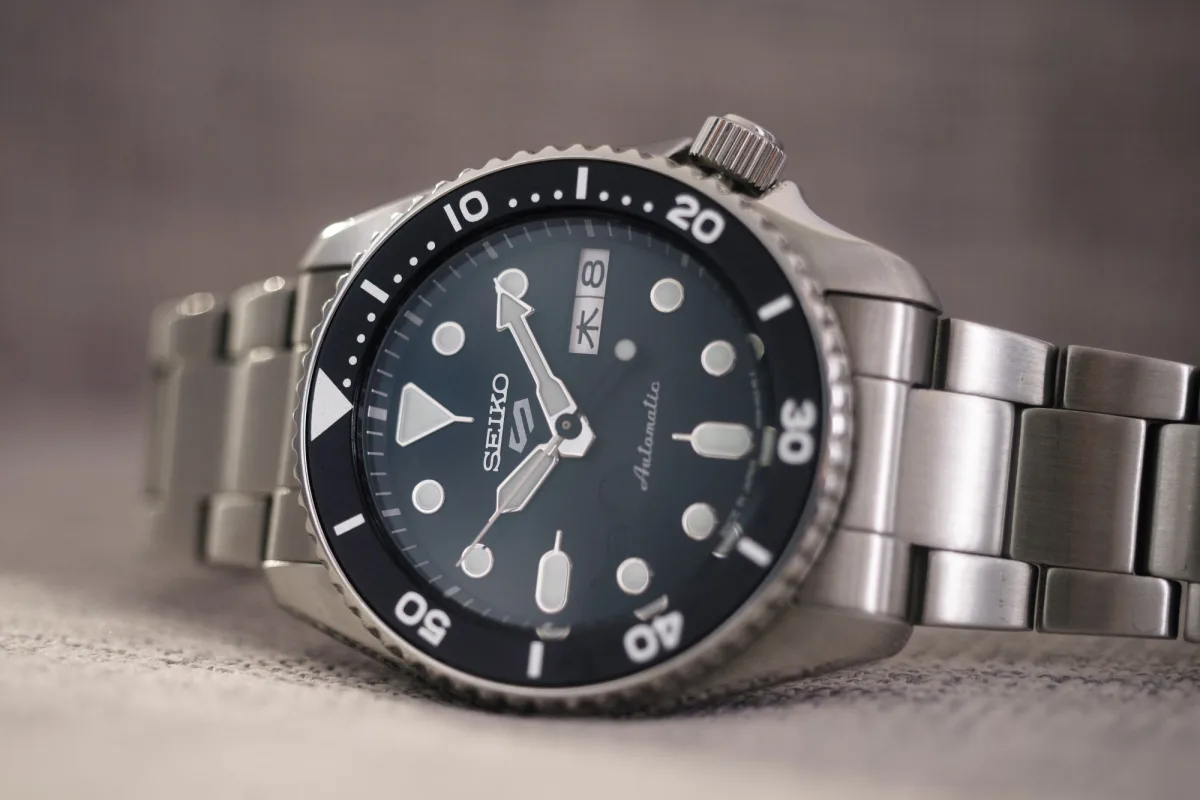
The legendary Seiko SKX series is a prime example and a significant milestone in the lives of many watch collectors. Some time ago, I had the opportunity to own the SKX013 model. Despite understanding the widespread enthusiasm for this model, it had several drawbacks that led me to sell it. Therefore, when Seiko announced the spiritual successor to the SKX series - the Seiko 5 Sports collection - I awaited the chance to see the watches in person before purchasing, with cautious yet noticeable interest. Now, a year later, I am ready to share my opinion. But first, the technical specifications:
| Parameter | Value |
|---|---|
| Model | SRPK29 (USA) / SBSA225 (Japan) |
| Case Material | Stainless steel |
| Case Diameter | 38 mm |
| Case Thickness | 12.1 mm |
| Lug-to-Lug Distance | 44.2 mm |
| Lug Width | 20 mm |
| Glass | Hardlex |
| Movement | 4R36 |
| Power Reserve | 41 hours |
| Frequency | 21,600 vibrations per hour (3 Hz) |
| Water Resistance | 10 bar |
Case
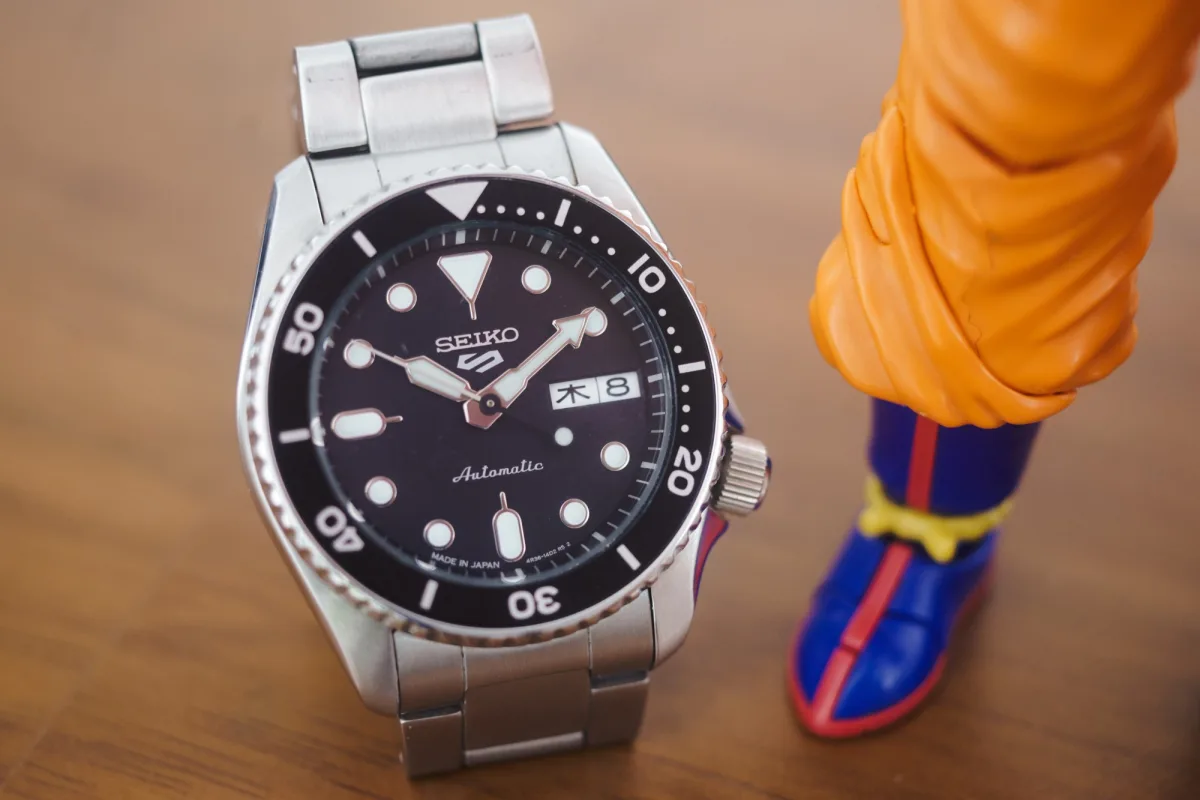
I always believed the SKX013 had better proportions compared to its larger sibling, the 007 model. The sleek silhouette and proportionally elongated lugs appeared to me far more harmonious than the somewhat bulky and stocky shape of the 007. However, the case thickness of 13 mm proved excessive, making the watch top-heavy and uncomfortable to wear.
Therefore, the news that the new Seiko 5 model reduced the case thickness by a whole millimeter brought me genuine satisfaction. The SBSA225 model wears excellently: the neat short lugs do not extend beyond the wrist, and the relatively small size by modern standards is combined with a pleasant weight, creating a sense of reliability. The polished sides of the case add elegance to this otherwise utilitarian tool with a monochrome color scheme.
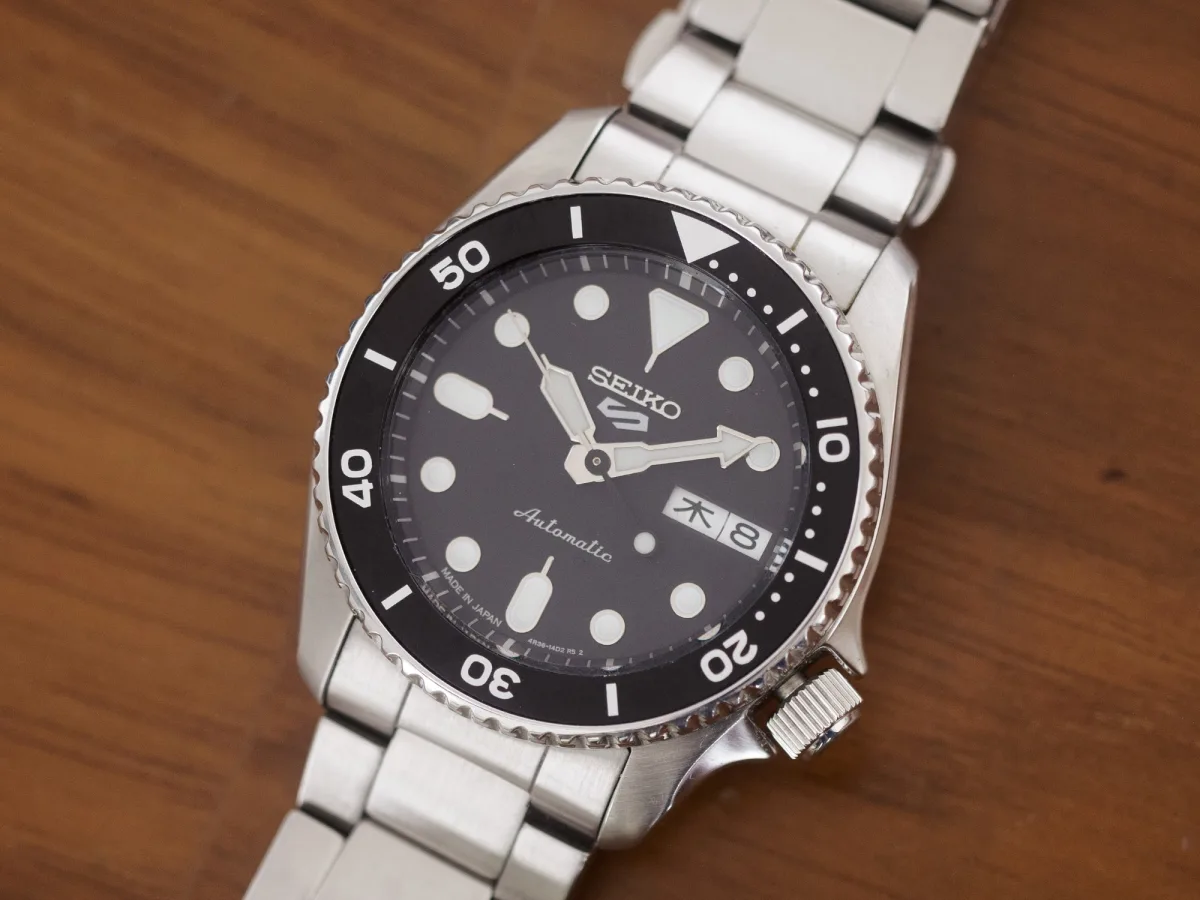
The crown is positioned at the "4 o'clock" position and oriented for comfort - it doesn't dig into the wrist like some models with larger crowns. However, there is an important difference from the SKX series: the crown is not screw-down, which directly affects the overall water resistance of the watch. I have mixed feelings about this. On one hand, I love dive watches for their reliability and confidence in water protection. In my collection, except for Casio and more formal Mido, almost all watches are divers.
Although I am not often near large bodies of water, the feeling of "invulnerability" of such a tool evokes a certain romanticism and even heroism. On the other hand, the non-screw-down crown makes manual winding easier - an important improvement over the SKX. Now you can not only wind the watch but also stop the seconds for precise setting! The old 7S26 movement was not known for accuracy, and the 4R36 is not certified as a chronometer, but honestly, a watch without a seconds stop function is more of a toy than a serious tool. I was a big fan of the SKX013, but I was always annoyed when I had to shake the watch to start the movement and couldn't set the exact time.
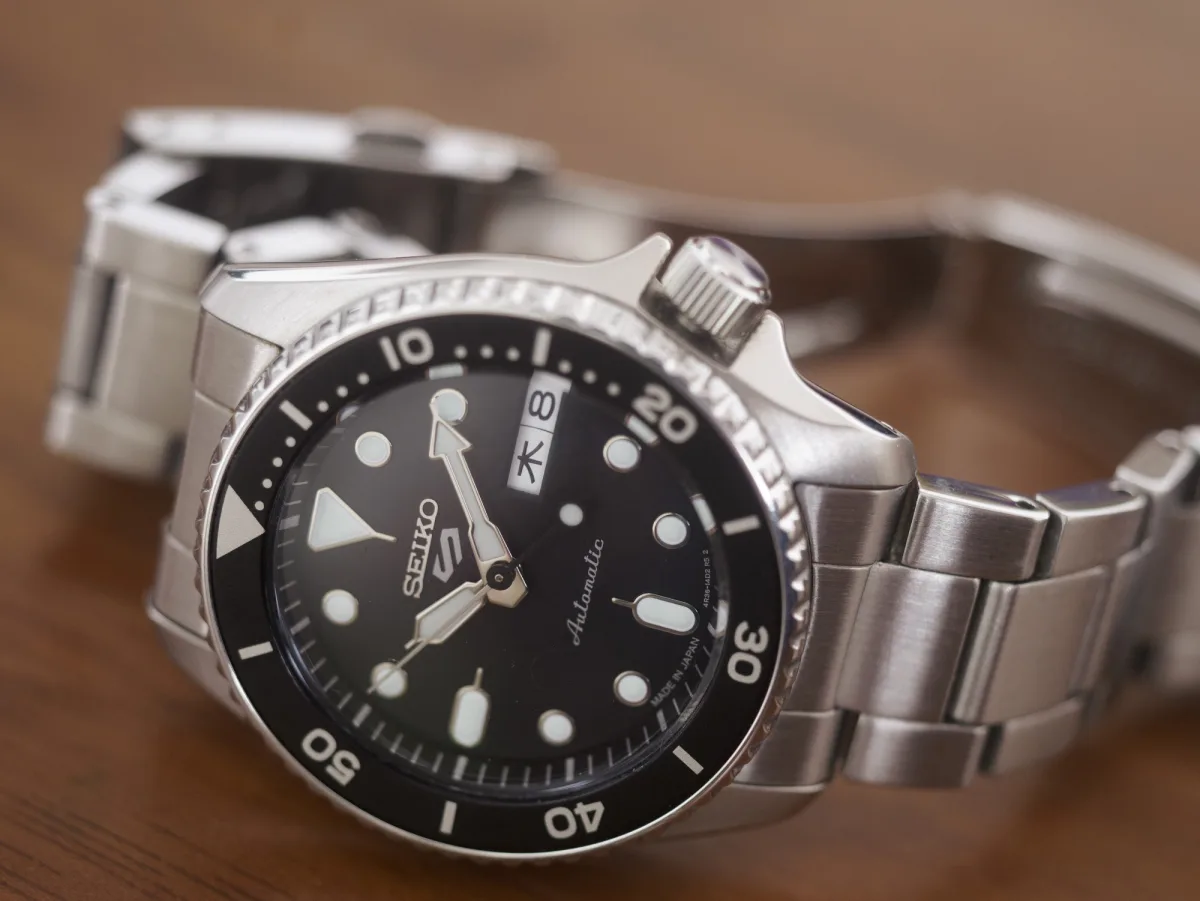
Turning over the SBSA225 reveals another pleasant surprise - a transparent case back. Even after a year, I enjoy taking the watch off and admiring the movement. The 4R36 movement does not claim to be a "beauty," but it is practical and perfectly complements the monochrome dial design.
Speaking of the movement's performance, I find the 4R36 quite adequate. On the first day after wearing, the watch neither gained nor lost a second, which delighted me. However, after a week, they began to consistently lose about 8 seconds per day. This quite quickly affects accuracy, so I have to stop the watch and reset the time with some margin - about a minute. I think I will fix this at the next service, which I hope won't be soon, as the 4R36 is, without exaggeration, a reliable and durable movement.
It is worth noting the excellent quality of the bezel rotation. It feels and sounds much more expensive than one might expect. The action is smooth and tight, with no play when rotating clockwise.
Dial
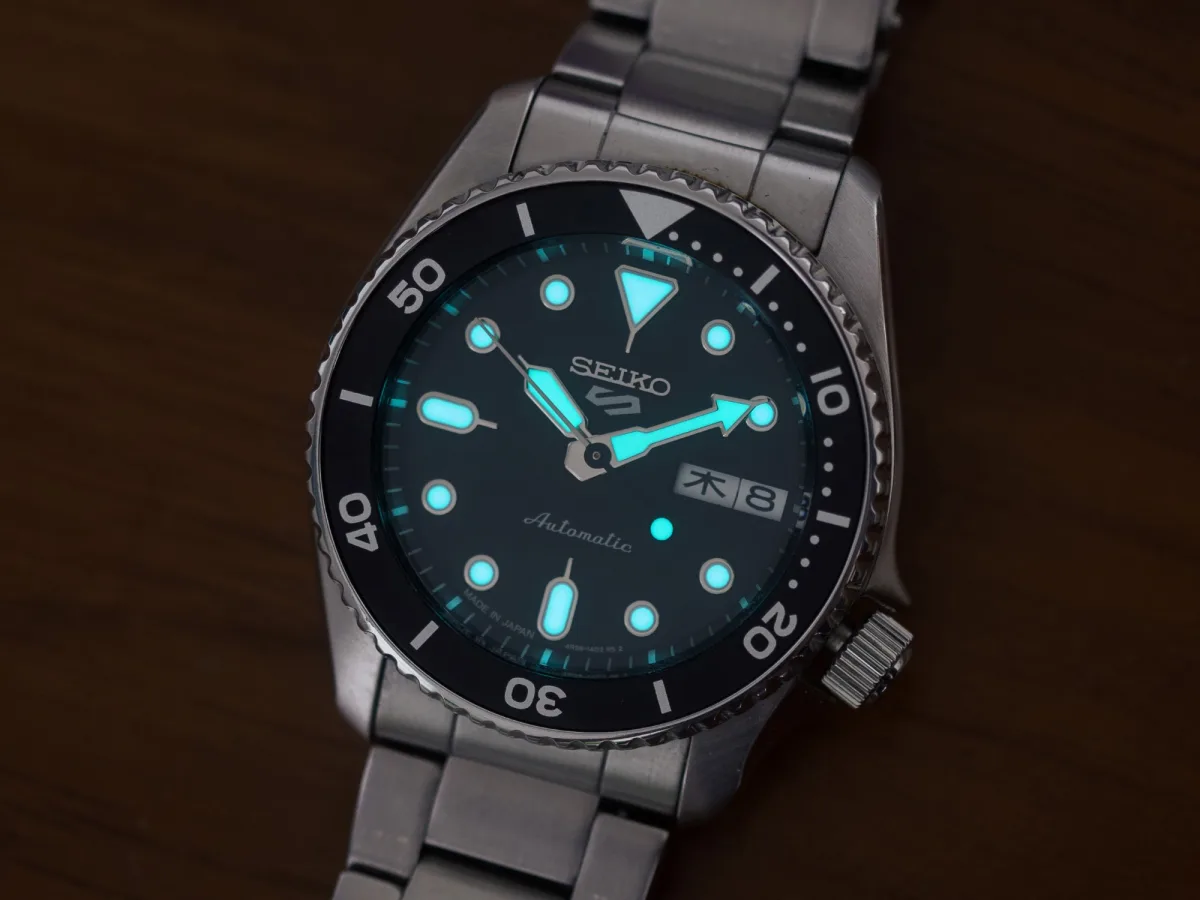
I like the contrast between the protruding indices and the matte black dial background. The new "House of El" logo looks nice, although I understand it may not appeal to everyone, especially fans of the previous "5" symbol, which was popular.
The only aspect that slightly bothered me when purchasing the SBSA225 was the hands. The new Seiko 5 model inherited the hands from the SKX007, which I previously considered less elegant than those of the SKX013. The minute hand seemed clumsy to me, and the "lollipop" on the second hand was inferior to the elegant hand of the SKX013. Now I have changed my opinion and have grown very fond of this design. I especially like the "lollipop" on the second hand: the black stem blends with the matte background, creating the effect of the hand "floating" above the dial.
The main reason I missed my old SKX was the day-date complication. I am so absent-minded that I often forget what day it is, so this was an additional argument in favor of the Seiko 5. Moreover, I chose the Japanese version of the SBSA225, where the days of the week are written in hieroglyphs - this adds uniqueness.
Some criticized the "Automatic" inscription in italics at the "6 o'clock" position. While I agree that this word is unnecessary for the watch community, it is personally harmless to me. I even like the balance between the capital letters at "12," the hieroglyphs at "3," and the italic at "6."
In the dark, the indices with Lumibrite coating glow brightly and for a long time. However, the model lacks a luminescent dot on the bezel, as these are not full-fledged dive watches. This is not a problem that cannot be solved by installing an additional bezel, but it is worth keeping in mind.
Bracelet
Perhaps the only downside of the watch is the bracelet. Instead of the pleasant "jubilee" bracelet of the SKX, it features a "sturdy" oyster-type bracelet. It serves its function but does not impress in appearance or elegance. At the very least, I would have liked it to taper down to 16 mm.
The triple-fold clasp is typical for Seiko, providing a secure fit on the wrist.
Conclusion
The SBSA225 model is more than just the sum of its parts. It inherits the design of a long line of Seiko dive watches, starting from 1970, and addresses some of my complaints about the legendary SKX013. Although I still hesitate whether to take it to the pool, considering I can always choose my beloved Seamaster, Seiko has been my everyday watch for almost a year, and I see no reason to change that soon.
Personally, after almost ten years of constantly searching for new watches, I am finally satisfied with my small collection. I continue to follow watch world news, and, as they say, never say "never," but right now I feel content and want to focus on other interests. In this spirit, I want to express special thanks to my editor Matthew Catellier - a wonderful person who showed patience and support. And, of course, many thanks to you, dear reader, for your attention to my thoughts.
That's the end of my review. Good luck!