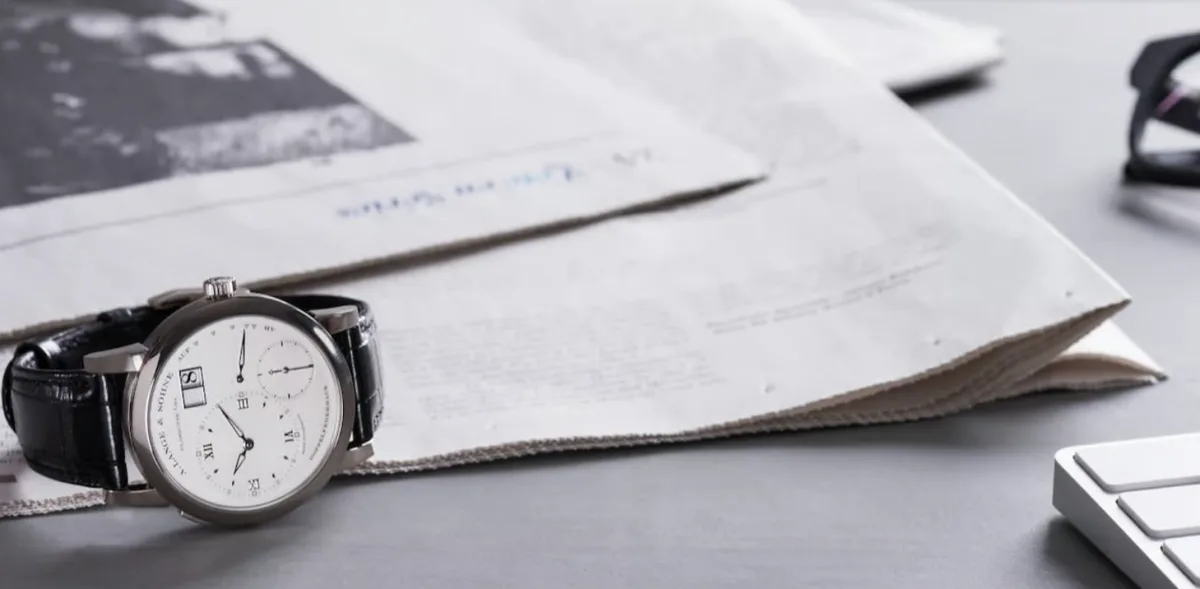
Few watches bear a brand's name as prominently as the Lange 1 by A. Lange & Söhne.
This chronometer is not just a flagship model of the brand, akin to how the Day-Date is associated with Rolex, but a true symbol of engineering pride and understated boldness. Seeing the Lange 1, it is immediately clear who created it and that the owner has a discerning taste in watches. However, this could be said about almost any Lange model on the wrist. Although the term 'iconic' is often overused, the Lange 1 truly deserves this designation. If you have considered purchasing this model or simply want to understand why there is so much buzz around it, here are five key facts about the Lange 1.
1. The Lange 1 Model Aided the Brand's Revival
The company A. Lange & Söhne was founded in 1845 in Glashütte, Saxony, by Ferdinand Adolph Lange and quickly became one of the leading names in German watchmaking. However, the brand did not survive World War II: the factories in Glashütte were destroyed by bombings and then nationalized by the GDR, leading to the merging of several local brands into one. For almost fifty years, the brand essentially ceased to exist in the form we know today.
After the fall of the Berlin Wall in 1989, Ferdinand's great-grandson, Walter Lange, along with entrepreneur Günter Blümlein, quickly restored the company. On October 24, 1994, exactly 150 years after the original firm's founding, Walter Lange presented four models simultaneously in Dresden. One of them was the Lange 1 - a model that became the brand's hallmark. Other models - Arkade, Saxonia, and Tourbillon Pour le Mérite - also stood out for their high quality but lacked the unique aesthetic inherent to the Lange 1.
2. The Dial Design is Based on the Rule of Thirds
The first thing that catches the eye when looking at the Lange 1 is the asymmetric dial, which seems visually unbalanced. The large date is located in the upper right corner, the main dial with hours and minutes occupies the left side, and the small seconds hand is positioned at the bottom right, just above which is the power reserve indicator. The functions are not where you would typically expect to see them.
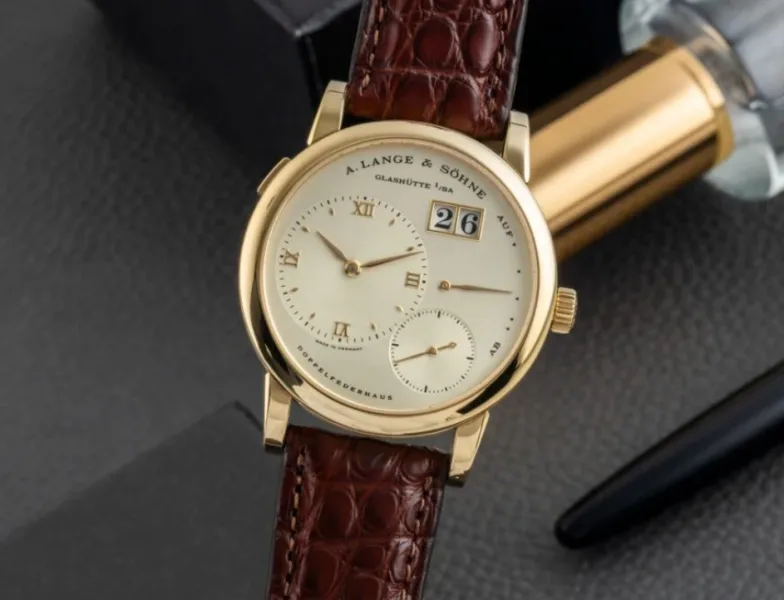
This was done intentionally. The design is inspired by the rule of thirds, according to which an image is divided into nine equal parts with three horizontal and three vertical lines, and key elements are placed along these lines or at their intersections. This approach creates a sense of randomness at first glance, yet ensures harmony and aesthetic balance. As a result, the Lange 1 dial stands out from other watches in its class but does not distract negatively.
3. The Large Date Indicator is a Signature Lange Innovation
Large date indicators are not new in watchmaking - they are used by brands like Audemars Piguet, IWC, Jaeger-LeCoultre, and others. However, Lange gave this element uniqueness, inspired by the five-minute clock at the Semper Opera in Dresden. The model was named Outsize Date or "Grossdatum" - a large date with two overlapping discs and a frame.
In marketing materials and boutiques, the date is always set to the 25th - in honor of the day when the first four models of the brand were first published in the press (October 25, the day after the presentation on October 24). The size and placement of the date are carefully calibrated according to the golden ratio (1.618). The lower edge of the date window is perfectly aligned with the bottom of the XII numeral on the main dial, and the central axis of the seconds hand aligns vertically with the middle of the date and horizontally with the VI numeral on the main dial. Thus, the large date indicator is a key element of the Lange 1 dial design both technically and aesthetically.
4. Features of Vintage Versions
Vintage watch enthusiasts know that small details can significantly impact collectible value. In the case of the Lange 1, there are two features that are especially important for collectors.
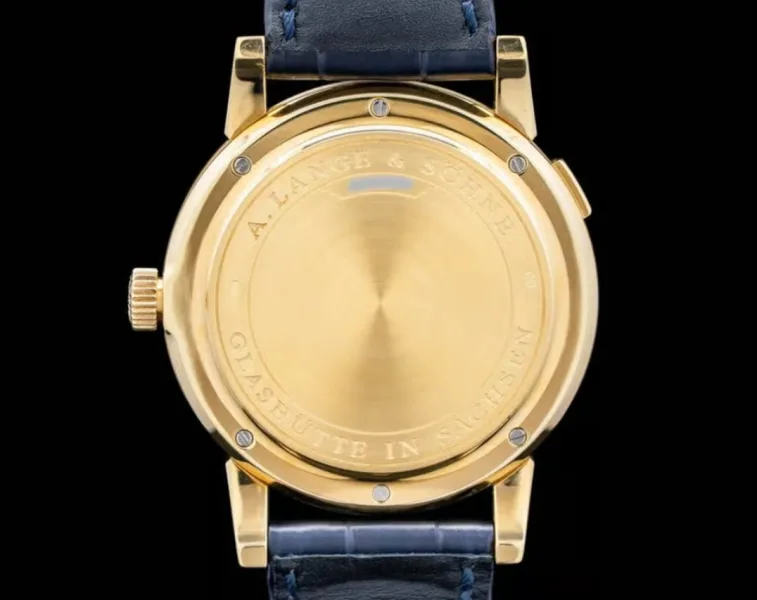
The first is the solid case back used in the original Lange 1 version. Already a year after launch, the brand began installing sapphire case backs, but having a solid back is a simple way to determine that the watch belongs to the first series from 1994. However, accompanying documents such as warranty cards and service records are important for confirming authenticity, as the backs could have been replaced.
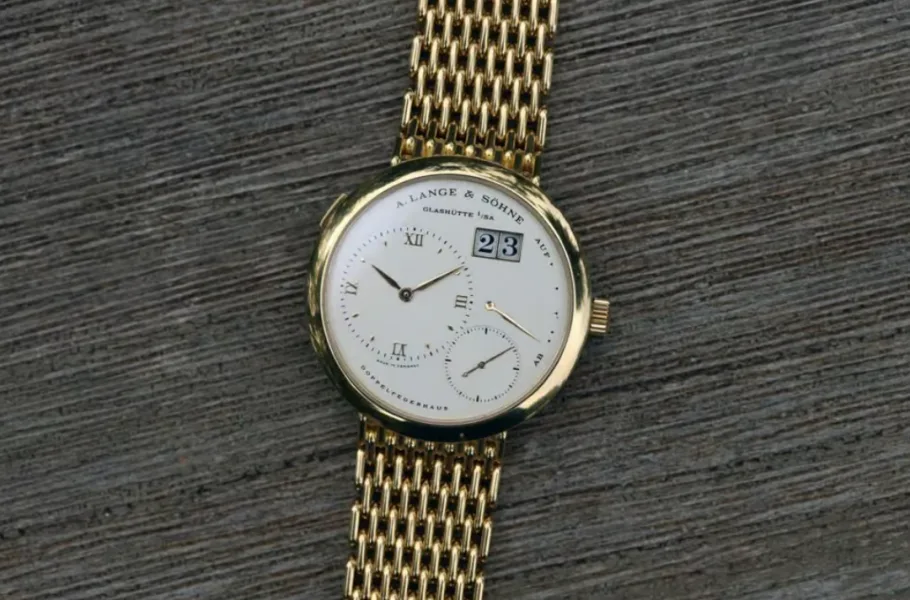
The second feature is the original Wellendorff bracelet. At the request of early buyers, the Wellendorff company, a family jewelry business from Pforzheim, crafted this "grain of rice" bracelet, which offers exceptional softness and comfort. The Wellendorff bracelet is rare due to its high cost and can fetch over $45,000 on the open market. Combined with a model with a solid back, it makes the watch especially valuable to collectors.
5. The Secondary Market is Gradually Gaining Momentum
Lange watches are traditionally not associated with sharp increases in market value or large premiums on the secondary market, but the situation is changing. Collectors' attention to vintage models and the overall trend of increasing demand for classic wristwatches contribute to the rising value of older Lange 1 versions. Modern models are also in steady demand.
It is difficult to generalize data for such a diverse collection, considering various case materials, dial colors, and sizes, but overall, the Lange 1 reflects the growing popularity of the brand on the open market. Collectors seek unique watches that go beyond mass production, and this has always distinguished the Lange 1. Helping to revive a brand that nearly disappeared, thanks to a unique dial design that became a symbol of the brand's style, the Lange 1 proves that success does not require being traditional. It is enough to have unique features that resonate with collectors. Over the past 32 years, the brand has clearly chosen the right path.
Technical Specifications of the A. Lange & Söhne Lange 1 (101.021):
| Parameter | Description |
|---|---|
| Case | Yellow Gold |
| Dial | Silver |
| Condition | Very Good |