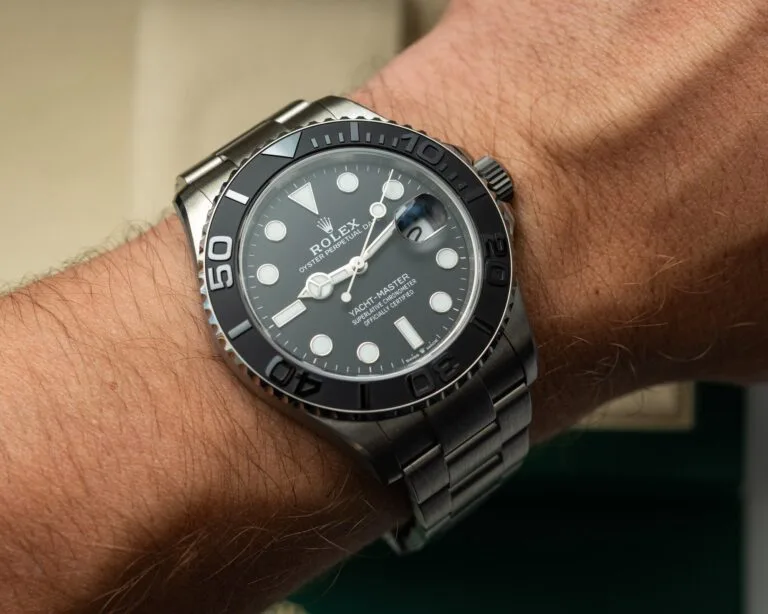
It's interesting how the "all about Rolex" system works - including opinions.
If I praise the watch, I'm told I'm too taken with the "cool" brand. If I criticize, I'm a "hater who understands nothing." Nevertheless, let's proceed. I remember the moment I first held the Rolex Yacht-Master 42 in RLX Titanium and immediately thought, "Something is off here." Moreover, the watch felt cheap, although it certainly isn't: the model 226627 was priced at $14,050 upon release in 2023 and has since increased to $16,050. And what accounts for the extra $50?
Personal Experience and Expectations from Rolex
First, a small clarification. I was fortunate enough to save up for a luxury watch - and I spent my money on a Rolex (after selling the Jaeger-LeCoultre Master Compressor Navy SEALs Automatic and Grand Seiko Spring Drive SBGC001, some of the best watches in my opinion). I wear my watches with high expectations: that they serve daily for a lifetime, have an endless supply of parts for decades, and that I, and possibly others, recognize them as some of the best in watchmaking. Some hate Rolex, some hate my watches, and that's fine. Some proudly wear the Yacht-Master 42, and I'm happy for them. However...
Why the Rolex Yacht-Master 42 is a Rare Misstep
I want to return to model 226627 because it's a rare case where Rolex makes a mistake. By the subjective standards of the luxury watch world, this is almost objectively a bad model. Moreover, I wrote 4,000 words comparing the original to a $600 counterfeit, and I think it's right to first examine the original in detail. A little text and photos for a deep understanding before moving on to the article about counterfeits.
History and Context of Using Titanium in Watches
So, the Rolex Yacht-Master 42 in RLX Titanium is the second production titanium Rolex after several prototypes. Before it, there was only the Deepsea Challenge - uncomfortable watches made from the same material, and the Citizen X-8 Chronometer - the first titanium wristwatch in history.
Try to guess when the first titanium watches came out? 2000? 1990? 1980? No - 1970. A half-century before Rolex, titanium watches were already widely offered by Swiss and Japanese brands at all levels. Rolex has long not been required to be first in anything - they were late to the trend of larger watches, ceramics, elastomer straps, integrated bracelets, and many others. And when a company with such a reputation appears late, it must surprise and impress. If it cannot - at least make an impression. It's like Ferrari with their first electric car Luce or Audemars Piguet with Code 11.59. But I digress.
Quality of Execution and Design Details at $16,050
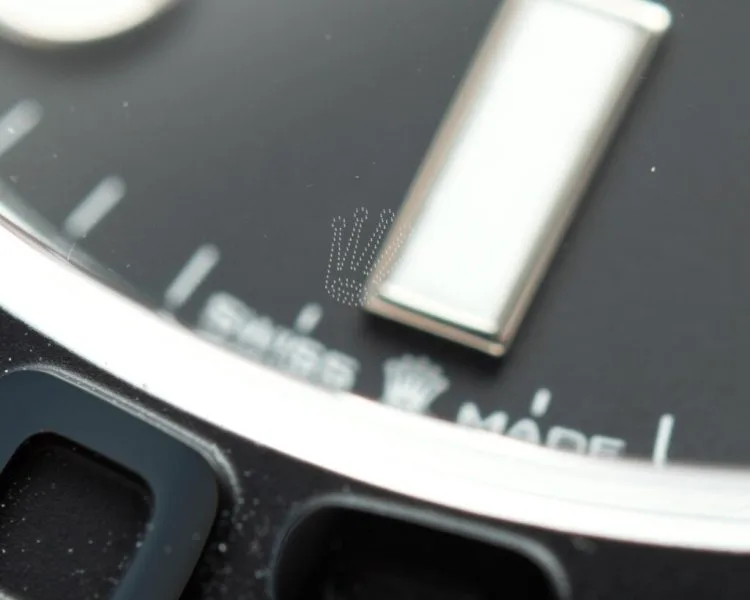
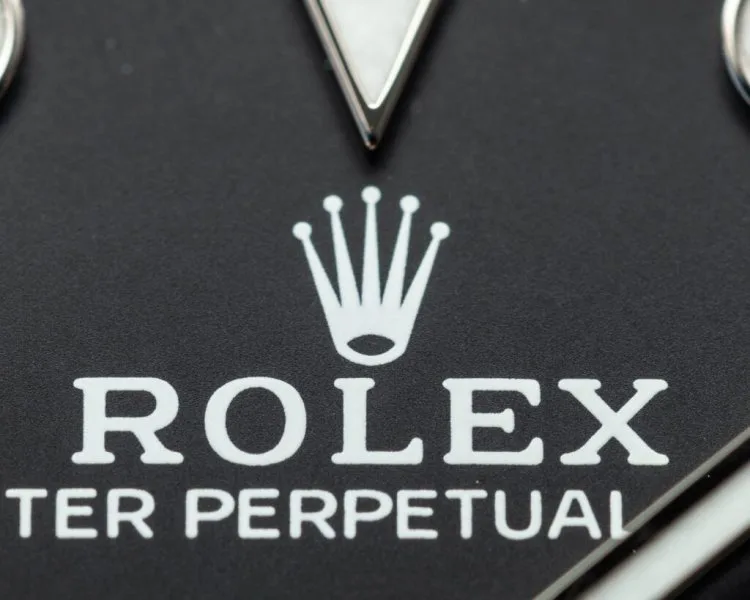
For $16,050 you get a cheap, printed crown, not an appliqué, and sloppy text. Long-term demand coincided with the almost stagnant portfolio of Rolex, Audemars Piguet, and Ferrari. Many individual interesting models, but overall - a continuation of long-known recipes. This, combined with mass demand, loud statements, and complacency, led to the "emperor coming naked." If the emperor appears in a suit with an inflatable effect, the myth collapses.
For Rolex, the "gym" is the R&D department, and I'm not sure the Yacht-Master 42 even knows where it is in the labyrinth of Rolex headquarters, where there exists an "elevator attitude" (trust me, it's a reality). Titanium requires a special approach to processing and assembly, different from stainless steel, with which Rolex has vast experience. That's why De Bethune and Grand Seiko received so much praise for their titanium finishing.
Issues with Processing Quality and Finishing
Honestly, I don't recall anyone seriously asking Rolex to use titanium, except "it would be nice." Rolex had half a century and more to bring the technology up to the "Superlative" level - their trademark quality standard that brought them success in mass production of accurate watches.
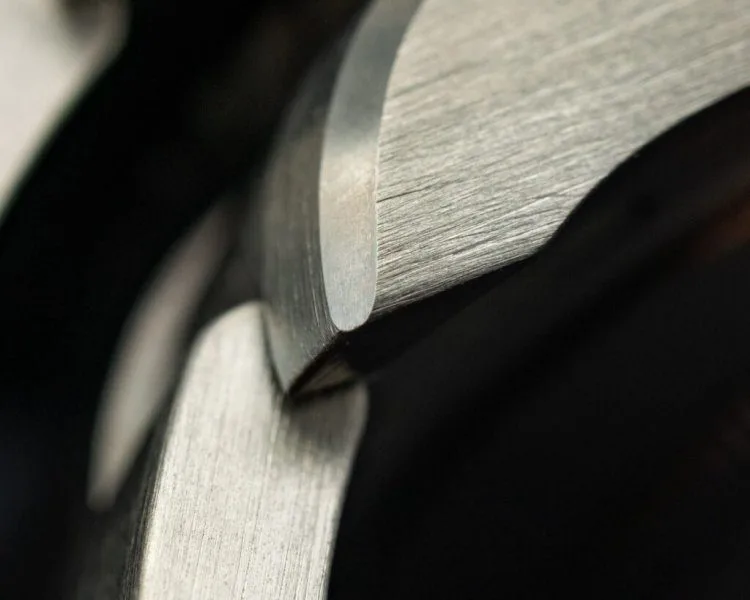
The best summary of my claims is the photo above. Honestly, for $16,050 I don't see a single acceptable element: no detail, no engineering solution, no execution. Look at the bevel on the corner of the lug: it doesn't create a sharp edge, the width of the bevel changes chaotically, the surface is uneven, as if made from a sketch. Compare with Grand Seiko in titanium - everything is sharp and delicate, and the watch costs $12,400 with a Spring Drive movement, which in my opinion, can compete with Rolex.
Repeated Defects and Rough Processing
I haven't done this before, but now I'll constantly return to the same image so you don't lose context. The rough grinding of the case is puzzling, even if considered a design decision. If someone ruined a Rolex after a scooter accident, I'd understand. But here - a factory piece, never worn. It's either machine or manual work - it doesn't matter, because neither justifies the quality.
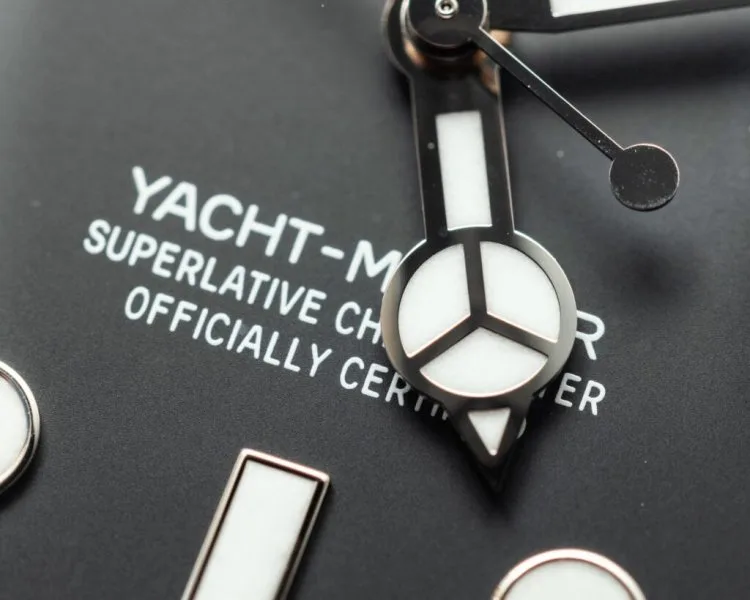
I wonder if Rolex truly believes that such a level of execution will impress buyers and collectors? Rolex knows how to create stories around its models. The Yacht-Master belongs to the professional category but is not a diving watch: there's no depth marking, no unidirectional bezel - it rotates both ways to measure time between buoys, which seems a dubious application. Meanwhile, Rolex doesn't explain why the titanium finish is so rough.
Bracelet Quality and Finishing Details
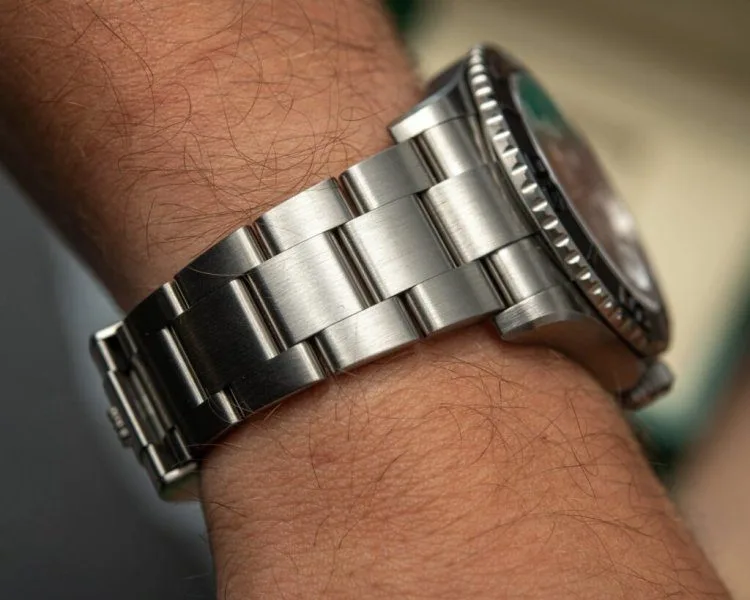
Look at the links of the bracelet, especially their edges. Rough grinding resembles a chain from an expensive bike lock. The links look soft and vague in shape, with scratches and irregularities. On luxury watches, angles are usually beveled and polished to create clear separation and beautiful highlights. Maybe this is difficult to do with RLX Titanium, but Rolex doesn't disclose the processing technology.
Questions to Buyers and Model Perception
I wonder: are Rolex buyers who genuinely love this look blind, foolish, or indifferent? This specimen belongs to a friend who has practically all the desirable Rolex models in various metals and dials, and he doesn't pay attention. These are new, unworn watches. Maybe I have some vision defect? As a Rolex owner, I couldn't live with myself paying $1,605 for such quality, let alone $16,050. But it's not about my preferences, it's about how close this is to objectively poor quality for luxury watches.
Lack of Information about RLX Titanium from Rolex
Rolex sticks to general information: "RLX titanium is grade 5 titanium, specially selected by Rolex." To me, "specially selected" means nothing. It's like in a restaurant "specially selected osso buco with saffron risotto" - it doesn't mean I participated in the cooking. Further: "RLX titanium can be finished with polishing or satin-finishing to brand standards. High mechanical strength complicates processing, so special manufacturing processes are introduced." But the final result is neither polished nor satin. The case bevels are supposedly "high gloss," but in reality - they aren't.
Discrepancy Between Official Photos and Actual Execution
In official Rolex photos, the bevels appear almost mirror-like with deep gloss. Compare with my shots, taken with a powerful flash - the difference is obvious. Rolex doesn't disclose details of "special processes." Other brands shoot documentary videos about production. Rolex, however, is extremely secretive, showing only the tiniest fragments of production, and nothing about RLX Titanium.
Bezel and Mechanical Processing Details
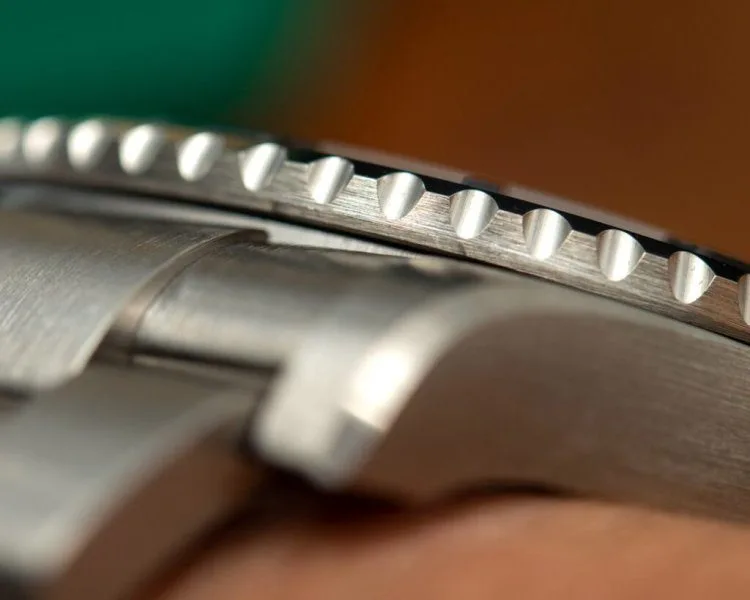
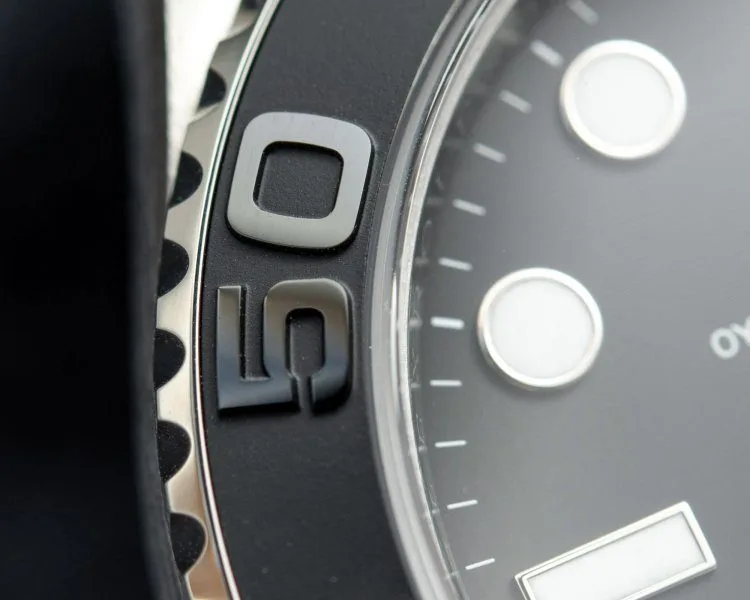
The bezel from the side appears unfinished. Processing marks are visible, left by the drill that made notches for better grip. Rolex bezels are usually intricately made, with sharp edges and mirror surfaces. Here, the bezel looks machine-made and unfinished. These indentations could have been neater or polished if it fit the design. Now it resembles a randomly taken unfinished component from production.
Comfort and Wearability
On the wrist, the Rolex Yacht-Master 42 in RLX Titanium feels light, yet reliable, large, yet comfortable. The case is relatively thin (11.7 mm), the bracelet is narrow and tapers significantly towards the Oysterlock clasp. Titanium provides comfort and lightness, and the 100 m water resistance is sufficient for most everyday scenarios, despite the diver's appearance. The Triplock crown adds reliability. The watch might withstand greater pressure, but that's at your own risk.
Conclusion: Rolex Yacht-Master 42 - Misstep or Challenge?
Despite the excellent caliber 3235, 5-year warranty, high accuracy (-2/+2 seconds), lightness, and comfort, these watches don't look or feel worthy of $16,050. Brands, including Rolex, will have to significantly raise the bar. Firstly, I hope buyers stop tolerating bezels with visible processing marks and sloppy bevels, especially in such "experimental" models like this Yacht-Master 42. Secondly, counterfeit manufacturers are not standing still. More on this in the next article, stay with WatchTested.
Comparison Table of Key Features of Rolex Yacht-Master 42 in RLX Titanium and Competitors
| Feature | Rolex Yacht-Master 42 RLX Titanium | Grand Seiko Spring Drive SBGC001 | Citizen X-8 Chronometer |
|---|---|---|---|
| Case Material | RLX Titanium (Grade 5 Titanium) | Titanium | Titanium |
| Case Thickness | 11.7 mm | ~14 mm | ~12 mm |
| Water Resistance | 100 m | 100 m | 100 m |
| Movement | Rolex Caliber 3235, automatic | Spring Drive | Automatic |
| Accuracy | -2/+2 seconds per day | High | High |
| Launch Price | $14,050 (now $16,050) | $12,400 | Significantly lower |
| Finishing Features | Rough satin finish, unclear bevels | High-class titanium finish | Classic titanium finish |
This analysis reveals the strengths and weaknesses of the Rolex Yacht-Master 42 in RLX Titanium, highlighting the need for higher quality standards and attention to detail when working with new materials in the luxury segment.