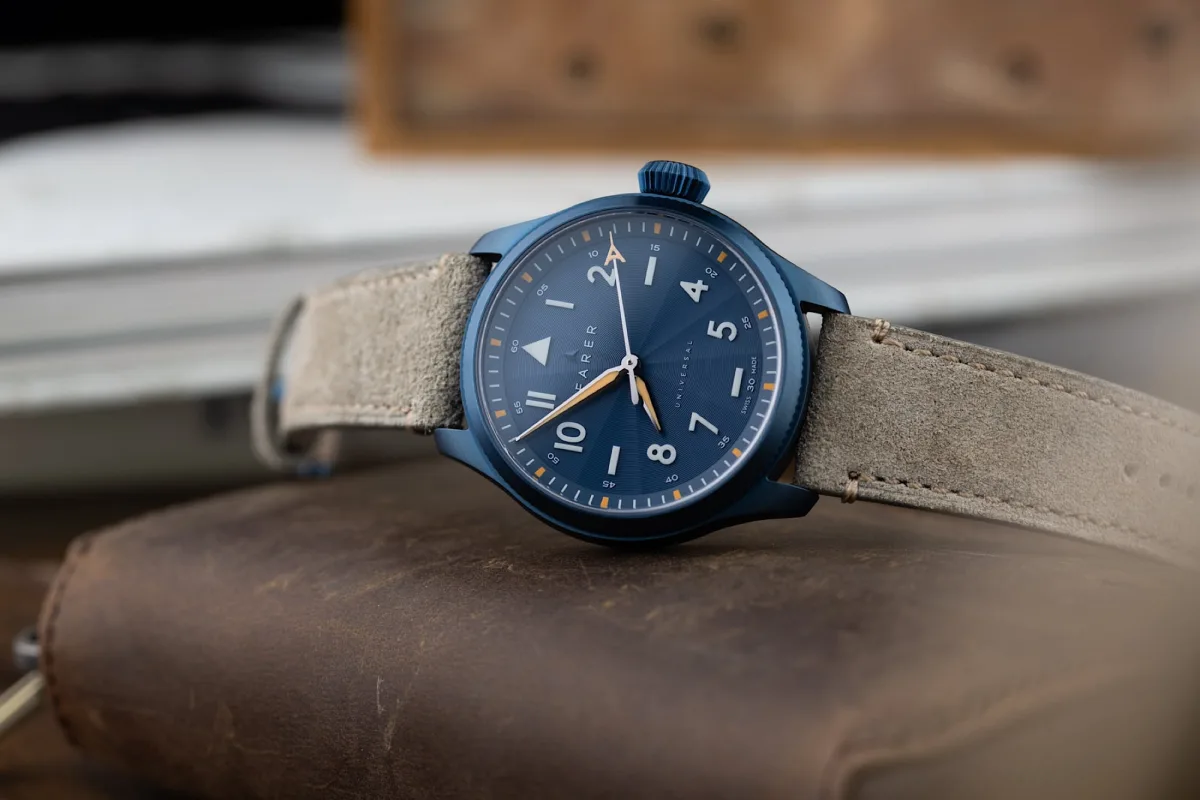
When I think of the brand Farer, I don't immediately associate it with pilot watches.
Moreover, I don't link it to any specific category of watches, although I have previously looked at several Farer World Timer models. The brand is primarily known for its vibrant and thoughtful use of color. Nevertheless, today we will discuss the Pilot Series II model, which shows that Farer feels quite comfortable in the aviation watch segment as well. How does the brand's signature design translate into watches traditionally focused on practicality and functionality? I spent several weeks with the new Farer Pilot Series II Curtis to find out.
Color Variety in the Pilot Series II
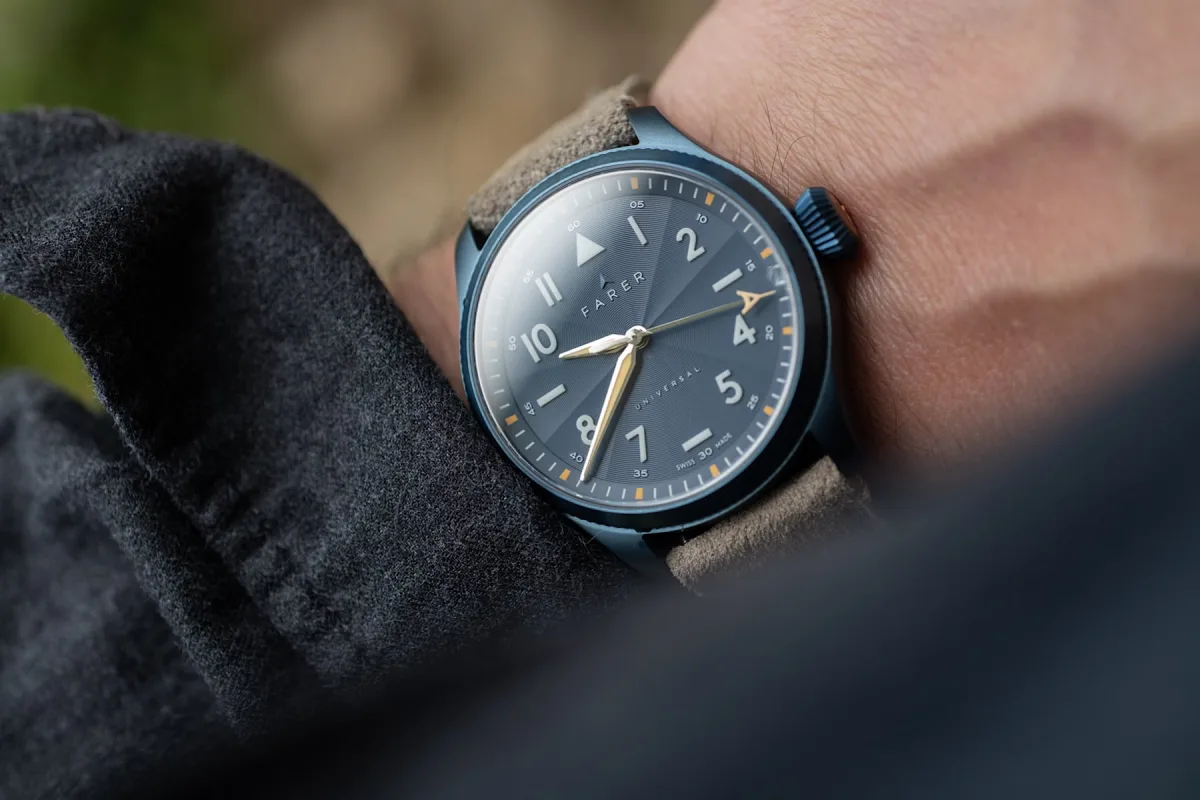
As is often the case with Farer, the launch of the Pilot Series II was accompanied by several color options. The Barnwell model with a brown dial and the Hewlett in a blue and white scheme look attractive, but it was the Curtis that caught my attention - and fortunately, this was the model I was quickly provided for review. At first glance, the watch showcases key features of pilot watches - a strong contrast between the dark dial and clear indices, Arabic numerals around the circumference (except for the triangle at the 12 o'clock position), and a large onion-shaped crown. Upon closer inspection, it becomes clear how Farer managed to maintain its individuality without compromising the model's functional essence.
Propeller Motif in the Dial Design
A blue dial in pilot watches is not revolutionary, but Farer's interpretation looks fresh and original. The Arabic numbers are set against a deep blue dial with a concentric texture and radial pattern reminiscent of guilloché, dividing the surface into 12 segments. Each adjacent sector absorbs and reflects light differently, causing the dial to constantly change as it moves. Opposite sectors visually align, creating a rotation effect reminiscent of an airplane's propeller.
This approach departs from the traditional matte black dial and enhances the aviation theme without compromising readability. Large and clear indices remain a key element: the Arabic numerals are made from Lumicast - a mixture of ceramic and X2 Super-LumiNova, forming three-dimensional markers. They are not as massive as on some other models of the British brand, but they are expressive enough.
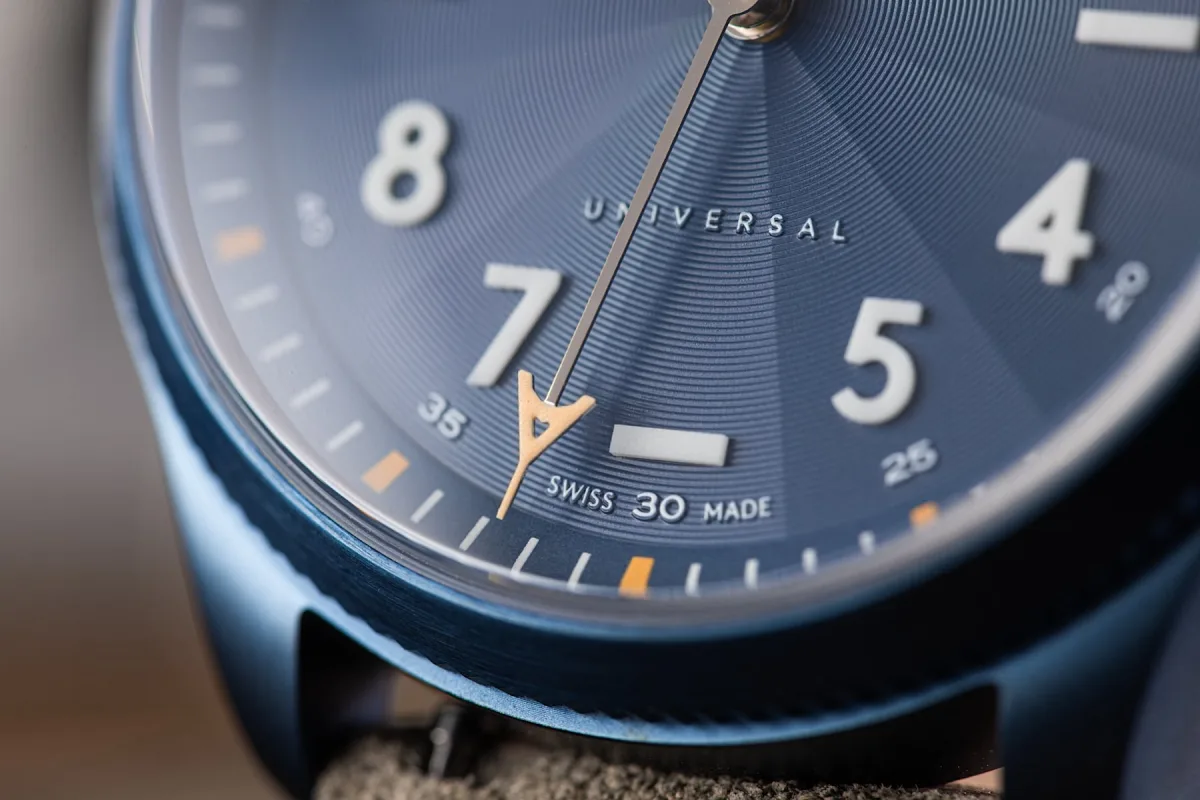
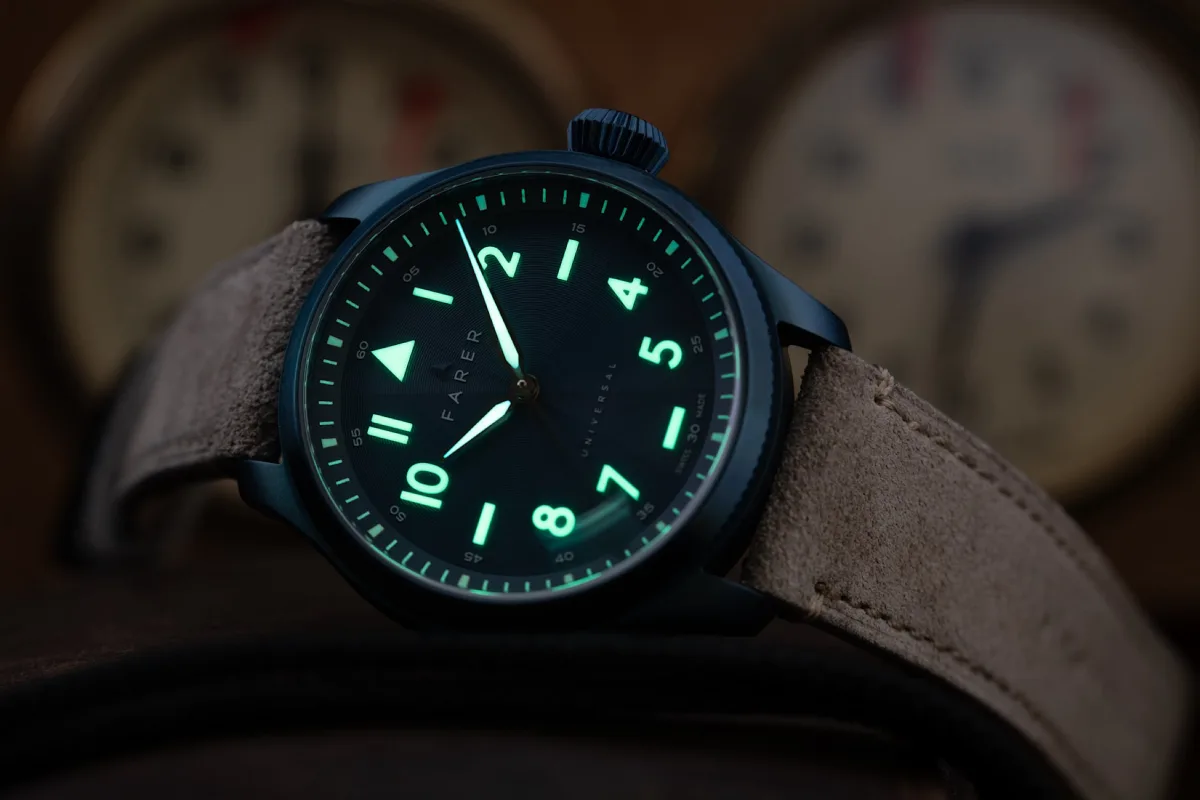
Additional touches of Farer's signature style are evident in the letter "A" at the end of the seconds hand and the orange five-minute markers inside the minute ring. The polished hour and minute hands in rhombus shape are covered with yellowish X2 Super-LumiNova - a shade that harmoniously contrasts with the subdued blue dial and resonates with the orange accents on the outer edge. In the dark, the hands and indices glow green.
Case and Materials: Balance Between Functionality and Style
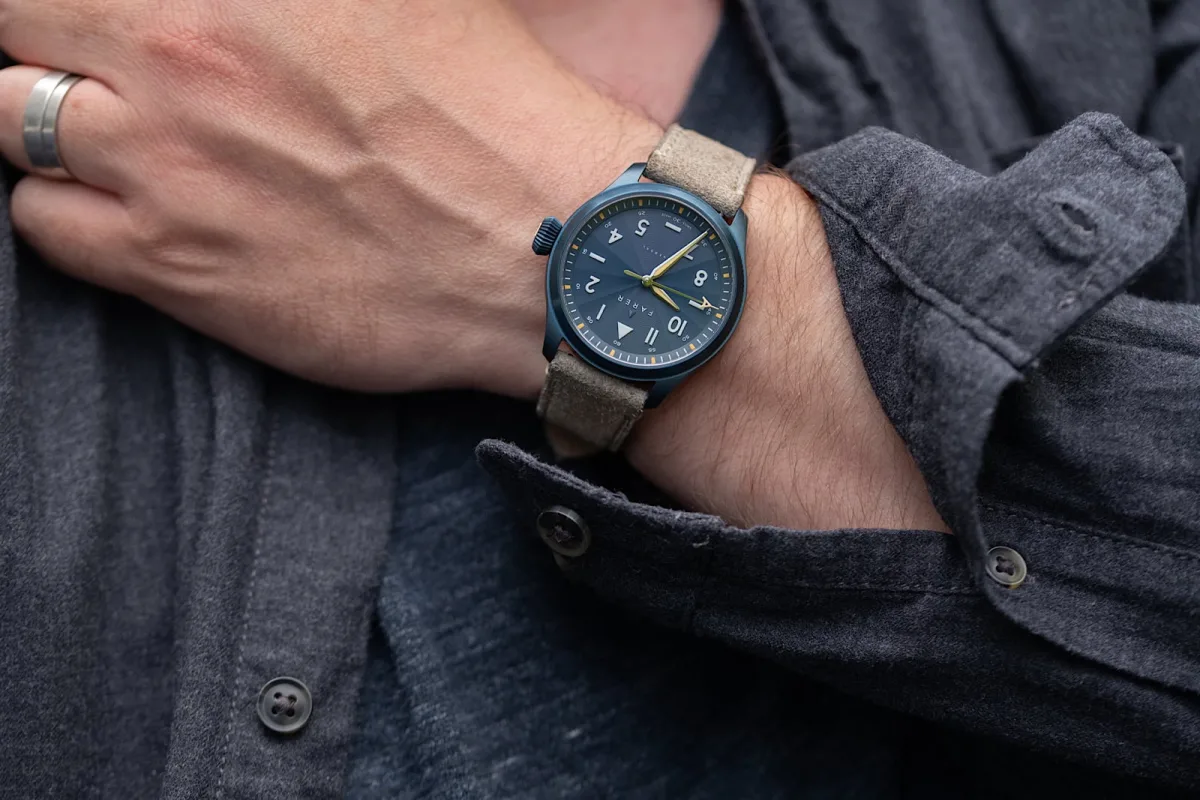
The case of the Pilot Series II Curtis is made of titanium with a dark blue PVD coating. Typically, a titanium case has a gray matte tint, so the blue color of the case, close to the dial color, was unexpected for me. This deep blue does not stand out from a distance but creates a cohesive perception that matches the brand's aesthetic. If the PVD coating initially caused me some doubts, the feeling of the watch's weight on the wrist - not typical for titanium - intrigued me even more. I'll talk about this a bit later.
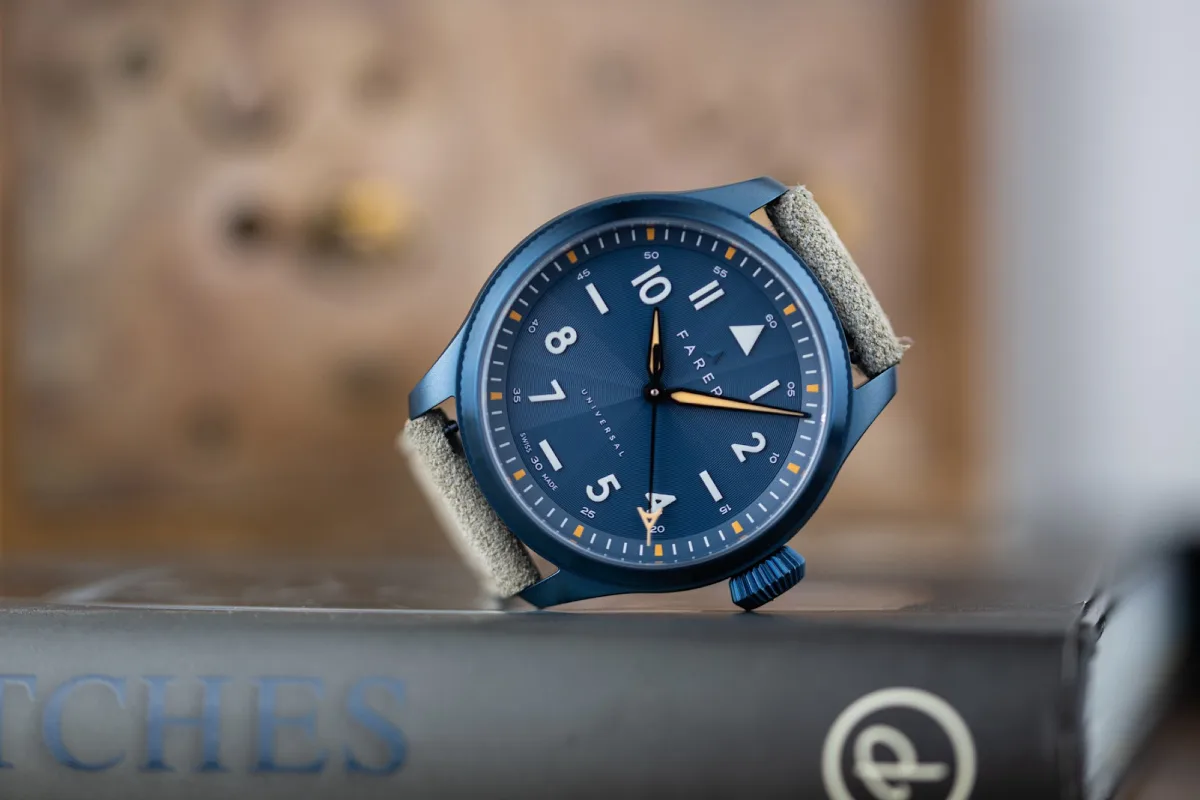
A typical feature of pilot watches is the large onion-shaped crown, originally intended for easy winding with gloves. The Pilot Series II Curtis's crown, made in blue with a bronze insert, retains the traditional shape but does not seem overly bulky. During my acquaintance, the watch did not cause discomfort - the crown did not press on the wrist.
The case back, also made of titanium with a blue coating, hides the reason for the unusual weight sensation - inside is a soft iron Faraday cage.
Magnetic Field Protection: Soft Iron Faraday Cage
Under the dial and inside the titanium case is a soft iron Faraday cage, providing protection for the movement from magnetic fields up to 500 Gauss. The Curtis model lacks a date window - its presence could reduce the anti-magnetic properties and disrupt the dial's aesthetics. Whether such a degree of protection is necessary is debatable, but it explains the use of titanium to offset the cage's weight and maintain wearing comfort. As a former owner of the Rolex Milgauss, I understand well how dense metal affects the feel of the watch on the wrist.
Inside the cage is the automatic Sellita SW300-1 Elaboré caliber - one of the most common movements in this price segment. It features a hacking function, manual winding, and a power reserve of up to 56 hours. Unlike the standard version with a date, this watch lacks the corresponding function and additional crown position.
Size and Wearing Comfort of the Pilot Series II Curtis
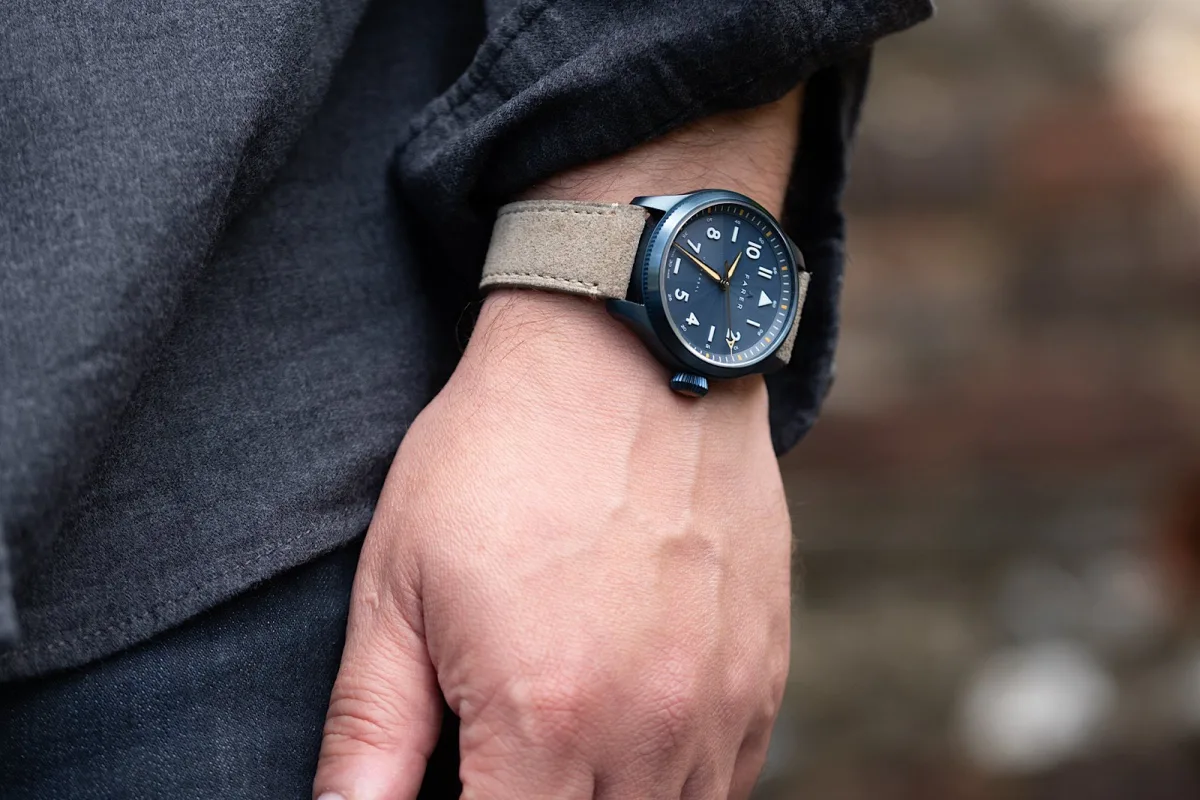
So far, I have not mentioned the watch size because it turned out to be optimal for my 17.75 cm (7 inches) wrist. The case diameter is 40 mm, with a lug-to-lug distance of 43 mm. This is not a large historical size, but it's not small either. The case thickness is only 10.9 mm, which is surprisingly low considering the Faraday cage inside. The lug width is 20 mm, which is standard and provides a wide choice of replacement straps. The set includes a discreet gray suede strap with a blue titanium PVD-coated clasp - a reliable and suitable option.
Conclusion: Harmony of Functionality and Signature Style
Farer Curtis is an interesting example of restraint. The watch combines the functionality of a pilot model with Farer's distinctive style. The dial is rich in color, textures, and dynamics, yet retains primary readability. The case successfully balances form and function. The added weight from the soft iron cage is offset by the lightness of titanium, while the muted PVD coating conceals the material and harmonizes with the dial. Virtually all design decisions, whether traditional pilot watch attributes or Farer's signature features, are executed with restraint. Instead of conflict or theme dilution, they merge into a harmonious whole.
If you're interested in the Farer Curtis model, its price is €1,555 / $1,525 / £1,350. To explore other options in the Pilot Series II, we recommend visiting Farer's official website.