Metallurgy is one of those rare sciences that in the 21st century still feels like magic, even when we have all the knowledge necessary to understand it.
However, for most people, the mystery ends with the simple knowledge that silver is a white metal, and gold has several different numbers or shades that blend with it. There is no need to delve into the nuances of every alloy on the planet, but knowing how to read distinctive marks is a valuable skill when exploring the world of watches. Whether you are trying to appraise a vintage pocket watch or stumble upon a pure gold watch while shopping, reading this list of the most common universal hallmarks will definitely help you.
Gold Standards
The purity of gold is usually measured in carats, with 24 carats being pure gold, and decreasing from there. Gold alloys are created to increase its strength as a soft metal and to change its color depending on which other metals you use. For example, a higher percentage of copper results in rose gold, while an alloy with nickel and zinc results in white gold.
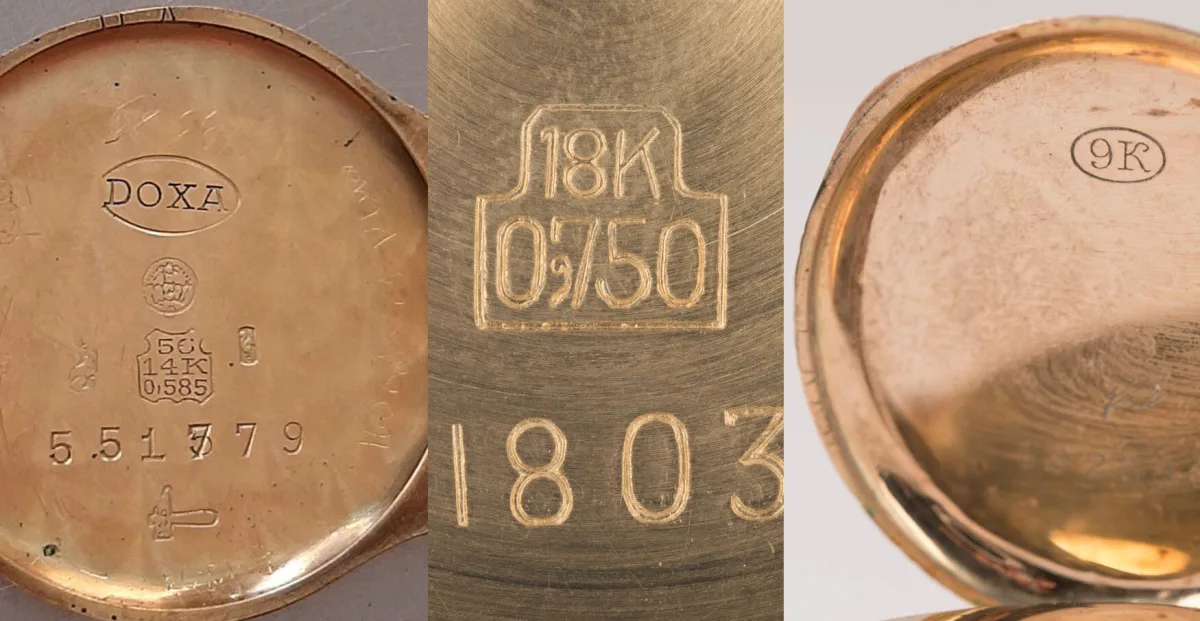
- 18K / 18ct / 750 - 75% gold content. This is the standard for most modern luxury watches, providing a good balance of strength, durability, and value retention, but it scratches fairly quickly.
- 14K / 14ct / 585 - 58.5% gold content. A more affordable alloy that is still mostly pure gold and the strongest alloy with a Mohs hardness of 3.5-4 out of 10. Often used in vintage watches.
- 9K / 9ct / 375 - 37.5% gold content. This is generally the lowest carat that is still considered solid gold and can have a beautiful color. Due to the high copper content, 9K gold ends up being roughly as soft as 18K gold.
- GP / KGP / HEG - these marks refer to gold plating, which is a very thin layer of gold applied via electroplating. Typically, it wears off over time and is considered the most affordable and least durable way to wear gold-colored watches.
- GF / RG / RGP - stands for gold filled, rolled gold, or rolled gold plated, which is also a type of electroplating but with a thicker layer of gold on the surface. The likelihood of such a coating wearing off completely is lower, though it is still not solid gold and is subject to wear.
- KP - the KP suffix is sometimes used to denote karat plumb gold, meaning