Are you familiar with Hokusai's famous engraving 'The Great Wave off Kanagawa'?
It's one of those images that you remember forever after just one glance. The wave on the left side of the composition towers over everything else; meanwhile, Mount Fuji in the background seems small and almost insignificant, and the three boats below appear lost and tiny. Nothing in this image seems balanced, and that's exactly why our gaze is drawn to it.
What is the mechanism of this effect? Symmetry soothes, while asymmetry provokes and forces the eye to adjust. This design principle is at the heart of some of the most captivating watches ever created. Asymmetric watches are not an accident or a mistake. They are a deliberate creative choice by the designer and simultaneously a clear statement by the owner. Those who wear asymmetric watches consciously reject monotony and predictability - or, provocatively speaking, boredom. It is this deviation from the norm that makes asymmetric watches so interesting and worthy of discussion.
What Does Asymmetry Mean in Watchmaking?
In the watch world, the term 'asymmetric' does not denote a single style but encompasses a wide range of design solutions. Typically, it refers to watches where the case, dial, or crown is offset relative to the axis - not mirrored, not centered, but in a way that maintains harmony of perception.
Examples of Asymmetric Watches:
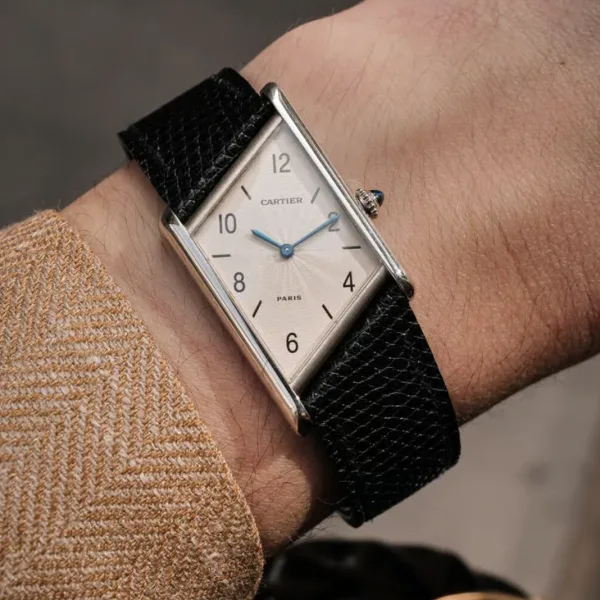
- A dial set at an angle, like the Cartier Tank Asymétrique.
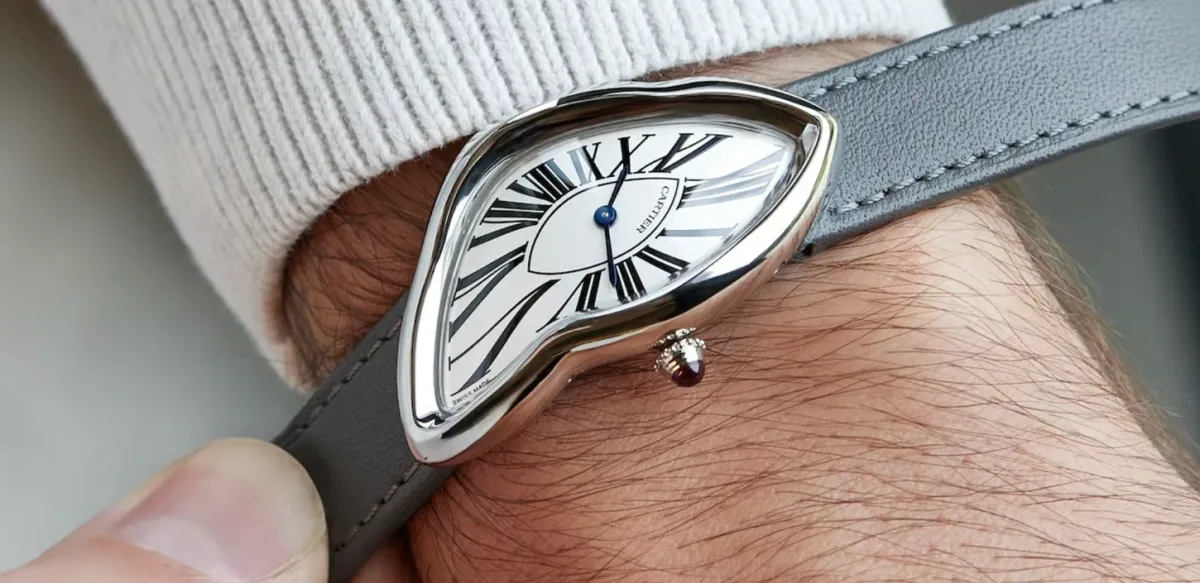
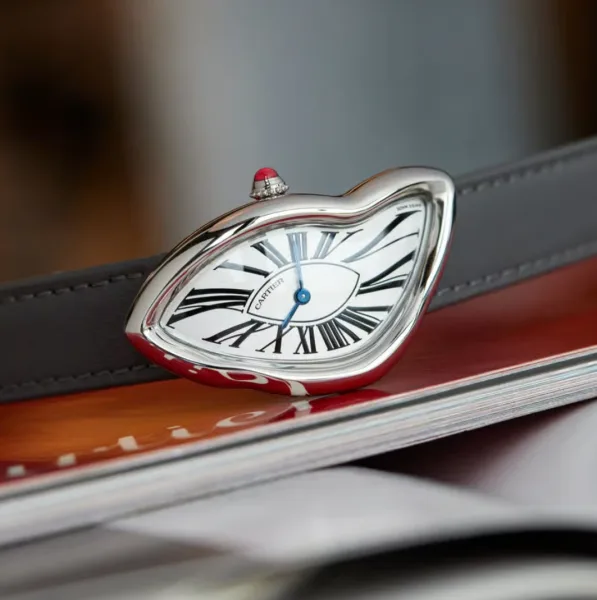
- An organically shaped case, such as the Cartier Crash.
- A noticeably off-center dial, like the A. Lange & Söhne Lange 1.
- A case seemingly sculpted from a solid piece of metal, like the Hamilton Ventura.
Less common but no less interesting are watches with asymmetric mechanisms. When a tourbillon is set at an angle, bridges are deliberately placed asymmetrically, and the axes of the hands are shifted, asymmetry ceases to be just a design technique and becomes an expression of an engineering or watchmaking concept. Examples include the Glashütte Original PanoLunarTourbillon and MB&F Legacy Machine FlyingT.
A Brief History of Asymmetric Watches
The origins of asymmetric watches date back to the 1930s. The Art Deco movement welcomed designs that broke traditions - rectangular cases, rotated dials, and unusual proportions. Cartier was a pioneer in this field. The Tank Asymétrique model with a dial rotated about 30 degrees was a true rebel.
By the late 1950s, asymmetry became increasingly associated with technological progress. Electric mechanisms, and later tuning-fork mechanisms, acquired a new futuristic design language. In 1957, Hamilton introduced the Ventura - angular, bold, and radically futuristic watches. Four years later, Elvis Presley wore this model in the film 'Blue Hawaii,' firmly establishing the unusual case shape as a pop culture icon.
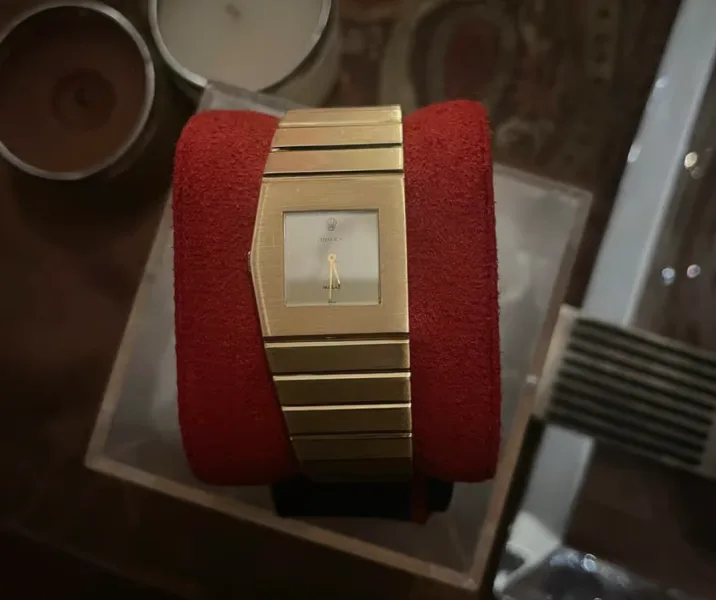
At the same time, Audemars Piguet began experimenting with Brutalist designs in the 1960s: massive trapezoidal cases, dials that seemed sliced, angular contours reminiscent of Brutalist concrete architecture. The 1970s saw the most extreme examples: Giugiaro designs for Seiko, Rolex King Midas, and the first conceptual watches that were more sculptures than time-telling accessories. All these designs reflected the spirit of optimism of their eras - each era had its unique trend, similar to Hokusai's famous motif.
Why Is Asymmetry Coming Back Into Fashion Now?
Modern watch collectors on Instagram show a clear shift from classic round sports chronographs to unusual shapes designed to grab attention. We have identified three reasons for the revival of asymmetry in watch design:
1. Revival of Brutalist Aesthetics
Architecture, fashion, and pop culture are rediscovering the honest, raw, and sharp style of the 1960s-1970s. Balenciaga embodies this in sculptural silhouettes and raw retail spaces. Films like 'Dune' and 'Blade Runner 2049' make monumental shapes part of the visual language. Watches also reflect this trend - with massive cases, sharp lines, and deliberately heavy proportions.
2. Rise of Independent Brands
Today, small manufacturers and independent designers, such as Sylvain Berneron, can directly reach a global audience of collectors through social networks. They don't need widespread distribution or participation in major exhibitions. Asymmetric watches are ideal for this format - they immediately capture attention and receive more clicks. In the digital world, attention has become the most important currency.
3. Desire to Stand Out
If you want to make a statement without resorting to bright colors or a large watch size, asymmetric models are an excellent way to express individuality. They are designed for those who don't just choose classic steel sports watches but consciously seek a unique solution.
My Current Favorites Among Asymmetric Watches
Cartier Crash
If you compare the Cartier Crash to a painting, Salvador Dali's 'The Persistence of Memory' comes to mind. The case looks like a classic Cartier design melted under the Parisian sun. Roman numerals follow the distorted contours, and the overall impression is as if the watch emerged from a surreal dream. Crash was created in 1967 at Cartier London under Jean-Jacques Cartier. There is a legend that it was inspired by a Baignoire Allongée model damaged in a car accident and deformed by heat, but there is no evidence to support this.
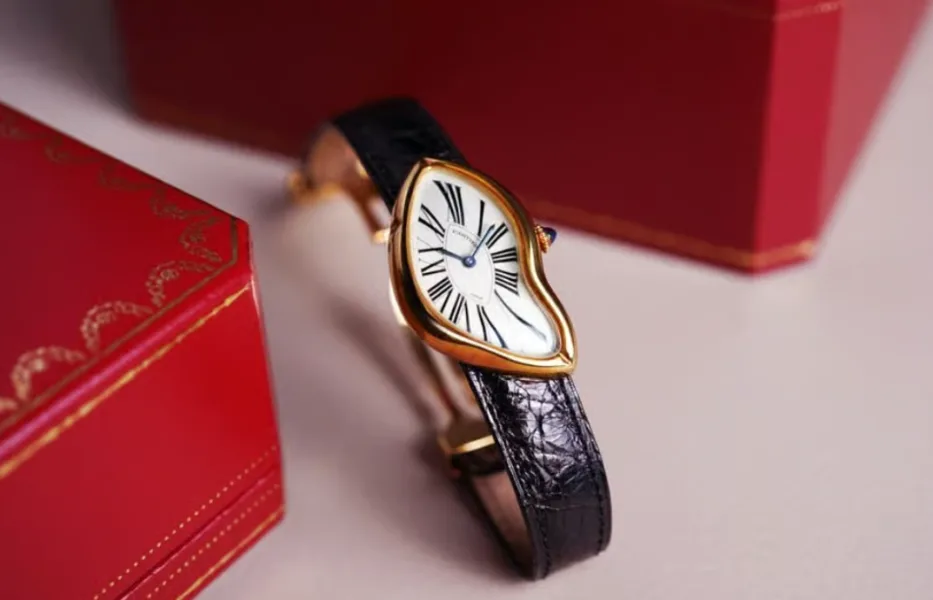
Most likely, the watch was born from the experimental spirit of 1960s London and was developed jointly with designer Rupert Emmerson as a radical alternative to classic Cartier models. Despite its apparent 'melted' appearance, the Crash is a very well-thought-out piece: the case, dial, and hands are coordinated so that time can be intuitively read. This is where its watchmaking mastery lies. The model looks chaotic, but inside there is precise order. Cartier has repeatedly returned to this design, releasing limited editions, such as the Paris Edition 1991 (400 pieces) and modern London Edition ref. WGCH0006. The Crash Skeleton ref. W7200001 went even further: its manual caliber 9618 MC follows the contours of the platinum case, making the mechanism part of the sculpture. Wearing a Cartier Crash is hard to do unnoticed - not only because of its rarity and cost but also because you can't take your eyes off it. It's more like a surreal work of art on the wrist than just a watch with an unusual shape.
Hamilton Ventura
Released in 1957, the Hamilton Ventura was not just the first mass-produced electric watch but a manifesto of technological innovation. Industrial designer Richard Arbib created an asymmetric shield-shaped case that allowed a view of the innovative mechanism inside. The electric caliber 500 combined a battery and electromagnetic drive with a traditional balance and mechanical transmission. Ventura became the intersection of traditional watchmaking and the electronic era.
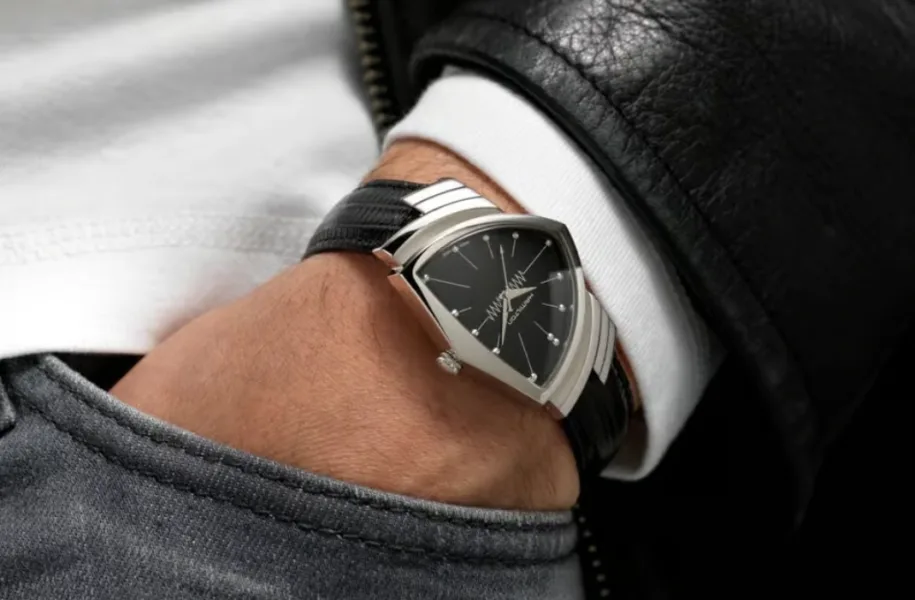
The radical style quickly made the model iconic: Elvis Presley wore it in the film 'Blue Hawaii' (1961), and later it became part of pop culture thanks to the 'Men in Black' film series. Hamilton continues to use this case shape in various versions: the Ventura Quartz ref. H24411732 closely resembles the historical original, while the Ventura Auto ref. H24515551 combines the characteristic silhouette with a mechanical automatic movement and an 80-hour power reserve. The movement, dial, and details have been adapted to the unique contours of the case, demonstrating that asymmetry is not just an external design decision but an internal concept.
MB&F Horological Machines
Maximilian Büsser and his team do not create traditional watches. Horological Machines are three-dimensional sculptures where time is displayed in separate domes, the mechanism elements are open, and the case shape resembles little of classic watches.
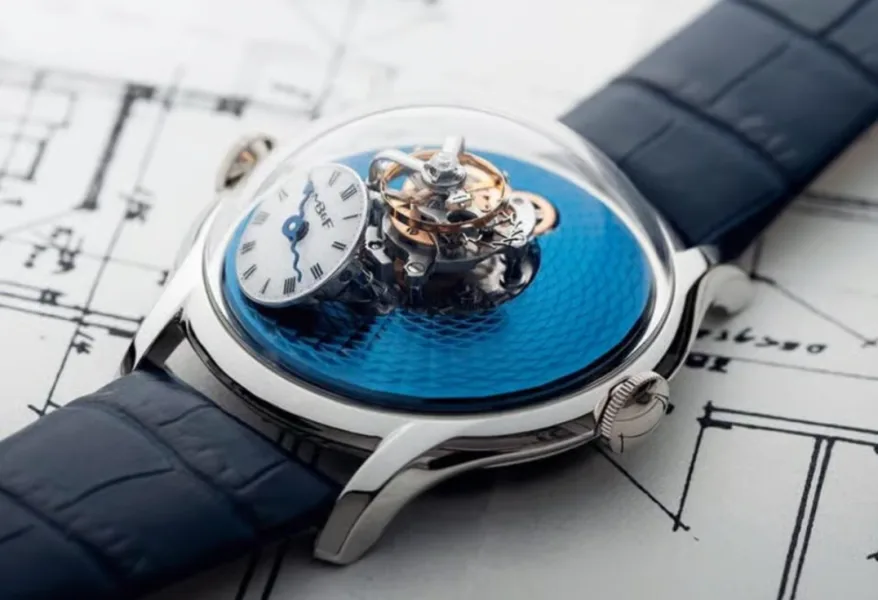
Asymmetry here is not a stylistic device but a logical consequence of the concept. This is especially evident in the Legacy Machine FlyingT: the dial is tilted, the tourbillon is positioned vertically and centrally, and the time display is intentionally offset. The watch is built in layers and planes - like Hokusai's wave cast in titanium.
Audemars Piguet [RE]Master02
In the early 1960s, Audemars Piguet experimented with cases resembling concrete architecture rather than traditional watches. Between 1959 and 1963, more than 30 asymmetric models were created in small editions. One of these was the 1960 Model 5159BA, produced in only seven copies. It became the prototype for the limited edition [RE]Master02 ref. 15240SG.OO.A347CR.01 (250 pieces), which the brand calls 'A Tribute to Brutalism.' The 41 mm case is made of sandblasted gold and resembles a composition of geometric surfaces offset from each other.
![Audemars Piguet [RE]Master02 with asymmetric design](/storage/images/2026/08/art-fa96bfb436-img-7-9f6444.webp)
The dial also defies tradition: twelve triangles of different shapes converge towards the axis of the hands, which is far from the visual center of the case. Inside operates the ultra-thin automatic caliber 7129. The contrast between the technical perfection of the mechanism and the radical asymmetry of the design gives the watch a special appeal. [RE]Master02 is perceived more as a wearable design concept than classic watches.
Berneron Mirage
After five years working as a product director at Breitling, Sylvain Berneron founded his own brand in 2022. Mirage is a watch where asymmetry is not imposed on a traditional mechanism but arises from a fully asymmetric caliber that determined the case shape. Berneron calls Mirage the first watch where asymmetry comes directly from the mechanism.
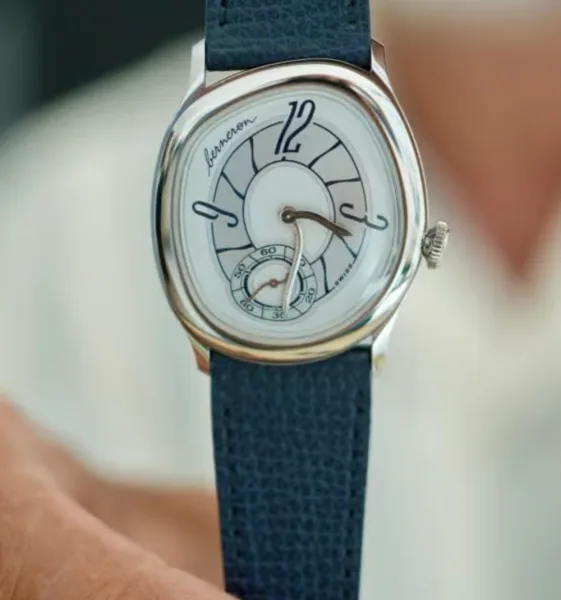
The manual caliber 233 consciously departs from the classic round form, making room for a large barrel, small second hand with direct drive, and large pocket watch-style balance. The reverse arrangement of the hands helps reduce the thickness of the mechanism to 2.3 mm and the overall thickness of the watch to 7 mm. The plates and bridges are made of 18-carat gold, as are the case, dial, and hands. This is what gives Mirage its unique character: the fluid silhouette seems distorted yet perfectly balanced - as if time itself is moving. Variants such as the Mirage 38 Sienna in yellow gold or Prussian Blue in white gold are released in limited editions of 24 pieces per year. Mirage targets collectors looking for something unusual but without excessive flamboyance.
Conclusion: Who Are Asymmetric Watches For?
Asymmetric watches are not for everyone. Those who choose such a model consciously strive to stand out and defy expectations - not necessarily making as bold a statement as with a Richard Mille or a large Hublot Big Bang. Well-designed asymmetric watches attract attention just like a successful work of art. They are distinguished by meticulousness in both design and construction, and it is this that evokes genuine interest.