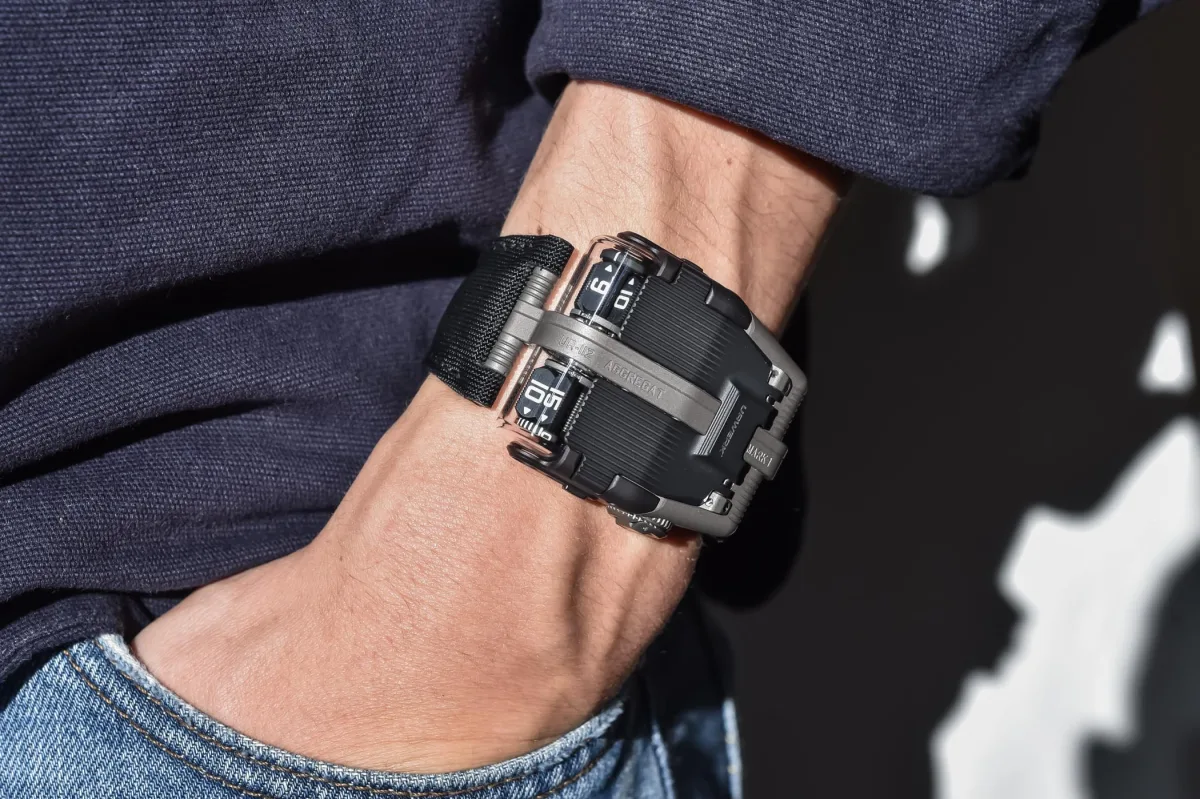
When it comes to presenting new ways of telling time, few brands can surpass the creativity, inventiveness, and technical prowess of URWERK. Since 1997, master watchmaker Felix Baumgartner and artistic director Martin Frei have been crafting modern adaptations of indicators like wandering hours and retrograde minutes to display passing hours. Today, the Urwerk "Special Project" collection introduces a new model, the UR-112 Aggregat, a compendium of complexity, technique, and radical design. Departing from the signature wandering hours, the UR-112 is equipped with double carousels with jumping triangular prisms that display digital hours and minutes in a new yet quintessential 3D Urwerk format. The watch is housed in a sleek black and gray titanium case, with secret seconds hidden beneath a hunter-style case.
COMPLEX DESIGN OF THE UR-112 AGGREGAT
Officially known as the UR-112, the watch is called Aggregat, meaning a way of combining disparate elements into a cohesive whole. “The sources of inspiration for the UR-112 Aggregat,” explains Frei, “are numerous and varied. The grille of the Bugatti Atlantique is the most obvious. An exceptional car whose contrasting spine underscores absolute symmetry.” Interestingly, he mentions the rare Bugatti Atlantic car, a beautiful vehicle built by Ettore Bugatti and inspired by his earlier Bugatti Aerolithe Concept 1935. Combined with its streamlined body, the 1936 Bugatti Atlantic was built from aluminum, a lightweight material designed to increase speed. Curved and aerodynamic, the Bugatti Atlantic had a seam running down the central body to emphasize its symmetry, along with a vertical grille with speed lines often found in objects created during the Streamline Moderne period of the mid-1930s.
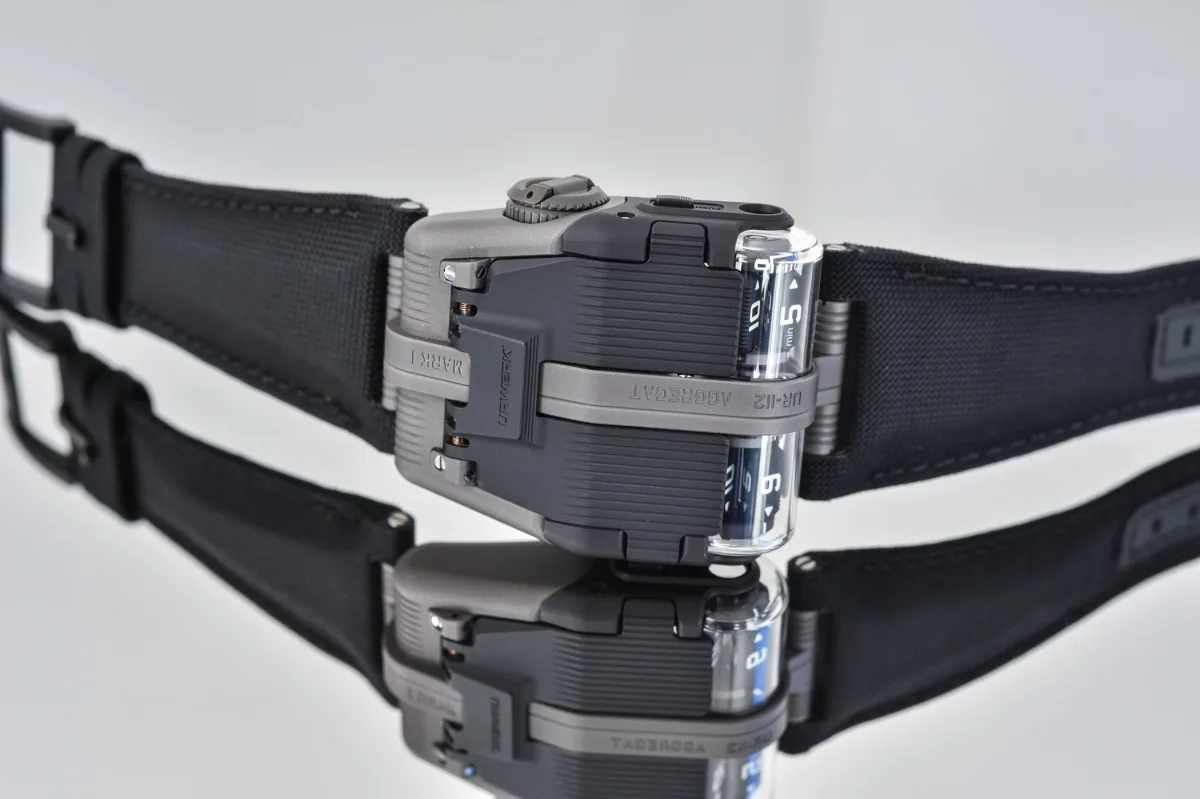
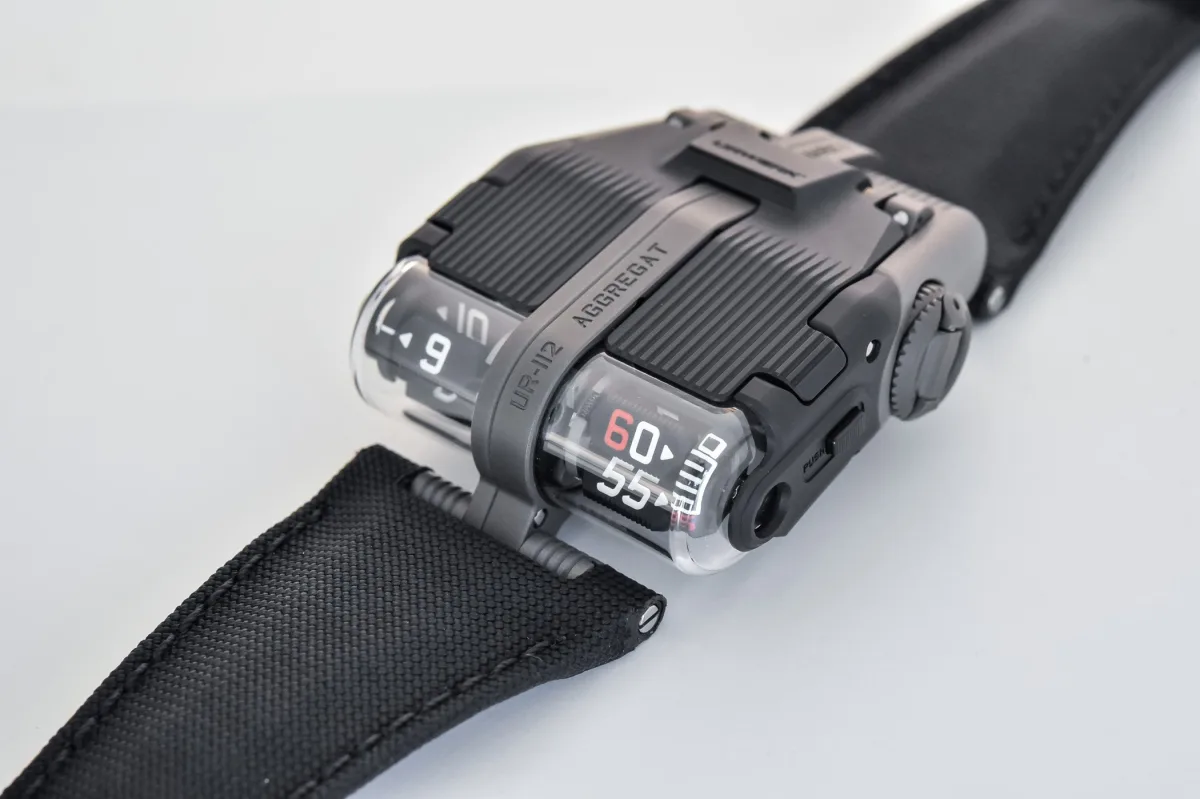
Like the Atlantic, the UR-112 Aggregat showcases a streamlined case with elegant smooth and rounded curves. Like the Atlantic, it is made from a lightweight material - titanium - and even has a central seam running across the case from end to end. The case dimensions (42 mm width x 51 mm length x 16 mm thickness) do not reveal the complex architecture of the case, made from titanium with black and metallic PVD coating. On the wrist, the rounded rectangular case displays hours and minutes horizontally (somewhat like driver’s watches), tapering and decreasing in height towards the end. Even on the reverse side of the case, there is a central seam that transforms into floating lugs when it reaches the case's extremity.
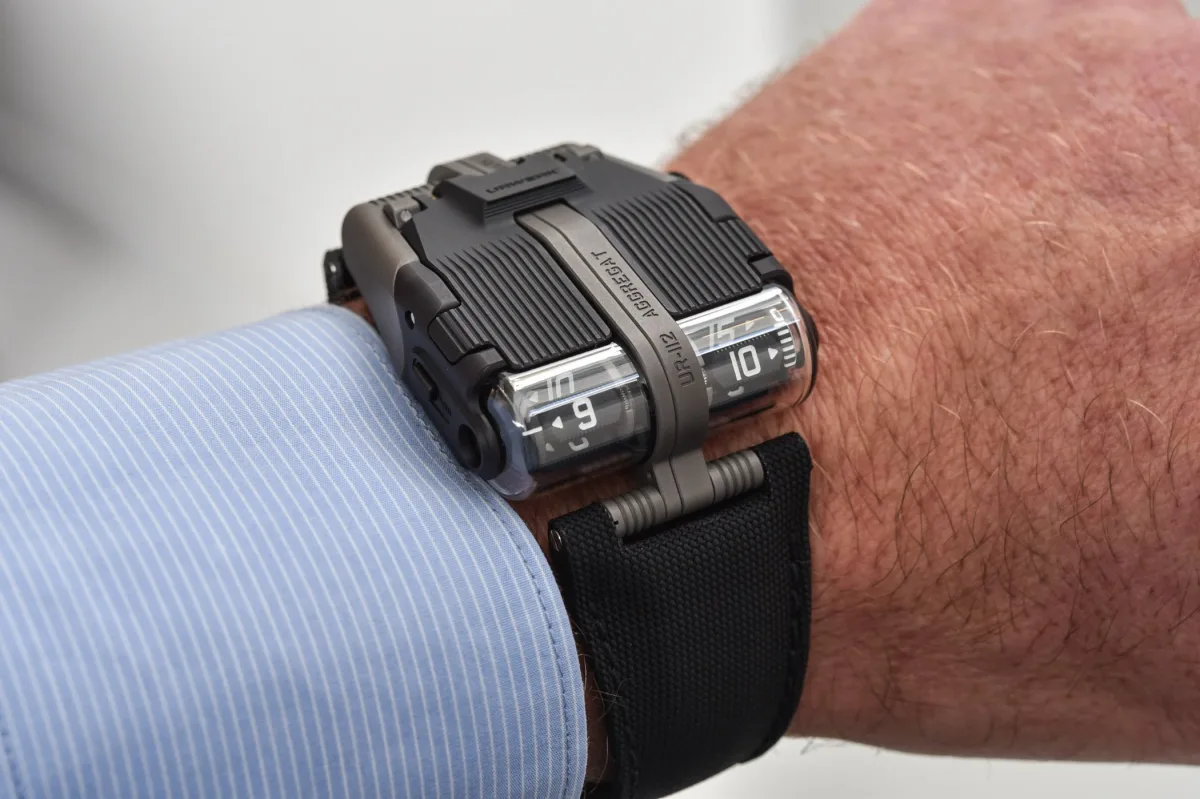
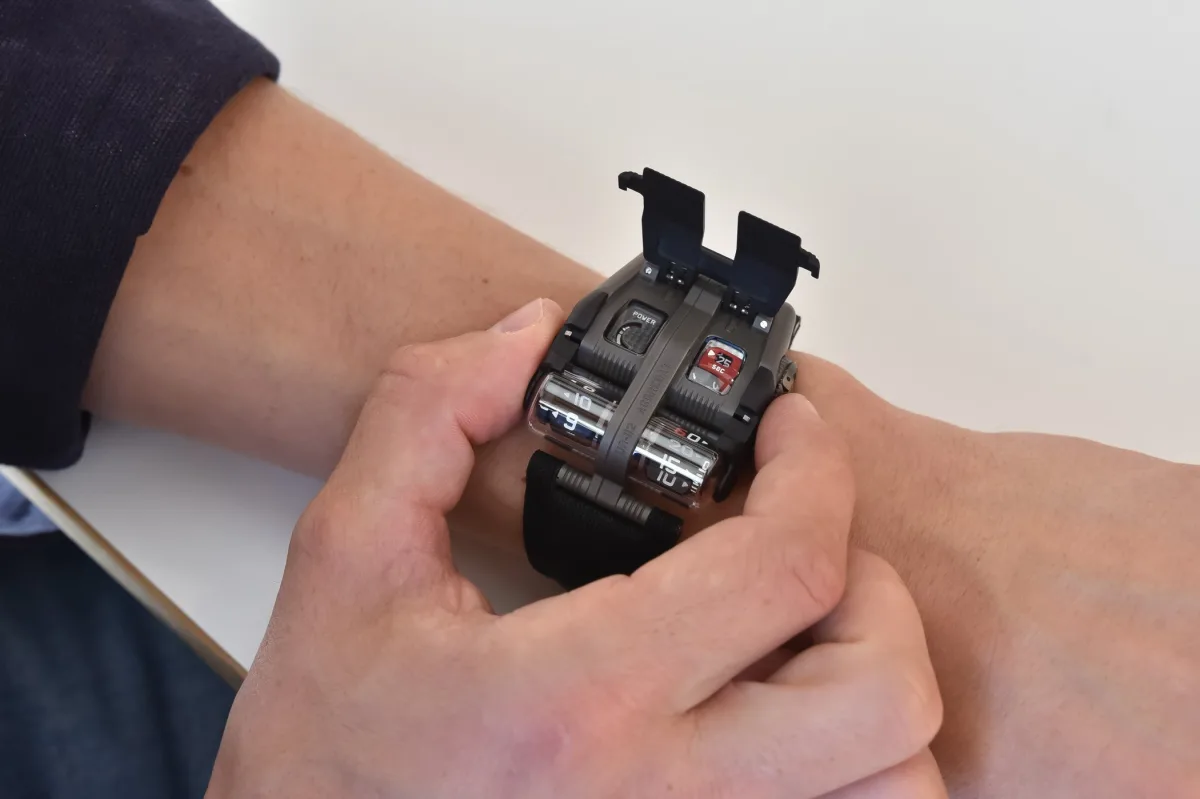
The digital hour and minute indicators are housed in two cylindrical sapphire glass containers, separated by a central seam. On the left is the digital hour display, on the right - the minutes. Each indication relies on triangular prisms that move in sharp, precise jumps, almost like old Solari displays (without truncating the numbers). All 12-hour numbers and minutes, which move in 5-minute intervals, are engraved on prisms and coated with Super-LumiNova, glowing blue in the dark. The operation of the jumping hour indicator is determined by the movement of the minutes. At the 60th minute, the power accumulated over the previous 3600 seconds is used to change the hour.
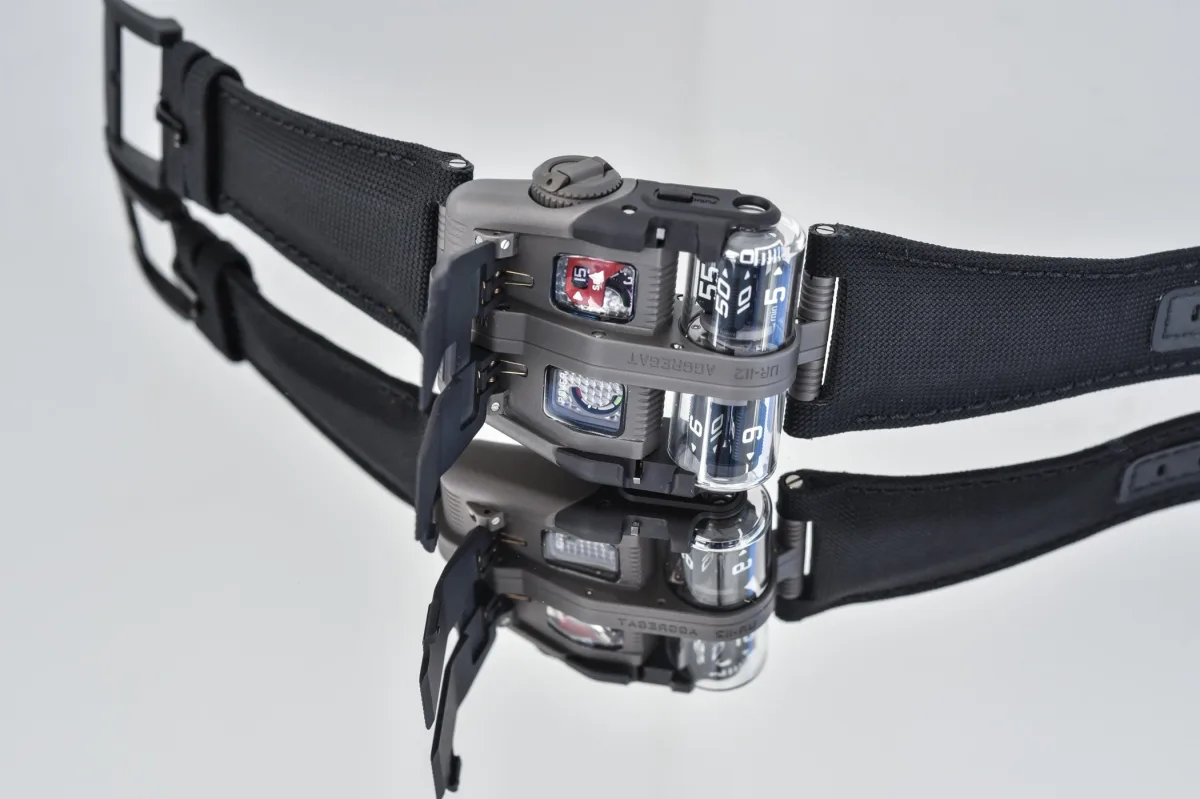
However, to see the seconds, you need to raise the hunter-style case using two side pushers on the case side. Adorned with horizontal speed lines mirroring the Bugatti Atlantic grille, the tilting titanium cover reveals a digital seconds indicator, also calibrated at 5-second intervals. Engraved on miniature silicon discs of a thin plate, tiny numbers on the right extend forward under a magnifying lens and are framed by a bright red plate with a white arrow. Perfectly symmetrical on the left side of the watch's anatomical shape is the power reserve indicator - the only analog display on the UR-112 Aggregat.
HEAVY MECHANICS
Although the watch weighs only 25.2 grams, it represents heavyweight mechanics with eight titanium planetary reducers. For transmitting the energy needed for jumping hours, minutes, and seconds, the UR-112 Aggregat uses a long thin rod known as a drive shaft, running horizontally through the central area between the seconds hand and power reserve indicator. Although hidden by the seam, the drive shaft has dual engagement - one at each end - and transmits all the necessary energy through a complex set of gears and pinions.
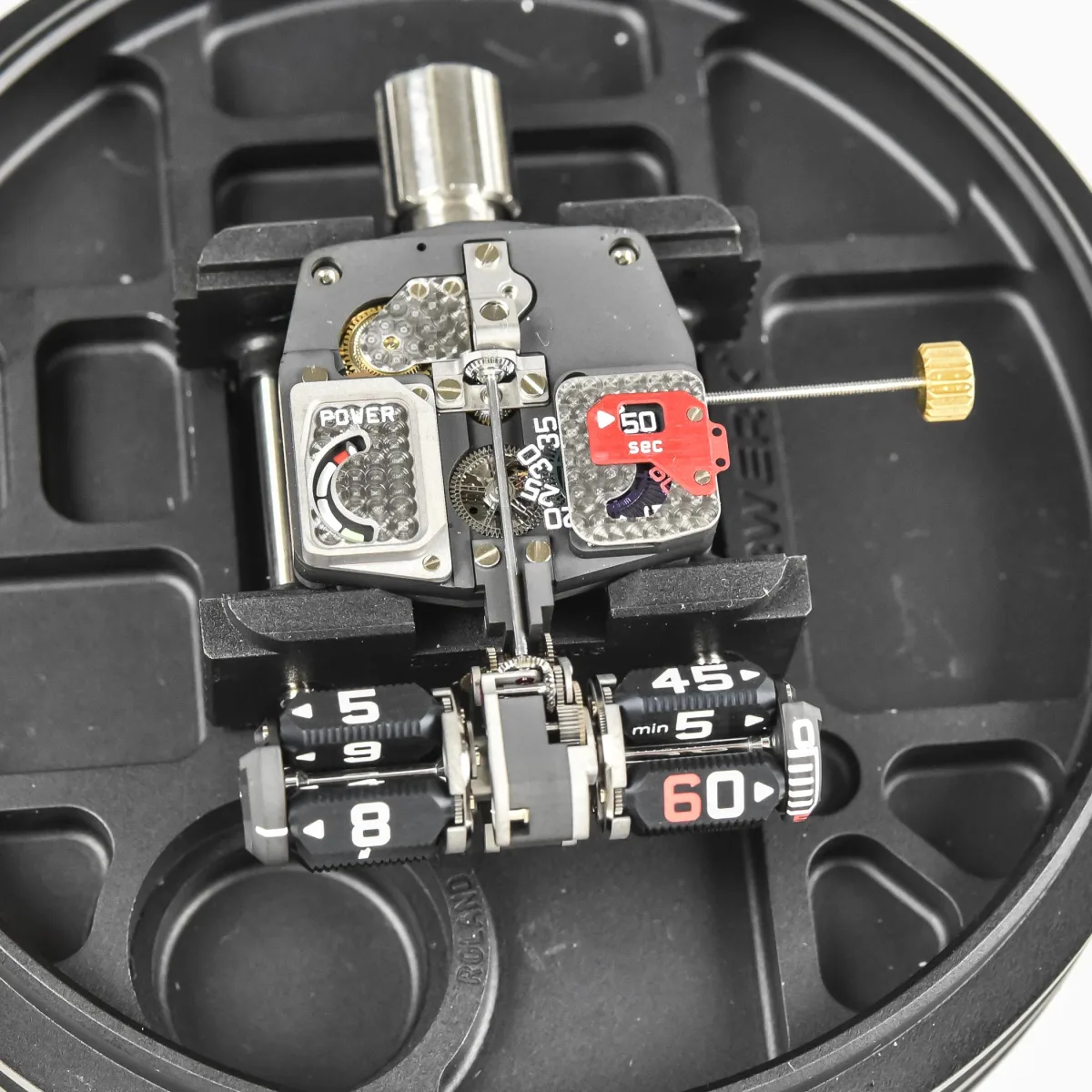
As Felix Baumgartner explains: “From one energy source, we power all the displays and mechanisms of these UR-112. This energy is distributed economically, and some are even ‘recycled,’ so from the digital second at the top of the dial to the trailing minutes and jumping hours at the opposite edge, each display receives precisely its required dose of energy.”
Despite the radical architecture, the watch's finishing is quite traditional: circular and straight graining, Côtes de Genève, and polished screw heads.
AVAILABILITY AND PRICE
The Urwerk UR-112 Aggregat is released in a limited edition of 25 pieces and will retail for 250,000 Swiss Francs. For more information, please visit Urwerk's website.
TECHNICAL SPECIFICATIONS – URWERK UR-112 AGGREGAT
Case: width 42 mm x length 51 mm x thickness 16 mm – titanium with PVD coating with matte gray and black finish – hunter-style titanium hood – buttons on the strap to unlock the hood – water resistance 30 m
Indication: digital jumping hours and minutes displayed on triangular prisms inside transparent sapphire glass cylinders – hours and minutes engraved on prisms and coated with Super-LumiNova – digital jumping seconds and analog power reserve indicator under the tilting hood
Movement: caliber UR 13.01 – automatic – 28,800 vph – flat hairspring – 48-hour power reserve – jumping digital hours, running digital minutes and seconds, power reserve
Availability: limited to 25 pieces
Price: 250,000 SWISS FRANCS