It's no secret that different countries are renowned for their ability to produce different things. If you want the best electronics, buy Japanese. If you need precise power tools or engines, buy German. And if you need good watches, buy Swiss. After all, that's where all the best watches are made, right?
It's true, Switzerland has made a name for itself in the production of high-quality watches. This is due to three factors. First, there is a tradition of watchmaking here that predates even the production of watches. Second, during the European wars of the 19th and 20th centuries, Switzerland maintained a neutral stance. While other countries either suffered the consequences of war or focused on military industries, Switzerland could focus on finer things. Third, this neutrality and local culture of watchmaking led several companies to relocate to the country in the 20th century. For example, although Rolex technically remains a British company, they have been producing their watches in Switzerland since the end of World War I.
However, France also has several excellent watchmakers. Most of them are not as well-known as the most famous Swiss brands, but they remain at the forefront of high watch technology. Here is an overview of my five favorite French watch brands.
Cartier

Cartier is a French manufacturer not only of exquisite watches but also of jewelry and leather goods. With this general aim, you can imagine what to expect: watches created for both beauty and functionality. The history of Cartier began in 1847 when Louis-François Cartier took over his former master's workshop. However, it remained local until the end of the 1800s. In 1899, Louis-François's son Louis moved the Paris branch to the fashionable Rue de la Paix. This brought new prestige, and Louis further solidified the company's reputation by developing new designs. It was during this time that Cartier developed their iconic mystery watches - watches with a transparent dial.
Like many luxury designers, Cartier survived the Great Depression as demand for their products fell. But after World War II, as France's economy recovered, the company found new prosperity. After the deaths of Louis and his brother Pierre, the remaining Cartier heirs agreed to sell the company. In 1972, a group of outside investors acquired the Paris company, and in 1974 and 76, the London and New York companies. In 2012, Cartier was acquired by the Swiss holding company Richemont. The company remains a semi-independent entity with its own managing directors and design team.
Breguet

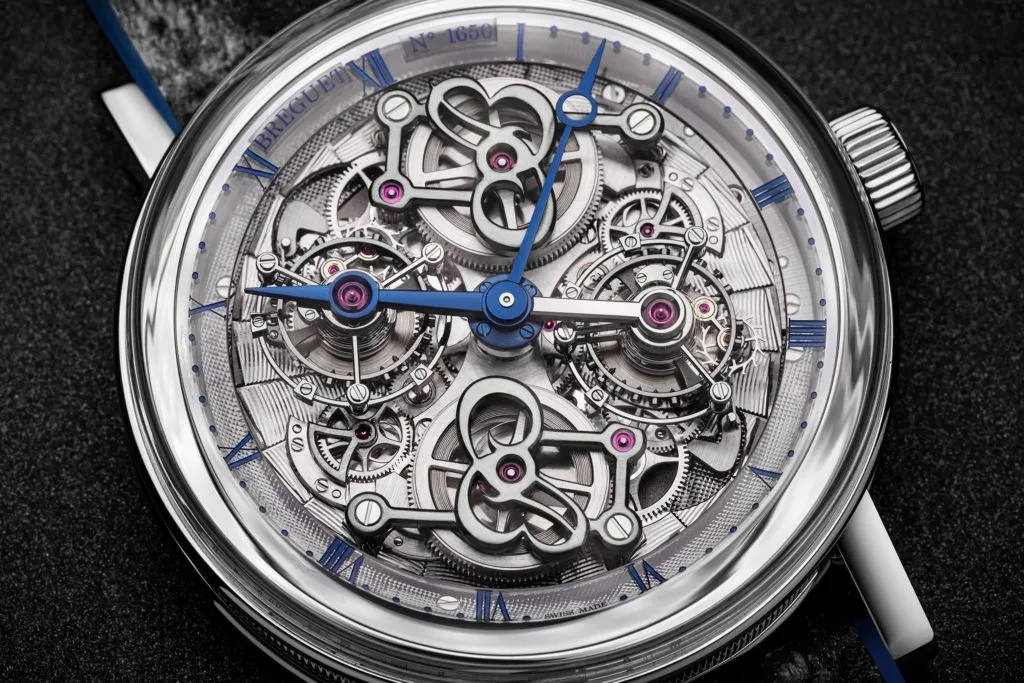
Breguet is one of the oldest watch companies in the world. Founded by Abraham-Louis Breguet in Paris in 1775, Breguet first gained fame by releasing the world's first automatic watch movement in 1780. This brought the company near-universal recognition. Within a few years, British King George III was wearing a Breguet pocket watch. Other notable Breguet watch owners included Queen Victoria, Napoleon, Winston Churchill, and Russian Tsar Alexander I. Some manufacturers spend fortunes endorsing celebrities. Breguet was "endorsed" by some of the greatest figures in human history.
In 1870, Breguet's remaining heirs sold the company to the British Brown family. They remained one of the world's leading watch manufacturers until the 1970s. When the quartz crisis hit, Breguet suffered along with many other manufacturers. Ownership changed hands several times, and in 1992, production moved to Switzerland. In 1999, Breguet was acquired by the Swatch Group and remains a Swiss manufacturer to this day. Nevertheless, the classic French sense of design persists, and the watches are more complex than most Swiss manufacturers. You also get the advantage of a brand that has existed for over two and a half centuries.
Bell & Ross

Bell & Ross is a relatively new watch company, founded in 1992 in Paris, France. Friends Bruno Belamich and Carlos Rosillo, instead of focusing on the boutique industry, which they felt was overcrowded, focused on producing high-quality aviation and diving watches. Bell & Ross first garnered widespread attention in 1997 with the release of the HYDROMAX 11 100 M model, which broke the world record for water resistance among watches. Watches with a maximum dive depth of 11,000 meters will last long after your limp human body is crushed by the incredible pressure of water. Alternatively, you could just accept that these are truly powerful diving watches and go about more ordinary activities.
It should be noted that while Bell & Ross is based in Paris, their watches are manufactured in La Chaux-de-Fonds, Switzerland. They are also part of the Swatch Group, so they are more "French-run" than genuinely French. Despite this, they produce a wide range of very well-designed watches. All their watches feature a high level of visibility. Additionally, many of them have square rather than round cases. This may be less comfortable to wear. However, a square case not only has a modern design but is better suited for extreme water resistance.
Dodane 1857

As the name suggests, Dodane 1857 was founded in 1857. Alphonse Dodane and his father-in-law François-Xavier Joubert decided to build a watchmaking factory on the border with Switzerland. This was not related to Switzerland and watchmaking. Instead, it was because the nearby river provided hydraulic power for their mechanisms. A few years later, they moved to the Haut Doubs region in eastern France to take advantage of better rail connections. Nevertheless, they remained a relatively small operation until World War I.
World War I saw the first use of airplanes to drop bombs. Unfortunately, targeting technology at the time was not very good, and hitting a target with a bomb was practically impossible. In response to this, Dodane developed a special reverse chronometer for use in bomb guidance mechanisms. This invention came too late to participate in World War I, but it established Dodane's reputation as a manufacturer of high-quality chronographs. By 1983, the company was producing over 100,000 watches annually. To this day, Dodane remains a major supplier of watches to the French and German armies.
L. Leroy

The Swiss may be known for their watchmaking skills, but modern automatic watches owe their existence to the Frenchman Pierre Leroy. Leroy invented the escapement, temperature-compensated balance, and isochronous balance spring - all essential elements for quality automatic watches. More importantly for Leroy, they are also necessary for marine chronometers. As the official Horloger du Roi (Royal Chronologist), Leroy developed a series of marine chronometers that surpassed anything available at the time. Unfortunately, he never achieved the coveted title of marine chronometer maker, which went to his rival Ferdinand Berthoud.
Pierre Leroy may never have achieved the recognition he sought, but the company he founded lives on. L. Leroy remains one of the world's most prestigious manufacturers of automatic watches. In the late 18th century, they largely relied on designs inspired by Breguet. But they also introduced many of their own innovations. Perhaps the most iconic L. Leroy watch is the Leroy 01. Created in 1900, the movement consists of more than 975 parts. For nearly a century, it remained the most complex in the world, surpassed only in 1989.