When you think of watchmaking, Switzerland is probably the first country that comes to mind. Switzerland's reputation as a watchmaker is well-deserved. Many of the world's leading brands, including Rolex and Orion, are manufactured there. But that doesn't mean other countries aren't capable of making their own good watches. In recent years, American and even Chinese manufacturers have started producing good automatic watches. It's unnecessary to mention that countries like France and Germany, with their horological histories, have their share of the world's most prestigious watchmakers.
Today, I will present a brief overview of the five best German watch brands. I hope you agree that any of these watchmakers can compete with any of the leading Swiss brands. Let's take a closer look at each of them.
A. Lange & Söhne

A. Lange & Söhne is a brand with ancient roots and a new beginning. The original company was founded in 1845, making it one of the oldest brands on the planet. The company was based in the town of Glashütte, Saxony, and was one of the few companies that brought the town worldwide fame with its advanced watches. The company almost ceased its operations during the Great Depression when widespread poverty and unemployment led to a sharp decline in watch demand. A. Lange & Söhne was 'saved' by Germany's military buildup for World War II, which again increased the demand for watches.
Ultimately, the war became the downfall of the watch manufacture. On the last day of the war, a Soviet air raid almost completely destroyed the main production building. Three years later, in 1948, A. Lange & Söhne was nationalized by the communist government along with other watch companies in the region.
When the Berlin Wall fell in 1990, Walter Lange, a descendant of the company's founder, secured investment funds to restore A. Lange & Söhne. Since then, they have been recognized for the high quality of their products. The company remains a smaller watchmaker, producing around 5,000 watches annually. Since 2000, A. Lange & Söhne has been owned by the Swiss holding company Richemont, but its production is still carried out in Glashütte.
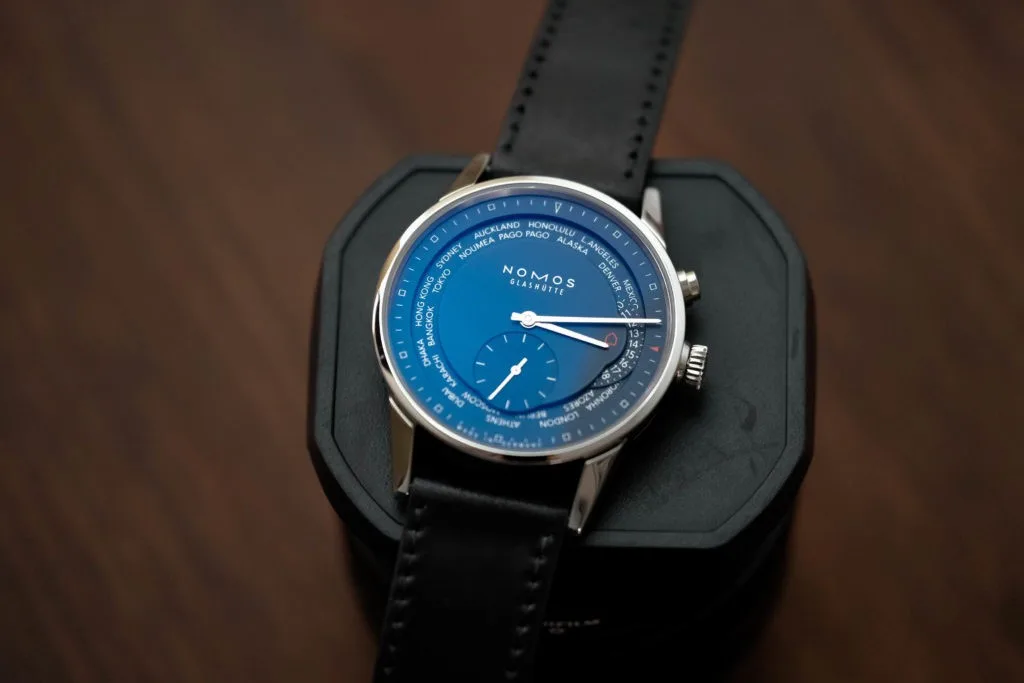
Nomos

Nomos was born in the town of Glashütte, Saxony, around the same time that A. Lange & Söhne was reviving its activities. In 1990, a photographer and watch enthusiast named Roland Schwertner decided to revive watchmaking traditions in the town. While other Glashütte brands such as A. Lange & Söhne and Glashütte Original worked on more modern designs, Nomos returned to the roots of Glashütte's reputation. In 1991, Nomos released the Tangente model, inspired by the classic look of Bauhaus-style watches from the 1930s. The market responded to this idea, and Nomos became a household name overnight. In fact, Nomos can be credited with the recent revival of the Bauhaus style as a whole. Nowadays, Bauhaus-style watches are produced by everyone from leading manufacturers to budget brands.
The young company quickly faced another challenge. To label the watches with the coveted Glashütte mark, at least 50 percent of the watch had to be produced in Glashütte. This was practically impossible when using Swiss movements. For some time, Nomos managed to comply with the law by heavily modifying its Swiss movements, including rhodium plating. However, the ultimate goal of Nomos was to create its own movement.
Nomos released its Tangomat movement in 2005. In 2013, they raised their level by introducing the DUW movement line. It took six years and 12 million euros to develop the DUW escapement system, but it is truly unique. With the development of new DUW movements as thin as 3.2 mm, Nomos is quickly becoming a leader in thin watch production. If you want to learn more about Nomos, check out my full brand history.
Sinn

Sinn was founded in 1961 by Helmut Sinn, who initially made a name for himself as a test pilot and flight instructor. Sinn focused on producing chronometers and cockpit watches, as he was frustrated with the performance of the chronometers currently on the market. With such specialization, Sinn was able to reduce its costs. Instead of selling products through retailers who took a share of the profits, Sinn sold them directly to consumers through a catalog. This allowed them to produce high-quality chronometers cheaper than other manufacturers.
Over the next 30 years, Sinn gained a reputation in the German and Swiss watch industry. But outside of serious enthusiasts, most consumers were unaware of their existence. By this time, Helmut Sinn was over 70 years old and decided to retire and sell his company. The buyer was Lothar Schmidt, a watchmaker who had just completed work on restoring A. Lange & Söhne. Schmidt expanded Sinn's offerings to appeal to a broader consumer market. He also opened up sales to distributors to make Sinn watches easier to obtain. Currently, the company sells over 12,000 individual watches a year, which is quite an achievement for a company that was virtually unknown 30 years ago.
Glashütte Original

Glashütte Original has an intriguing history. In some ways, it dates back to the founding of A. Lange & Söhne in 1845. In other ways, it only appeared in 1994. The issue is that in 1948, the communist government dissolved the original Glashütte watch workshops. In 1951, the remnants of these companies were amalgamated into the East German state conglomerate VEB Glashütter Uhrenbetriebe. When Germany reunified in the early 90s, these state companies were privatized. In 1994, VEB Glashütter Uhrenbetriebe officially became a private company called Glashütte Original. As of the writing of this article, Glashütte Original is owned by the Swiss company Swatch Group but continues to produce most of its products in Glashütte.
Glashütte Original prides itself on its history, calling itself the “legitimate successor of the founding fathers” of the Glashütte watch industry. Besides being known as watchmakers, they are also renowned as educators in watchmaking. The Alfred Helwig School of Watchmaking is technically new, operating under the aegis of the Swatch Group. However, like Glashütte Original itself, it has older roots. The school is located in the same building that once housed the German School of Watchmaking Glashütte, founded back in 1878. No matter how you look at it, that's an impressive pedigree.
Junghans

Unlike watch manufacturers in East Germany, Junghans has been able to operate continuously since its founding in 1861. Located in the city of Schramberg, Baden-Württemberg, in western Germany, the company originally produced both watches and clocks. In fact, you can still purchase Junghans clocks in addition to wristwatches today. Junghans also entered the defense industry. They manufacture a wide range of high-precision fuses for mortars, artillery, tanks, and even cruise missiles. The fact that militaries worldwide use their fuses should tell you a thing or two about Junghans' reputation as a high-precision manufacturer.
Junghans is known not only for its automatic but also digital watches. In the mid-90s, they even released solar-powered watches, although Citizen has since dominated that market. Junghans also collaborated with Seiko in creating the first wristwatches that automatically adjust to time zones.