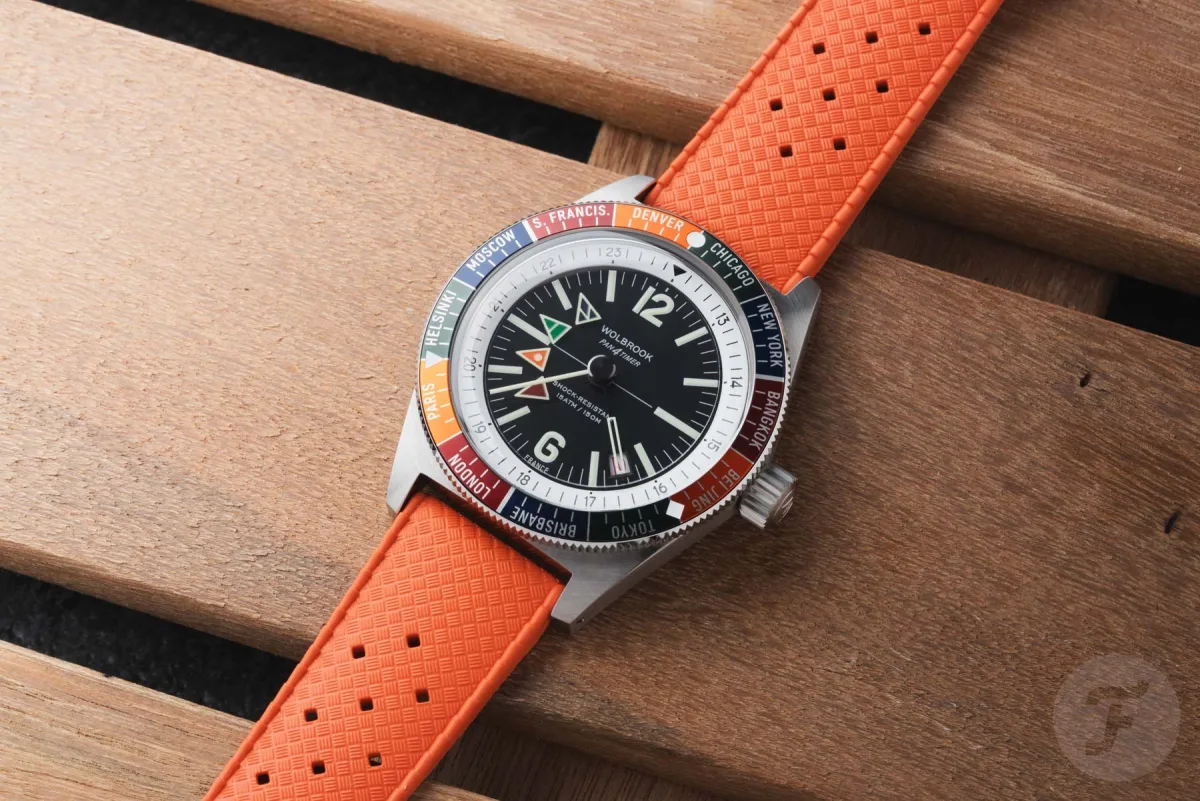
When people ask me for the time, I usually show them my watch rather than just telling them the time.
Why this happens isn't entirely clear. Perhaps I think that without visual confirmation, they won't believe me. Or maybe it's just my quirk... In any case, when I wore the Wolbrook Pan4Timer Automatic, this approach didn’t work. These watches don't allow for quick and intuitive time reading. To use them, you need to figure them out. Why? Because they offer a rather original way of displaying multiple time zones.
This leads to an important question: is this an improvement or just an artificial attempt to stand out? A brilliant solution or overly complex? Let's find out.
What is the Wolbrook Pan4Timer Automatic?
Before diving into the multi-timezone display feature of the Wolbrook Pan4Timer Automatic, let's briefly talk about the brand and model. Wolbrook is a French brand revived in 2019. The company produces a collection of vintage-style watches, focusing particularly on skin divers and chronographs. A key point is their aggressive pricing strategy. For instance, the Pan4Timer costs only €449.
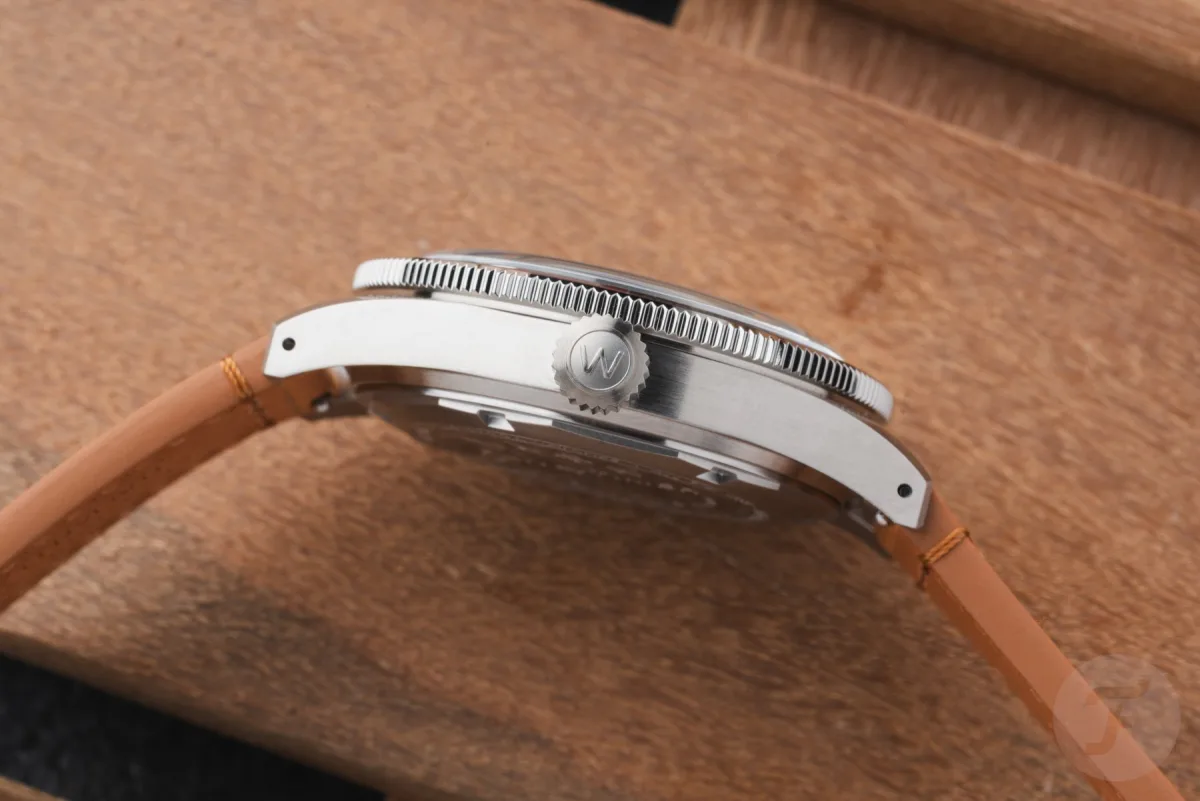
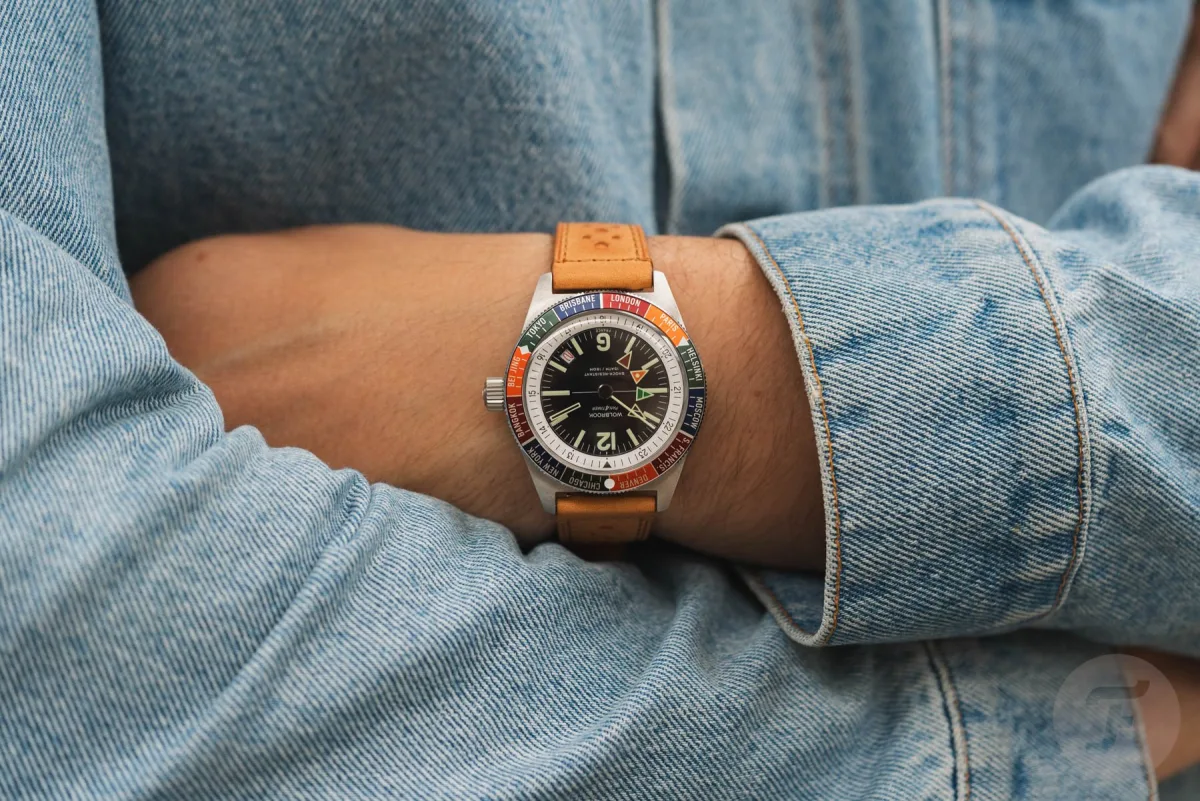
Based on a skin diver's platform, this stainless steel model has a case diameter of 40 mm, a lug-to-lug distance of 48 mm, and a thickness of 13 mm. Part of the thickness is due to the box-style domed sapphire crystal. The watch features a screw-down crown and water resistance up to 150 meters. The lug width is a standard 20 mm, with various strap and bracelet options available. In my review, the watch was on a light brown leather strap.
Inside is the automatic Miyota caliber 8315 movement, with a frequency of 21,600 vibrations per hour and a power reserve of 60 hours. In Wolbrook's execution, the movement displays the date in a 'roulette' window at the 4:30 position and offers an accuracy of ±15 seconds per day.
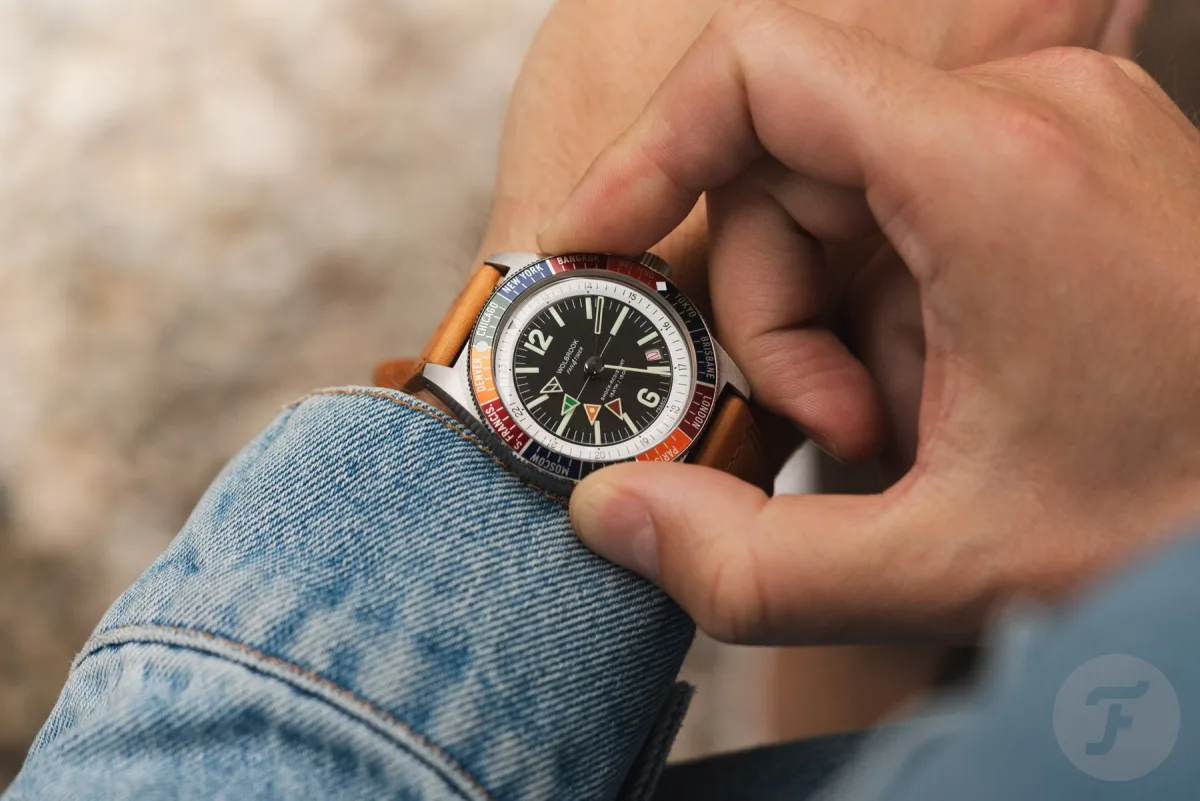
How are the watches arranged?
Let's move to the main feature of the Wolbrook Pan4Timer Automatic. Note the absence of a traditional hour hand. Instead, four sequential hour indicators are applied on a transparent disc. These are complemented by the usual minute and second hands. The four-hour indicators correspond to four colors on the bezel, each representing different cities around the world.
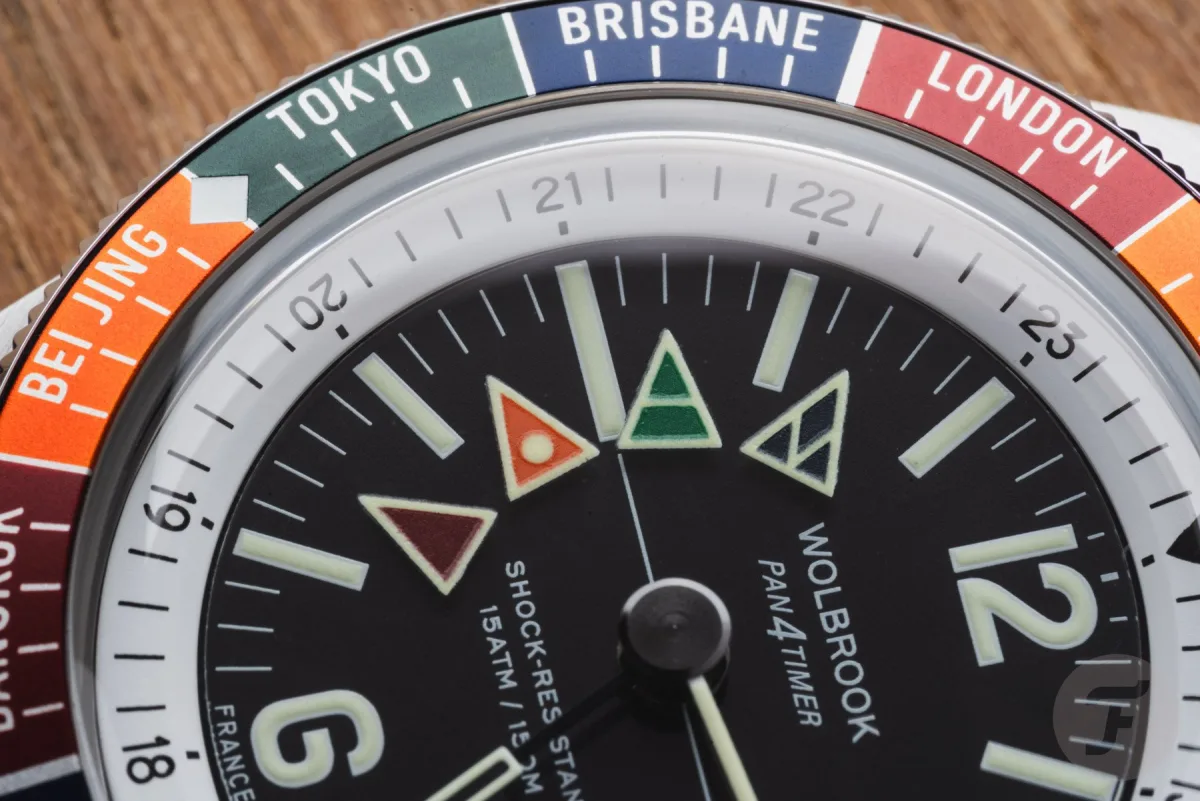
The idea is that the Pan4Timer allows for intuitive reading of time across four sequential time zones. For example, if you are in Paris, you set the correct time using the orange hour indicator. Now you can immediately see that it's one hour earlier in London, one hour later in Helsinki, and two hours later in Moscow. For clarity: the four indicators are fixed on one transparent disc and can only rotate together, not individually. The region is set by turning the unidirectional bezel. In our example, the diamond index on the bezel is set to the '12' mark, indicating the London-Moscow zone.
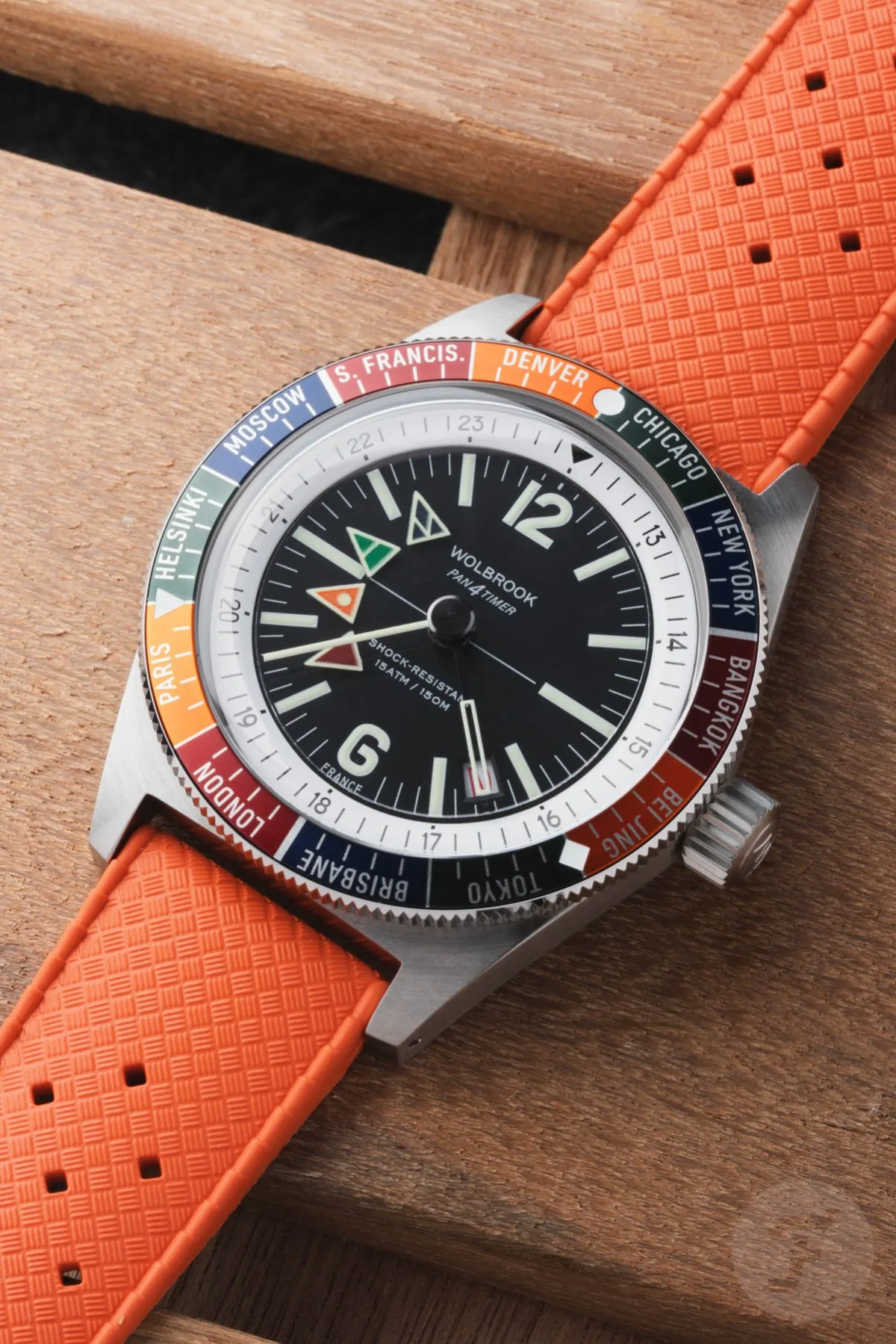
Suppose you remain in Paris but want to know the time in Denver. In this case, you rotate the Paris section of the bezel to the orange hour indicator. The Denver mark on the bezel now indicates the corresponding time in Denver. For example, if it's 8:00 in Paris, you rotate the bezel to the 8 mark, and the Denver mark will point to 00:00. However, you have to determine yourself whether this means midnight or noon.
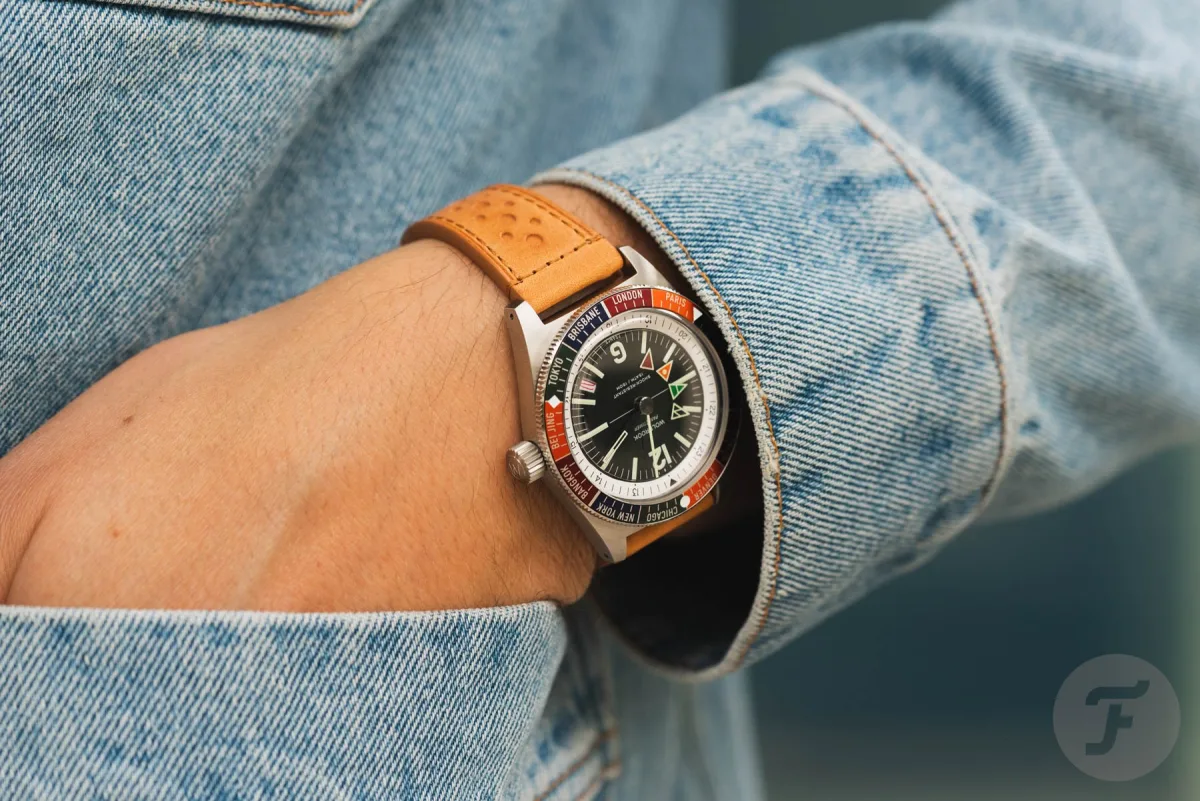
How to use the Wolbrook Pan4Timer Automatic?
As you can see, the Pan4Timer is best suited for reading sequential time zones. If you need to quickly know the time in different parts of the world, a classic worldtimer would be more practical.
Question: who would these watches suit? Perhaps, personally, me. I live in the Netherlands (Paris time zone) but often work with colleagues in the UK. The Pan4Timer allows me to immediately see the time both at home and for my English friends.
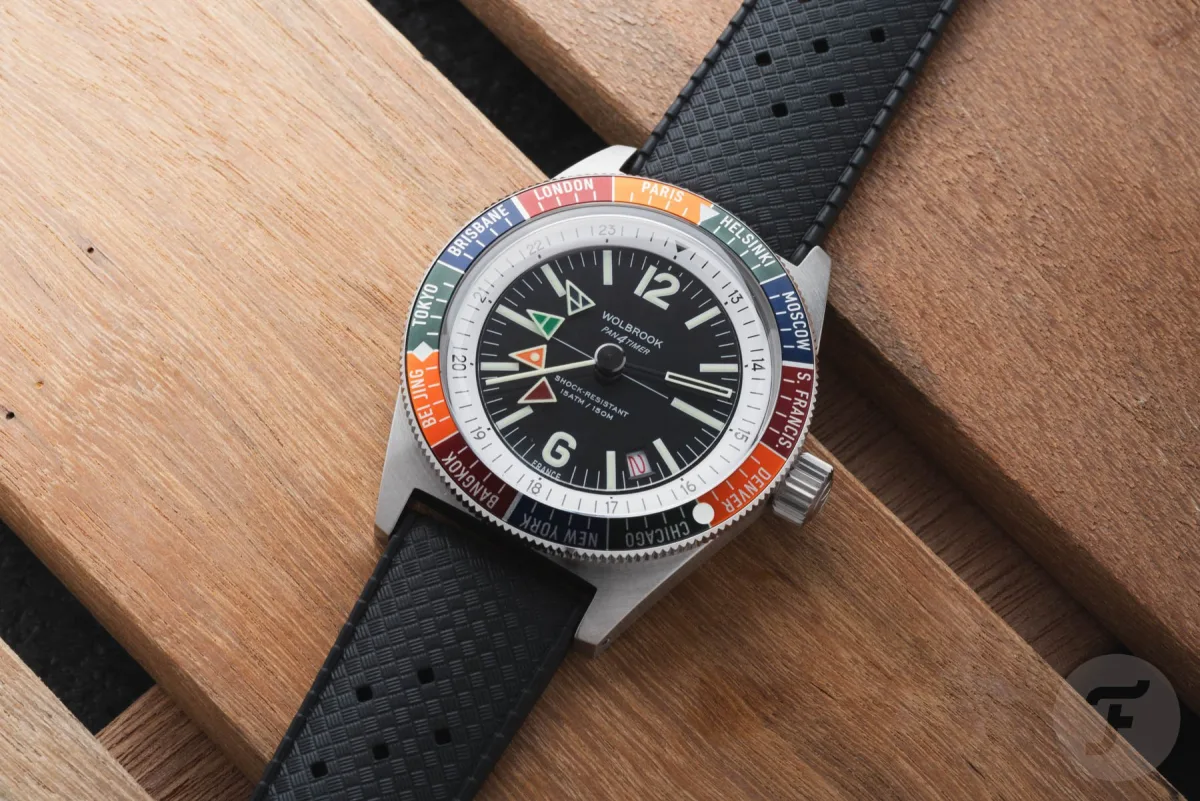
These watches can also be useful for travelers moving within one region. For example, when traveling through Asia and Australia, you can track four sequential time zones from Bangkok to Brisbane. Theoretically, this allows for setting the watch once.

Wolbrook Pan4Timer Automatic: Brilliant or Overly Complex?
Of course, there are situations where the Pan4Timer proves useful. But the main question is - is it better than a traditional worldtimer, a classic worldtimer bezel, or a GMT complication? I tend to answer 'no' to this question.
When tracking adjacent time zones, complex functions are not required. I know that London is one hour behind Amsterdam, and that doesn't require complex calculations. For travel, I would prefer more precise bezel markings to accurately determine the transition to another time zone.
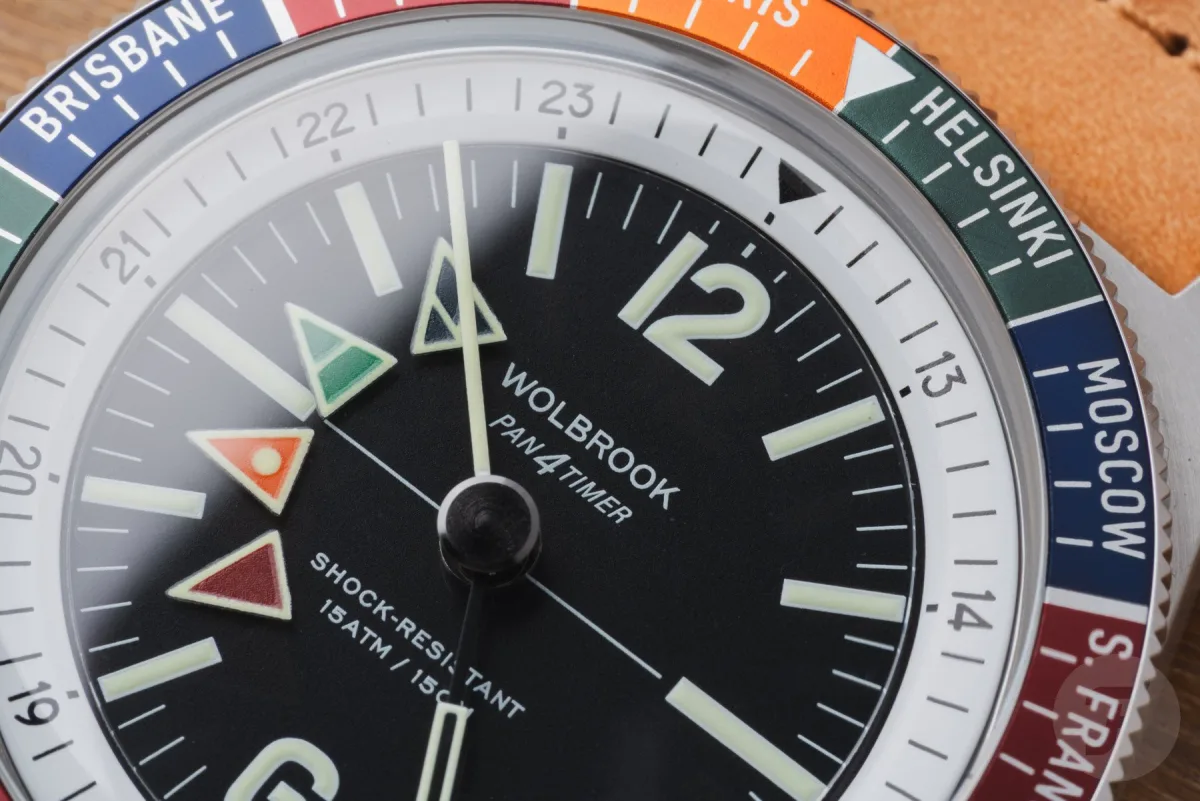
Maybe I'm taking this too seriously. Perhaps the Pan4Timer is more about the romance of a global perspective than practicality. From this point of view, the watch works excellently. The four indicators remind us of the relativity of our viewpoint. Color coding adds a sense of lightness and playfulness. The visual effect of 'floating' hands evokes associations with Haute Horlogerie designs in the 'Mysterieuse' style.
Conclusion
It's important to remember that these watches cost less than a typical service for a Rolex GMT-Master. In the traditions of Wolbrook, they offer an affordable and interesting alternative. The goal is to be a bright highlight in the collection or a conversation starter. I appreciate them as an exercise in an unconventional view of time. Their task is not to revolutionize timezone tracking but to offer an unusual approach. And in this regard, they are successful both visually and conceptually.

You can put on the hat of a picky reviewer and point out the lack of a bidirectional bezel, the rough finish, and execution reflecting the price. But that would miss the point. In the end, you get a lot of watch for your money and the opportunity to smile - and sometimes that's the most important thing.
What do you think about the Wolbrook Pan4Timer Automatic? Share your opinion in the comments!