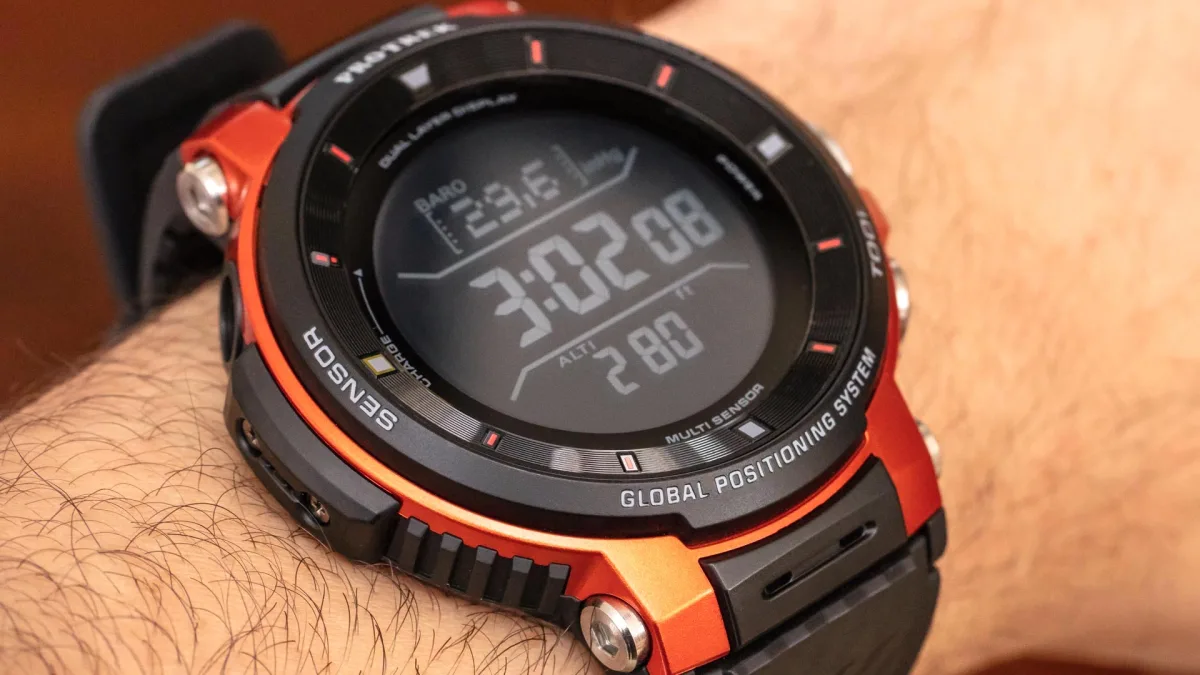
The latest smartwatch from the Japanese watch company Casio in 2019 is the WSD-F30 model from the Pro Trek Smart collection. In this watch review, we will discuss how Casio has updated its only product from the smartwatch collection and where Casio seems to be heading in its still-new journey of connected smartwatches, considering that most watches Casio continues to produce are classified as traditional watches (though many of them have connectivity features).
Casio began producing modern connected smartwatches with the WSD-F10 model, followed a year later by the WSD-F20 model. The WSD-F30 is the third-generation product for Casio's only smartwatch with Android Wear support.
Smartwatch for Hiking and Adventures on Android Wear
With the release of the WSD-F20, Casio officially included this product in the Pro Trek family, dedicated to hiking and outdoor adventures, calling it Pro Trek smart. This designation is important for consumers as it helps define the specific smartwatch niche that Casio is targeting. I am not familiar with all the smartwatches currently available, but as far as I can tell, Casio's niche with the WSD-F30 is rugged, durability-oriented outdoor watches running on the Google Android Wear operating system.
Competitors from companies like Samsung, Apple, Garmin, and Suunto have their worthy products, but none occupy this particular niche.
Casio has years of experience with the larger Pro Trek collection of hiking watches (known as Pathfinder in the USA), and with smartwatches, the world of features and capabilities of adventure watches truly blossoms. Wearing the WSD-F30, I try to ignore the standard Android Wear functions (except for Google Fit and Google Maps) to focus on the software developed by Casio for the Pro Trek Smart collection, including the WSD-F30.
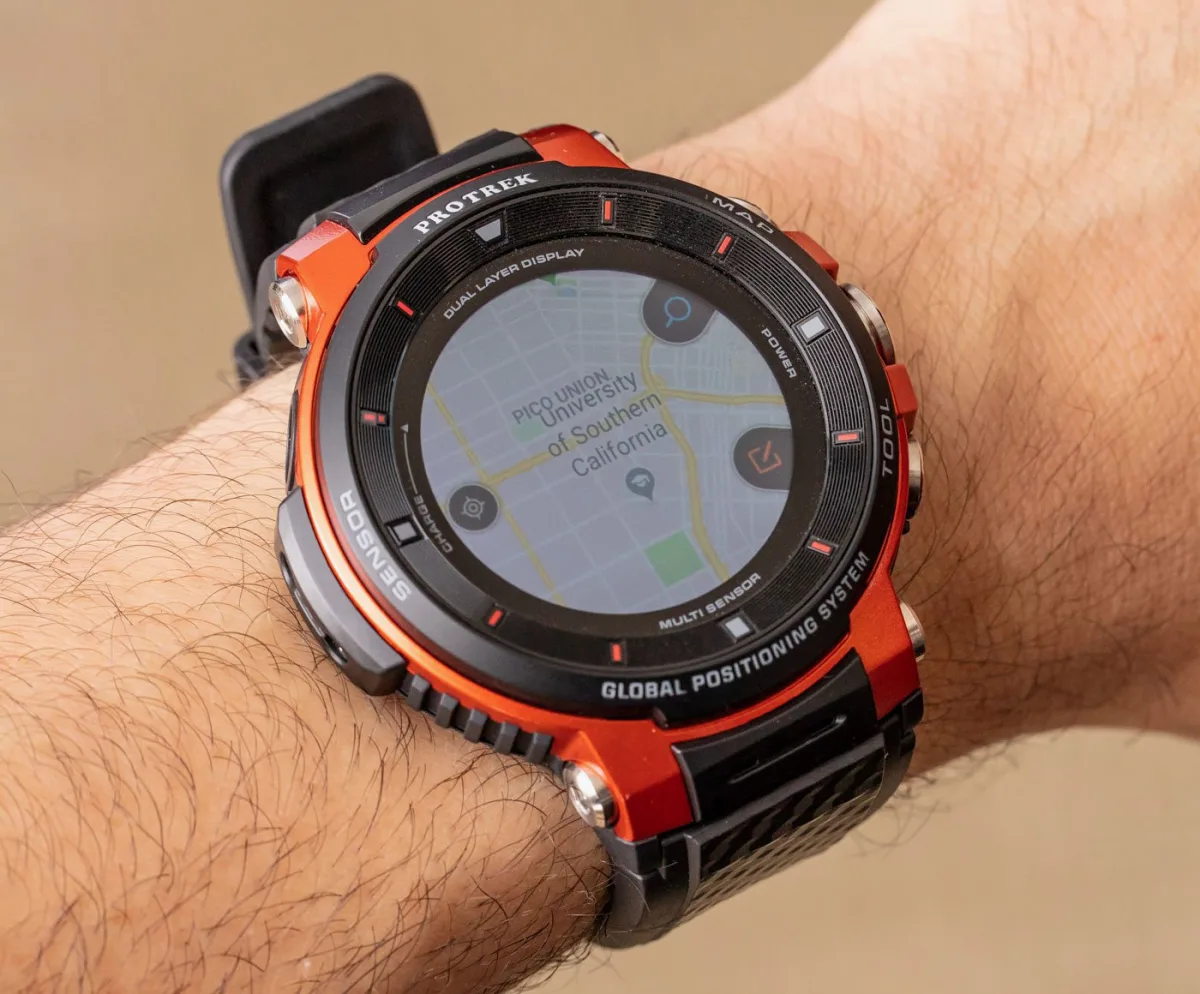
The main advantages of the smartwatch platform are the GPS sensors and the sophisticated software that can use this information. The WSD-F30 can also store maps, which allows for a range of mapping tasks, waypoints, and navigation directly on the watch without relying on an Internet connection.
In fact, it seems that Casio designed the WSD-F30 with the idea that their owners would regularly be out of traditional cell phone reception zones. (One example of this is the ability to store map data). The watch also features a range of energy-saving functions to help extend the smartwatch's battery life from one or two days to a month if necessary.
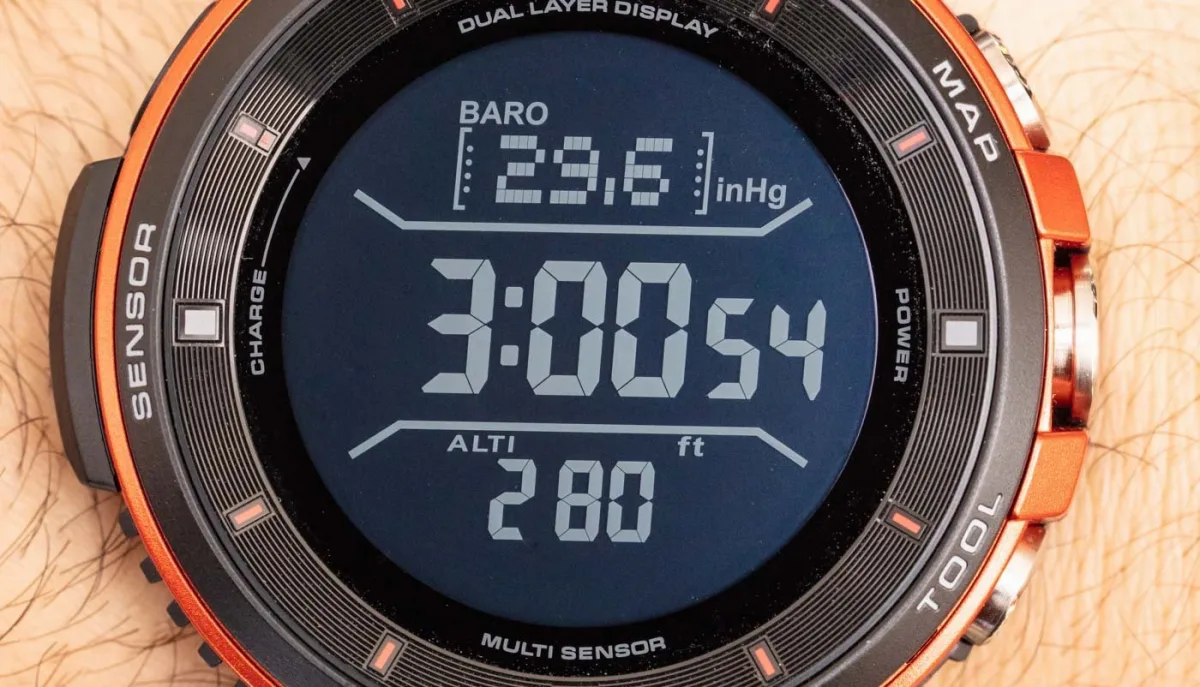
The way this is implemented in the WSD-F30 is interesting because Casio introduced dual-screen technology in this product. This is not new to Casio per se, but it is new to the brand's smartwatches. The idea is that the lower backlit full-color OLED screen is complemented by a transparent monochrome screen.
The watch features an attractive and useful always-on display that uses only the top screen. This allows the watch to save power by showing the time without requiring the main display to turn on and drain the battery. The owner of the WSD-F30 can use various power-saving options to selectively turn some features on and off to extend the WSD-F30’s battery life or turn everything on so the watch constantly tracks GPS data and functions as a fully connected smartwatch with notifications and alerts.
I believe the dual-screen system is a brilliant concept, but I don’t feel Casio’s user interface design has used it to the best advantage. It feels like Casio introduced dual-screen technology for purposes like battery saving, but they have yet to take full advantage of how two screens can work together when it comes to various displays.
New, More Comfortable and Refined Case Design
Casio claims that the Pro Trek Smart WSD-F30 watch meets the US military standard MIL-STD-810G for environmental resistance, and the case is water-resistant to 50 meters - meaning you can swim with it. There are a number of sensor openings in the case (such as the built-in barometer), so the durability rating is still impressive. The watch does not have a heart rate sensor, though I think Casio will want to include one in the future. The brand has other products that it considers more for physical exercise and fitness.
Remember that Pro Trek Smart is a watch for adventure and navigation, not a fitness device. This doesn’t mean you can’t use the WSD-F30 for workouts, just that Casio hasn’t yet reached the need to include a heart rate monitor in the set of built-in tools.
The touch OLED display with a resolution of 390×390 pixels is bright and clear, with mineral glass (unfortunately not sapphire at this price point) above the screen; I definitely don’t miss the days of incomplete round screens for Android Wear devices. I found the screen overall to be very responsive, despite having to do some finger gymnastics on the 1.2-inch screen from time to time. Casio has provided three buttons on the case, though interacting with the touchscreen is the main part of the Android Wear operating system.
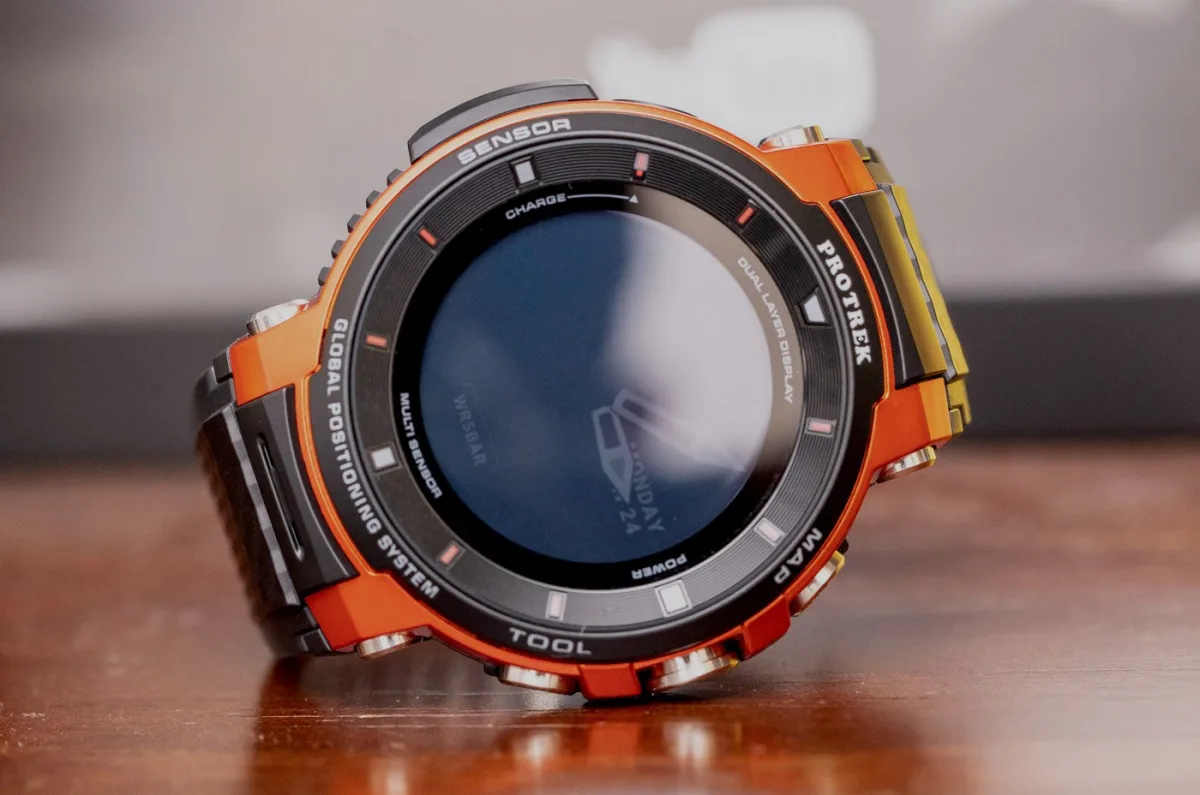
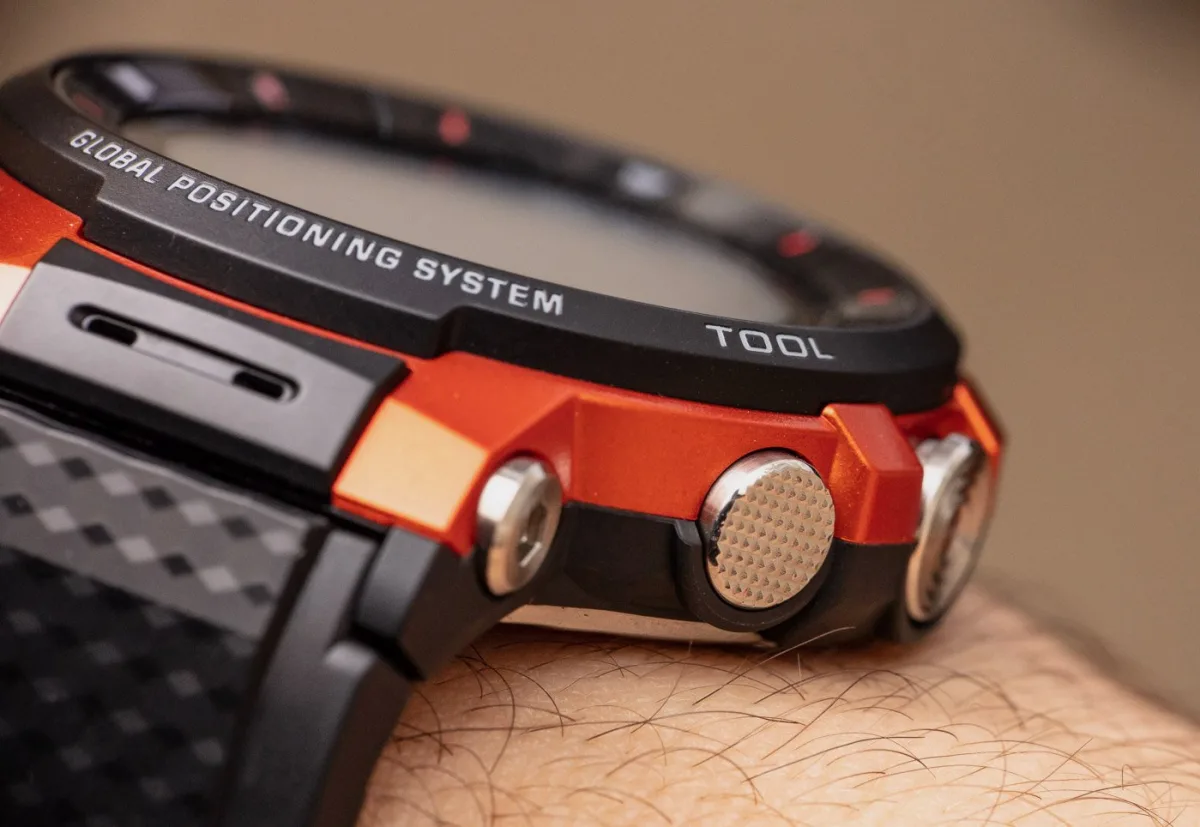
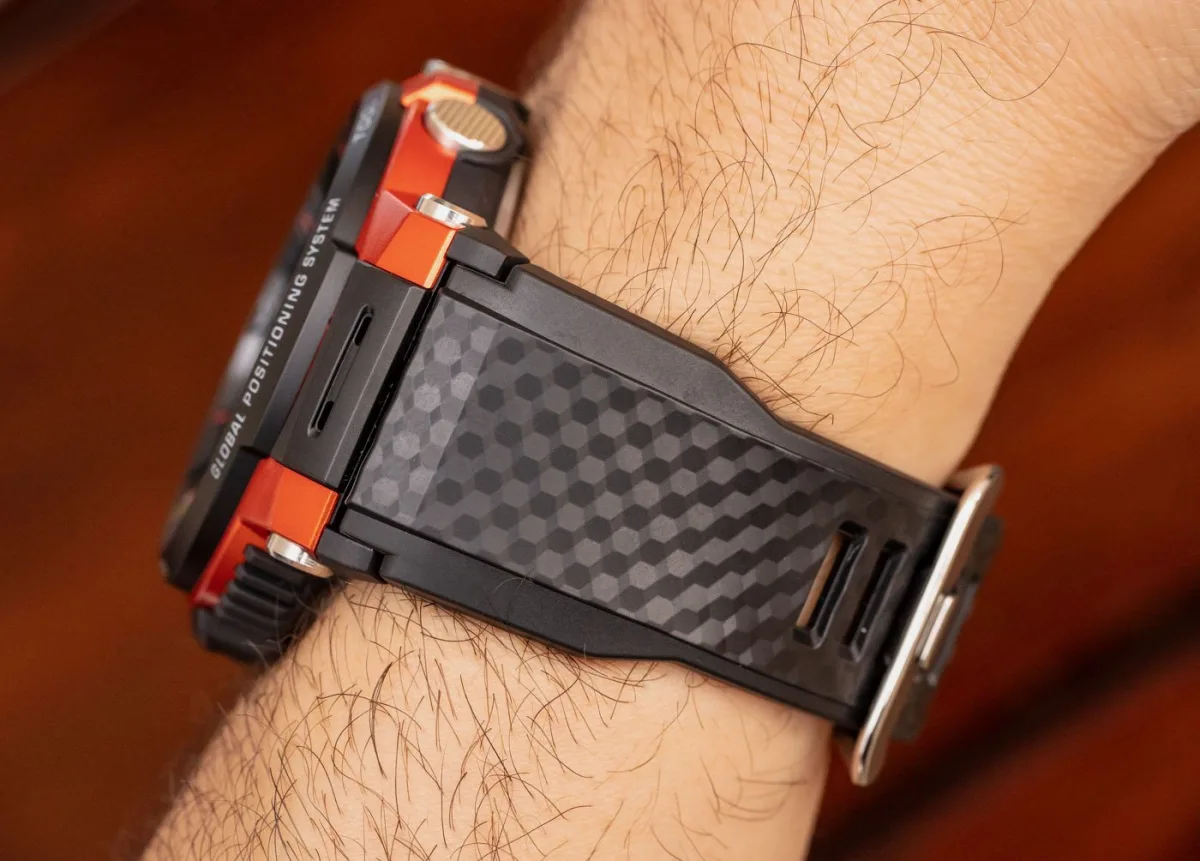
In the WSD-F30 model, Casio presents a completely new design for its smartwatches. It's still large, but much more attractive and visually interesting compared to the WSD-F10/20 products. The case has a width of 53.8 mm, a thickness of 14.9 mm, and a lug-to-lug length of 60.5 mm. It’s a large size, but at just 83 grams, the watch is very comfortable to wear. Casio also continues to improve the straps of its smartwatches, which now feature quick-release spring bars.
The polyurethane straps look quite nice, but it's good to know they can be easily replaced with something else.
Charging the WSD-F30 is still done with a magnetic charging cable that attaches at approximately the “10 o’clock” position on the case. The magnetic connection is reliable, but I still believe there should be a more secure way to attach the charging cable if the watch is in a backpack or you are on the move while charging.
Casio sells a “Powertraveller” kit that includes a solar USB charger, which would be great for the WSD-F30 if you can sit and wait for it to charge over several hours.
Software Development
Like many other Japanese companies, Casio prefers to be vertically integrated as much as possible. This means they want not only to manufacture and develop their watches but also to produce and develop the internals of these watches. The Pro Trek Smart WSD-F30 uses Google Android Wear software, for which Casio has written special software.
Casio cannot fully control Google Android Wear, and I suspect their engineers feel constrained by this. For this reason, I assume Casio has included “standard smartwatches” (Pro Trek Smart, that is) among their modern connected watches. I want to say that while Casio seems to firmly believe in the future of smartwatches, it invests part of its resources only in those that run on Android Wear.
This is alright because Android Wear can teach Casio a lot about how watches can better interact with the connected world than traditional watches. For example, Casio has other watches using Bluetooth, but it is only used for a basic communication protocol between the watch and the user’s phone via a special app. With Android Wear, Casio is forced to constantly ask itself how to best utilize the operating system’s capabilities to fulfill its mission of producing world-class watches for hiking and outdoor activities.
One of the first software products users discover on the WSD-F30, written by Casio for this platform, is “Tool”. There is a special button on the case to activate this multi-screen software, which displays a compass, barometer, and altimeter on the screen. Tool is Casio's way of including traditional Pro Trek “triple sensor” functions in the watch - and I think it is done very well in the WSD-F30. However, I would like to see more updates - at least visual improvements over the last-generation WSD-F20 watches.
In fact, there is no new Pro Trek Smart software in the WSD-F30 (as far as I noticed). Casio Moment Setter + remains the primary utility app that allows using GPS and mapping functions for various purposes. These tools are some of the most interesting in the WSD-F30, but they are really intended for those who are serious about trekking or need a GPS device as a survival or productivity tool.
But I want to commend Casio for being able to match the software and watch features to the audience they hope to attract with the WSD-F30. In addition to the special buttons on the case for the Tool and Map functions, the watch’s preloaded software (with a total of 4 gigabytes of internal memory) contains many tools for specific sports and outdoor activities. With a little searching, the WSD-F30 smartwatch user can easily find tools to help make some of their favorite activities more interesting (or at least more data-rich).
In the technology industry, it is a common cliché for companies to claim that “this year’s model is the best we have ever produced.” The technology industry typically uses an iterative approach to development, where new products are based on the strengths of previous ones. So it is not surprising that the WSD-F30 is Casio’s best smartwatch yet. Does this mean they are done? Hardly. It seems Casio is taking its time with standard smartwatches, having released a single line (WSD-FXX) in one activity category (for outdoor/recreational activities).
Casio could easily create a family of Android Wear smartwatches for other activities, from fishing to flying, but they are not doing that. Rather, they are observing where the smartwatch industry is headed while participating in it. The shortcomings of the WSD-F30 are mostly related to the limitations faced by hardware manufacturers when it comes to accessing the core Android Wear software system. The platform is designed for hardware to be in it, as opposed to hardware really integrating with it. Casio is used to a more integrated approach to software and hardware working together, which makes their smartwatches a particular challenge for the team.
I would like Casio to continue developing the software both in terms of practicality and aesthetics. Casio more or less defined how plastic digital sports watches should look by releasing the G-Shock model.
Now the brand can introduce new innovations and show the world how digital smartwatch screens should look. There are hints of design brilliance in the software Casio created for the WSD-F30, but I don’t think we have seen the full potential of what a company like Casio can do if it truly invests in smartwatch screen interfaces. If these faces are good enough, they could offer all Casio Pro Trek Smart product owners free downloads, and perhaps the company could earn some profit by selling digital faces for other compatible Android Wear smartwatch devices.
From a pricing perspective, the Casio Pro Trek Smart WSD-F30 seems to sit in between premium “lifestyle” smartwatches and entry-level fitness-themed smartwatches and wearables. The plastic and metal case construction and original design allow the WSD-F30 to exist between these two worlds. The watch is entirely devoid of any claims to luxury but doesn’t feel like a toy either. It might be the Android Wear smartwatch I would purchase right now if I were in the market. Casio introduced the WSD-F30 in blue as WSD-F30-BU and in orange (as tested) as WSD-F30-RG.
The retail price is $549.99 USD. More information on Casio's website.
Essential Data
>Brand: Casio
>Model: Pro Trek Smart WSD-F30 (WSD-F30-RG, as tested)
>Price: $549.99 USD
>Dimensions: 53.8 mm wide, 14.9 mm thick, and 60.5 mm lug-to-lug.
>Why Buy: Hiking or traveling in unfamiliar wilderness are great occasions to wear this smartwatch.
>Friend We’d Recommend Them To First: A data enthusiast who loves hiking and will use native maps to track their adventures where cell phone signals don't reach.
>Best Characteristic of the Watch: Comfortable and lightweight, with a bright, responsive screen, the WSD-F30 is a fast smartwatch with great Casio software on Android Wear, specifically designed for outdoor use.
>Worst Characteristic of the Watch: Casio seems to have invested most of its efforts in the WSD-F30 in the new case and dual-layer screen technology. The latter is not used as well as it could be, and the overall package seems to need updates and expansion in the software and visual design interface areas.