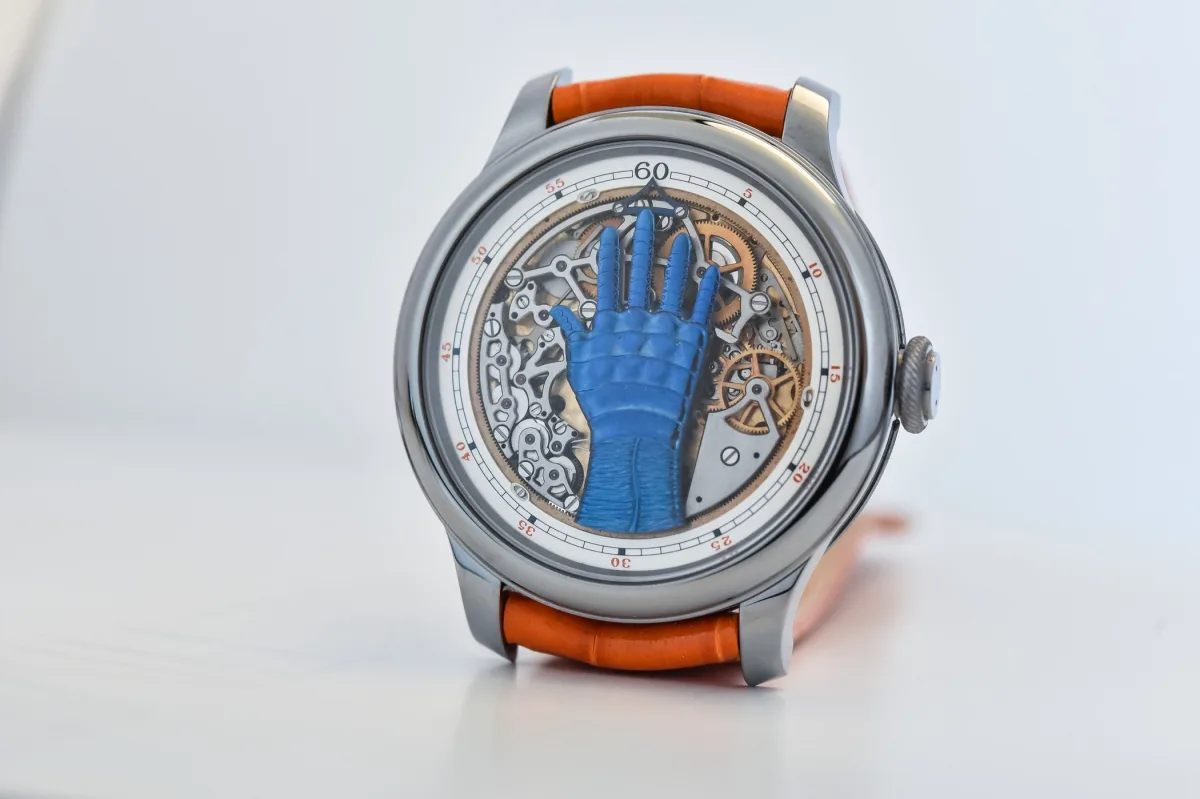
We have all heard of watch collaborations with designers and artists, and even chased watches on the wrists of famous actors and directors, but I am sure this is the first watch collaboration with a film director. Possibly the most original watch in the lineup of models submitted for the Only Watch 2021 charity auction, F.P. Journe equipped a model from his iconic Octa collection with an automaton driving the time-telling hand. The idea of telling time with a hand was proposed by Francis Ford Coppola, the famous American film director, producer, and screenwriter: the result is this unexpected, technically mind-blowing, one-of-a-kind F.P. Journe FFC (Francis Ford Coppola) Blue model.
THROWING DOWN THE GAUNTLET
According to F.P. Journe, the idea for the watch arose during a dinner at Francis Ford Coppola's house in Napa Valley. (A man of many talents, Francis Ford Coppola opened a winery resort in Sonoma County, California, in 2010). "He asked me," explains Journe, "if time could be told by a hand in a watch. I replied that the idea was interesting and needed thinking over. But how to display 12 hours with 5 fingers? It wasn't easy, and this complex challenge inspired and motivated me. Once I figured it out, Francis immediately sent sketches of finger placements. More than 2 years later, I was finally able to focus on 'Fecit.' After 7 years of development, I proudly present the FFC prototype."
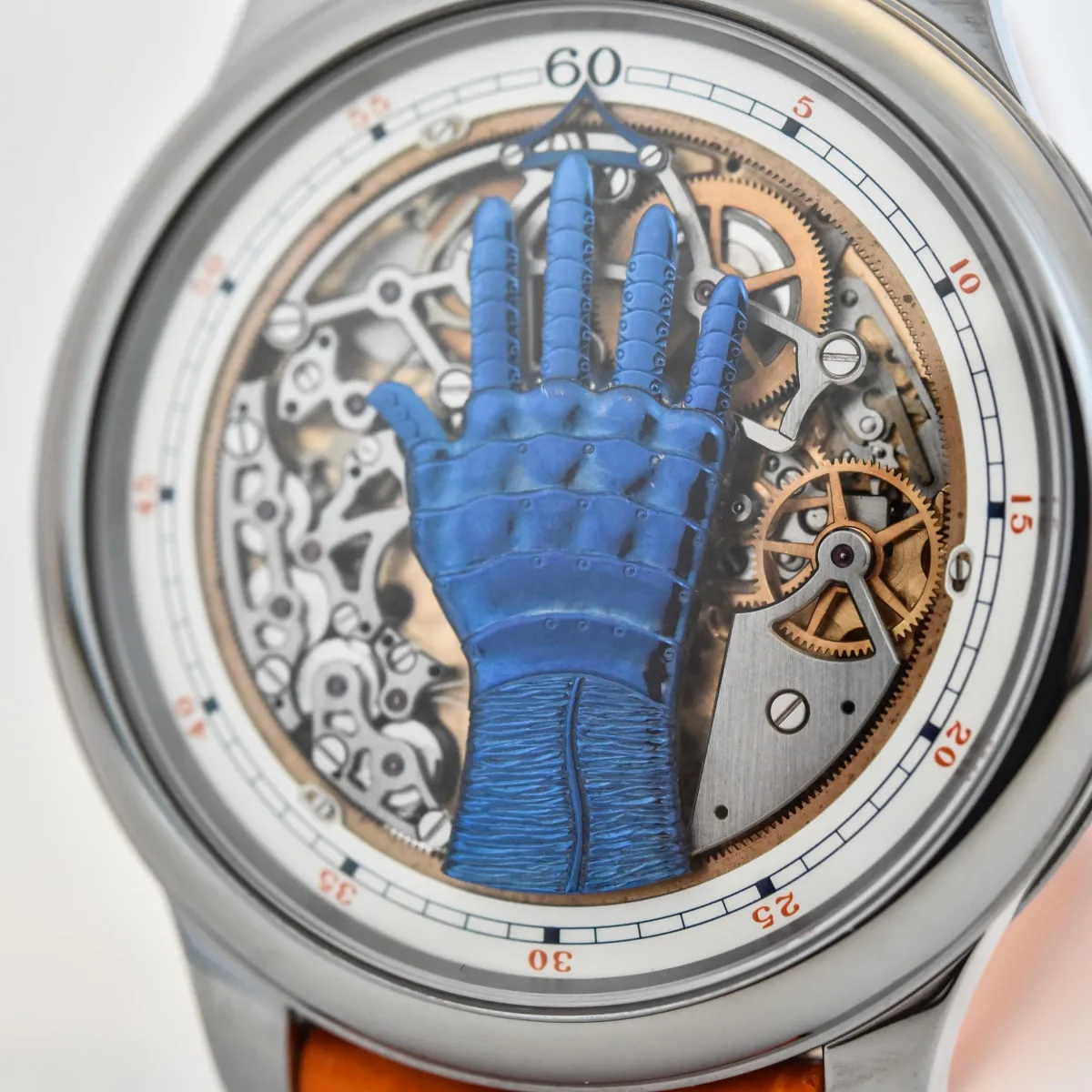
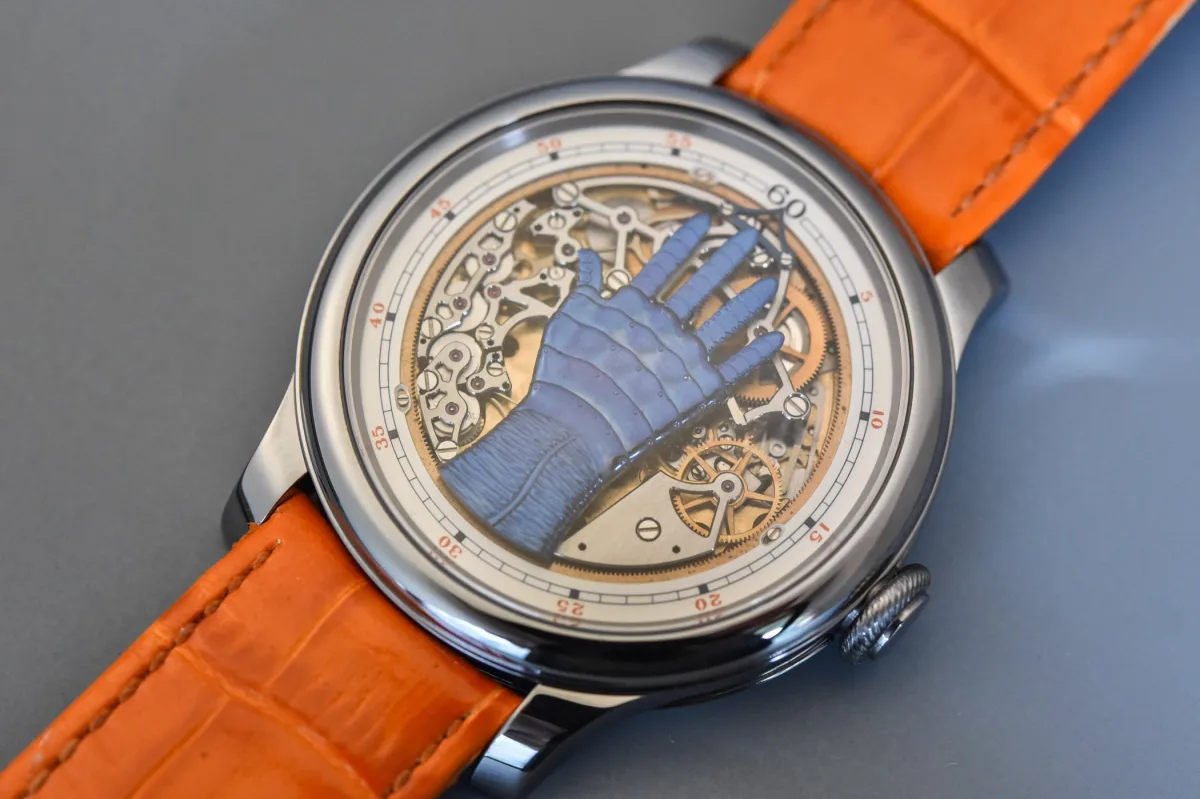
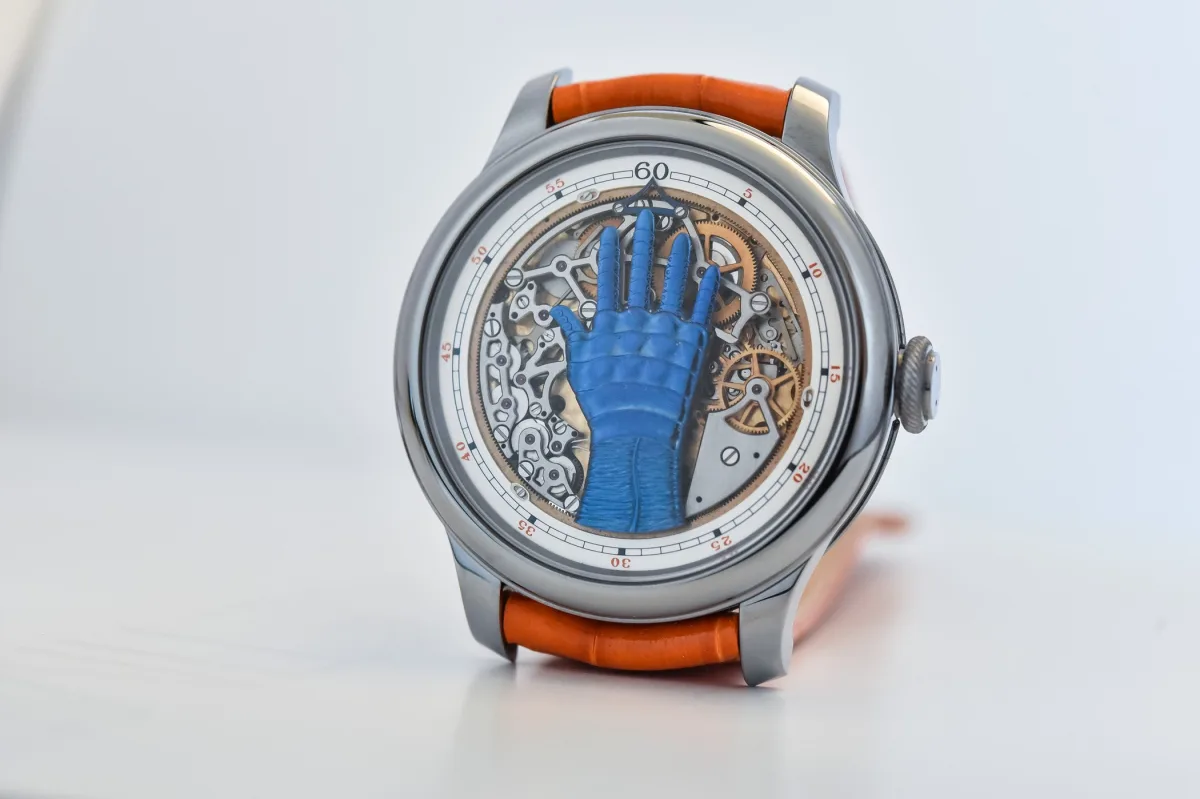
Apart from the mechanical complexity, a more important question had to be addressed: how to make one hand with five fingers indicate twelve hours? Coppola came up with a fascinating solution for indicating twelve hours, and Journe brought it to life. An enormous challenge, the individual fingers on the blue hand extend and retract thanks to a series of levers, cams, and wheels built into the mechanism. The idea was inspired by a mechanical hand crafted by a 16th-century French surgeon.
PARE, THE FATHER OF PROSTHETICS
Ambroise Paré (1509-1590) was a French military surgeon who developed artificial limbs for amputation victims. In Philippe Hernigou's article "Ambroise Paré IV: Early History of Artificial Limbs (from Robots to Prostheses)," published online by the National Center for Biotechnology Information (NCBI), the author describes how Paré's limbs went a step beyond rudimentary prosthetics. Paré "was an experienced anatomist, and thus, in creating limbs, he attempted to make them work the way biological limbs do."

Paré was inspired by early mechanical devices (automata) invented in China in 500 BC (later associated with names like Pierre Jaquet-Droz) to animate toys and even a mechanical orchestra with pulleys, gears, and levers. Paré's most famous prosthetic was a mechanical hand equipped with catches and springs to mimic the joints of a biological hand. In 1551, a captain of the French army went into battle, "it worked so well that he could grasp and release the reins of his horse."
THE TIME HAND
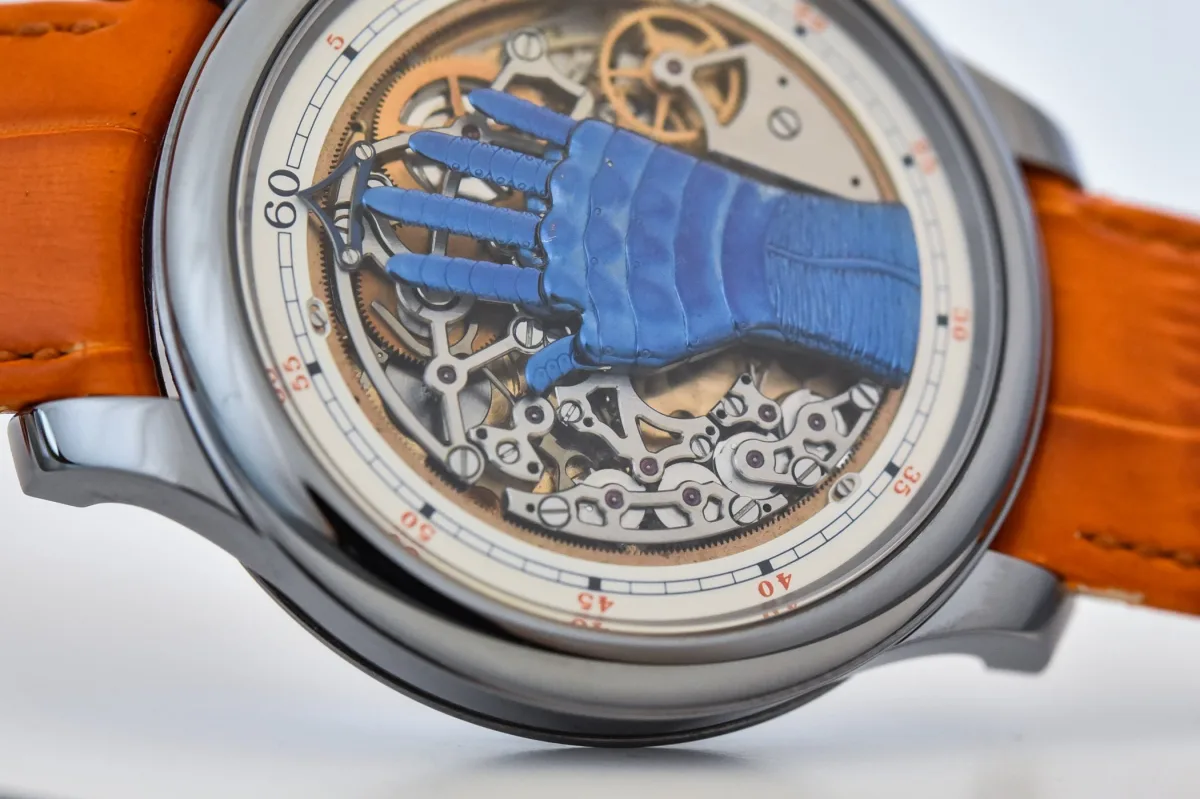
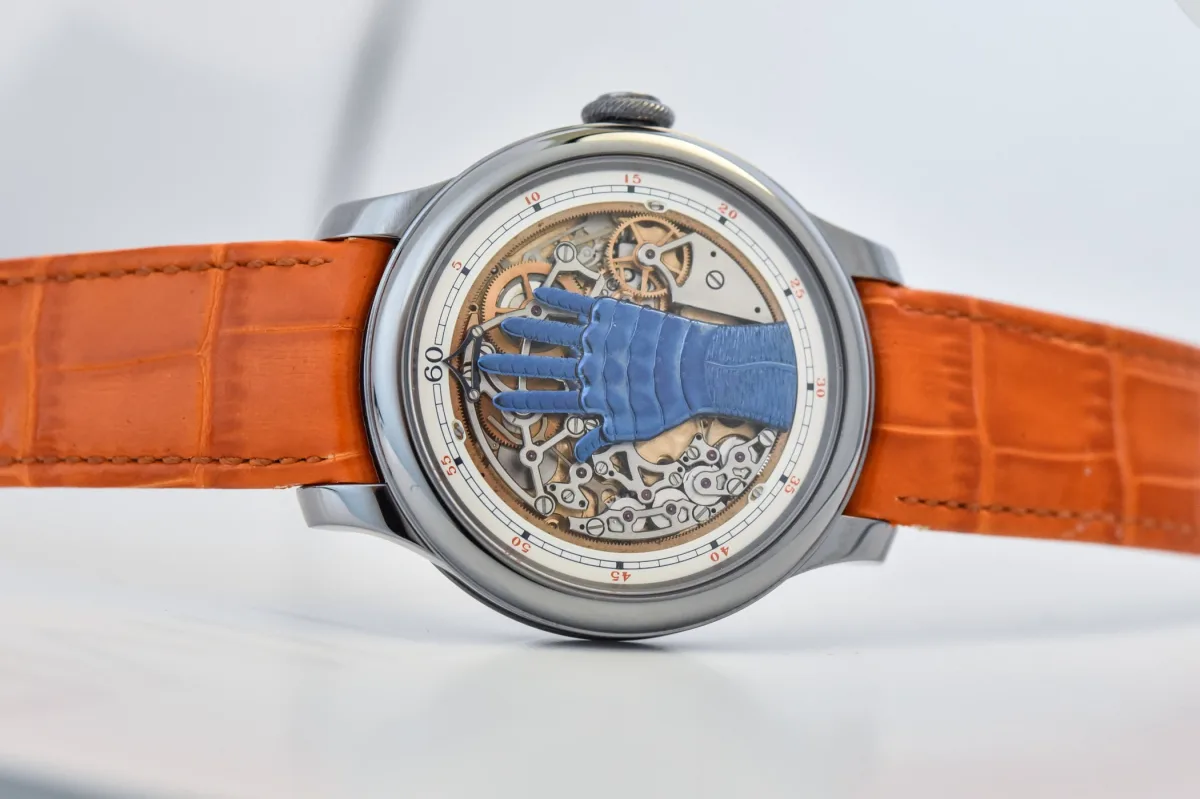
Unlike anything we have seen from F.P. Journe before, the watch's dial is dominated by a large blue articulated hand, inspired by Paré's mechanical hand. The five fingers instantly retract and extend to indicate the hours through the use of an automaton. Beneath the bright blue metallic hand on the openwork dial, the automaton's cams are visible between 6 and 9 o'clock. Minutes are displayed on a peripheral disk, which rotates and aligns with a blue triangular indicator at the '12 o'clock' position. Even more incredible is that the automaton is powered solely by the Octa’s mainspring.
THE BASE AUTOMATIC OCTA CALIBER
In 2001, François-Paul Journe introduced the Octa, the first automatic caliber developed by the watch company as a base mechanism for the collection, which fitted into the same-sized case regardless of the complication involved. The task of Journe's automatic mechanism was to combine increased autonomy without compromising accuracy. The original Octa caliber boasted an impressive 8-day (192-hour) power reserve with a 1-meter mainspring in a single barrel. However, Journe noticed that this extended power reserve competed with accuracy and decided to reduce it to 7 days (120 hours). To ensure optimal torque with such a long power reserve, a slightly off-center 22-karat gold rotor and variable inertia balance working at 3 Hz were developed.
In his relentless pursuit of perfection, Journe noticed that his friend's Octa watch never wound completely because he "works on a computer, and his right hand is not sufficiently mobile." Based on this observation, he developed a new enhanced mechanism - the Octa caliber 1330.3, which responds to the slightest movement to wind the watch. Unlike the original mechanism, Journe installed a new unidirectional rotor on a ball bearing system, which allows the rotor to move in one direction and locks it in the other, utilizing every infinitesimal movement and providing a 5-day power reserve and variable inertia balance.
Later, the Octa mechanism transitioned from rhodium-plated brass to solid gold (22-karat gold rotor, 18-karat rose gold plates and bridges), following Journe's desire to offer the most luxurious and durable watches. Used as the base mechanism for an entire collection, including chronographs, annual calendars, moon phase models, and power reserve indicators, the Octa mechanism celebrates its twentieth anniversary with a limited edition Automatique released in April.
THE LURING TANTALUM
The FFC Blue case measures 42 mm and is 10.70 mm thick. It is made of tantalum - a material Journe has used in other watches for charity auctions, such as the 2015 Tourbillon Souverain and the stunning rattrapante chronograph gifted in 2017, which sold at Christie's for 1,150,000 Swiss francs. In 2019, F.P. Journe upped the ante by presenting the highly complex Grande Complication Astronomic Blue, also housed in a tantalum case. Tantalum is a hard, gray, ductile metal extracted from the mineral columbite-tantalite.
THE 1330.3 CALIBER
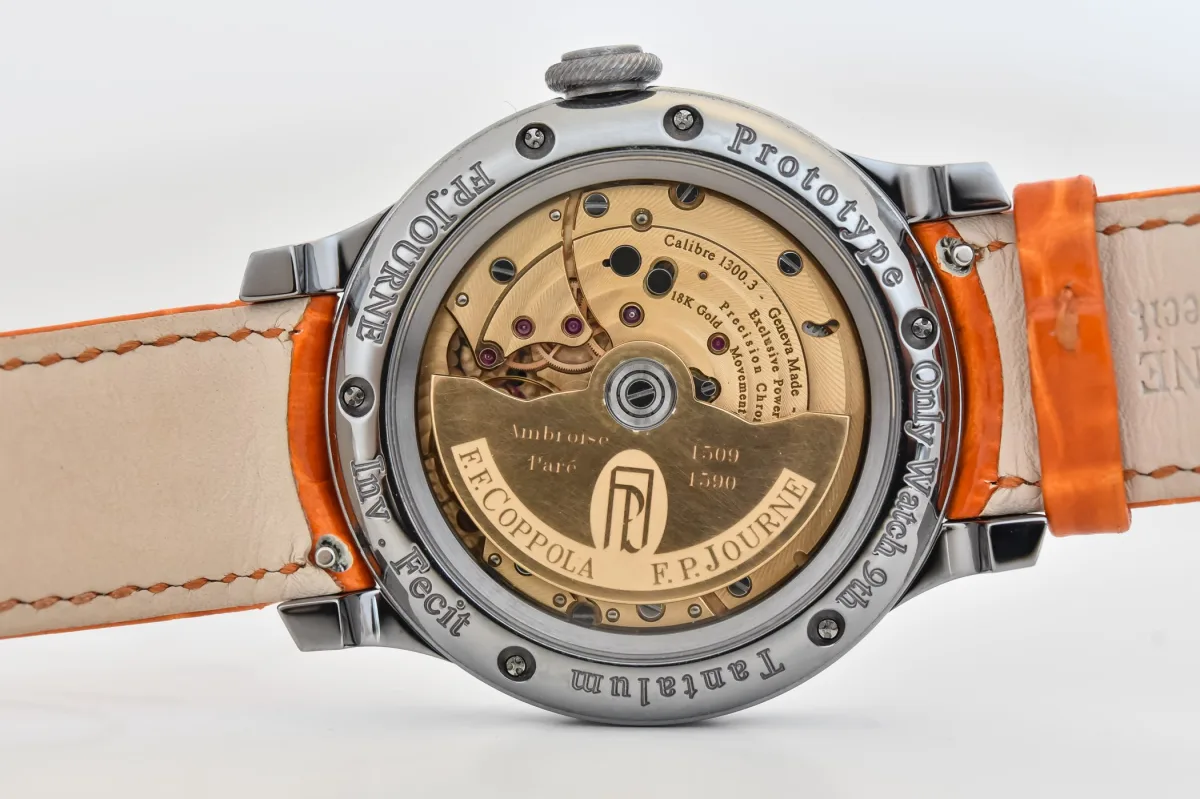
Through the sapphire case back of the F.P. Journe FFC Blue, the automatic caliber 1300.3 is visible, featuring beautiful bridges and plates made of solid 18-karat rose gold. However, unlike "regular" Octas, the 22-karat rose gold rotor is not decorated with guilloché. Instead, it features the three great names behind this watch: Ambroise Paré (1509-1590), F.F. Coppola, and F.P. Journe. As with all mechanisms, the finish is impressive: hand-polished chamfers, polished screw heads and sinks, bridges adorned with circular Geneva stripes, and circular graining on the plate. The caliber 1330.3 provides a powerful 5-day power reserve and a large variable inertia balance ensuring chronometric performance.
The auction price for J.P. Journe FFC Blue ranges between 300,000 and 400,000 Swiss francs (~$330,000 - $440,000). However, given its originality and cinematic fame, don't be surprised if this figure jumps to a six-digit number (pun intended).
More information on the F.P. Journe and Only Watch websites.
TECHNICAL SPECIFICATIONS – F.P. JOURNE FFC BLUE FOR ONLY WATCH 2021
Case: 42 mm x 10.70 mm - tantalum - sapphire crystal over the dial and case back
Dial: skeletonized - blue articulated mechanical hand in the center with retractable and extendable fingers for hour indication - minutes on a rotating peripheral track, indicated by a blue triangular marker at the '12 o'clock' position
Movement: automatic FFC 1300.3 in-house caliber - bridges and plates in 18-karat rose gold - rotor in 22-karat rose gold - engraving of the names Ambroise Paré (1509-1590), F.F. Coppola, and F.P. Journe - 21,600 vph - 120-hour power reserve (+/- 12 hours) - instantaneous digital hours indicated by blue automatic hand, and rotating minutes - 396 components
Strap: orange alligator leather strap
Availability: unique piece for Only Watch 2021