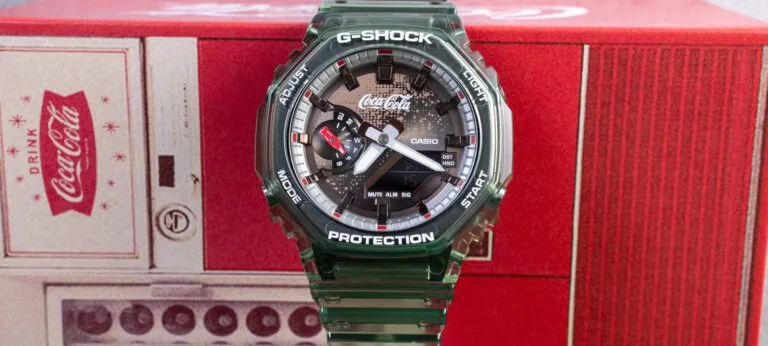
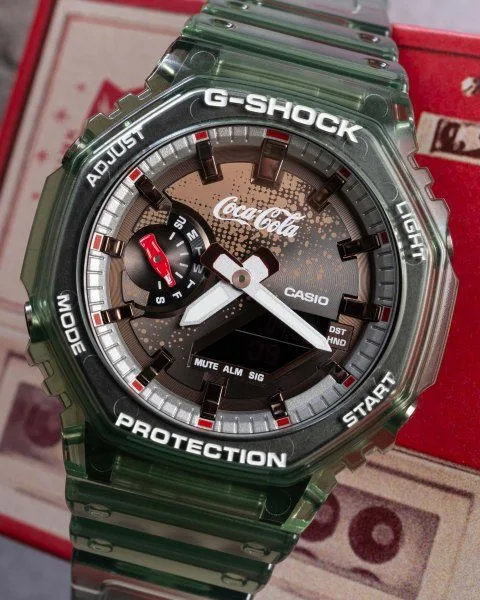
The summer watch of 2026 is a special collaborative edition: Casio G-Shock x Coca-Cola GA2100CC-3A.
These watches embody the essence of what many Americans dream of in the hot months, and in my opinion, it's a fitting way to celebrate the 250th anniversary of the United States in 2026. More on this later, as these watches were not originally created specifically for America's birthday. Rather, they are dedicated to the 140th anniversary of Coca-Cola, founded in Atlanta in 1886.
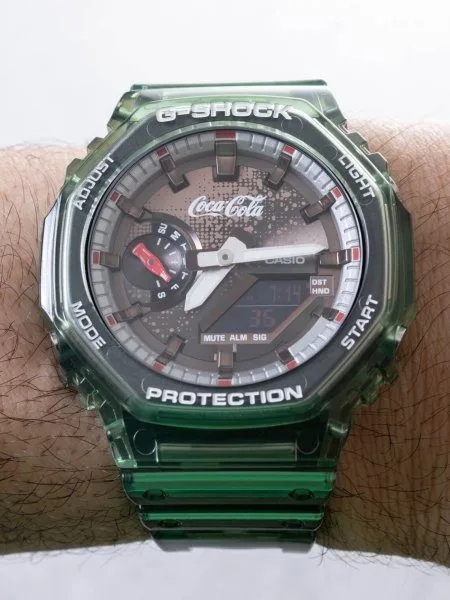
I have the opportunity to see many Casio collaborative products, and as a devoted fan of the brand, I must admit that some are noticeably better than others. This G-Shock x Coca-Cola model is among the most detailed and visually appealing of the recent G-Shock collaborative editions I've seen in the past few years. Even if you're not a Coca-Cola fan, these watches draw attention.
Design and Technical Features of Casio G-Shock GA2100CC-3A
The watch is based on the popular Casio G-Shock GA2100 series - analog-digital models with resin cases and a trendy octagonal bezel. The only thing that could make this model even better is using the slightly improved GAB2100 models as a base, as they feature solar charging and Bluetooth connectivity to smartphones. However, this isn't critical, as the basic models are still highly functional, and Casio has its internal reasons for choosing them for collaborations.
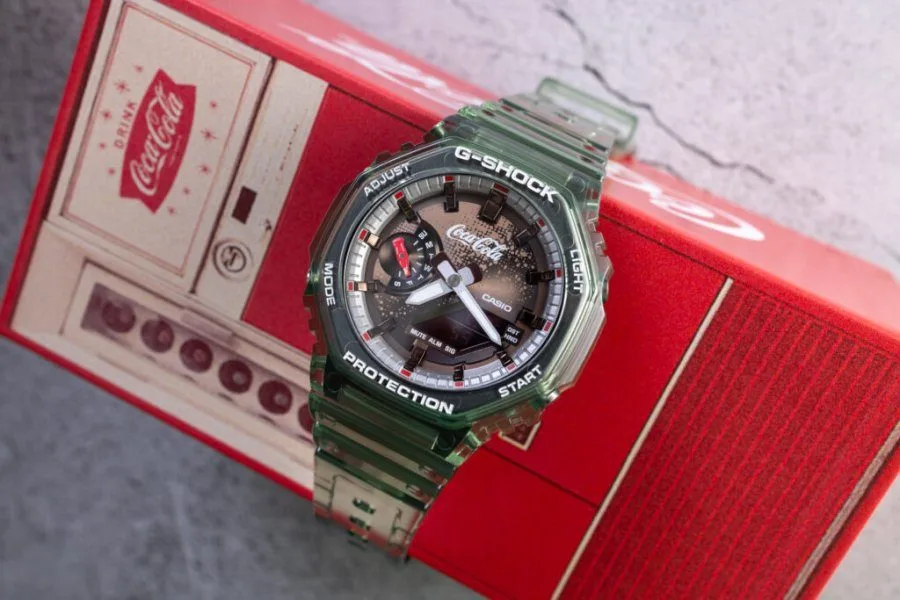
We have previously written about the GA2100 models multiple times, but I'll briefly recap the main features. The case and strap are made of signature resin, measuring 45.4 mm wide, 11.8 mm thick, and 48.5 mm from lug to lug. As expected from G-Shock, the GA2100 is water-resistant to 200 meters and highly resistant to shocks and vibrations. These are comfortable watches for daily wear. The multifunctional mechanism with bright illumination is powered by a battery that lasts about three years before needing replacement.
Personal Experience and Associations with the Coca-Cola Brand
I'm not an active consumer of Coca-Cola or its products. Recently, I tried Diet Coke - it was probably the first time in years in the USA. The company owns many other beverage brands, so it's sometimes difficult to understand what exactly I'm drinking. Usually, I allow myself Coca-Cola only once a year - when attending the Watches & Wonders exhibition in Geneva. At an event that is tiring and requires a lot of walking, a cup of espresso or coffee doesn't always help. Then I take a chilled cola with ice and lemon, if available - it provides a pleasant taste and a slight caffeine boost. Perhaps consuming fast food and sweet drinks is part of the American lifestyle.
My first accountant was a collector of Coca-Cola memorabilia. He was proud that he could deduct expenses for collectible items, claiming they occupied space in his home, which served as a "waiting room" for clients. He had watches, vintage signs, figurines, and models of historic Coca-Cola trucks. I have never seen so many Coca-Cola items in one place. It reminded me of Disneyana collectors - fans of Disney collectibles. I once asked him why he was so fascinated by Coca-Cola. Like many, he associated the brand with childhood in the USA, simpler times, what he loved in California (he was a pilot and car collector), and the best American ideals. I was surprised then, as I considered Coca-Cola just flavored sweet water.
History and Significance of the Coca-Cola Brand
To understand Coca-Cola, one must look beyond the product itself. The drinks it produces have changed and returned to their roots many times. As the name suggests, it was initially a drink with narcotic substances - including cocaine. It was tasty and genuinely addictive. Over time, cocaine was removed, and sugar, its substitutes, and caffeine became the active ingredients.
Today, the exact formula of the beverage is a closely guarded trade secret. There are alternative colas (the most famous competitor being Pepsi), but no company has achieved the same level of marketing recognition as Coca-Cola. One of the company's most impressive achievements is that most people worldwide recognize the brand visually and by name. The shape of the Coca-Cola bottle (which has changed several times) is considered a protected trademark, and other companies are prohibited from copying it.
Marketing Lesson from Coca-Cola for Luxury Brands
Before these Casio G-Shock Coca-Cola watches, I often cited this American company in conversations with luxury watch manufacturers. During the Great Depression of the 1920s, Coca-Cola did not cut marketing expenses but instead actively advertised itself. Unlike many luxury brands, which cut advertising during economic difficulties, thereby giving way to competitors, Coca-Cola created a culture. Its red and white color scheme became a symbol of American values, nostalgia, and dreams.
One of the most vivid examples is the image of Santa Claus. In 1822, an artist depicted St. Nicholas in a red and white robe, and in 1931, Coca-Cola invited artist Haddon Sundblom to create an advertising image of Santa inspired by these early depictions. This image became globally recognizable and is still used today. Coca-Cola even dedicated an entire section on its website to the history of Santa Claus.
The Power of the Brand and Emotional Marketing of Coca-Cola
Coca-Cola never advertised its product directly - it sold the lifestyle around the drink. This is an example of the power of American branding, creating a value system, deep nostalgic feelings, a sense of warmth, and the joy of youth - all through a bottle of not the healthiest drink. Coca-Cola strives to be where Americans have fun, to associate with good moments. This is a vivid example of how marketing affects not only the wallet but also the imagination of consumers.
For luxury brands, watches are not just a tool for telling time but an emotional symbol. This is how the Casio G-Shock Coca-Cola works: people choose these watches not for their functions but for how they make them feel. Coca-Cola has spent 140 years creating this effect, and its experience should be a subject of thorough study for all marketers.
Design Features of Casio G-Shock GA2100CC-3A
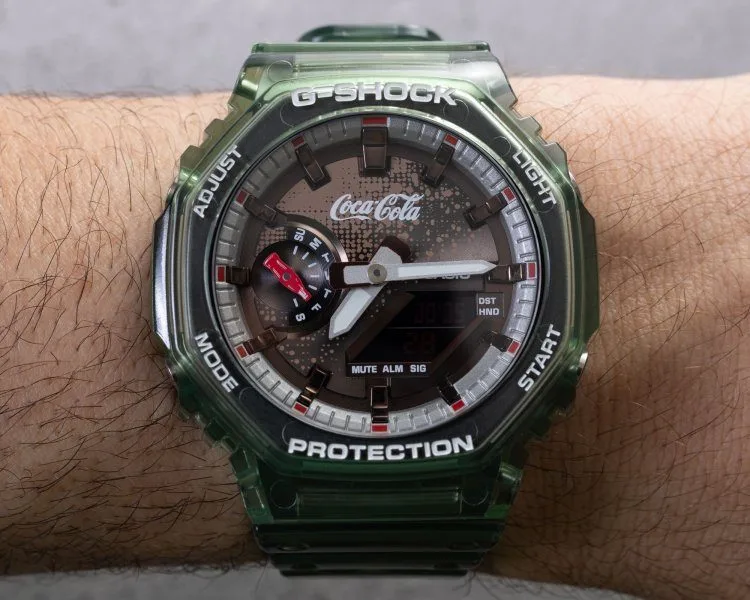
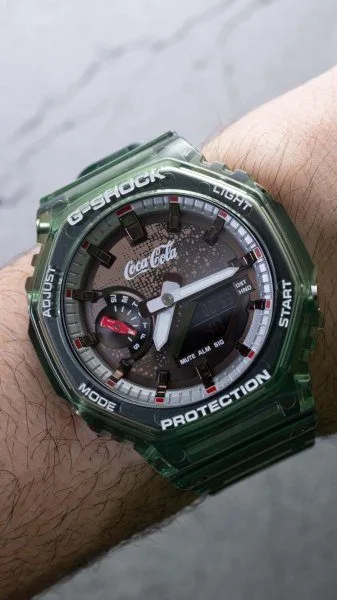
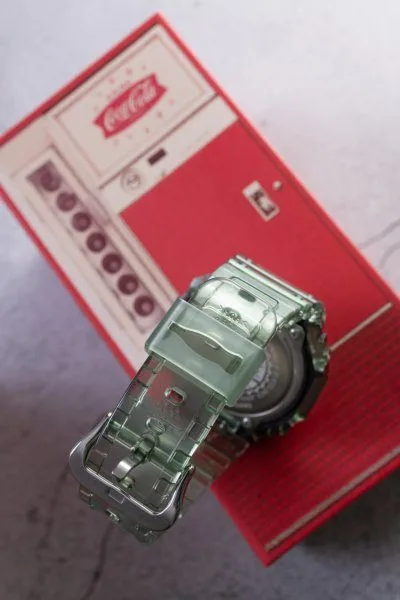
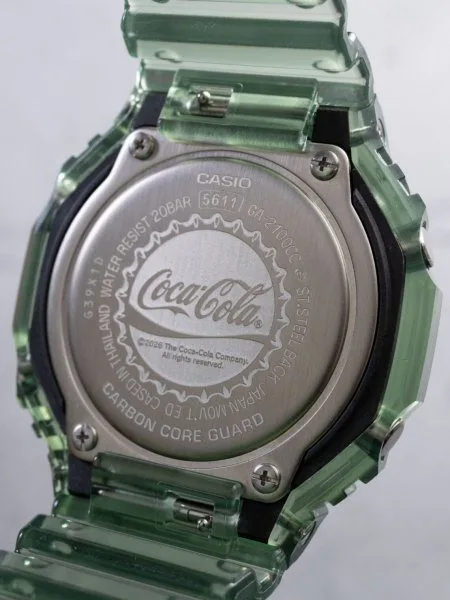
The case and strap of the watch are made of translucent resin with a green tint, inspired by vintage Coca-Cola glass bottles with a greenish hue. Modern bottles, in my observation, are usually clear. The shape of the Coca-Cola bottle is used in two design elements: on the dial, instead of the standard day-of-the-week indicator hand, there is a red hand in the shape of a bottle, and on the strap holder, there is an embossed silhouette of a bottle. The case back is adorned with a motif reminiscent of a classic metal bottle cap.
The dial is adorned with the Coca-Cola logo and a background that mimics the brown color of the drink with bubbles. The main hands have a matte finish, ensuring good readability. The brown shades on the hour markers and LCD screen enhance the drink effect. It gives the impression of looking directly into a freshly opened bottle of cola. The design could have looked kitschy, but Casio and Coca-Cola managed to create a very pleasant and stylish dial.
The Significance of the Watch in the Context of the 250th Anniversary of the USA
In 2026, when America celebrates its 250th anniversary, not everyone perceives clearly how and what to celebrate. I grew up in an era of patriotism, but times have changed. Coca-Cola is an institution supported by many Americans, possibly even more than some government institutions. Therefore, when celebrating the 250th anniversary on July 4, it makes sense to pay attention to the strongest global American brands.
These watches are a bright way to do this. It would be interesting to see if my former accountant would be interested in them. Casio sets a premium price for these watches compared to the standard GA2100 models, but this doesn't deter fans. Although the watch is not a strictly limited edition, it will be hard to find. It is recommended to use responsibly and with plenty of ice. The price of the Casio G-Shock x Coca-Cola GA2100CC-3A is 200 USD.