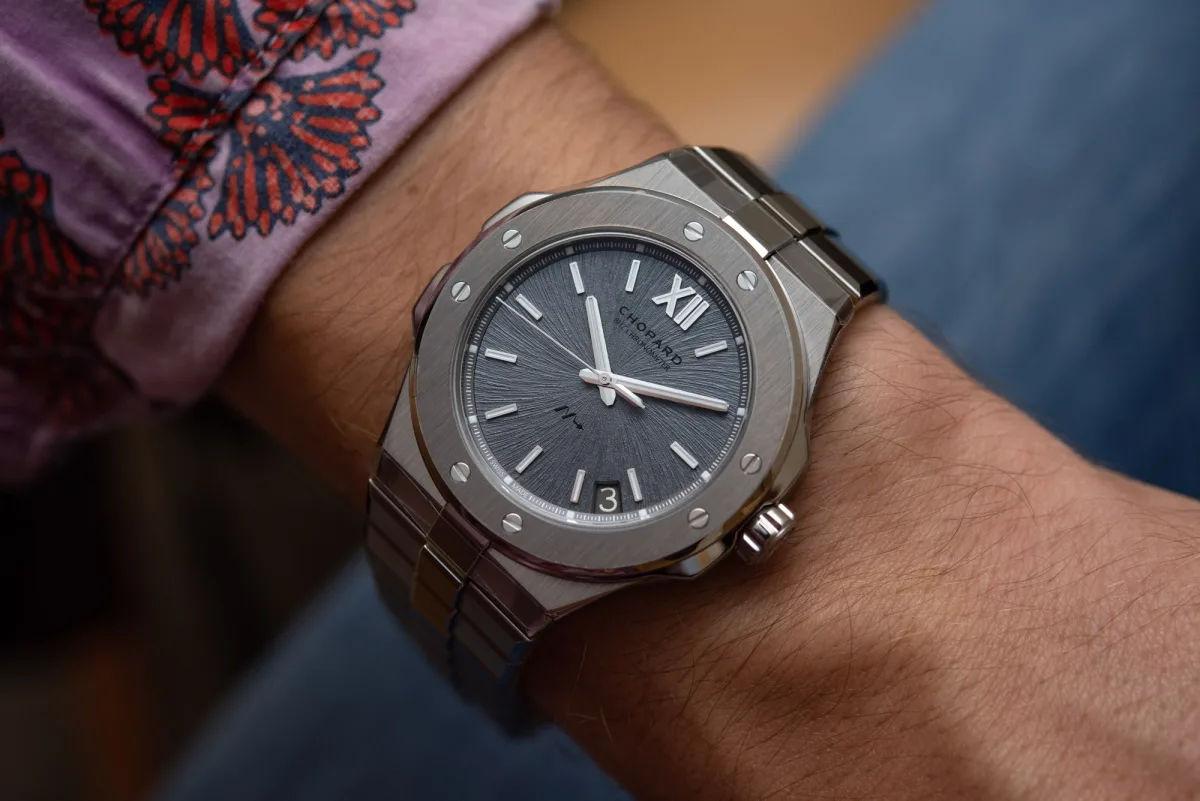
Do you know what is truly rare in the world of watches? Mechanical watches that can boast both a very high-frequency movement and a COSC chronometer certification. Strange, right? Strange because the main notion has always been "the higher the frequency, the greater the accuracy." Well, the Chopard Alpine Eagle Cadence 8HF is here with an exceptionally high-frequency 8 Hz movement, now fully encased in titanium, and, as you guessed it, COSC certified. And it's expensive.
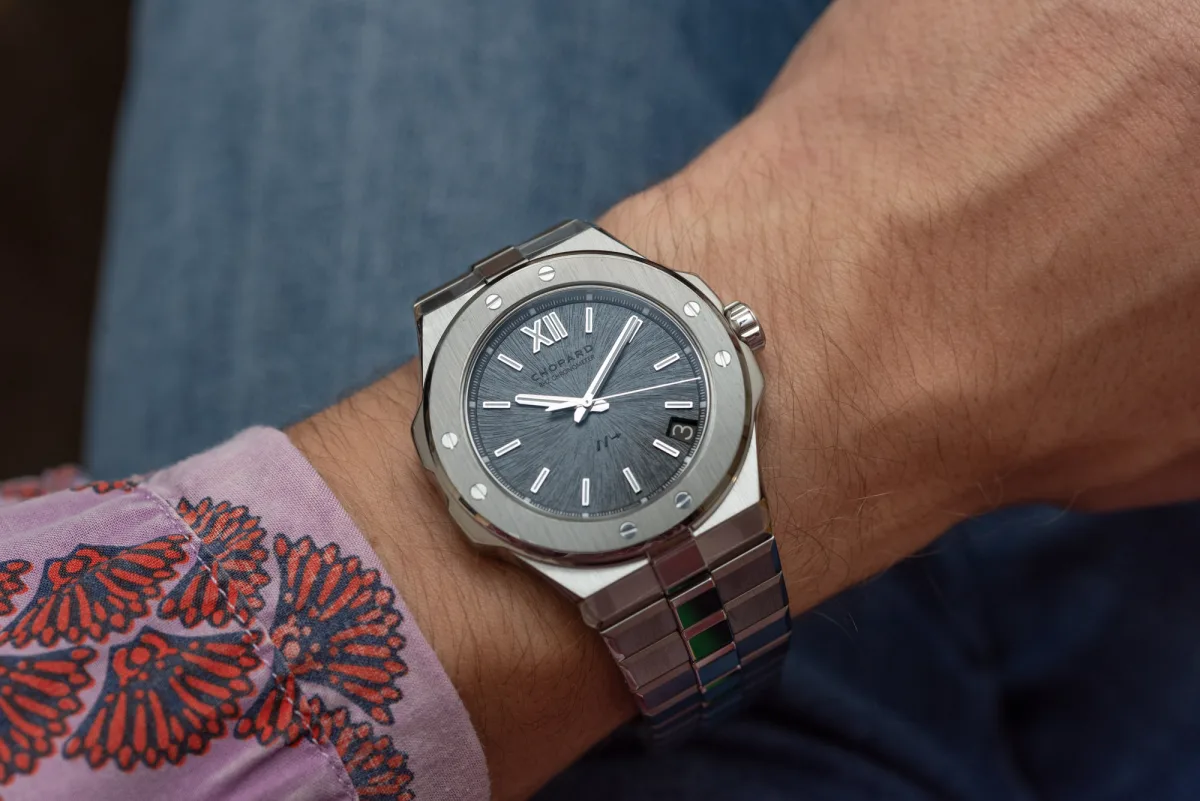
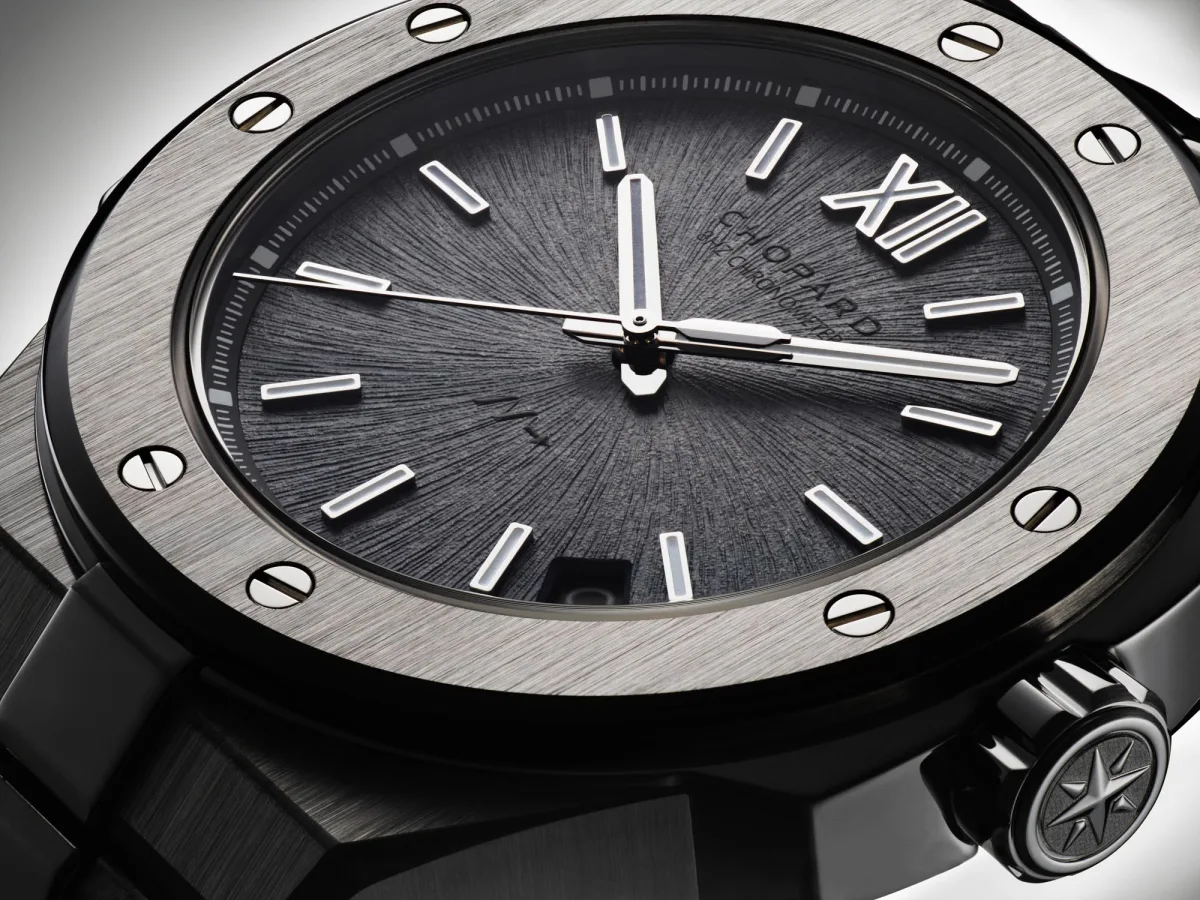
We debuted the Chopard Alpine Eagle model during its premiere in Lucent Steel A223. The new Chopard Alpine Eagle Cadence 8HF, being the most technologically advanced version of the AE, has moved away from steel in favor of Grade 5 titanium. Strangely, for most other luxury sports watches, this is considered an upgrade - titanium cases and bracelets are much less common and more expensive than steel - but here, in my opinion, it's merely an alternative to the tactile sensations and shining whiteness of Lucent Steel.
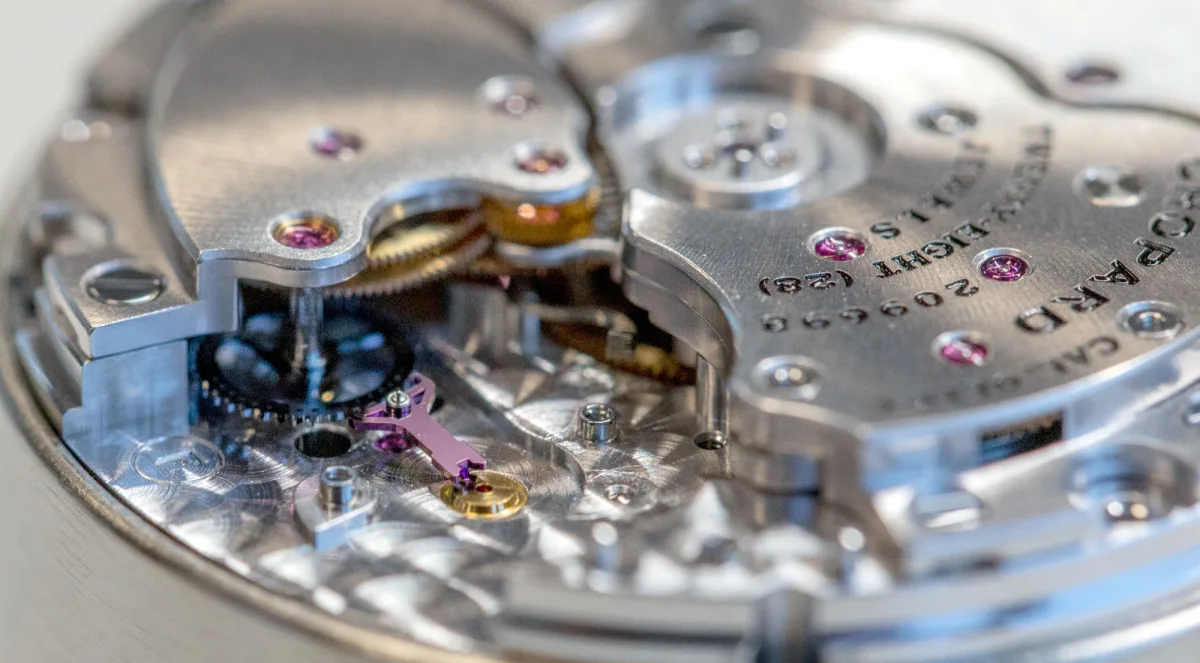
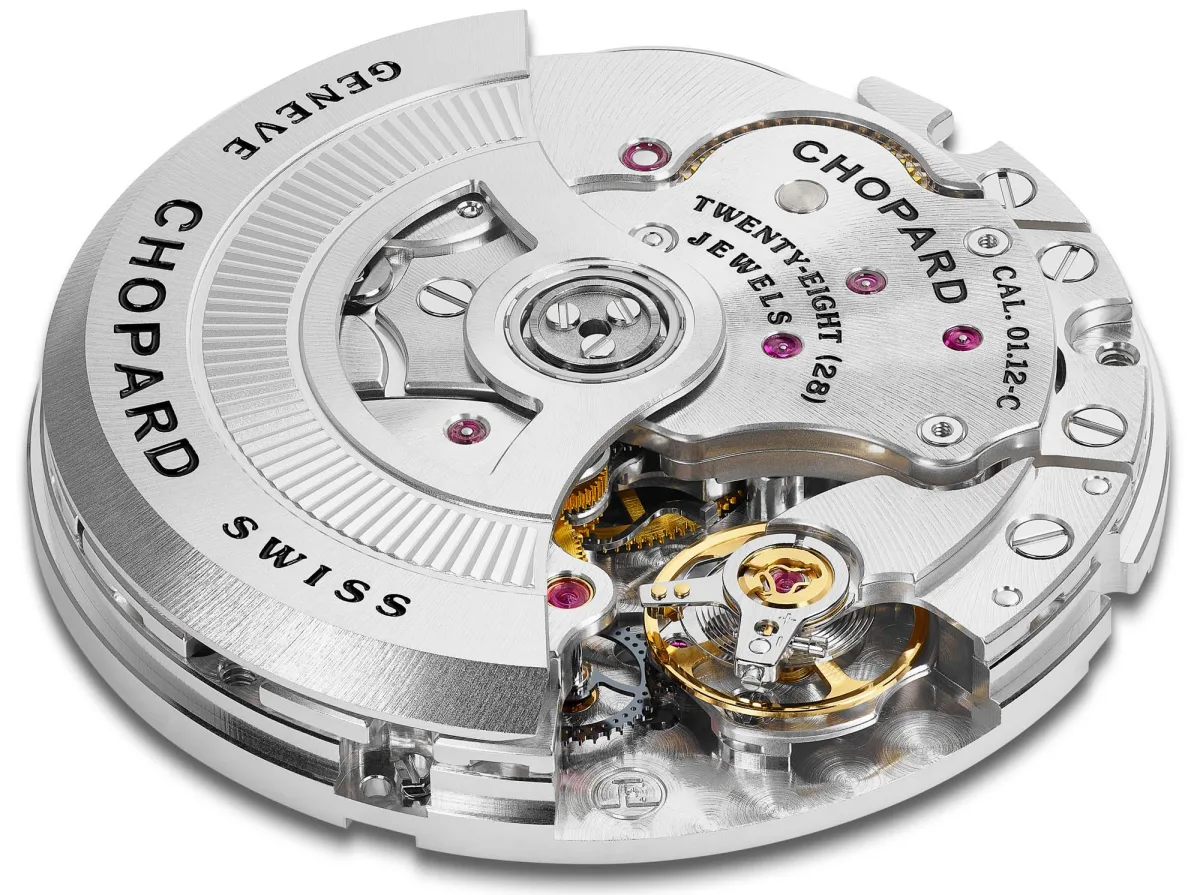
The 8 Hz technology is the main feature here, so we will leave further design discussions for later. Back in 2012, Chopard introduced a chronometer-certified high-frequency movement - by high-frequency, we mean not 5 Hertz, but 8 Hertz, which is twice what is considered the modern frequency for mechanical watches. Chopard hasn't quite succeeded in mass-producing such movements: Over the last decade, they have been offered occasionally in quantities of 100-250 pieces, as in the case of the Chopard Alpine Eagle Cadence 8HF, which is limited to 250 numbered pieces.
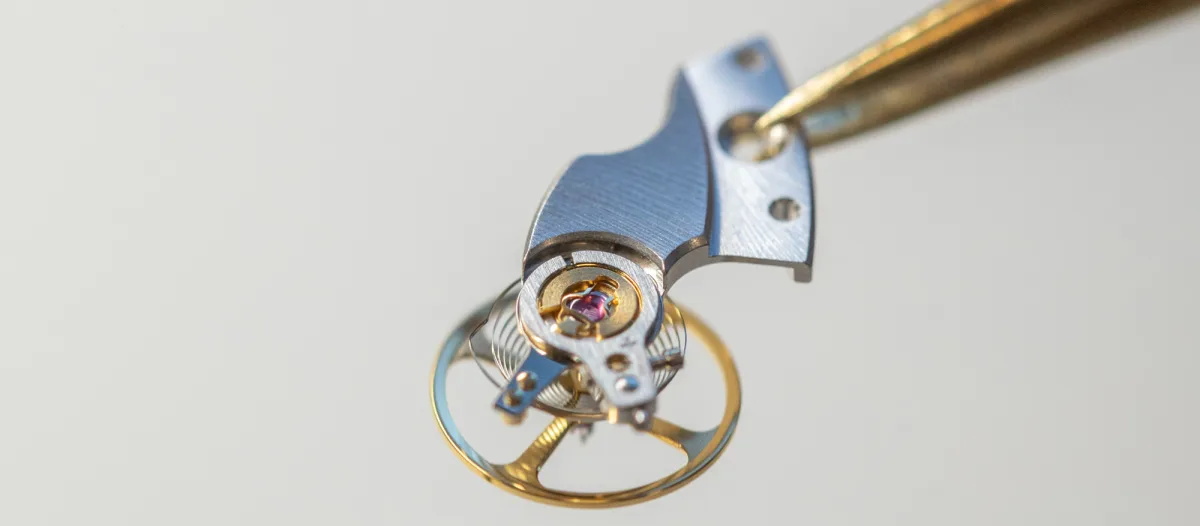
The reason is that regulating these movements requires additional effort, know-how, and time, especially if the watch is to not only function well but also pass COSC chronometer tests. From years of communication with watchmakers (small and large, historical and high-tech, and so on), I've found that 4 hertz is generally considered the ideal frequency for passing COSC and meeting modern consumer expectations like shock resistance, accuracy in real-world wear, and power reserve.
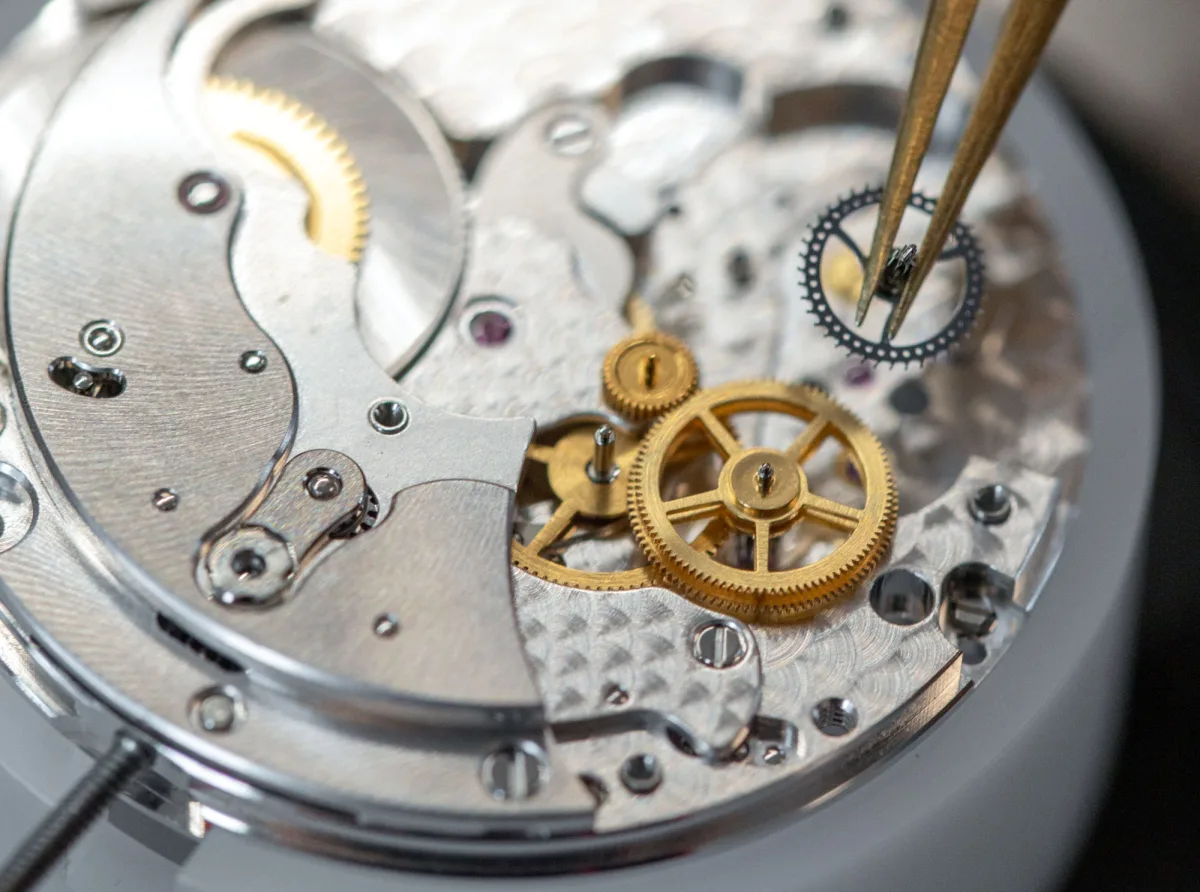
Because here's the catch: For chronometer certification, COSC tests uncased movements only in stationary conditions, in five different positions at three different temperatures (8 °C, 23 °C, 38 °C). And while a low frequency, as some claim, is easier to modulate for these stationary tests and various positions, in the real world, an impact (e.g., putting your hand on a table a little more energetically) could disrupt the movement's balance. The higher the frequency, the faster the balance wheel returns to its proper "rhythm" when it is ready to measure time accurately.
Very high frequencies, like 8 Hertz, can handle this task exceptionally well, but it complicates the task for watchmakers when it comes to adjusting for various positions - a delicate balance that must be done well to stay within the various COSC chronometer requirements, such as daily rate, the arithmetic mean of daily rate, the arithmetic mean of five absolute values of rate variations obtained for five positions of the watch during the first 10 days of testing... and so on.
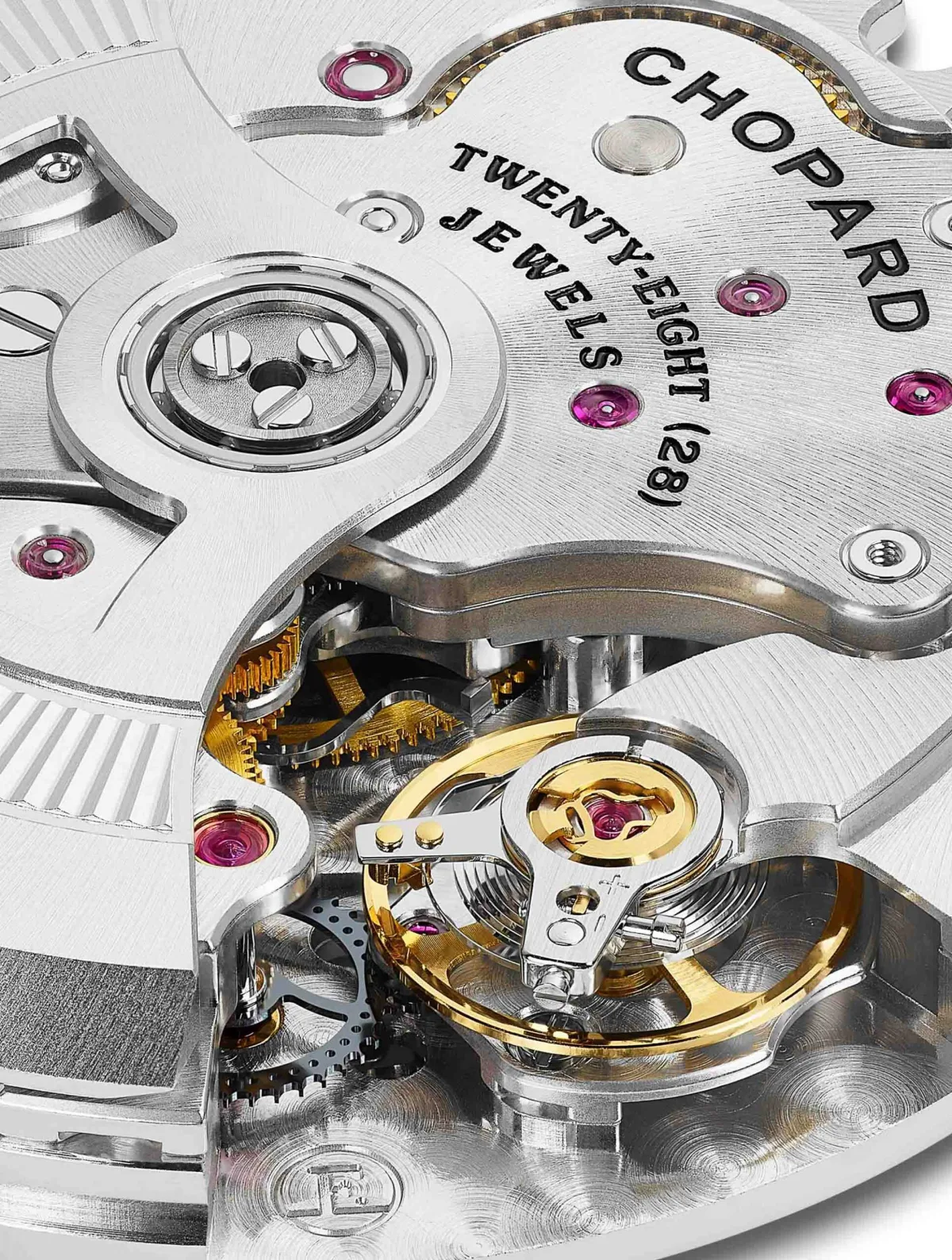
Chopard claims to use "the properties of monocrystalline silicon to make the most of this 8 Hertz frequency. This light and self-lubricating material is used for the pallet lever, escape wheel, and impulse-pin - all components subject to high friction, which is thus minimized." Achieving an 8 Hertz frequency, i.e., 57,600 vibrations per hour, would be practically impossible using lubricants (even modern synthetics).
At such a frequency, the tiniest droplets of lubricant are either washed away or contaminated due to the enormous amount and speed of interaction between various surfaces sliding against each other in the escapement. The brand says: "The lightness of silicon, its tribological properties, and the freedom provided by its manufacturing technology allowed Chopard to develop an escapement designed to operate at high frequencies without increasing energy consumption."
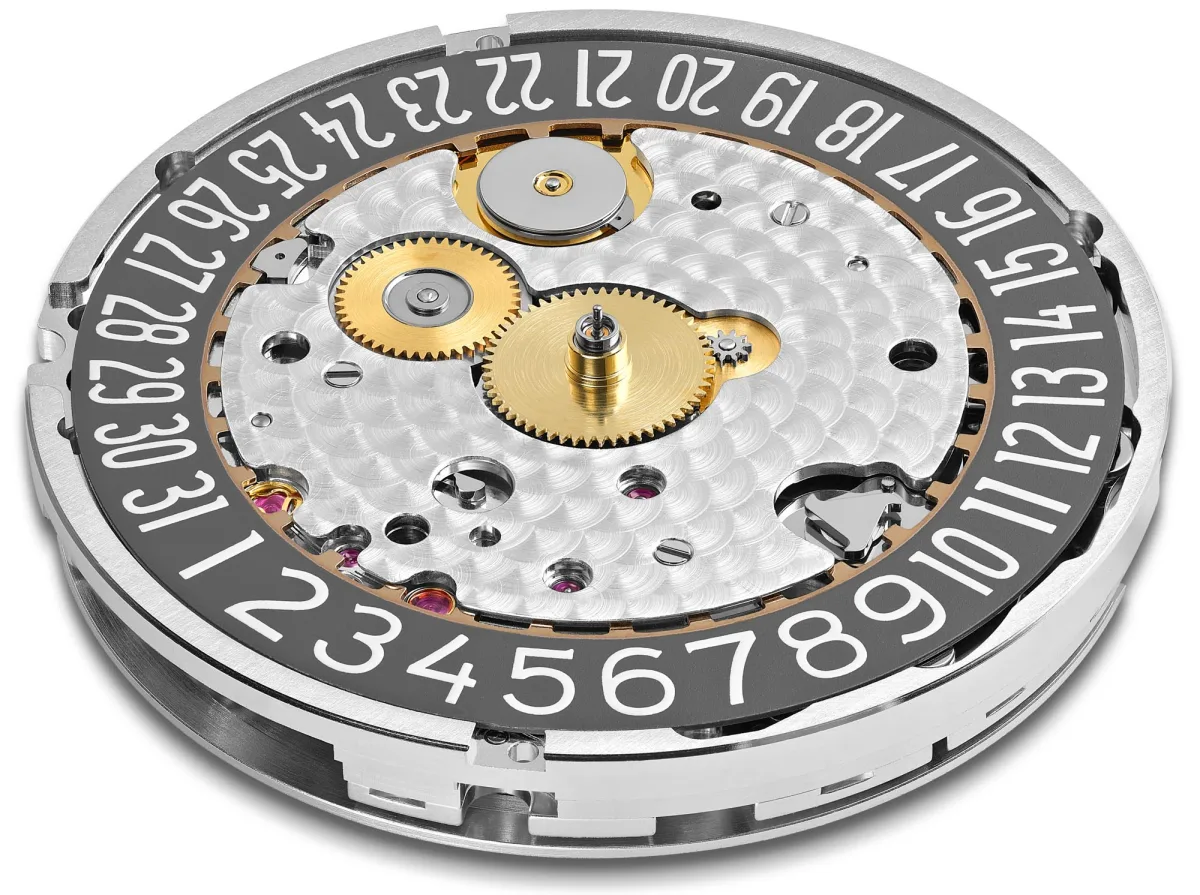
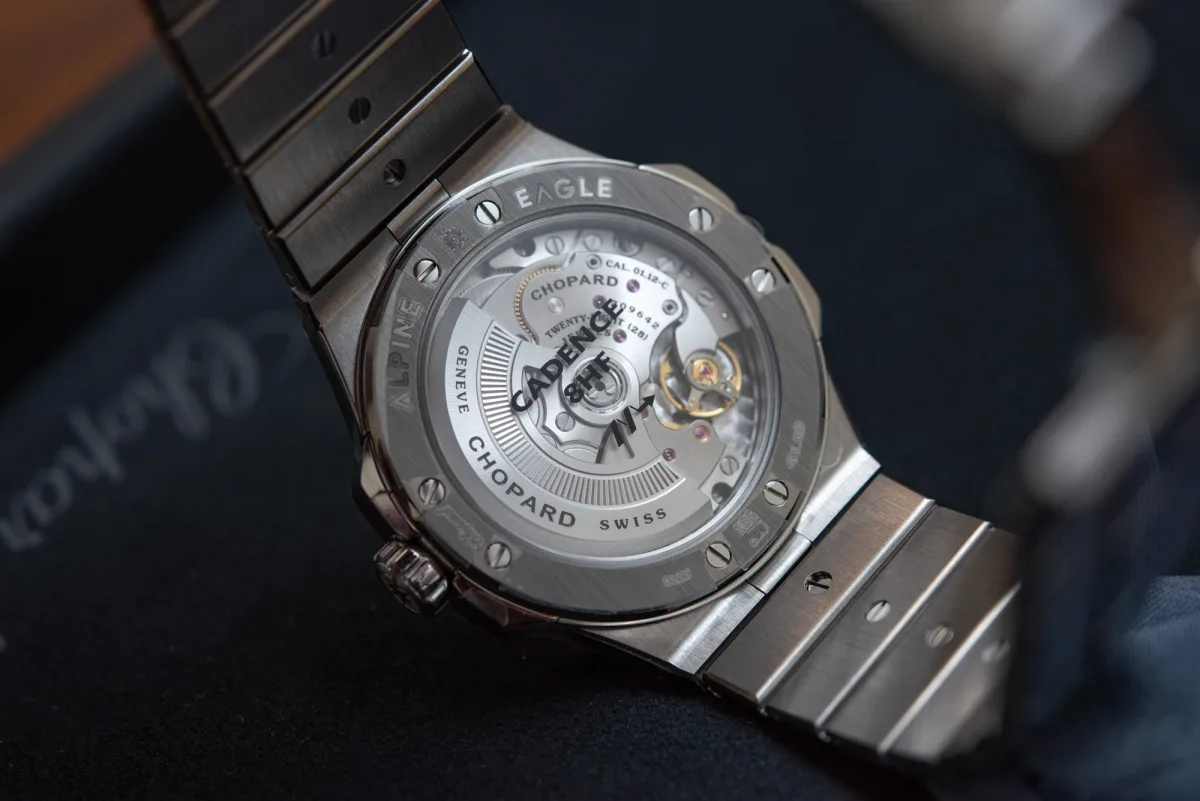
The caliber 01.12-C in the Chopard Alpine Eagle Cadence 8HF has a 60-hour power reserve, which is truly an amazing degree of autonomy, usually incompatible with high frequencies. Chopard says: "Several patents and the technologies used have reconciled seemingly contradictory goals: chronometry, autonomy, and reliability." The movement is only 4.95 mm thick, which is quite an engineering feat, especially considering the 57,600 vph operating frequency, 60-hour power reserve, and automatic winding system - all totaling 210 components.
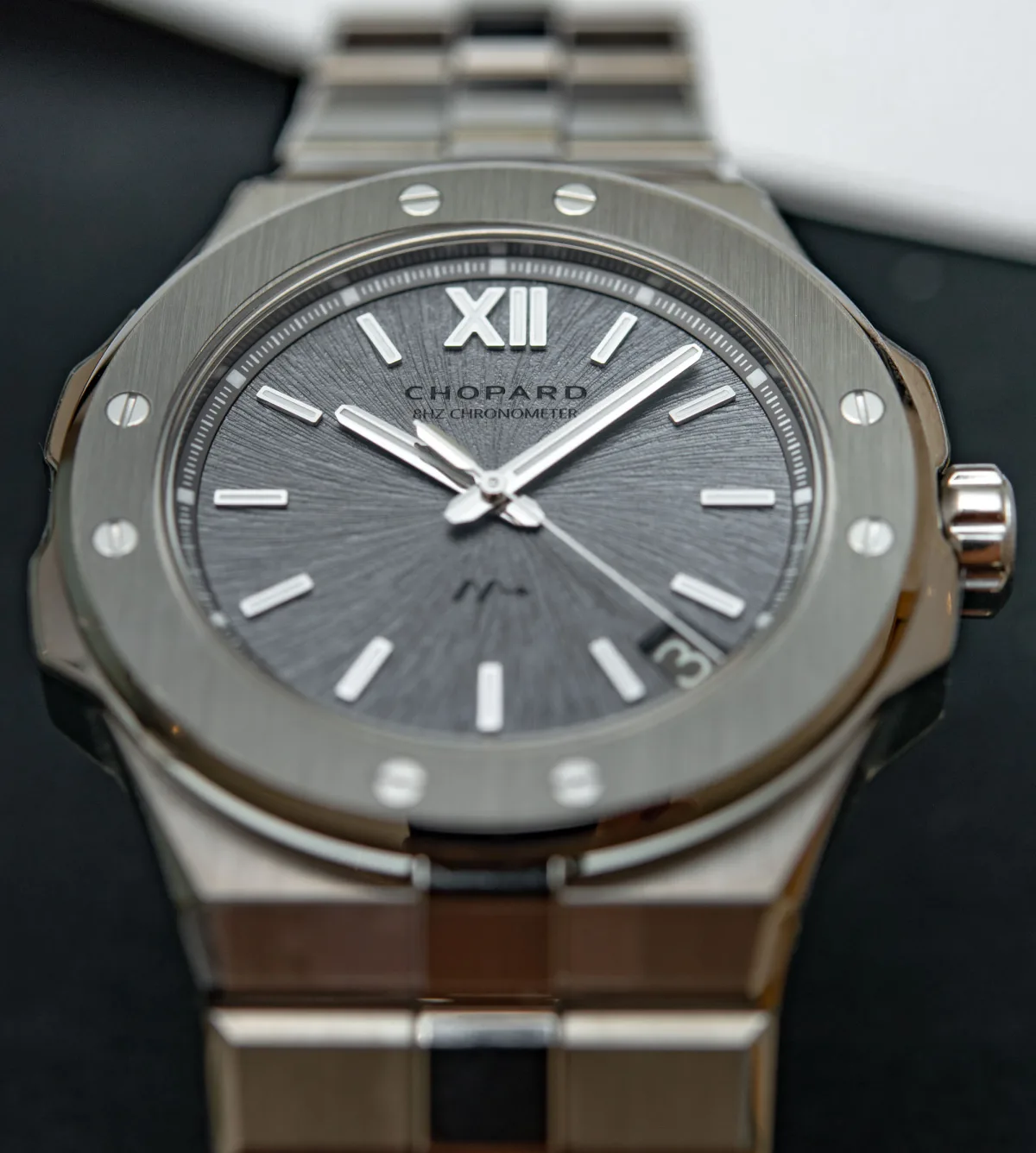
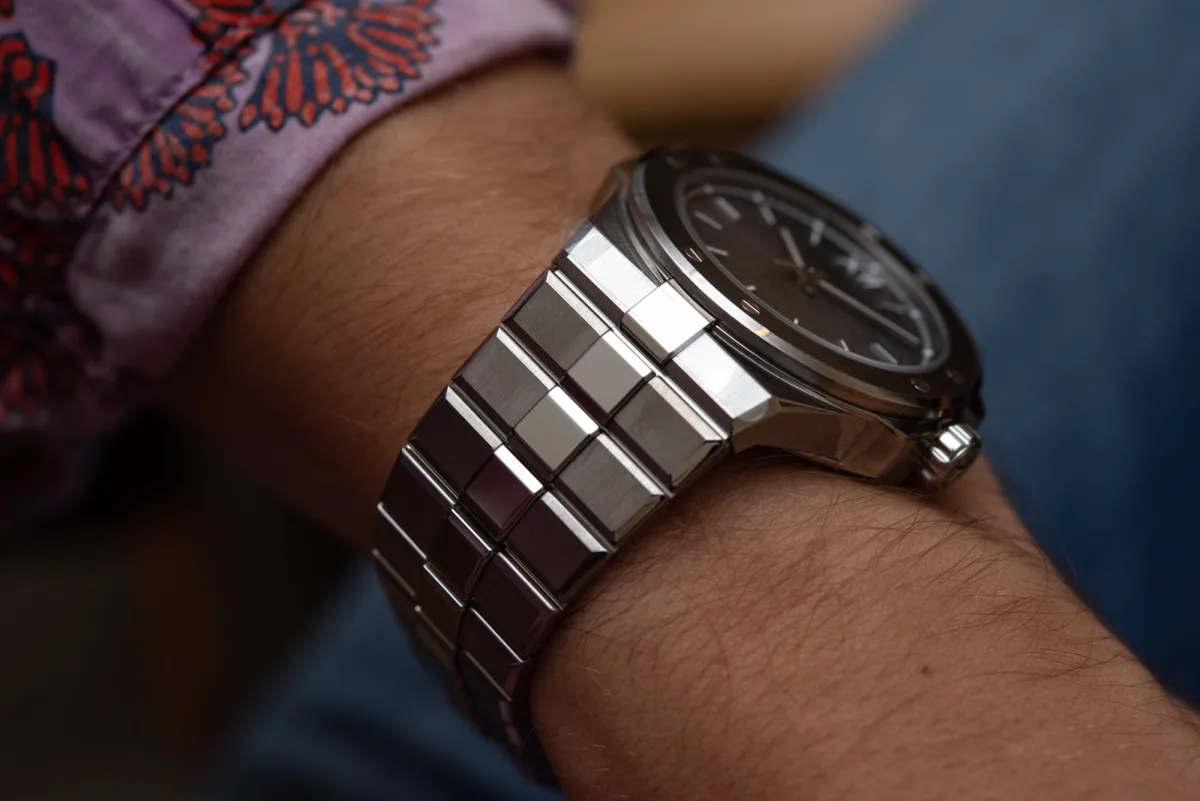
All these characteristics are housed in a case less than 10 mm thick - 9.75 mm, to be precise. We've already seen high-performance movements of such thickness, so a full case less than 1 cm is an achievement that has not gone unnoticed. The nominal water resistance of 100 meters is another pleasant touch, exactly what all luxury sports watches should have - and yet we too often see 30- and 50-meter ratings in much thicker watches. Both the front and back crystals are sapphire with extensive anti-reflective protection.
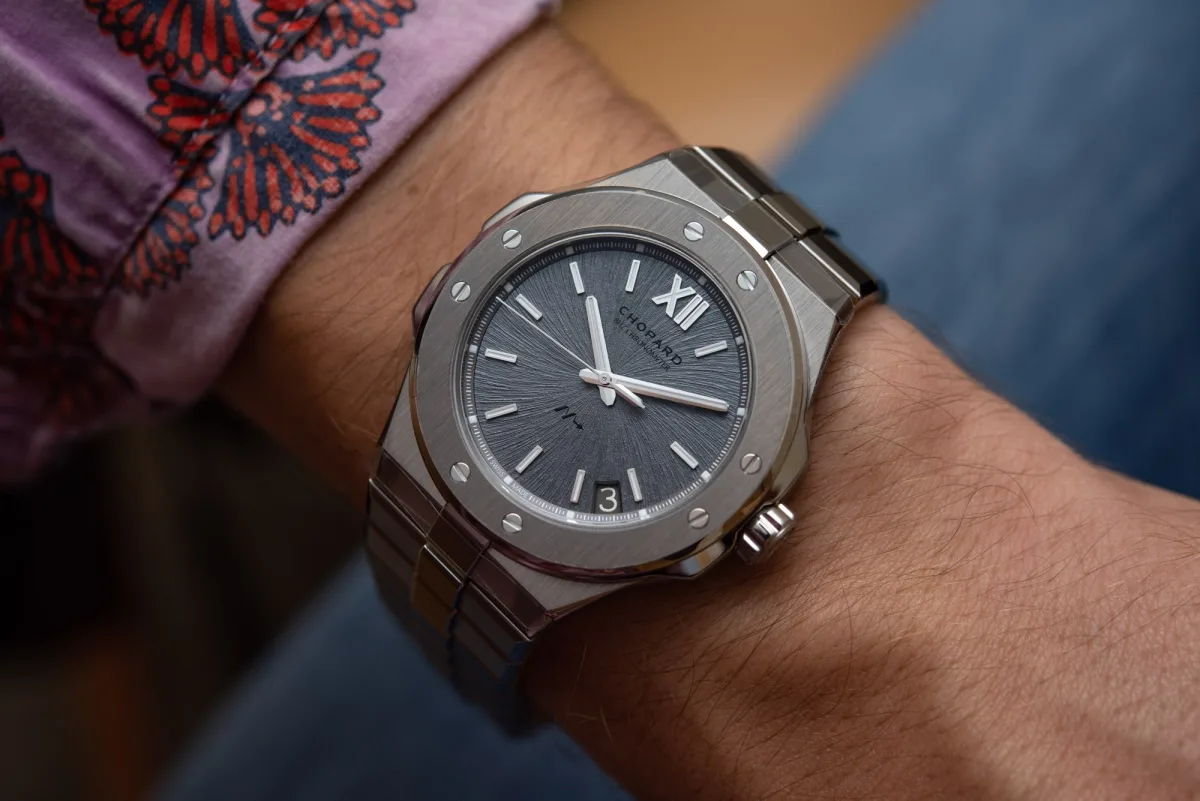
The case and bracelet are made of Grade 5 titanium, finished to a rather impressive level of quality and complexity. Today, titanium is often presented as a mass of fully polished metal, with no sharp edges and matte surfaces. Chopard did make a steel version, and somehow managed to make titanium one of the whitest and brightest I've ever photographed. Overall, the links, case, and bezel are exceptionally well done - only the strange squared section of the "crown" seems a bit bloated to me compared to all the other polished angles and surfaces.
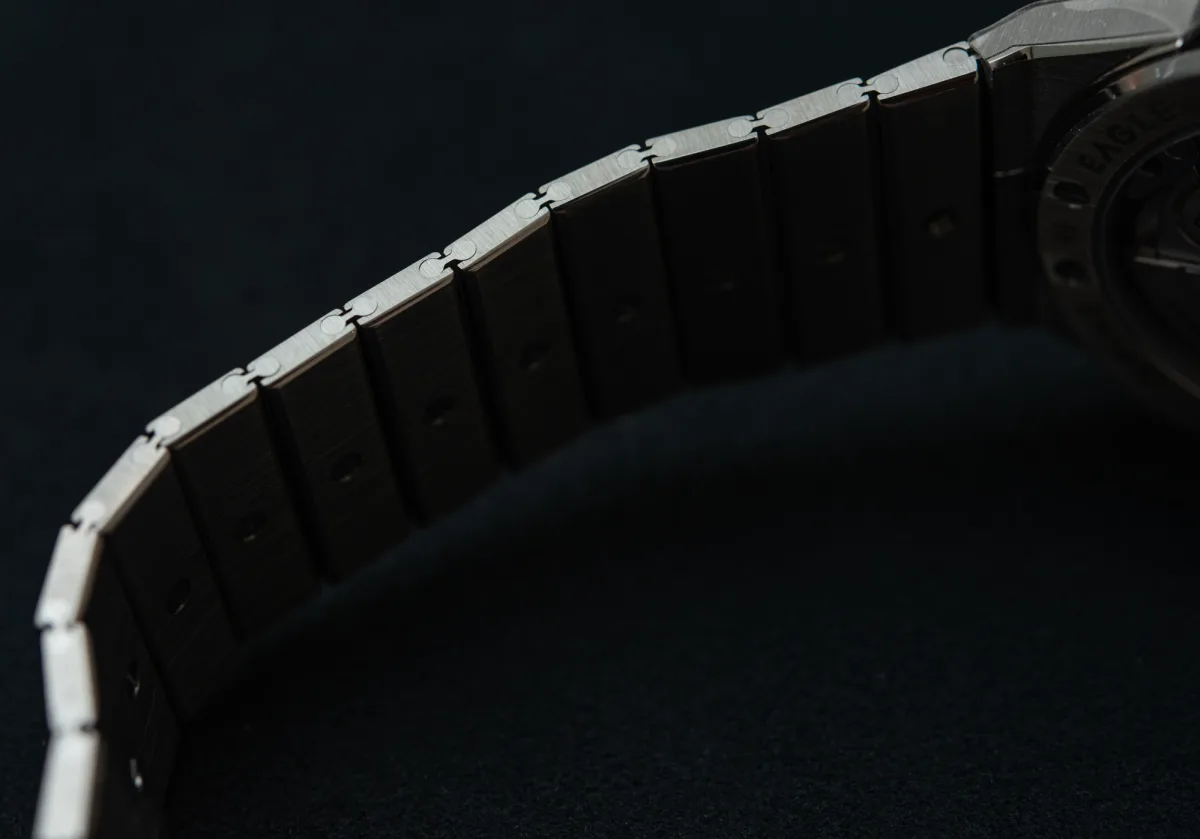
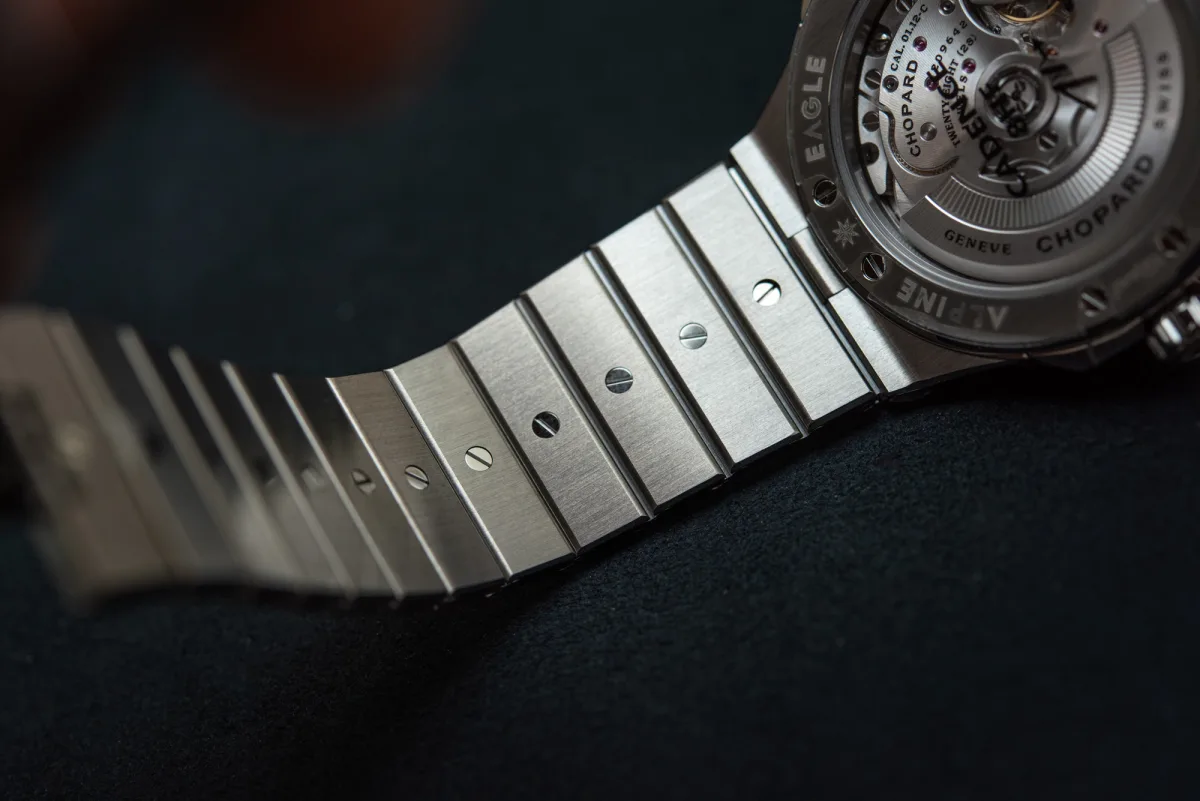
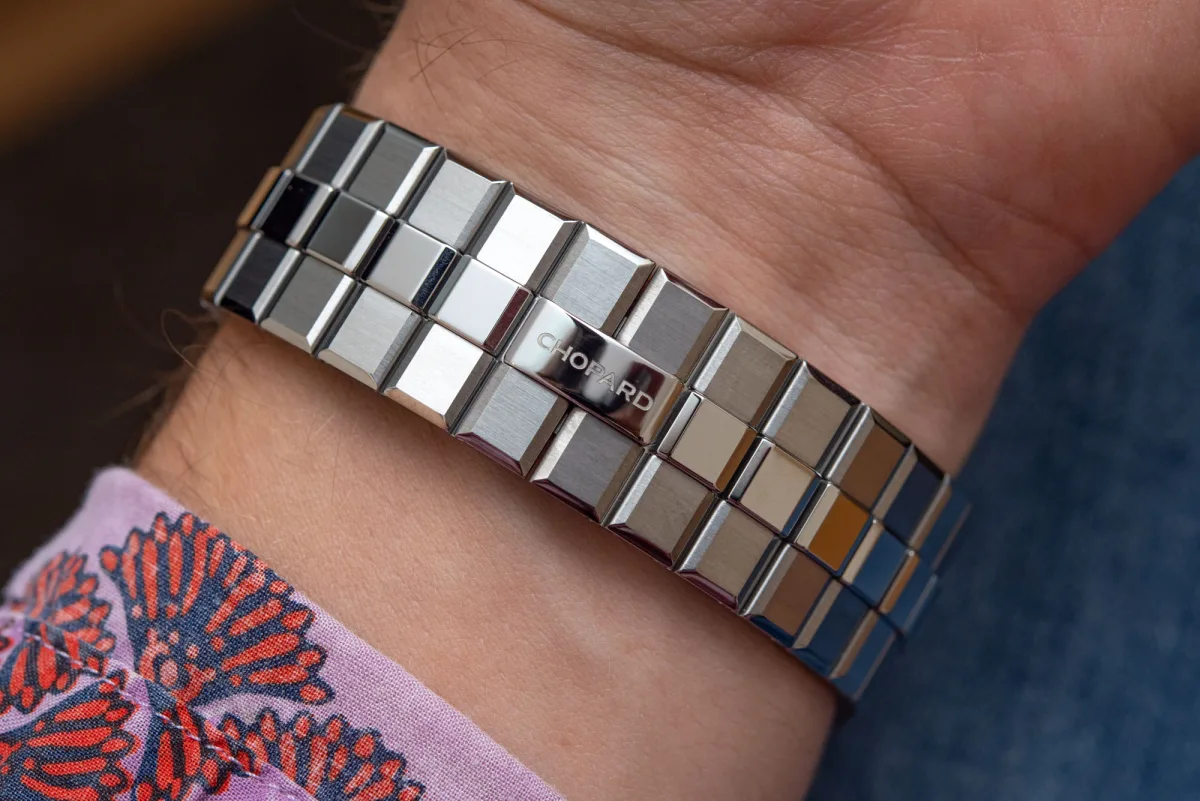
The hidden clasp adds elegance, as does the shockingly simple yet sturdy-feeling link construction: the bracelet is held by a single central screw in combination with 8-shaped intersecting facets that allow subsequent links to connect and pivot. The Royal Oak bracelet (possibly the benchmark in this segment) does not seem more expensive, robust, or comfortable, though I would gladly do a side-by-side comparison in the same lighting.
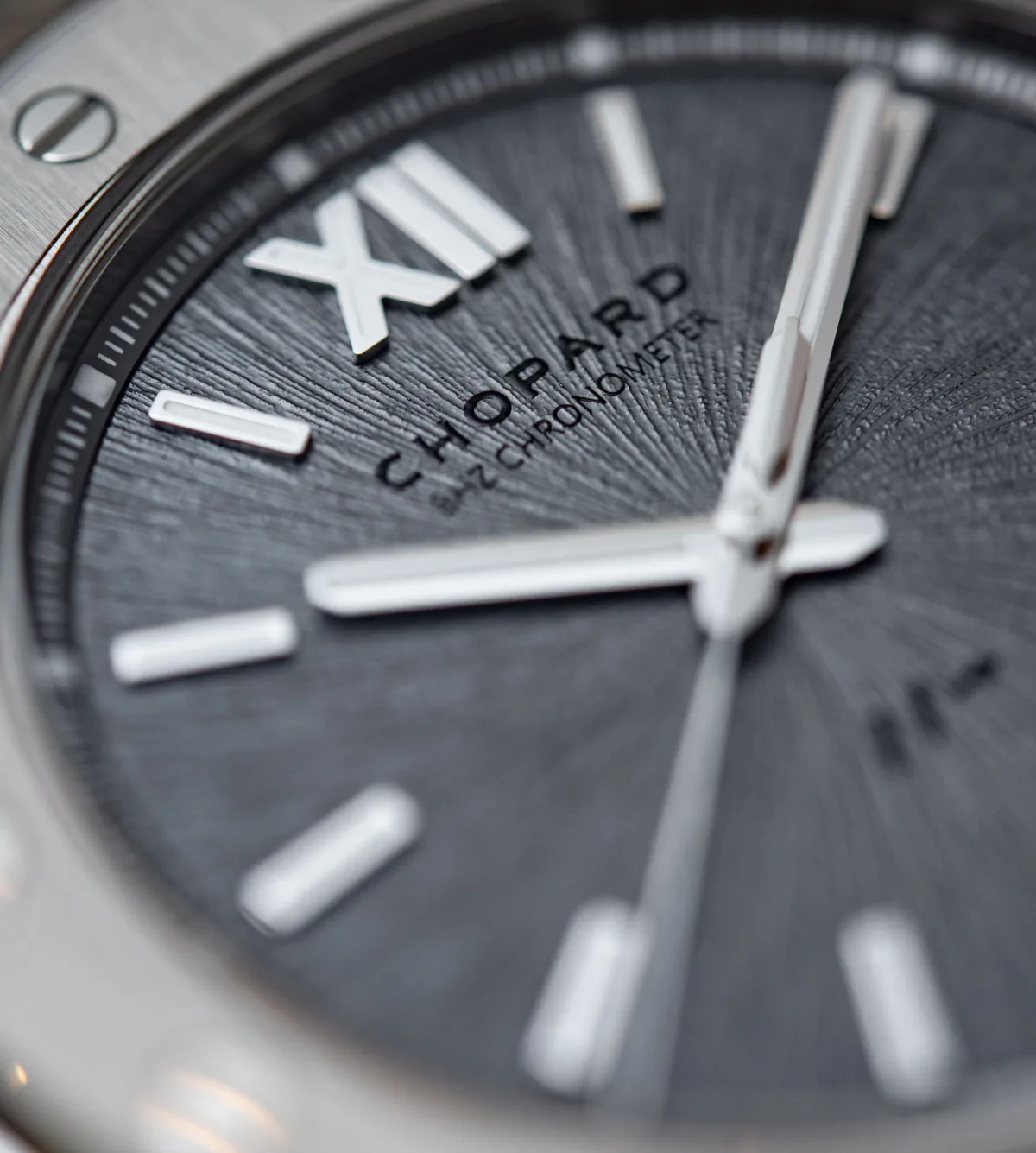
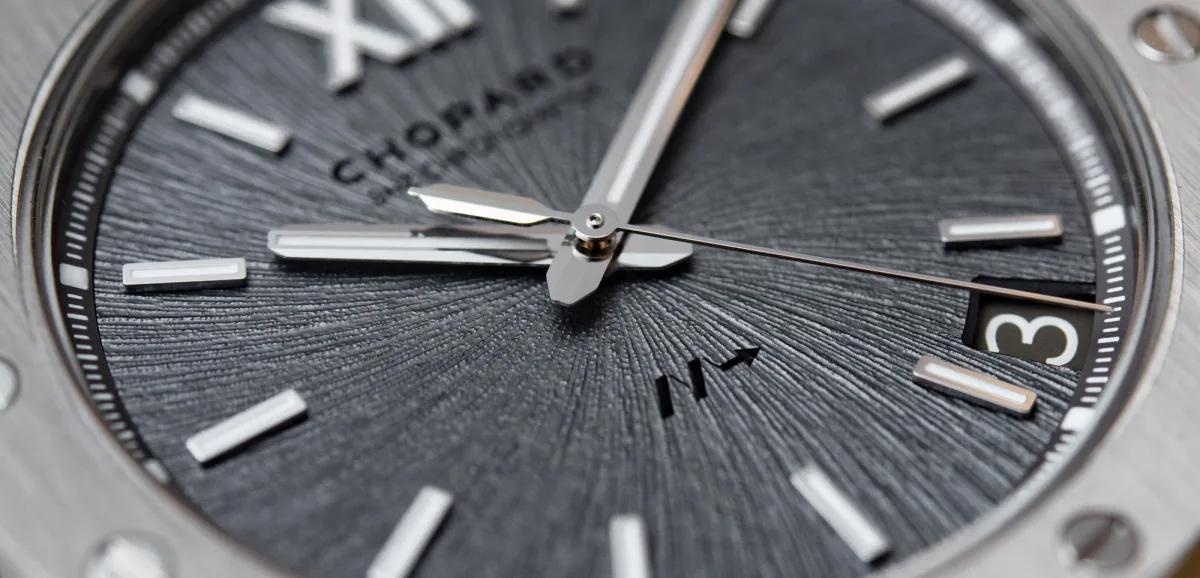
The dial still features a textured design inspired by the eagle iris, which works well with the Alpine Eagle inspiration, but I long for something flatter and more elegant. Rolex Day-Date 40 laser dials come to mind, which look more high-tech and elegant (though more artificial) - attributes that align well with the Alpine Eagle's appearance. Each hour marker and the two main hands are luminescent, the second hand has a counterweight reminiscent of feathers, and above the "6 o'clock" mark is the Chopard High-Frequency logo. The date window seems large, easy to read, and, although some photos suggest otherwise, neatly color-matched in real life.
Since its appearance a few years ago, the Chopard Alpine Eagle has been an underdog in the luxury sports watch segment - and undeservedly so. The steel version, priced around $12,000, matches the Royal Oaks and Patek Nautilus in quality of appearance. This more expensive version adds a significant premium, but again, it's a virtually unmatched movement with proven performance and truly impressive engineering solutions.
Combined with a fully titanium case and accompanying luxury sports watch features - a thin case, good WR, increased power reserve, excellent readability - it's a well-rounded package offered at a rounded price: the Chopard Alpine Eagle Cadence 8HF costs $20,000 and is released in a limited edition of 250 pieces.
SPECIFICATIONS - CHOPARD ALPINE EAGLE CADENCE 8HF TITANIUM
Case: diameter 41 mm x height 9.75 mm - Grade 5 titanium case, matte and polished - sapphire crystals with A/R coating front and back - water resistance up to 100 m
Dial: brass dial with "sunburst" pattern and Vals Grey galvanic patina - applied rhodium-plated hour markers with Grade X1 Super-LumiNova luminescent coating - rhodium-plated stick-type hour and minute hands with Grade X1 Super-LumiNova luminescent coating - rhodium-plated arrow-type second hand
Movement: Chopard Caliber 01.12-C, in-house - COSC certified - 28.80 mm x 4.95 mm - 210 parts - 28 jewels - 57,600 semi-oscillations/hour or 8 Hz - 60-hour power reserve - hours, minutes, seconds, and date
Bracelet: Grade 5 titanium - triple folding clasp in Grade 5 titanium with steel blades
Reference: 298600-3005
Availability: limited edition of 250 pieces
Price: 19,000 SWISS FRANCS / 18,900 EUROS